
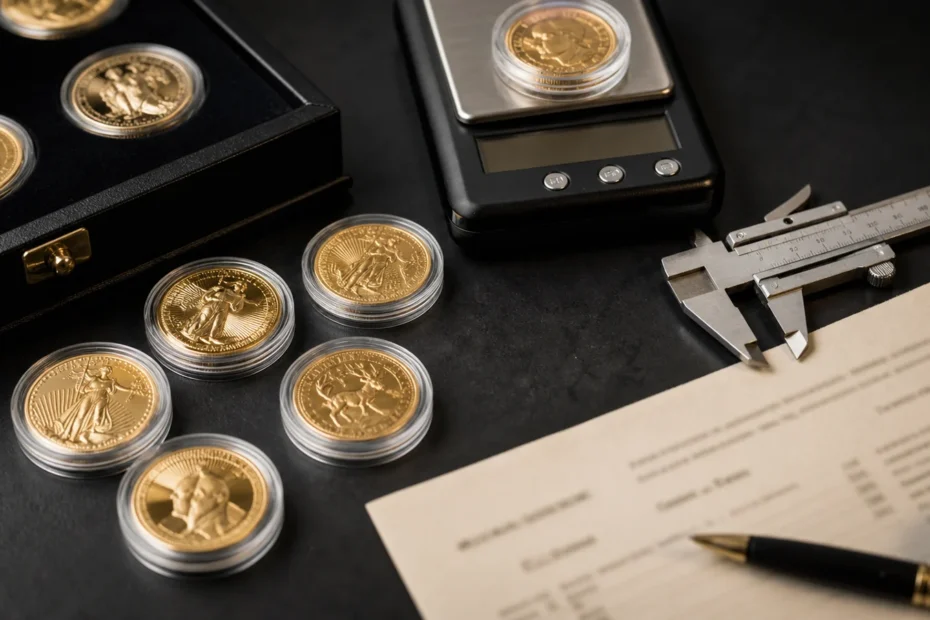
Learn how to buy gold coins safely: bullion vs collectible coins, premiums, dealer checks, authentication, storage, resale and common fraud red flags.
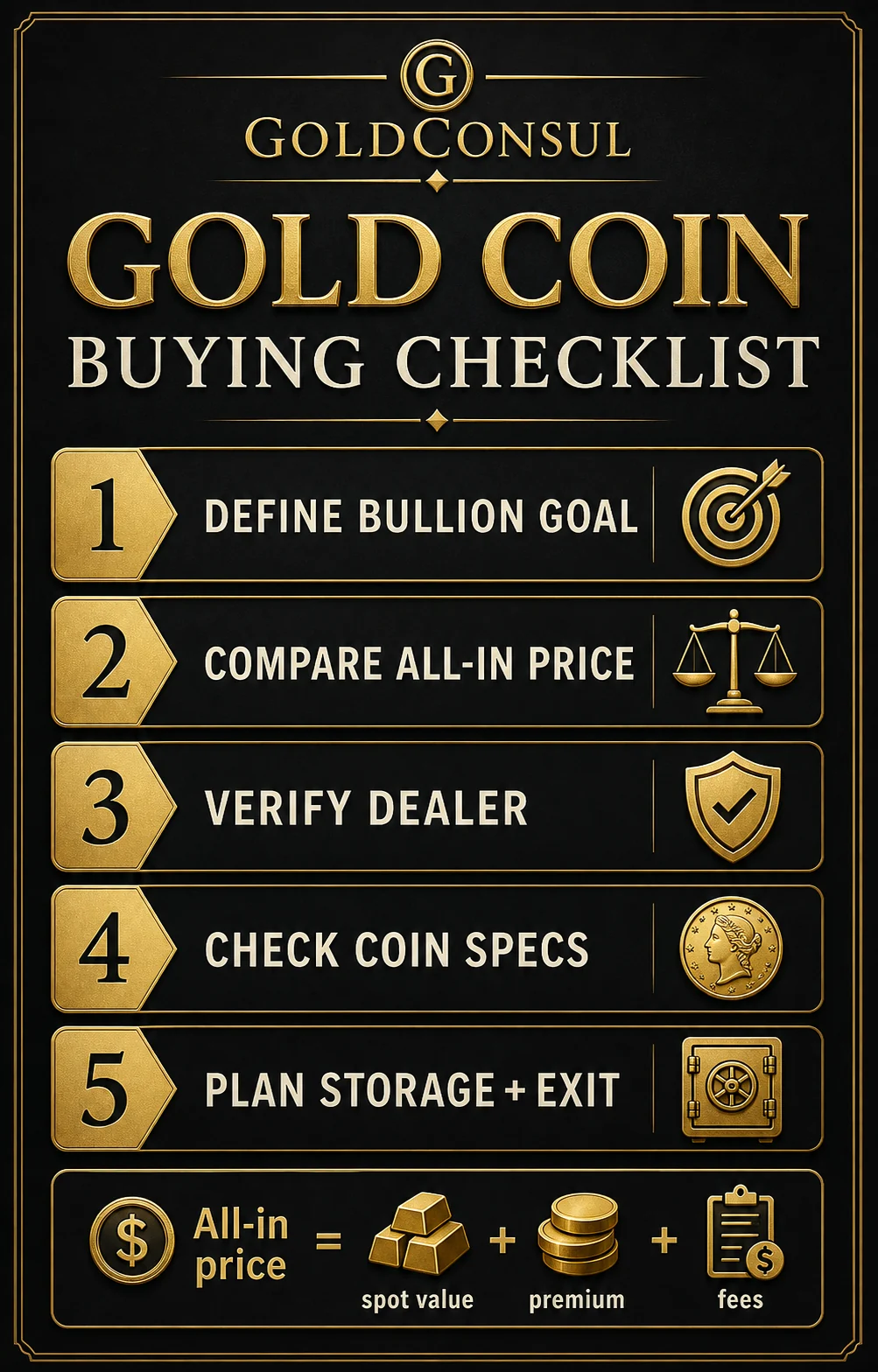
- Define whether you want bullion exposure or collectible value before comparing coins.
- Compare the all-in purchase price and the dealer's current buyback—not just the advertised premium.
- Verify the dealer, official coin specifications, delivery, storage and exit plan before paying.
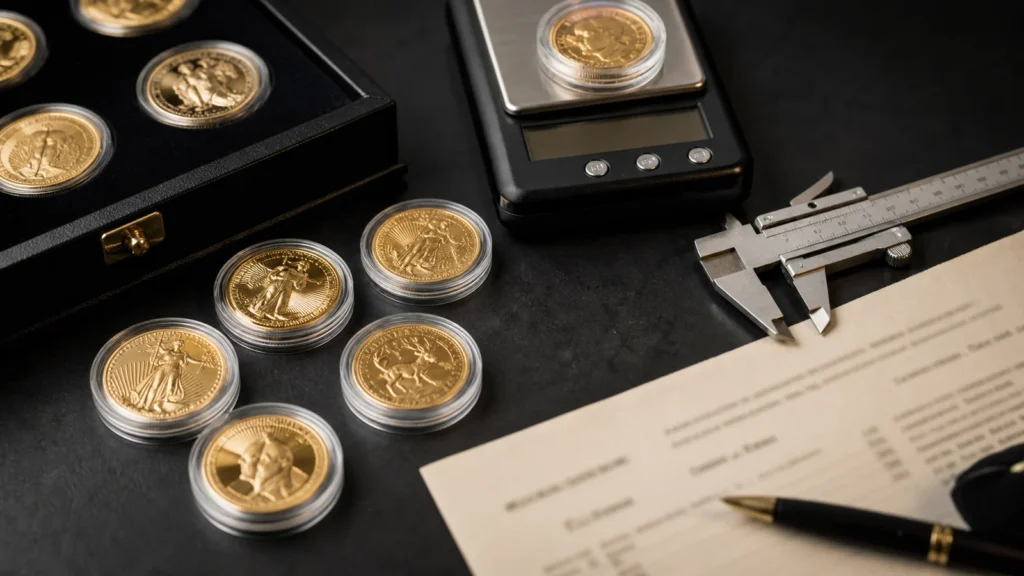
- Beginners usually get a clearer price comparison from widely traded bullion coins than from rare or “semi-numismatic” pitches.
- Premium is only one cost; include payment, shipping, tax where applicable, storage and the resale spread.
- Smaller fractional coins normally cost more per fine ounce, though they may be easier to sell in parts.
- Use mint specifications, documented provenance and a reputable dealer; price below metal value requires extra scrutiny.
- Gold prices fluctuate. Physical coins also create custody, theft and liquidity risks.
A purchase is a six-part system
The coin, price, dealer, verification, custody and exit plan all matter. Optimizing only the advertised premium can lead to an obscure product, weak delivery terms or an expensive future resale. Start with your purpose.
Step 1: bullion or collectible?
The U.S. Mint defines bullion coins as investment-grade coins valued by weight and fineness, unlike numismatic pieces whose value depends on rarity, condition and age. A proof finish does not automatically make a coin a good bullion buy.
Step 2: calculate the all-in price
For a coin containing one fine troy ounce, the metal value is approximately one ounce times the spot quote at the same timestamp and currency. For a fractional coin, use the stated fine-gold content—not gross coin weight. Compare offers at the same moment because spot moves.
Worked example, using hypothetical numbers: spot is $2,400 per fine ounce, a one-ounce coin is quoted at $2,520, and insured delivery is $20. The all-in price is $2,540. The premium and delivery together are $140, or about 5.83% of metal value. If the dealer’s immediate buyback is $2,364, the round-trip gap is $176. Gold would need to rise enough to cover that gap before other costs for the buyer to break even.
Step 3: evaluate the dealer
- Verify legal name, physical address, operating history and complaint record.
- Require a written product description, quantity, total price, delivery window and return/cancellation policy.
- Ask for the live buyback on the same coin, not a general “we buy gold” promise.
- Confirm insured delivery and who bears loss before signature.
- Walk away from cold calls, guaranteed returns, urgency, free-metal promotions or pressure to move retirement funds.
The CFTC’s physical-metals advisory warns that large markups, fees and commissions can consume substantial value. It also calls “semi-numismatic” a made-up industry term with no special meaning and warns against claims used to justify inflated spreads.
Step 4: choose a recognizable product
| Factor | Why it matters | What to record |
|---|---|---|
| Issuing mint and series | Widely recognized products can be easier to quote and resell | Exact name, year and denomination |
| Fine-gold content | Drives metal value | Fine troy ounces and fineness |
| Dimensions and gross weight | Supports nondestructive screening | Official mass, diameter and thickness |
| Condition and packaging | Damage can affect retail resale even when gold content is unchanged | Capsule, assay/provenance and photos |
| Dealer buyback | Shows practical liquidity | Bid price, conditions and timestamp |
The U.S. Mint consumer checklist tells buyers to understand spot, premiums, dealer reputation and official specifications. It also notes that U.S. Mint bullion reaches the public through a distribution network rather than direct retail sales by the Mint.
Fractional coins versus one-ounce coins
Fractional coins reduce the cash required per unit and allow partial resale. Their manufacturing and distribution cost is spread across less gold, so the premium per fine ounce is often higher. Compare equivalent fine ounces: ten one-tenth-ounce coins versus one one-ounce coin, including all fees and likely buyback.
Favor a common one-ounce bullion coin when lowest all-in cost per ounce and straightforward resale are priorities. Use fractional coins when purchase size or divisible resale is worth the extra premium. Choose numismatic coins only when you intentionally accept collector-market expertise, grading and liquidity risk.
This video is included as a practical visual supplement. Use the evidence and decision rules in this guide—not a dramatic demonstration—as the basis for a purchase or test.
Verification, storage and exit
On receipt, document the sealed parcel and compare the coin with the issuing mint’s published features, weight and dimensions. Do not perform damaging tests. If uncertainty remains, use a dealer or professional verifier familiar with the series; our gold-authentication guide explains the evidence ladder.
Choose custody before delivery: a suitable home safe, bank option where available, or professional allocated storage each has access, insurance and counterparty trade-offs. Review where to store gold and the difference between allocated and unallocated storage. Keep invoices, serial or capsule details and photographs separately from the coins.
For wider context, compare gold bars, ways to invest in gold and gold-backed crypto structures. These solve different custody and liquidity problems.
Run a three-quote comparison
Before buying, obtain three timestamped offers for the exact same coin, quantity and payment method. Record spot, unit price, shipping, payment surcharge, tax where applicable, delivery promise and live buyback. Normalize every quote to cost per fine troy ounce. A dealer with the lowest headline premium may lose once wire fees, shipping or a weaker buyback are included.
Then stress-test the exit. Ask each dealer what it would pay today if the coin were in normal secondary-market condition, whether original packaging is required and how identity and payment are handled. This does not guarantee a future price, but it reveals whether the claimed liquidity is operational or merely marketing.
Red flags that end the transaction
Stop when a salesperson refuses to provide the total in writing, discourages price comparison, says a common coin is “exclusive,” guarantees appreciation, or pushes financing and leverage. Also stop when payment must go to an unrelated person or entity, shipment insurance is vague, or storage is offered without identifying the custodian and legal ownership. For retirement accounts, do not rely on the coin seller for tax interpretation. The CFTC notes that self-directed IRA rules and fees are complex; use an independent qualified professional before moving retirement assets.
Retail premiums and buybacks change by product, payment method, inventory and market conditions. A generic “best coin” list becomes stale quickly. A timestamped all-in comparison is more durable than a brand ranking.
The coin is only half the transaction. A recognizable product bought from a transparent dealer can still be a poor deal if the spread, custody or exit plan is ignored.
Frequently asked questions
What is the best gold coin for a beginner?
A widely traded bullion coin with clear official specifications and competitive local buy/sell quotes is usually easier to evaluate than a collectible. The best series depends on your market and dealer liquidity.
Should I buy 24K or 22K gold coins?
Compare fine-gold content, recognition, premium and buyback. A 22K bullion coin can still contain its stated fine ounce of gold because its gross weight includes alloy.
Why do small gold coins cost more per ounce?
Minting, packaging and distribution costs are allocated across less gold, and retail demand can increase the premium.
Can I buy bullion directly from the U.S. Mint?
The U.S. Mint states that its bullion coins are distributed through authorized purchasers and retail dealers rather than sold directly to the public as bullion.
How many gold coins should I buy?
That is a personal allocation decision depending on finances, liquidity needs, risk tolerance and storage. Do not let a dealer set it through urgency or promises.
Sources and methodology
This guide favors consumer regulators, scientific institutions and technical trade references. Commercial claims are not treated as proof.
Update policy: Product rules, scientific interpretations and market practices can change. We date-check the linked authority pages during a major revision, avoid live-price claims in evergreen guidance and distinguish measured evidence from editorial judgment. If a source describes one jurisdiction, alloy, coin or experiment, we do not silently generalize it to every product. Readers making a material purchase should confirm the current specification and local rules at the point of decision.
- U.S. Mint — Bullion Consumer Awareness — Premium, dealer and specification checks.
- U.S. Mint — Bullion Coins — Bullion definition and distribution model.
- CFTC — 10 Things to Ask Before Buying Physical Metals — Spreads, markups, cold-call and semi-numismatic warnings.
- CFTC — Precious Metals Fraud — Fraud patterns and high-pressure sales.
- World Gold Council — Buying Gold Safely — Buyer due diligence framework.
 When you purchase a service or a product through our links, we sometimes earn a commission, at no extra cost to you.