
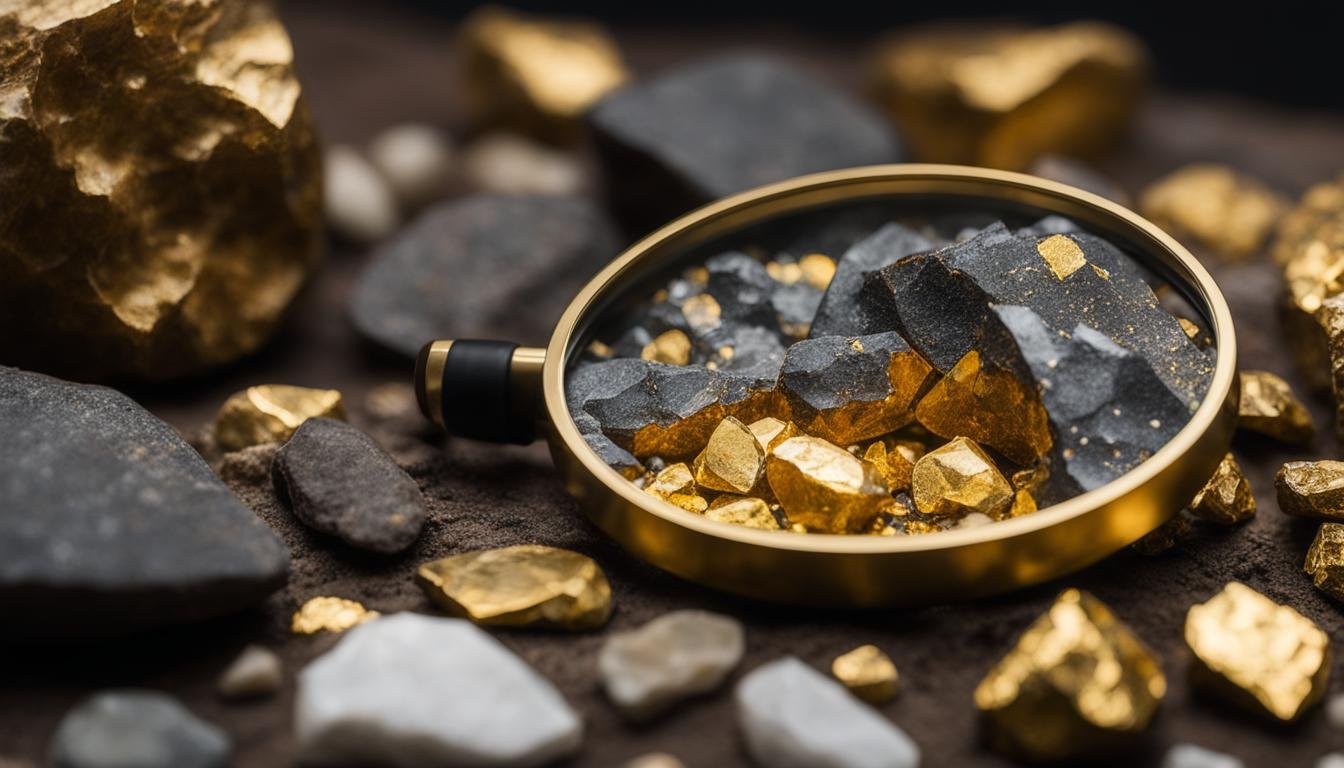
You usually cannot identify gold ore with confidence from color alone.
You can screen rock for field clues that make gold more or less likely, but real confirmation often requires assay, microscopy, or at least a more disciplined mineral-identification workflow than most hobby pages explain.
That matters because many rocks that look “golden” are not gold-bearing ore at all. Pyrite, mica, chalcopyrite, and iron-stained quartz fool beginners far more often than actual native gold does.
TL;DR
- Visible yellow specks in quartz do not automatically mean gold ore.
- Real field screening starts with host rock, fracture/vein context, density clues, streak behavior, and whether the metallic material is brittle or malleable.
- Pyrite and other sulfides can occur near gold systems, but they are not the same as visible native gold.
- If the economic answer matters, field identification must end in assay or professional testing.
What Most Readers Miss
Gold ore does not need to look golden. Many important ores carry gold invisibly inside sulfides, while many rocks that sparkle in sunlight contain no recoverable gold at all.
Gold Ore, Native Gold, and Gold-Bearing Rock Are Not the Same Thing
Readers often use all three phrases as if they mean the same thing. They do not.
Native gold means visible metallic gold. Gold-bearing rock may contain gold at microscopic scale without obvious yellow metal, while economic gold ore means rock that contains enough gold to matter under real recovery conditions.
That distinction is why resources like the USGS gold-ore collection are useful: real ore samples vary widely in appearance and do not all resemble bright jewelry-metal fragments in quartz.
What Real Field Clues Actually Matter
The first useful clue is geologic context. Veins, breccias, iron staining, sulfides, and altered host rock give you a system-level story that loose visual sparkle cannot.
The second clue is behavior. Real gold is soft, dense, and malleable, while common lookalikes tend to flake, shatter, streak differently, or reflect light in a more glittery, plate-like way.
Chart 1: Field Confidence Ladder
How much each step improves confidence before assay (conceptual prospecting workflow)
Interpretation: A field clue can justify more testing. It cannot replace it.
The Biggest False Positives
Pyrite is the classic trap. As Geology.com notes in its pyrite reference, pyrite can have a brass-yellow color and metallic luster, but it is brittle, harder than gold, and tends to break rather than flatten.
Mica is another frequent mistake because it flashes strongly in sunlight. But mica reflects in thin sheets and usually flakes apart instead of behaving like dense metallic particles.
Chalcopyrite and other sulfides can complicate the picture further because they may be associated with hydrothermal systems that also carry gold. That makes them important clues, but not proof of gold by themselves.
Chart 2: What Most People Misidentify First
Common false-positive mix in beginner field screening (conceptual distribution)
Brassy color, metallic luster, brittle behavior.
Strong sparkle in sheets, but not dense metallic grains.
System clues, not automatic gold confirmation.
Oxidation and color alone can mislead badly.
Interpretation: Most mistakes happen because prospectors overweight color and underweight behavior.
A Practical Field Workflow Before You Claim You Found Gold Ore
Start with location and rock setting. Ask whether the piece came from a quartz vein, sulfide-rich zone, altered host rock, placer environment, or just isolated float.
Next, test the metallic-looking material itself. Does it smear or flatten, or does it shatter and crumble along crystal faces?
| Field question | If yes | If no |
|---|---|---|
| Does the material flatten slightly instead of breaking? | Gold becomes more plausible | Pyrite or another sulfide becomes more likely |
| Is the host rock part of a real vein or altered zone? | Worth closer sampling | One loose shiny grain means much less |
| Does the rock feel unusually dense for its size? | Useful clue, especially with sulfides | Does not rule gold out, but lowers excitement |
| Would the answer matter financially? | Move to assay or professional testing | Treat it as a field-learning sample only |
Quartz Matters, but Not the Way Most Articles Suggest
Quartz is relevant because many gold systems are hydrothermal. But “gold in quartz” has become internet shorthand for overconfidence.
As Britannica’s overview of gold occurrence makes clear, gold occurs in multiple geologic settings, and quartz alone does not prove economic gold. You need structure, mineral association, and ideally multiple supporting clues.
If you want broader context, also review our related guides on gold ore, gold mining methods, gold mining in Nevada, gold mining in Idaho, and gold mining in Virginia.
Use this screening rule in the field
Worth keeping
Vein context, density clues, sulfide association, and metallic material that does not flake like mica.
Worth testing
You have multiple clues pointing in the same direction, but no clean proof yet.
Probably a false positive
The sample only sparkles, breaks easily, and lacks broader geologic context.
The GoldConsul Editorial Perspective
Most beginners do not fail because they miss gold. They fail because they become too certain too early from one visual clue and stop asking whether the whole rock system actually supports a gold story.
Where Hidden Gold Systems Complicate the Picture
Some important deposits do not advertise themselves with visible free gold. The Carlin-style story is a good reminder that sulfide-hosted or chemically subtle systems can carry gold that is not obvious to the naked eye.
That is why work like the USGS publication on gold-bearing arsenian pyrite matters conceptually. It shows how far reality can drift from the beginner expectation that gold ore must always contain clearly visible yellow metal.
The real beginner mistake is not missing a color clue
The real mistake is assuming every gold system should look like a textbook chunk of quartz with bright native gold.
Some ore looks boring. Some spectacular-looking rock has no economic gold at all. That is why ore identification should be treated as a staged confidence process, not a visual yes-or-no game.
When You Need Assay, XRF, or Professional Help
If the sample is just a curiosity, field identification may be enough for learning. If the answer affects money, selling decisions, land claims, or serious prospecting time, stop at the point where visual confidence runs out.
At that stage, assay, microscopy, or a qualified lab becomes the only defensible next step. This is especially true for sulfide-rich rock, fine disseminated mineralization, or any sample where the supposed “gold” is too small or too ambiguous for confident physical testing.
Chart 3: When to Escalate Beyond Field Identification
Practical escalation map for rock screening and confirmation
Interpretation: The higher the economic consequence, the faster you should stop guessing and start testing.
What You Can Do in Practice
Carry a field notebook, hand lens, small magnet, scale, and a structured checklist rather than trusting memory. The better your sample notes are, the more useful any later test becomes.
Photograph the host rock, fracture context, and any sulfide association before breaking or cleaning the sample. If the piece still looks promising after basic screening, treat it as a candidate for formal testing, not a proven strike.
- Record exact location and host-rock context.
- Note whether the metallic material flakes, smears, or shatters.
- Compare suspect grains against pyrite and mica behavior, not just color.
- Separate learning samples from samples that justify assay spending.
- Use our related gold ore page and regional mining guides to anchor your field observations in real geology.
Video walkthrough: this clip shows how prospectors inspect rock, cut samples, and distinguish visible clues from guesswork.
Bottom Line
If you want to identify gold ore, start by downgrading your confidence. Color and sparkle are weak clues on their own.
The better workflow is geologic context first, physical behavior second, and assay confirmation when the answer truly matters. That is how you avoid mistaking glitter for value.
FAQ: How to Identify Gold Ore
Can you identify gold ore just by looking at it?
Not reliably. You can improve probability with context and physical screening, but visual appearance alone is not enough for confident confirmation.
Does quartz mean a rock contains gold?
No. Quartz can be part of gold systems, but quartz by itself does not prove gold-bearing ore.
How do you tell pyrite from gold in the field?
Gold is softer and more malleable. Pyrite is harder, more brittle, and tends to break rather than flatten.
Can sulfide minerals mean there is gold nearby?
Yes, they can be useful clues in some systems. But sulfides are not automatic proof of recoverable gold.
When should you stop field guessing and get an assay?
As soon as the answer carries economic, legal, or claim value. That is the point where field clues stop being enough.
 When you purchase a service or a product through our links, we sometimes earn a commission, at no extra cost to you.