
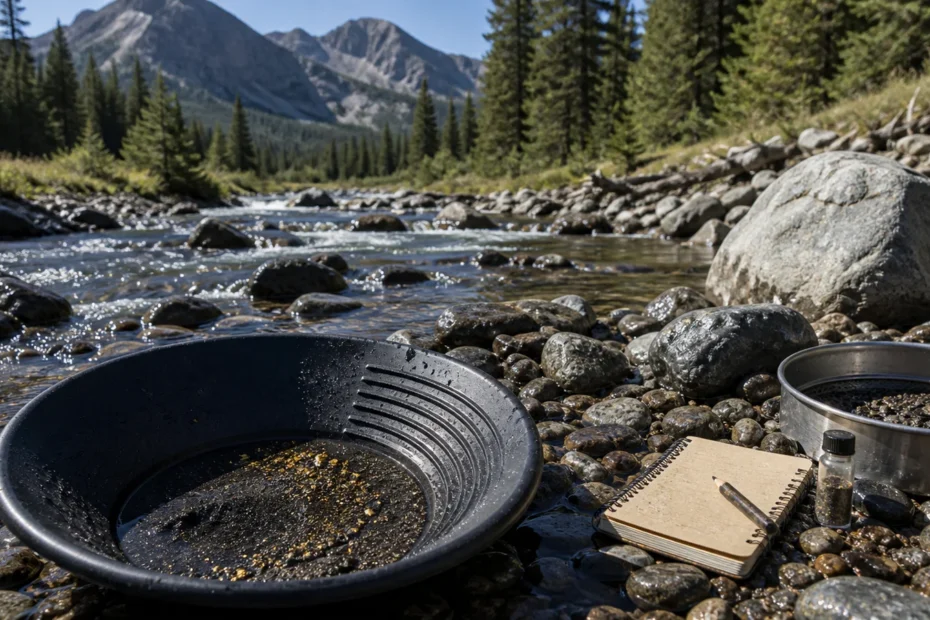
Review gold mining in Idaho by history, districts, land access, geology, modern panning rules, and realistic expectations before prospecting. in context.
- Idaho has real districts, but casual panning still needs land research.
- Claims, private land, protected areas, and water rules come first.
- Expect small placer finds unless evidence supports a stronger target.
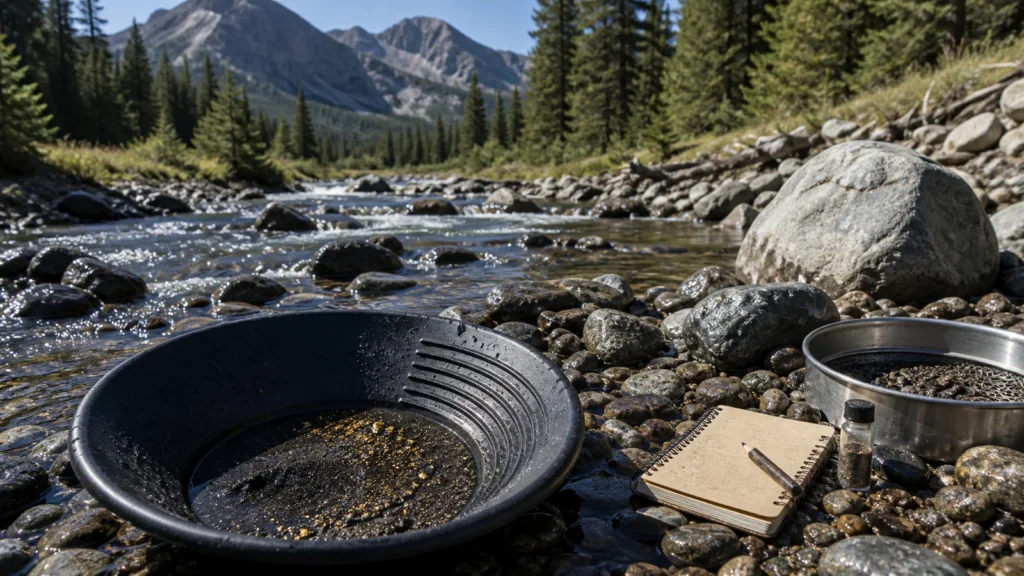
Idaho is a real gold state with historic mining districts and placer streams, but casual prospecting still requires land research, rule checks, and realistic expectations. Recreational finds are usually small compared with the state’s historic production story.
- Idaho has significant gold history, especially in historic mining districts.
- Modern recreational panning is governed by land ownership and equipment rules.
- Placer streams can produce small flakes, but yield is inconsistent.
- Claims, private land, protected areas, and water rules must be checked first.
- Treat prospecting as sampling and field learning, not a guaranteed income plan.
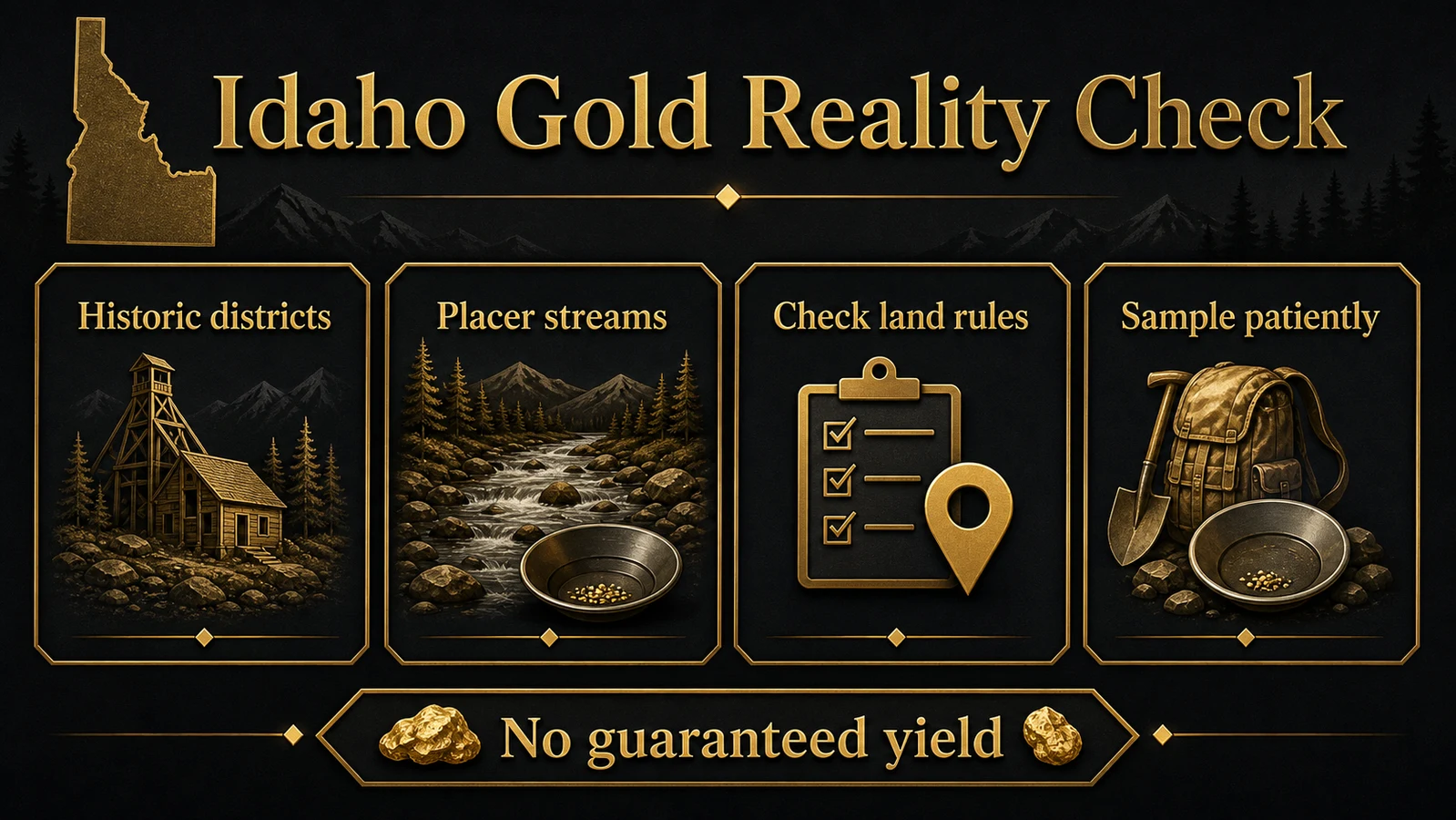
Idaho Gold in Context
Idaho’s gold reputation is grounded in real history. The state saw major nineteenth-century mining activity, and many place names still reflect that legacy.
The modern recreational prospector faces a different reality. The question is not only where gold occurred historically, but where access is legal, low-impact, and worth sampling today.
Prospecting Reality Table
| Setting | What to check | Reality |
|---|---|---|
| Historic district | Claims and private land | Good clues, limited access |
| Public stream | Agency and water rules | May allow simple panning only |
| Forest land | Mineral and surface rules | Equipment limits matter |
| Old mine area | Safety and closures | Do not enter abandoned workings |
Before acting, review Bureau of Land Management mining guidance, USGS gold statistics, U.S. Forest Service minerals guidance for the difference between mineral rights, surface rules, and public-land permissions.
Practical Field Checklist
- Confirm land status before visiting.
- Check claim maps and local restrictions.
- Use hand tools unless rules clearly allow more.
- Sample black-sand traps, inside bends, cracks, and behind boulders.
- Leave stream banks stable and packed out.
Compare Idaho with GoldConsul’s Michigan, Alabama, and Virginia prospecting guides.
How to Use This Information
Use this guide as a practical filter, not as a shortcut to certainty. Start with the quick answer, then match the advice to the exact item, location, claim, or risk level in front of you.
If the subject involves jewelry, separate solid gold from plating, filled construction, stones, clasps, and repairs. If the subject involves prospecting or history, separate documented evidence from rumor, modern access rules, and simplified timelines.
For broader GoldConsul context, continue with testing gold purity, the gold purity calculator, bullion basics, how to invest in gold, and where to store gold.
| Reader situation | Best next step | Why |
|---|---|---|
| Casual learning | Use the summary and table first. | It prevents overcomplicating a simple question. |
| Buying or selling | Document the claim and verify independently. | Money changes the evidence standard. |
| Unclear result | Do not force a conclusion from one clue. | Gold topics usually require multiple signals. |
| High-value decision | Use a jeweler, dealer, official agency, or authoritative source. | Professional confirmation reduces avoidable risk. |
Editorial Perspective
For readers, the practical takeaway is to treat simple checks as a starting point, not as the final answer. A hallmark, a gold-pan location, a cleaning method, or a historical date can be useful, but it should still be tested against the specific item, place, or claim in front of you.
If money, safety, legal access, or resale trust is involved, raise the evidence standard. Look for documentation, official rules, reputable references, or professional verification before acting on one quick clue.
Knowledge Gap
The recurring gap in thin content is missing context. Readers are often told that something can happen, that a place has gold, or that a method works, but not how to distinguish normal cases from edge cases.
This update fills that gap with a direct answer, a summary, a comparison table, a checklist, external authority links, and clear escalation points. The goal is not to make the topic sound complicated; it is to prevent simple advice from being applied in the wrong situation.
Evidence Ladder
Use an evidence ladder before making a final judgment. The first rung is a general fact: gold alloys can discolor, historic gold districts exist, gold appeared early in human history, or a cleaning method is usually safe. General facts help orientation, but they do not prove the exact case in front of you.
The second rung is item-specific or location-specific evidence. For jewelry, that means hallmarks, construction, wear patterns, seller disclosure, and whether the piece is solid, plated, hollow, stone-set, or repaired. For prospecting, it means land status, claim status, water rules, geology, old records, and whether sampling is allowed at the exact site.
The third rung is independent confirmation. That may be a jeweler’s inspection, XRF test, dealer verification, official agency guidance, mine-record research, museum or archaeological context, or a recognized standard. This level matters most when the value is high, the legal risk is real, or a wrong assumption could damage an item.
Decision Checklist
- Identify the exact object, location, or claim before applying general advice.
- Separate visible clues from verified evidence.
- Check whether the recommended action can cause damage, cost money, or create legal risk.
- Use at least two independent signals before trusting a conclusion.
- Escalate when the answer affects resale value, safety, legality, or an irreplaceable item.
A useful rule is to raise the evidence standard as the stakes rise. A casual learning question can be answered with education and common-sense checks. A purchase, repair, prospecting trip, or historical claim needs documentation and, in some cases, professional or official confirmation.
Common Red Flags
Be cautious when a source promises certainty from one simple sign. A single hallmark, a single creek name, one cleaning trick, or one historical date can be directionally useful and still incomplete. Gold topics often involve alloy chemistry, land law, market incentives, and historical uncertainty.
Also watch for advice that ignores exceptions. Plated jewelry behaves differently from solid gold. Public land rules differ from private land rules. A historical gold-use milestone is not the same as the first moment a human noticed native gold. A safe cleaning method for a plain solid chain may be wrong for a hollow, plated, or stone-set chain.
The safer approach is slower but more reliable: define the case, collect evidence, compare it with authoritative sources, and only then act. That is the standard this Wave 2 update applies across all six rewritten posts.
Before You Act
Before cleaning jewelry, testing metal, visiting a prospecting location, or repeating a historical claim, write down what would change your conclusion. That small step prevents confirmation bias. If every clue is interpreted to support the answer you already wanted, the process is not really verification.
For practical decisions, set a stopping rule. If the piece is valuable, stop before using harsh chemicals. If the land status is unclear, stop before collecting material. If the history source is vague, stop before presenting it as fact. A clear stopping rule protects the object, the reader, and the credibility of the article.
When in doubt, choose the lower-risk next step first. That may mean cleaning with mild soap instead of abrasives, calling the relevant land agency before panning, checking a museum or geology source before repeating a claim, or asking a jeweler before testing a valuable piece. The right next step is often modest, but it keeps a small uncertainty from becoming an expensive mistake.
FAQ: gold mining in Idaho
What is the short answer for gold mining in Idaho?
Idaho is a real gold state with historic mining districts and placer streams, but casual prospecting still requires land research, rule checks, and realistic expectations. Recreational finds are usually small compared with the state’s historic production story.
What is the biggest mistake with gold mining in Idaho?
The biggest mistake is treating one clue, location, label, or cleaning method as a complete answer. Match the advice to the exact item, source, rule, or value at risk.
When should I get professional help?
Use professional help when the item is valuable, the result is unclear, legal access is uncertain, or cleaning/testing could damage the piece.
Can I rely on online tips alone?
No. Online guidance is useful for orientation, but jewelry, bullion, prospecting, and history claims should be checked against authoritative sources or expert review when stakes are meaningful.
What should I do next?
Document what you have, compare it with reliable specifications or rules, and escalate to a jeweler, dealer, agency, or authoritative reference when needed.
Bottom Line
Idaho is a real gold state with historic mining districts and placer streams, but casual prospecting still requires land research, rule checks, and realistic expectations. Recreational finds are usually small compared with the state’s historic production story. Use the article’s checklist and evidence ladder to decide whether the next step is simple care, more research, official permission, or professional verification.
 When you purchase a service or a product through our links, we sometimes earn a commission, at no extra cost to you.