
See 2026 gold-demand data from India and China, separated into jewelry, bars and coins, ETFs and central-bank buying—with key risks.
- Separate jewelry, investment, ETF, central-bank, and technology demand
- Use dated 2026 country data instead of a generic growth narrative
- Check who bought, where, when, and how the demand was measured
Emerging-market gold demand is not one synchronized growth story. In early 2026, India’s investment demand rose sharply while jewelry demand weakened, and China showed official-sector buying alongside softer retail and ETF indicators; the useful analysis separates buyer type, country, period, and measurement.
- Jewelry, bars and coins, ETFs, central banks, and technology are different demand channels.
- High local gold prices can increase investment interest while reducing jewelry volumes.
- India and China remain central, but their quarterly signals can move in different directions.
- Tonnes, local-currency value, imports, and exchange flows do not measure the same thing.
- Use dated country data instead of assuming all emerging markets are “buying more gold.”
The phrase “growing demand for gold in emerging markets” is attractive because it sounds like a single structural trend. It is also easy to misuse. A central bank adding reserves, a household buying a small bar, an investor subscribing to a gold ETF, and a bride receiving jewelry all appear under the broad word “demand,” but they respond to different incentives.
The better question is: which buyers, in which market, during which period, measured how? That framework reveals a more useful 2026 picture than a generic growth claim.
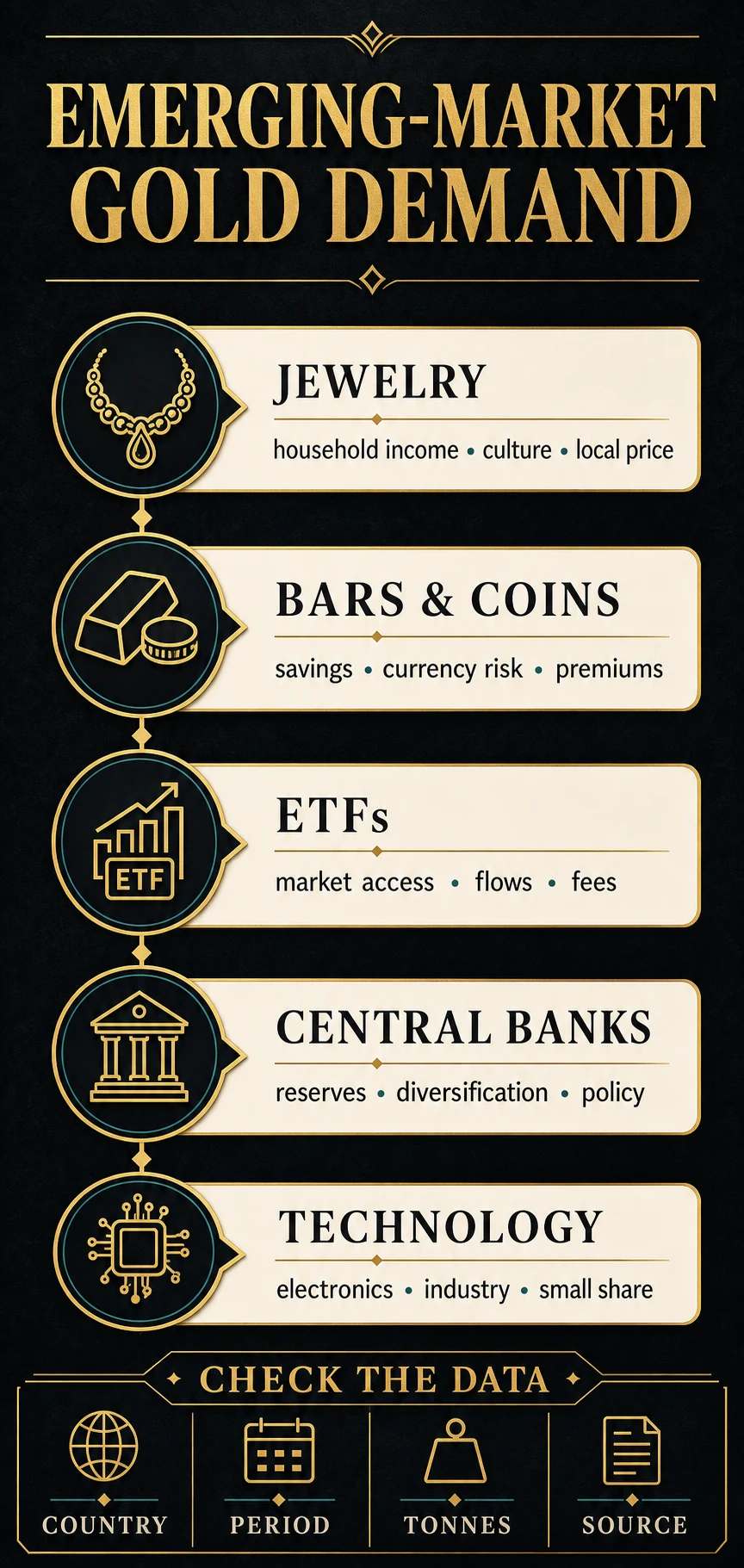
Start by separating the five demand channels
| Demand channel | Typical decision | Useful evidence | Common interpretation error |
|---|---|---|---|
| Jewelry | Adornment, gifting, wedding, and wealth display | Fabrication and consumption in tonnes; local value | Assuming higher spending means more gold by weight |
| Bars and coins | Direct savings, inflation concern, or tactical investment | Retail investment tonnes and local premiums | Treating a short demand spike as permanent |
| Gold ETFs | Portfolio exposure through financial markets | Holdings and fund flows | Equating ETF flows with physical household buying |
| Central banks | Reserve diversification and institutional policy | Reported official purchases and reserve data | Using official buying as proof of retail demand |
| Technology | Industrial use in electronics and other applications | Fabrication volumes by sector | Reading industrial demand as an investment signal |
The World Gold Council’s market primer describes a market with multiple sources of demand and a large, geographically diverse trading structure. That diversity can make gold resilient, but it also means a headline from one channel cannot stand in for the whole market.
What the first quarter of 2026 actually showed
Global gold demand including over-the-counter activity was 1,231 tonnes in Q1 2026, according to the World Gold Council, up 2% from a year earlier. The composition was uneven: bar-and-coin demand reached 474 tonnes, up 42%, ETF inflows added 62 tonnes, and central-bank demand was 244 tonnes, while jewelry consumption and fabrication were both roughly 23% lower year over year.
These figures do not prove that every emerging market followed the global mix. They do show why “demand rose” is incomplete without the category.
| Market and period | Observed signal | What it suggests | What it does not prove |
|---|---|---|---|
| Global, Q1 2026 | Bar and coin demand 474t; +42% y/y | Strong retail investment interest | Uniform growth across countries |
| Global, Q1 2026 | Jewelry consumption roughly −23% y/y | High prices constrained volume | Jewelry’s cultural role disappeared |
| India, Q1 2026 | Total demand 151t; investment 82t; jewelry 66t | Investment overtook jewelry in the quarter | That the mix will persist every quarter |
| China, May 2026 | Official buying continued; ETF holdings and wholesale withdrawals weakened | Institutional and private signals diverged | One simple “China demand” direction |
The table uses World Gold Council reporting available in June 2026. Tonnes are rounded as reported; revisions and methodology differences can affect comparisons.
India: investment strengthened as jewelry volumes fell
The World Gold Council’s India focus for Q1 2026 reported total demand of 151 tonnes, 10% above the same quarter a year earlier. Investment demand rose 54% to 82 tonnes, including 62 tonnes of bars and coins, while jewelry demand declined to 66 tonnes.
This combination matters. A rising local-currency price can make gold more attractive to savers who fear missing further gains, yet make a fixed-weight jewelry purchase unaffordable. Consumers may spend a similar or greater amount while receiving fewer grams, trade in old jewelry, choose lighter designs, or delay purchases.
Investment driver
Price momentum, inflation expectations, currency concerns, and familiarity with physical gold can support bars and coins.
Jewelry constraint
Record local prices can reduce the weight purchased even where weddings and gifting preserve expenditure.
Measurement caution
Rupee value can rise while tonnage falls. Always identify whether the chart shows money spent or metal weight.
India is not only a consumer story. Recycling, imports, local premiums, taxes, and rural incomes can change the supply-demand balance. Readers examining production-side exposure should distinguish consumption from gold mining in emerging markets.
China: official buying and private demand moved differently
The World Gold Council’s June 2026 China update reported that the People’s Bank of China added 10 tonnes in May, bringing reported official holdings to 2,332 tonnes. At the same time, Chinese gold ETFs recorded an RMB 8.2 billion outflow and their holdings fell by 8.3 tonnes to 293 tonnes.
Shanghai Gold Exchange wholesale withdrawals were 64 tonnes in May, down 38% from April and 36% from a year earlier. April imports had been 157 tonnes. These measures cover different parts of the market and different months, so they should not be blended into a single bullish or bearish score.
China demonstrates the central analytical point: the official sector can add gold while private financial flows or physical wholesale activity soften. A headline saying “China bought gold” must identify the buyer.
Why households in emerging markets buy gold
The drivers vary by country and household, but several mechanisms recur. Their existence does not guarantee higher demand at every price.
- Store-of-value familiarity: Gold may be more culturally and practically familiar than formal securities.
- Currency risk: A weakening local currency can raise the local gold price even if dollar gold is stable.
- Financial access: Small bars, coins, jewelry, digital products, and ETFs offer different entry routes.
- Gifting and ceremony: Wedding and festival demand can support purchases, though timing and weight change with price.
- Policy and trust: Taxes, import restrictions, banking confidence, and capital controls can redirect buying or encourage recycling.
- Income and harvest cycles: In some markets, rural income and seasonal cash flow influence physical purchases.
For price transmission, see why gold prices rise and the broader map of gold price factors. Neither article should be read as a promise that demand translates one-for-one into price.
A five-question test for any demand headline
Who bought?
Households, ETF investors, jewelers, manufacturers, or a central bank?
Where?
A single country, a regional group, or the global market?
When?
A month, quarter, calendar year, or a forecast period?
Measured how?
Tonnes, local-currency value, imports, premiums, flows, or reported reserves?
Compared with what?
The prior month, prior year, a long-run average, or a model?
This test also helps investors avoid category errors. Strong jewelry expenditure does not necessarily mean higher tonnage, and a central-bank purchase does not tell you whether a gold ETF is attracting private capital. If you are evaluating personal exposure, start with how to invest in gold rather than treating a country-demand statistic as an allocation instruction.
We view emerging-market demand as a portfolio of separate stories, not a single line pointing upward. The most valuable update names the buyer and the measure, dates the observation, and shows where the signals disagree.
Country data can arrive with lags, estimates, and later revisions. Unrecorded cross-border trade, recycling, informal transactions, and changes in inventory can make imports or withdrawals an imperfect proxy for final demand.
Video: Gold Demand Trends highlights
This World Gold Council overview shows how its demand report separates the market’s major components instead of treating gold demand as one number.
Bottom line
Emerging-market gold demand is important, but the evidence is mixed by design: jewelry, investment, ETFs, central banks, and technology answer different needs. The most defensible 2026 reading is that investment demand was strong in key areas while high prices constrained jewelry volumes, and that even within China official and private signals diverged.
Track the mix, not the slogan. Then connect demand data to the wider gold price outlook and a timestamped gold-today quote without assuming causation from a single quarter.
Frequently asked questions about emerging-market gold demand
Which emerging markets buy the most gold?
China and India are usually the most consequential consumer markets by volume, but rankings depend on the period and whether the measure is jewelry, investment, imports, ETFs, or official reserves.
Why can gold investment rise while jewelry demand falls?
High or rapidly rising prices may attract investors while forcing jewelry buyers to reduce weight, choose lighter designs, trade in old pieces, or postpone purchases.
Does central-bank buying count as consumer demand?
No. It is official-sector demand and should be analyzed separately from household jewelry, bars and coins, and ETF investment.
Are gold imports the same as final demand?
Not necessarily. Imports can enter inventory, be re-exported, respond to policy timing, or cover future fabrication. They are useful evidence but not a complete measure of end-user buying.
Does stronger emerging-market demand guarantee a higher gold price?
No. Gold prices also reflect supply, developed-market investment flows, interest rates, currencies, derivatives, central banks, and expectations. Demand data is one input, not a price guarantee.
 When you purchase a service or a product through our links, we sometimes earn a commission, at no extra cost to you.