
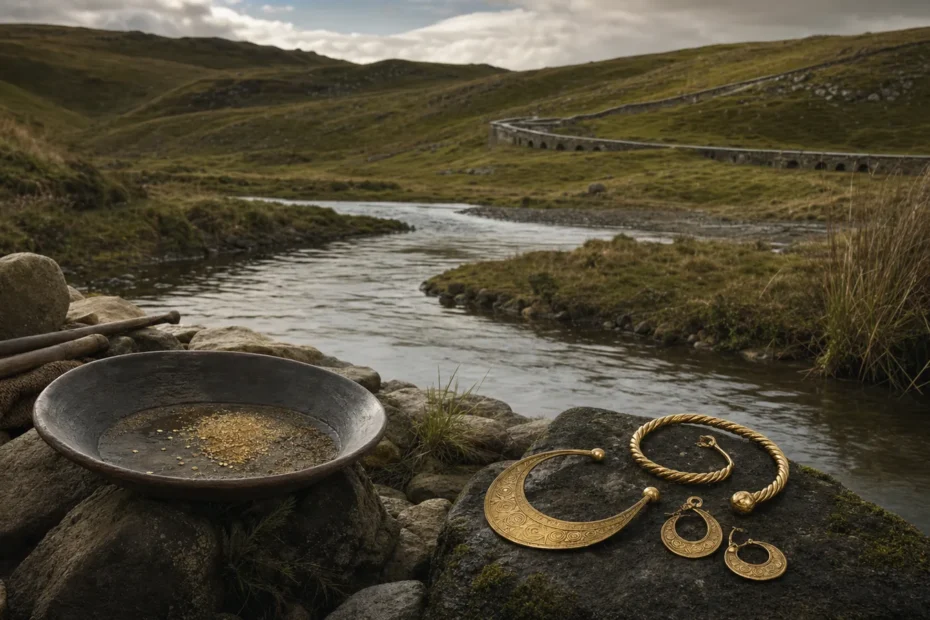
Review evidence for ancient British Isles gold mining, including river gold, Bronze Age goldwork, Dolaucothi, and what remains uncertain or debated.
- Do not treat every Bronze Age gold object as proof of a local mine.
- Compare river gold evidence with stronger Roman mining evidence.
- Use Dolaucothi carefully as a later benchmark, not a prehistoric default.
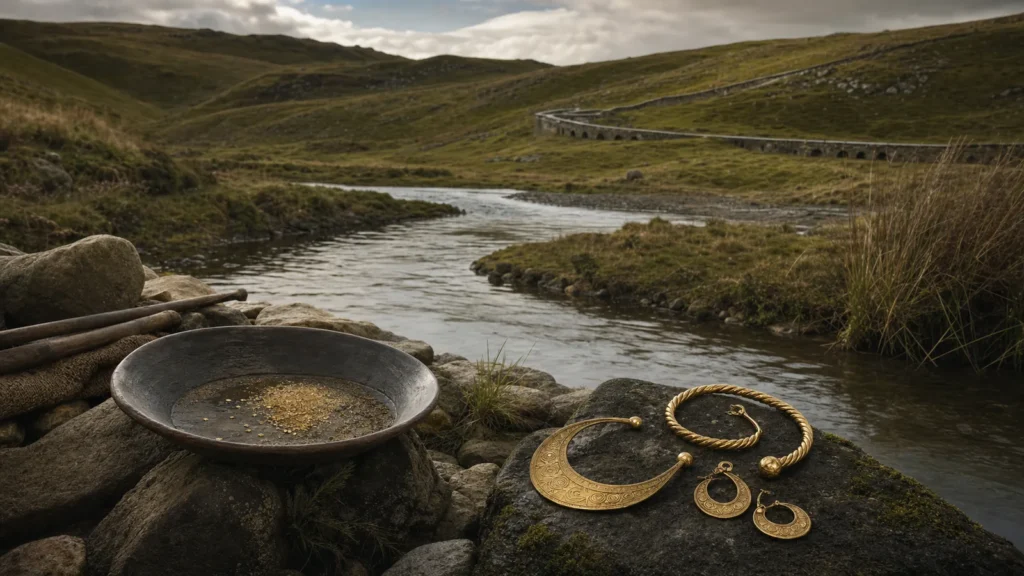
Gold mining in the ancient British Isles is best understood as a careful mix of hard evidence, plausible inference, and a few persistent myths that need trimming back. The evidence is strongest for Bronze Age gold objects, alluvial gold sources, and Roman mining at Dolaucothi in Wales. It is weaker when people try to turn every prehistoric gold ornament into proof of a nearby mine.
Gold mining in the ancient British Isles is best understood as a careful mix of hard evidence, plausible inference, and a few persistent myths that need trimming back.
The evidence is strongest for Bronze Age gold objects, alluvial gold sources, and Roman mining at Dolaucothi in Wales. It is weaker when people try to turn every prehistoric gold ornament into proof of a nearby mine.
TL;DR: ancient British Isles gold mining
- Bronze Age Ireland and Britain produced remarkable goldwork, but artefacts do not automatically prove organized local mines.
- The most plausible early source was often river or placer gold: small grains and nuggets collected from stream sediments.
- Dolaucothi in Carmarthenshire is the clearest ancient gold-mining site in Britain, with major Roman workings from the late first century AD.
- Ireland, Wales, Cornwall, and Scotland all matter to the story, but the evidence varies sharply by region and period.
- The safest interpretation is evidence-first: distinguish mined sites, artefact distributions, geological sources, and trade routes.
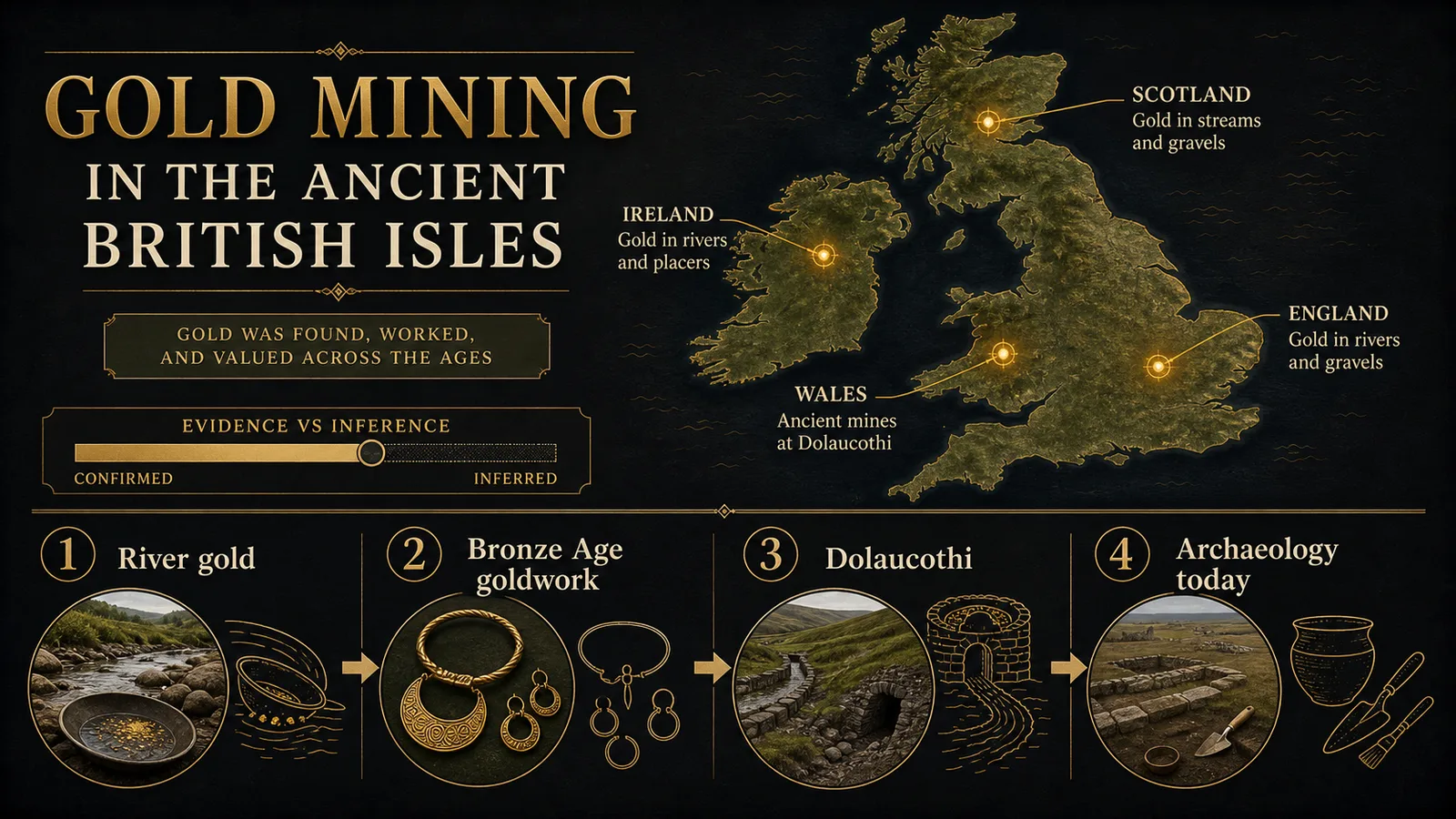
The Short Answer: What We Can Actually Say
People in the British Isles knew gold, valued gold, and worked gold long before written records describe mining. The challenge is proving where that gold came from and how it was gathered.
For the Bronze Age, the strongest visible record is goldwork: lunulae, discs, bracelets, lock rings, beads, torcs, and hoards. The National Museum of Ireland notes that Early Bronze Age Irish gold objects include discs and lunulae, with Ireland especially rich in surviving examples.
For actual mining landscapes, the strongest ancient British example is Dolaucothi in Wales. The National Trust describes it as the only known Roman gold mine in the UK.
Those two facts should not be blended too casually. Gold objects prove skilled metalworking and access to gold. Mine workings prove extraction. The link between them can be likely, possible, or unproven depending on the case.
Evidence vs Inference
| Claim | Evidence strength | Better wording |
|---|---|---|
| Bronze Age people in Ireland and Britain worked gold. | Strong | Artefacts and hoards show advanced goldworking traditions. |
| All Bronze Age gold was mined locally. | Weak | Some gold may have been local, traded, recycled, or sourced from elsewhere. |
| River gold was a likely early source. | Moderate to strong | Alluvial collection is plausible because native gold can occur as stream grains. |
| Dolaucothi was worked by the Romans. | Strong | Roman open-cast workings, adits, leats, tanks, and tools are visible or documented. |
Ireland: The Goldwork Powerhouse
Ireland dominates many discussions because so much prehistoric goldwork survives there. Early Bronze Age lunulae and discs are especially important because they show a refined tradition of hammering, shaping, and decorating thin gold sheet.
That does not mean Ireland was the only source of the metal. Provenance studies are difficult because gold was mobile, recyclable, and chemically variable. A University of Brighton summary of microchemical research on Irish prehistoric gold stresses that comparing artefacts with natural gold requires detailed characterization of both artefact gold and natural gold populations.
This is where cautious language matters. Ireland had natural gold and a strong goldworking tradition. But some studies suggest that at least some early gold could have moved across the Irish Sea, possibly from south-west Britain. That kind of result supports Atlantic exchange, not a simplistic one-way story.
For readers comparing ancient gold traditions beyond the Isles, GoldConsul has related background on gold mining in ancient Mesopotamia and gold mining in ancient Greece.
Britain and Wales: From Artefacts to Dolaucothi
Britain’s prehistoric record includes gold ornaments, hoards, and isolated finds across Wales, Cornwall, southern Britain, and Scotland. Wales is especially useful because it offers both Bronze Age gold finds and the later Roman mining landscape at Dolaucothi.
Museum Wales records Late Bronze Age hoards such as Llanarmon-yn-Ial, where gold bracelets and fragments were deposited with a bronze socketed axe. It also notes parallels in Ireland and Cornwall, which is exactly the kind of pattern that points toward exchange across western metal-producing zones.
Dolaucothi is different because it is not just an artefact findspot. It is a mining landscape. The National Trust dates the first extensive Roman mining there to around AD 70-80, with open-cast workings, tunnels, leats, and water tanks used for washing and scouring.
That makes Dolaucothi central to any serious article on ancient gold processing in Europe. It shows extraction, water management, and ore handling in a physical landscape rather than only in museum cases.
Scotland: Important Finds, Harder Source Claims
Scotland belongs in the story because prehistoric gold objects have been found there, including ornaments and high-status fittings. The source question is harder.
Some Scottish finds may reflect long-distance exchange rather than local extraction. That should not make Scotland a footnote. It instead shows how gold moved through social networks, gift exchange, elite display, and possibly metalworker mobility.
The practical lesson is the same: do not turn every beautiful object into a local mine. A Scottish gold object can tell us about status and connections even when it does not identify a Scottish mining site.
How Early Gold Was Probably Collected
The earliest practical route to gold was likely alluvial collection. Native gold can weather out of bedrock and concentrate in streams as heavy grains, flakes, or small nuggets.
That matters because alluvial gold does not require deep shafts. A small group can collect it with simple washing, sorting, and repeated attention to promising river gravels.
Possible steps looked like this:
- Search streams below gold-bearing geology.
- Collect heavy sediment from bends, bars, and trapped pockets.
- Wash lighter sand away while keeping dense grains.
- Pick out visible gold grains and consolidate small amounts over time.
- Melt, hammer, or alloy the recovered metal depending on later workshop practice.
For a broader explanation of ore, native metal, and extraction vocabulary, see GoldConsul’s guide to gold ore.
Timeline: What Happens When?
Early Bronze Age gold discs and lunulae appear, especially in Ireland.
Middle and Late Bronze Age bracelets, lock rings, beads, and hoards show changing forms and deposition habits.
Roman mining expands at Dolaucothi, using water systems, open workings, and adits.
Chemical analysis, landscape survey, and museum records refine what can and cannot be claimed.
What Dolaucothi Adds to the Story
Dolaucothi gives the ancient British Isles a rare, visible gold-mining landscape. The site includes Roman features, later Victorian and twentieth-century workings, and geological evidence for gold in quartz veins.
The Roman phase matters because it shows organized extraction at scale. Water was used to expose and process material, while tunnels and adits allowed miners to pursue ore underground.
It is still sensible to avoid overreach. Dolaucothi proves Roman gold mining in Wales. It does not prove that every earlier Welsh or Irish gold object came from Dolaucothi.
What Ancient Gold Mining Was Not
It was not a modern mining industry with standardized assays, mapped reserves, and predictable output. It was also not a romantic treasure hunt in which anyone could simply dig a hill and find ornaments.
Most early work was probably small-scale, seasonal, and opportunistic. Roman mining at Dolaucothi was more organized, but even there the evidence must be read through the landscape, tools, water systems, and later disturbance.
This distinction also separates ancient British Isles gold from later industrial stories such as the Witwatersrand Gold Rush, where deep mining and capital transformed an entire region.
Editorial Perspective
GoldConsul view: The best reading is neither skeptical to the point of dismissal nor romantic to the point of fiction. The ancient British Isles clearly had gold knowledge, gold objects, and at least one major Roman mining site.
The honest uncertainty sits in the middle: which rivers, which geological zones, which workshops, and which trade routes supplied specific artefacts?
Knowledge Gap
What archaeology still cannot fully prove: The exact source of many Bronze Age gold objects remains uncertain. Gold can be melted, mixed, recycled, and traded, which weakens simple source-to-object claims.
Better chemical datasets, clearer find contexts, and careful landscape archaeology are more useful than broad claims about national origins.
Practical Reading Checklist
When you see a claim about ancient British Isles gold, test it with five questions:
- Is the claim about an artefact, a mine, a geological source, or a trade route?
- Does it name a dated archaeological context?
- Does it distinguish Bronze Age, Iron Age, Roman, medieval, and modern mining?
- Does it rely on chemical analysis or only visual similarity?
- Does it admit uncertainty where the evidence is incomplete?
This is the same evidence-first approach readers should bring to other ancient mining topics, including ancient Chinese gold mining and ancient Nubian gold mining.
Bottom Line
Gold mining in the ancient British Isles was real, but unevenly evidenced. Bronze Age goldwork proves access to gold and impressive craftsmanship. River gold offers a plausible early supply route. Dolaucothi proves organized Roman gold extraction in Wales.
The strongest conclusion is a cautious one: Ireland, Britain, Wales, and Scotland were part of a connected Atlantic gold world, but every object and site needs its own evidence trail.
FAQ: Gold Mining in the Ancient British Isles
Was there gold mining in the ancient British Isles?
Yes, but the evidence varies by period. Dolaucothi in Wales is the clearest ancient mining site, especially for the Roman period, while Bronze Age evidence is often artefact-based rather than mine-based.
Did Bronze Age Ireland have its own gold?
Ireland had natural gold and an extraordinary goldworking tradition, but the source of specific objects is not always certain. Some gold may have been local, traded, or recycled.
What was Dolaucothi?
Dolaucothi is a gold-mining landscape in Carmarthenshire, Wales. It is widely described as the only known Roman gold mine in the UK and contains evidence of Roman workings and water-management systems.
How did ancient people collect gold before deep mining?
The most plausible early method was collecting alluvial gold from streams. Gold is dense, so small grains can concentrate in river gravels and be separated by washing and careful sorting.
Can chemical analysis prove where ancient gold came from?
Sometimes it can narrow the possibilities, but it rarely gives a simple answer by itself. Gold sources vary internally, and artefacts can be mixed, recycled, or traded across long distances.
 When you purchase a service or a product through our links, we sometimes earn a commission, at no extra cost to you.