Learn how to buy gold bars safely by comparing size, fineness, premium, dealer buyback, authenticity, delivery, storage, and resale.
- Choose bar size by resale and storage needs, not only the lowest premium per ounce.
- Compare total landed cost and the dealer’s written same-day buyback—not the retail premium alone.
- Verify the dealer, refiner, weight, fineness, packaging, delivery, storage, and exit path before paying.
- Decide whether you need physical possession, allocated vault ownership, or simply price exposure.
- Compare fine-gold value, premium, tax, payment fee, shipping, insurance, storage, and buyback.
- Recognizable small bars are more divisible; large bars can be cheaper per ounce but harder to sell partially.
- An assay card and an LBMA-listed refiner help documentation but do not prove every retail item or price is sound.
- Test the complete dealer-to-storage-to-resale process with a modest first order.
Buy the round trip, not the front-page price
Gold bars are compact, durable, and easy to describe badly. Two products containing the same fine-gold weight can have different premiums, counterfeit risk, dealer acceptance, storage requirements, and resale friction.
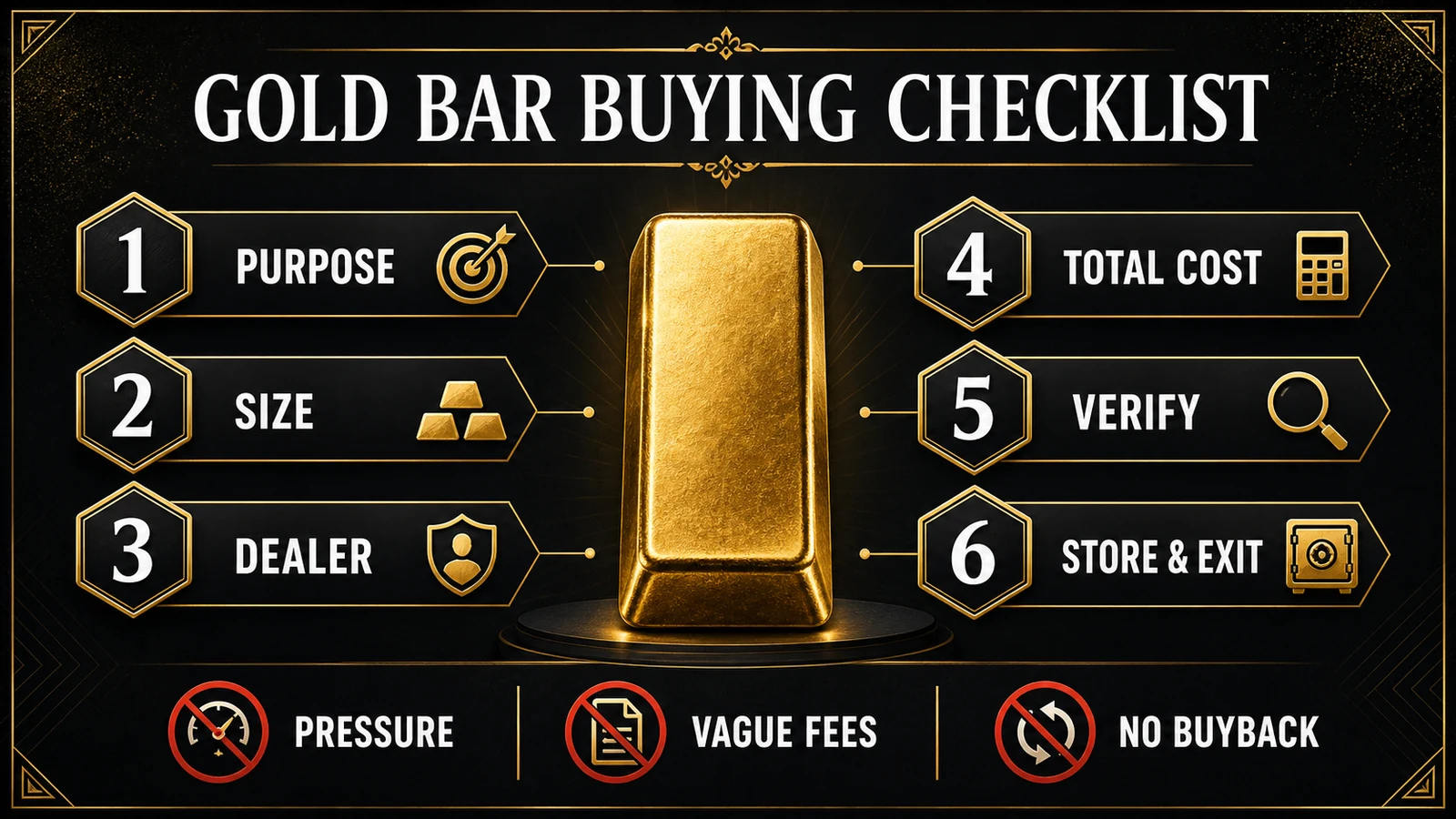
Step 1: decide whether a bar fits the job
Physical bars provide direct ownership or an allocated claim to specific metal. They also create delivery, storage, insurance, verification, tax, and resale work.
If the goal is short-term price exposure, a regulated exchange-traded product may be more liquid. Read how gold ETFs work before assuming physical possession is the only route.
Step 2: choose size by resale, not ego
Retail bars are sold in grams and troy ounces. One troy ounce equals about 31.1035 grams. Common sizes range from one gram to one kilogram, while London Good Delivery bars are wholesale products around 400 troy ounces.
| Size choice | Advantage | Trade-off | Best question |
|---|---|---|---|
| 1–10 gram bar | Low cash amount and divisibility | High premium per ounce | Will the dealer buy this exact brand back? |
| 1 troy ounce bar | Recognizable retail unit | Premium and packaging vary | What is fine weight and same-day buyback? |
| 50–100 gram bar | Potentially lower premium | Less divisible | Can I liquidate only part of the holding? |
| 1 kilogram bar | Efficient large holding | High unit value and verification stakes | Who will assay and buy it, at what discount? |
| ~400 oz Good Delivery bar | Wholesale market standard | Institutional logistics, not normal retail possession | Is the holding allocated and documented by bar list? |
Use the gold-bar weight guide and the 12 kg gold-bar calculation to separate gross weight, fine weight, and television-style “standard bar” myths.
Step 3: understand minted, cast, and assay packaging
Minted bars are cut or stamped with more uniform finishes and often come in tamper-evident assay packaging. Cast bars are poured, can have irregular surfaces, and may carry lower fabrication premiums at larger sizes.
An assay card records the maker’s representation of weight and fineness. It is evidence, not an independent guarantee that the package was never compromised or that a marketplace seller is legitimate.
Opening packaging can affect some dealers’ resale process. Ask in writing whether opened packaging changes the buyback, whether the bar will be tested, and who pays assay or shipping costs.
Step 4: calculate fine-gold value and total landed cost
Fine gold weight = gross weight × fineness. Metal value = fine troy ounces × dated reference spot. Premium % = (dealer price − metal value) ÷ metal value × 100.
Total landed cost adds tax, payment fee, shipping, insurance, and immediate storage setup. Round-trip gap = total cash paid − dealer’s written immediate buyback.
The CFTC and FINRA warn that dealers sell above spot and buy below spot. The spread plus other costs determines how far gold must rise before a cash resale breaks even.
Worked example: why buyback matters
Assume a one-ounce bar, a hypothetical spot price of $4,000, a retail quote of $4,140, $25 insured shipping, and a written same-day buyback of $3,940.
| Line | Illustrative amount | Meaning |
|---|---|---|
| Fine-gold value | $4,000 | One fine troy ounce at the assumed reference |
| Retail premium | $140 | 3.5% above metal value |
| Shipping | $25 | Raises cash outlay |
| Total paid | $4,165 | Before tax or storage |
| Immediate buyback | $3,940 | Dealer’s hypothetical purchase quote |
| Initial round-trip gap | $225 | Amount spot and/or buyback must overcome before other costs |
These figures are educational, not live prices. Repeat the calculation with a timestamped benchmark and the exact dealer’s two-way quote.
Step 5: verify the dealer
Retail precious-metal dealers are not uniformly regulated like securities brokers. CFTC guidance recommends checking the business address, operating history, owners, complaint record, fees, and written product details.
- Verify legal business name, physical address, phone number, owners, and operating history.
- Search state attorney-general, consumer-protection, court, and regulator records for complaints and enforcement.
- Obtain maker, product line, gross weight, fine weight, fineness, dimensions, serial number policy, and packaging condition.
- Request retail price, premium, commissions, tax, shipping, insurance, storage, and payment charges in writing.
- Ask what the dealer will pay today for the exact bar and whether packaging or assay changes the quote.
- Confirm price-lock rules, cancellation fee, delivery deadline, signature, inspection window, returns, and dispute procedure.
- Reject cold calls, leverage, guaranteed returns, secrecy, urgency, vague fees, or an unwillingness to provide a buyback quote.
Step 6: check refiner and product recognition
LBMA Good Delivery rules and lists are wholesale market standards for refiners and qualifying bars. A refiner’s listing can support recognition, but it does not authenticate a random retail bar, certify the seller, or guarantee a fair premium.
Compare the exact bar with manufacturer specifications and ask multiple dealers how they buy it. Regional recognition matters: a globally known refiner may receive a more predictable bid than an obscure private label.
Step 7: receive and inspect safely
Use insured, tracked delivery with a clear loss policy. Record the unopened parcel and inspect the shipping label, tamper evidence, packaging, dimensions, mass where appropriate, markings, and condition within the dealer’s window.
Do not scratch, drill, acid-test, or open sealed packaging before understanding return and resale consequences. Escalate to a professional using non-destructive methods when specifications or provenance do not match.
See how to tell if gold is real, testing gold purity, and the limits of a magnet test.
Step 8: choose storage by threat model
| Storage | Control | Main risk | Verify |
|---|---|---|---|
| Home safe | Immediate access | Theft, coercion, fire, privacy, insurance gaps | Safe rating, anchoring, disclosure, insurer limits, recovery plan |
| Bank safe-deposit box | Institutional premises | Access hours, contract exclusions, insurance, estate access | Box terms, insurer, authorized users, succession |
| Allocated professional vault | Identified metal under contract | Counterparty, fees, jurisdiction, withdrawal friction | Bar list, audit, insurance, subcustodian, delivery rights |
| Unallocated provider account | Provider-managed exposure | Creditor claim and redemption conditions | Legal status, solvency, fees, conversion and withdrawal |
Read where to store gold and allocated versus unallocated storage before choosing a vault.
Step 9: design the exit before entry
Ask two or three dealers how they quote the exact bar, how long payment takes, whether they require assay, and who bears shipping risk. Record the method rather than a verbal promise.
Keep invoices, photos, serials, packaging, custody statements, and insurance records. Do not publish your home storage location or total holdings.
If using a service such as GoldBroker, read the custody, ownership, jurisdiction, fees, and withdrawal terms yourself. This is an affiliate link; GoldConsul may earn compensation without changing your price.
Taxes and retirement accounts
Sales tax, capital-gains treatment, reporting, import rules, and eligible retirement-account assets differ by jurisdiction. In the U.S., IRA rules for collectibles and precious metals are technical, and personal possession can create problems.
Use a qualified tax professional and custodian before moving retirement money. “IRA eligible” is not a judgment about price, suitability, dealer quality, or expected return.
The lowest premium is visible; the costly variables are often hidden: payment surcharge, delivery risk, storage, insurance, assay, buyback discount, and the inability to sell only part of a large bar.
A strong first purchase is intentionally boring: a modest, recognizable bar from a verified dealer, with transparent two-way pricing, documented delivery, secure storage, and a rehearsed exit.
This guide is educational and not personalized financial, legal, or tax advice. Gold can decline, physical ownership has costs, and rules depend on jurisdiction and circumstances.
Watch: Buying Gold Bars – Everything You Must Know (Beginner’s Guide)
This beginner guide offers a useful visual overview of retail gold bars. Verify every product, dealer, cost, storage, and tax claim against written terms and the primary sources above.
Video: Sean Foo. YouTube oEmbed availability validated July 17, 2026.
Bottom Line
Buy gold bars as a complete process. Match size to resale, calculate the round trip, verify dealer and refiner, protect delivery, choose storage by threat model, and preserve the documents your future buyer will want.
FAQ: How to Buy Gold Bars
What size gold bar is best for a beginner?
Often a recognizable small retail size that balances premium with divisibility, but compare exact buyback terms and your budget.
Is an assay card proof a bar is real?
It is useful maker documentation, not independent proof of every item or seller. Verify specifications and use appropriate testing.
Does LBMA approval guarantee a retail bar?
No. LBMA lists qualifying refiners and wholesale standards; it does not authenticate a random retail item or certify its price.
Is it safe to buy gold bars online?
It can be when the dealer, product, payment, insurance, delivery, inspection, and return terms are verified in writing.
Should I store gold bars at home?
Only after assessing theft, coercion, fire, privacy, insurance, estate access, and whether professional allocated storage fits better.
Sources and verification
Use these primary and specialist sources to verify the claims, rules, specifications, and market definitions. Access rules, prices, and product terms can change.
- CFTC and FINRA — 10 questions before buying physical metals
- CFTC — Precious metals fraud
- World Gold Council — How to invest in gold
- World Gold Council — Retail Gold Investment Principles
- World Gold Council — Buying gold online
- LBMA — Good Delivery rules
- LBMA — Good Delivery current list
- LBMA — Precious metal prices
- U.S. Mint — Bullion consumer awareness
- IRS — Investments in collectibles in qualified plans
 When you purchase a service or a product through our links, we sometimes earn a commission, at no extra cost to you.