
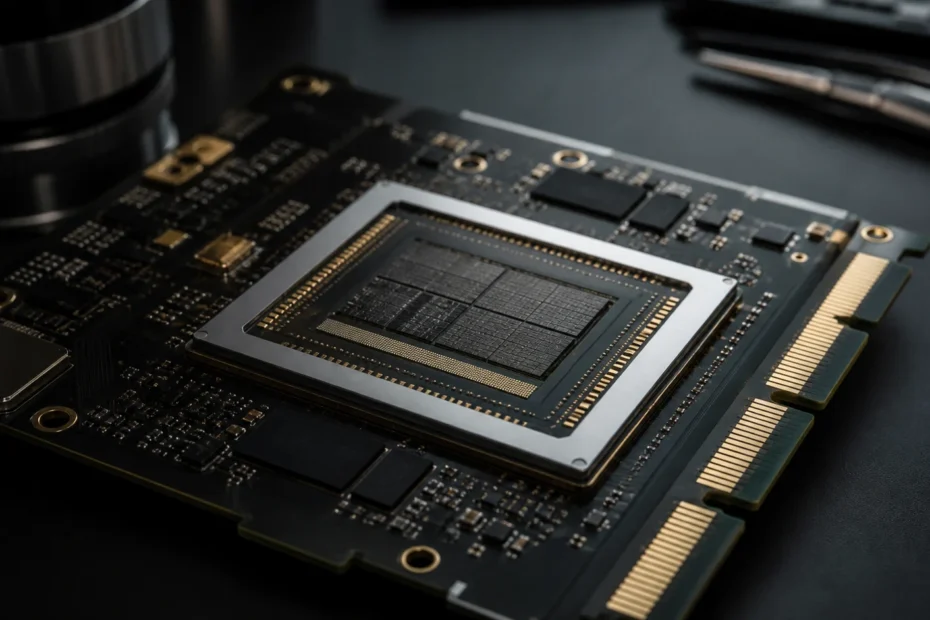
See where AI hardware uses gold in contacts, finishes, and bonds, why engineers select it, where substitutes work, and what demand data shows.
- Find where gold is actually used in AI servers and semiconductor packaging.
- Separate reliability-critical uses from claims that overstate gold dependence.
- Understand substitution, recycling, and the limits of AI-demand forecasts.
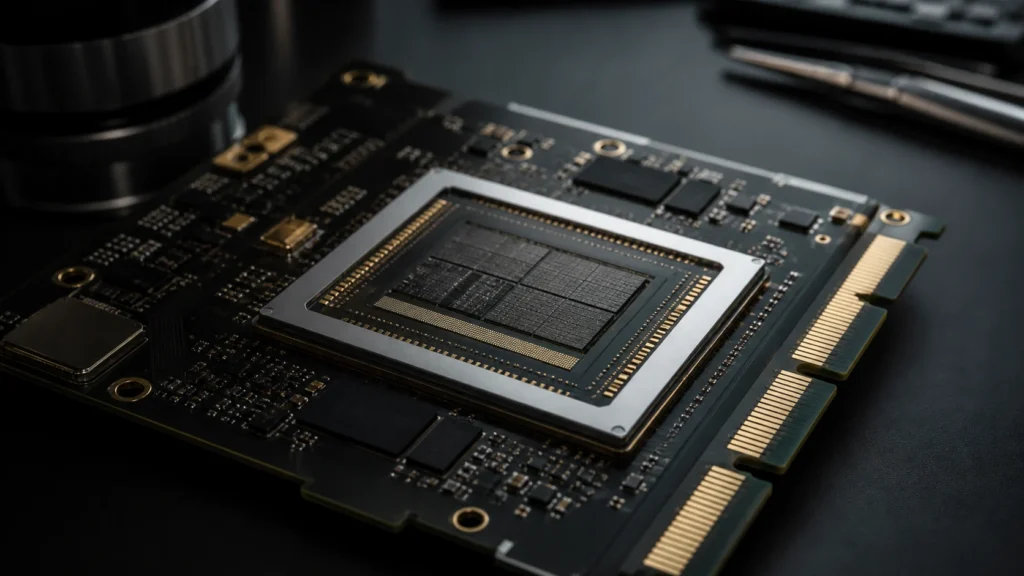
AI hardware uses small amounts of gold mainly in corrosion-resistant contacts, connector finishes, selected package surfaces, and some bonding applications. Gold improves long-term electrical reliability, but copper and aluminum carry most current and signals, and manufacturers actively reduce or replace gold where performance allows.
- Gold is a selective reliability material, not the main conductor inside an AI processor.
- Its value comes from stable, corrosion-resistant surfaces and workable microscopic connections.
- Advanced packages may use gold in some bonds and pads, but copper-based interconnects dominate many layers.
- High gold prices drive thinner plating, selective deposition, and substitution.
- AI supports electronics demand, but it does not make every accelerator a large gold product.
Where Gold Actually Appears in AI Hardware
An AI server is a system of accelerators, CPUs, memory, networking, power delivery, cooling controls, circuit boards, cables, and connectors. Gold may appear at several interfaces, but the exact amount and location depend on the package design, supplier, reliability target, and generation.
| Location | Typical role of gold | How universal is it? |
|---|---|---|
| Board and cable contacts | Thin gold or gold-alloy finish protects the contact surface from oxidation and wear | Common in high-reliability interfaces, but thickness and underlayers vary |
| Package or device bonding | Gold wire, stud bumps, or selected metallization can make workable, corrosion-resistant bonds | Design-specific; copper and other systems have replaced gold in many applications |
| Edge fingers and test contacts | Stable low-resistance surface for repeated insertion or probing | Selective use rather than coating the whole board |
| Sensors and control electronics | Contacts, bond wires, or coatings in supporting equipment | Depends on component and operating environment |
| Bulk power and on-chip wiring | Usually no primary role | Copper and aluminum dominate because they are cheaper and suited to volume wiring |
This distinction matters. Saying “AI chips contain gold” is true, but saying “AI processors depend on gold everywhere” is not. A more accurate picture is selective use at interfaces where a microscopic amount can protect a high-value system from corrosion, contact instability, or difficult bonding conditions.
For the broader electronics context, see GoldConsul’s gold in electronics guide and gold conductivity explainer.
Why Engineers Pay for Gold
It resists corrosion at exposed surfaces
Copper conducts electricity better than gold on a volume basis, but bare copper forms oxides. At a removable connector or tiny contact, the stability of the surface can matter more than the conductivity of the bulk metal beneath it. A thin engineered gold finish can preserve a repeatable contact without paying for a solid-gold component.
It can form workable microscopic connections
Gold is ductile and can be formed into very fine wire or deposited on selected areas. It also has a long manufacturing history, which gives engineers mature process knowledge. A NIST NanoFab tool description provides a concrete example: separate bonders use 25-micrometer gold and aluminum wires to connect device chips with packages.
That does not mean gold wire is always preferred. Copper wire bonding has expanded because it lowers material cost and can offer useful electrical and mechanical performance when the process is controlled.
Its cost is small compared with some failure modes
A data-center accelerator, network switch, or server board can be expensive, and downtime can cost far more than the gold on a contact. Engineers therefore compare total reliability and manufacturing yield, not just metal price. The same logic can also favor substitution when another finish meets the required life at lower cost.
Gold is most defensible where the surface must remain stable, the contact is small, and failure is costly. It is least defensible where a protected copper or aluminum conductor can do the job without the same exposure or wear.
Advanced Packaging Does Not Mean “More Gold Everywhere”
AI accelerators increasingly combine compute dies, high-bandwidth memory, package substrates, and dense interconnect structures. More interfaces can increase the value of reliable contacts, but advanced packaging uses many materials: copper redistribution layers, solder systems, under-bump metallization, barrier layers, organic substrates, and other finishes.
Some designs use gold-bearing bonds or surface finishes; others minimize them. Product photographs cannot reveal the bill of materials, and package diagrams often simplify multiple metal stacks into a single “gold contact.” Without manufacturer data, precise per-chip gold claims should be treated as estimates.
That is the knowledge gap readers should remember: public disclosures rarely provide a complete, model-specific gold mass for an AI accelerator, and the amount in a packaged chip is not the same as the amount across a whole server, network, or data-center build.
Four scopes that should never be mixed
- Die: the semiconductor itself and its on-chip interconnects.
- Package: the die or chiplets plus substrate, bumps, bonds, lids, and other package materials.
- Accelerator card: the package plus board, memory, power stages, and external contacts.
- AI server or cluster: multiple cards plus CPUs, networking, power, storage, cables, and controls.
A gold estimate that is plausible for a whole card may be wildly wrong if attributed to the die alone. Always ask what physical boundary, production generation, and measurement method an estimate covers.
- Define whether the number covers the die, package, accelerator card, or complete server.
- Look for a manufacturer bill of materials, teardown assay, or named measurement method.
- Check the product generation and packaging design; do not transfer one figure to every accelerator.
- Separate gold mass per unit from total market demand, which also depends on shipment volume and manufacturing thrift.
- If the source gives no boundary or method, treat the number as an illustration rather than a fact.
Gold vs Copper, Aluminum, Silver, and Palladium
| Material | Why engineers use it | Why it does not simply replace every other metal |
|---|---|---|
| Gold | Corrosion-resistant surface, ductility, mature bonding and plating processes | High cost; soft surface; often unnecessary in protected bulk conductors |
| Copper | Excellent conductivity, low cost, established wiring and packaging ecosystem | Oxidation and process-control challenges at some exposed interfaces |
| Aluminum | Low mass, low cost, mature on-chip and bonding applications | Oxide behavior and different mechanical/electrical tradeoffs |
| Silver | Highest electrical conductivity among metals | Tarnish, migration, cost, and process constraints limit universal use |
| Palladium systems | Useful in some finishes, barrier layers, and alloy combinations | Price volatility and application-specific performance |
Substitution is usually not a one-for-one metal swap. It can require new underlayers, bonding tools, protective coatings, process temperatures, and qualification testing. That is why a technically possible substitute may take years to become standard—and why gold use can still shrink through thinner coatings rather than disappear.
What Current Demand Data Says
The World Gold Council reported 322.8 tonnes of technology-sector gold demand in 2025, including 270.4 tonnes in electronics. In its Q1 2026 update, electronics demand was 69.3 tonnes, up 3% year over year, with AI infrastructure cited as support.
The same 2026 report also describes the counterforce: high prices encourage thinner and more selective plating and maintain pressure to substitute gold wire. That is the balanced conclusion. AI can support electronics demand while manufacturers simultaneously reduce gold per component.
Recycling and Supply-Chain Reality
At end of life, boards and components can contain recoverable gold mixed with copper, tin, nickel, precious metals, resins, and ceramics. Recovery is an industrial refining problem, not a safe home experiment. Collection, pre-processing, assay, scale, and environmental controls determine whether recovery is practical.
Gold’s recyclability is a genuine advantage because it can be refined repeatedly without losing its elemental properties. It does not remove the need for responsible sourcing or documented material flows. See how gold is recovered from e-waste, whether gold can be recycled, and GoldConsul’s ethical gold guide.
Editorial Perspective
The most useful way to understand gold in AI hardware is neither “gold is obsolete” nor “AI cannot run without gold.” Gold remains valuable at selected reliability-critical interfaces, while engineering teams continuously redesign those interfaces to use less gold when qualification permits.
FAQ: Gold in AI Hardware
How much gold is in an AI processor?
There is no reliable universal figure. The amount varies by package, generation, supplier, and whether “processor” means the package alone, the accelerator card, or the whole server. Public bills of materials usually do not disclose model-specific gold mass.
Is gold inside every AI chip?
Not necessarily in the same location or amount. Gold can appear in selected bonding, pad, contact, or connector systems around AI hardware, while copper and aluminum dominate many internal and board-level conductors.
Why not replace gold with copper?
Copper already replaces gold in many applications. Gold remains where its stable surface, corrosion resistance, or manufacturing behavior justifies the cost. Switching requires qualification of the complete materials and process stack.
Does AI growth guarantee higher gold prices?
No. AI can support electronics demand, but technology is one demand sector, manufacturers thrift gold when prices rise, and the gold price responds to many larger market forces.
Can gold from old AI hardware be recycled?
Yes, through professional electronics collection and refining. The concentration in any one device is small, so economic recovery normally depends on aggregating large material streams.
Bottom Line
Gold helps AI hardware where durable electrical surfaces and reliable microscopic connections justify a premium. It is important but selective, and the honest trend is dual: more AI infrastructure can support demand while better manufacturing reduces gold used per connection.
 When you purchase a service or a product through our links, we sometimes earn a commission, at no extra cost to you.