
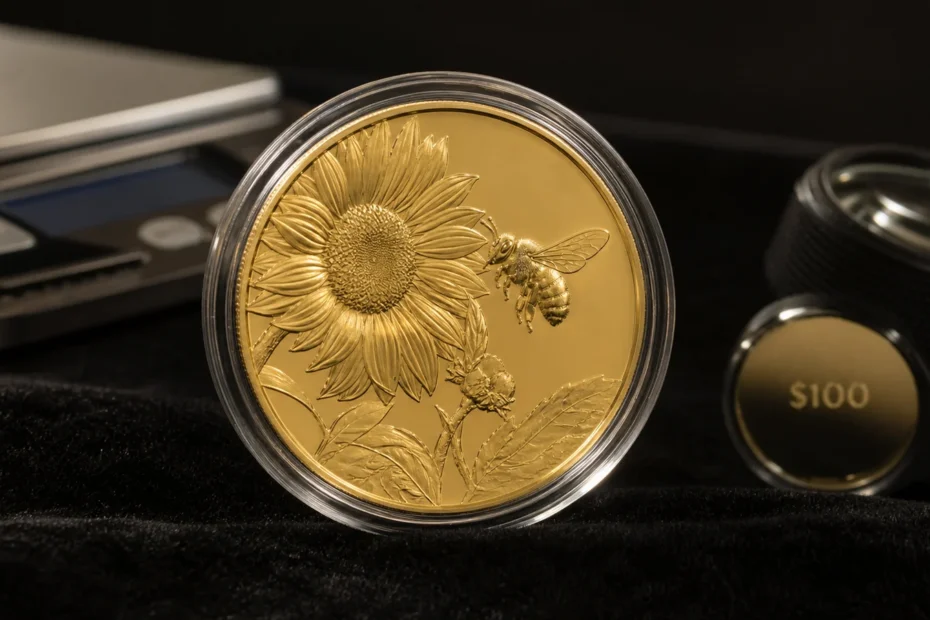
A U.S. $100 gold coin usually means a 1 oz American Liberty issue. Check country, metal, year, gold content, condition, packaging, and market bids.
- The U.S. American Liberty $100 gold coins contain one troy ounce of .9999 fine gold, but the $100 is only face value.
- A U.S. $100 American Platinum Eagle is platinum—not gold—so identify the metal and program before using a value formula.
- Realizable value depends on spot gold, year, condition, original packaging, certification, dealer spread and collector demand.
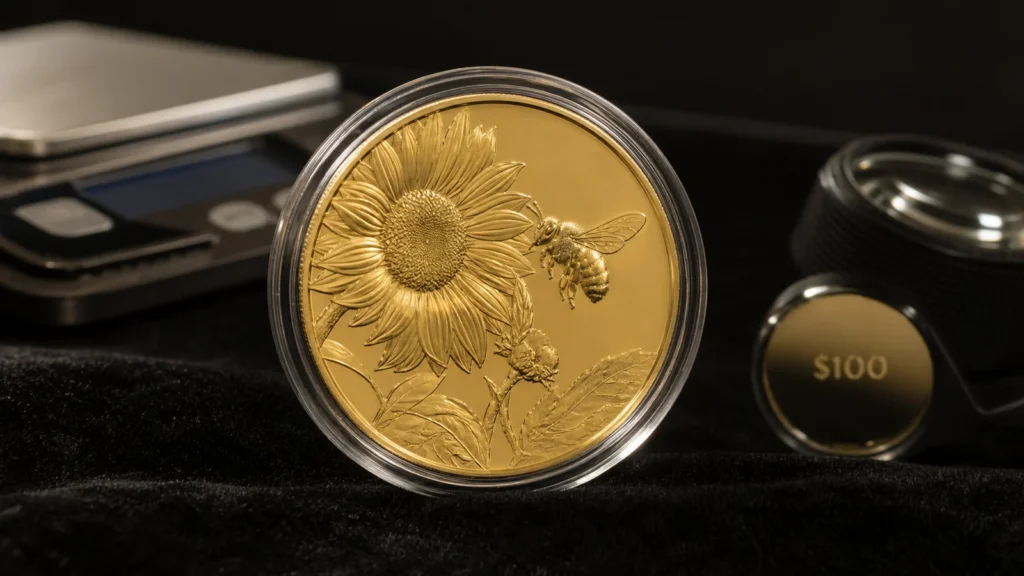
- Face value identifies legal denomination; it usually does not equal bullion or collector value.
- U.S. American Liberty $100 gold coins contain one troy ounce of .9999 fine gold.
- The U.S. $100 American Eagle is a one-ounce platinum coin.
- Foreign issuers also use “100 dollars,” so country and currency matter.
- Value can include metal, retail premium, collector premium and resale spread.
Identify first, value second
A denomination is an incomplete description. Two coins marked “100 dollars” can differ in country, metal, weight, fineness, issue type and market. The fastest safe workflow is to read every inscription, confirm the issuing authority, then compare the coin with official specifications.
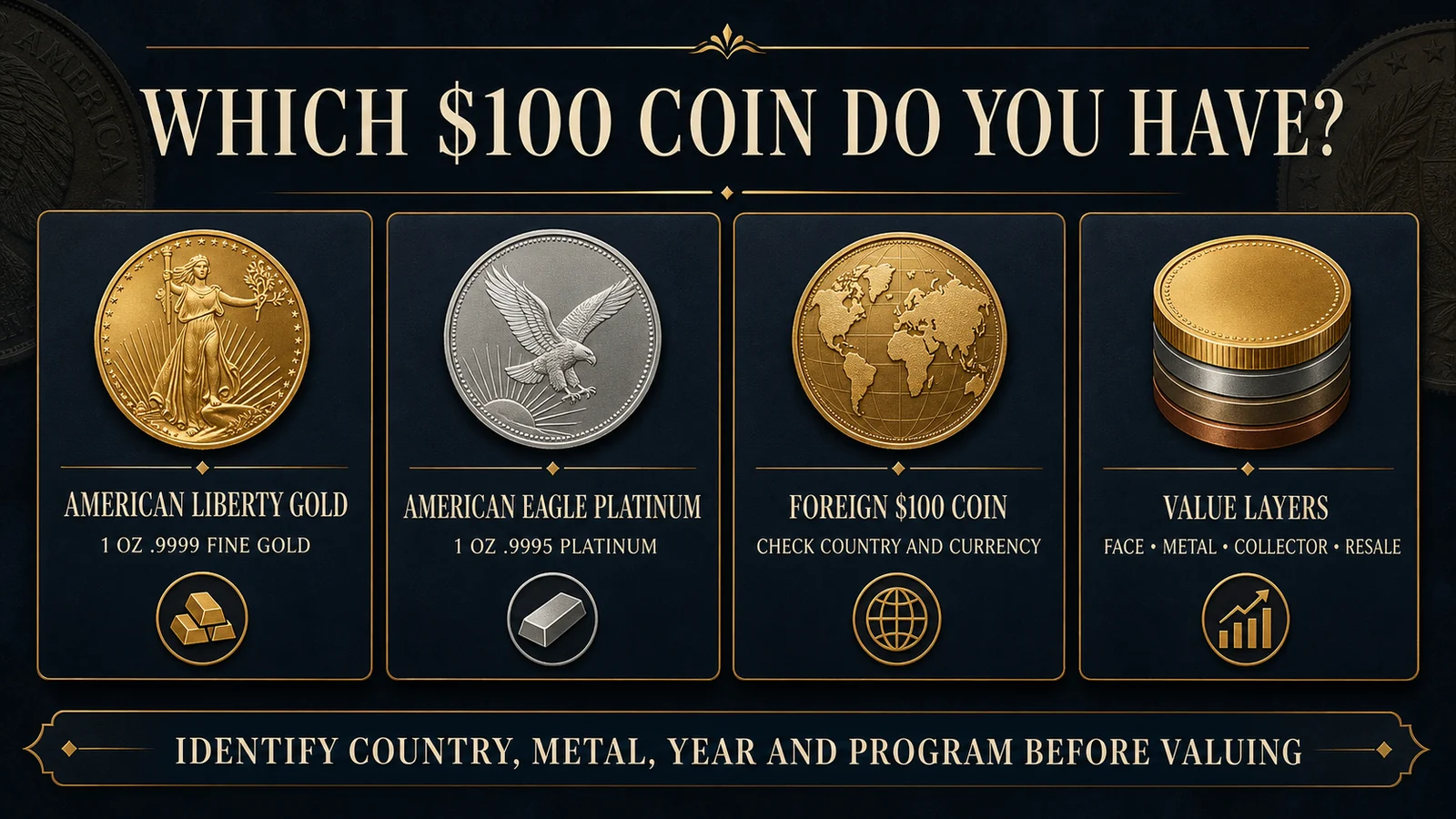
The main U.S. $100 coin types
| Coin family | Metal and content | Why it says $100 | Primary value driver |
|---|---|---|---|
| American Liberty high-relief gold coin | One troy ounce, .9999 fine gold on recent issues | Legal-tender face value | Gold value plus issue-specific collector premium |
| American Eagle platinum bullion/proof coin | One troy ounce, .9995 platinum | Legal-tender face value | Platinum value, premium and condition |
| Foreign $100 gold coin | Varies by country and program | Denomination in the issuer’s currency | Verified metal content, rarity and market |
| Novelty, plated or privately issued piece | May contain little or no gold | May be decorative rather than legal tender | Actual material and collector demand, if any |
The U.S. Mint American Liberty program is the authoritative starting point. The Mint’s 2025 high-relief product page lists a $100 denomination, one troy ounce of gold and .9999 fineness. Do not transfer those specifications automatically to a different country or unofficial piece.
Why a $100 face value coin can be worth much more
Face value is the amount recognized as legal tender. Melt value reflects recoverable precious-metal content at a current reference price. Retail value includes dealer margin and market premium. Collector value can add scarcity, design, condition, packaging, certification and demand.
If a verified American Liberty coin contains exactly 1.000 fine troy ounce, insert the current gold spot price at the time of valuation. At a hypothetical $3,000 per ounce, metal value is about $3,000. A dealer may ask more and offer less; a scarce issue may trade on collector evidence rather than bullion value alone.
The number is illustrative, not today’s quote. Use the same timestamp for price, currency and transaction comparison.
For the underlying unit, see GoldConsul’s gold weight estimator and the guide to gold and silver bullion.
How to identify a $100 coin
- Record country, denomination, date, mint mark and all edge text.
- Identify the named program: American Liberty, American Eagle or another issuer.
- Confirm metal, fineness, fine weight, gross weight and diameter from the issuing mint.
- Weigh the coin with a calibrated scale and measure diameter without scratching it.
- Do not clean it; cleaning can permanently reduce collector value.
- Compare design details only with official or established grading references.
- Verify any certification number directly with the named grading service.
- For a high-value coin, obtain an in-person opinion from a reputable specialist.
Weight alone cannot authenticate a coin. A counterfeit can be engineered near the correct mass by changing composition or dimensions. Combine measurements with design inspection, magnetic response where appropriate, electrical or XRF testing by a qualified professional, and provenance. See testing gold coins for the limits of each method.
American Liberty gold versus American Eagle platinum
The shared $100 denomination causes the most common confusion. American Liberty gold coins use modern high-relief designs and are sold as numismatic products. The American Eagle platinum program uses platinum and has its own bullion and proof specifications. Color in a photograph is not sufficient evidence because lighting, toning and image editing can mislead.
The U.S. Mint’s bullion coin program page separates the gold, silver, platinum and palladium programs. If a seller calls a $100 American Eagle “gold,” stop and verify before paying.
Premium, spread and collector value
The retail premium is the amount above metal reference paid to acquire the coin. The resale spread is the gap between what a dealer sells for and buys for. A premium is not automatically recoverable. Popularity, dealer inventory, condition and transaction size all matter.
For collector coins, completed auction results can be more informative than a static price guide, but comparables must match date, variety, grade and holder. PCGS price resources and the NGC certification lookup are starting points, not purchase guarantees.
Years, designs and packaging change the collector comparison
The American Liberty program uses changing modern designs rather than one permanent motif. A listing should match the exact year to the Mint’s product archive. High relief, prooflike surfaces, privy marks, companion medals or special finishes can be meaningful, but only when the official issue description confirms them.
Original capsule, case and certificate may support collector value even though they add no gold. Packaging can also be replaced, so it does not authenticate the coin by itself. A sealed-looking box is weaker evidence than a correct coin, documented purchase record and verified third-party certification.
What grading does—and does not—tell you
A grading service assesses authenticity and condition under its standards and encapsulates the coin with an identification number. Small grade differences can produce large price differences in a thin market. That makes holder verification and matched sales essential.
A grade is not a guaranteed resale price. Labels such as “First Day,” signatures or special sets may command premiums for some buyers but not others. Compare the same label and grade in completed transactions, then ask what a dealer would pay today rather than relying only on retail listings.
Two genuine one-ounce American Liberty coins have the same fine-gold reference. Coin A is raw with missing packaging; Coin B is certified at a high grade with original packaging. A bullion-oriented buyer may offer nearly the same metal-based bid for both, while a specialist collector may pay more for Coin B. The correct value therefore depends on the sale channel and matched demand.
Buying and selling safely
Compare the exact coin, payment method, shipping, return policy and buyback offer. Avoid urgency, guaranteed-profit claims and prices far below metal value. The FTC scam guidance applies: verify the business independently and do not let a caller control the pace.
Read how to buy gold coins, the American Gold Eagle buying guide, and the exact Gold Eagle weight table before comparing unrelated U.S. coin programs.
Choose the sale channel by the coin’s strongest value layer
A bullion dealer is efficient when most value comes from metal and the coin is familiar. A numismatic dealer or specialist auction may expose a scarce, high-grade piece to more relevant collectors, but fees, consignment time and reserve terms matter. A local general buyer may offer speed while pricing only for melt.
Before accepting an offer, request at least two quotes stated in dollars and as a percentage of the same-time metal reference. For a collector coin, ask which comparable sales support the premium. Photograph the coin and packaging, record certification details and confirm insured shipping terms before it leaves your control.
| Sale route | Best fit | Main trade-off |
|---|---|---|
| Bullion dealer | Common verified metal-value coin | Fast quote, limited numismatic premium |
| Numismatic dealer | Special issue or certified grade | Specialist knowledge, dealer margin |
| Major auction | Scarce coin with strong documentation | Broader collector reach, fees and delay |
| Peer-to-peer sale | Experienced parties with safe settlement | Potentially better price, greater fraud and payment risk |
Search results often answer “what is a $100 gold coin worth?” before identifying the object. That reverses the evidence order. Denomination, country, metal, fine content and authenticity are inputs; value is the output.
The most useful fact is not a current dollar estimate. It is the decision rule that survives price changes: identify the coin, calculate its metal floor, then justify any collector premium with matched market evidence.
This guide is educational, not an appraisal or investment recommendation. Spot prices, premiums and collector markets change. Do not clean, alter or ship a potentially valuable coin before receiving appropriate specialist advice.
Watch the mechanism: This close-up is useful for visual orientation; verify specifications and prices with the primary sources in this guide.
Bottom Line
A U.S. American Liberty $100 gold coin typically represents one ounce of .9999 fine gold, but “$100 coin” can also mean platinum, a foreign issue or a non-mint piece. Confirm identity first, then separate face, metal, retail, resale and collector value.
FAQ: 100 Dollar Gold Coins
Is there a U.S. $100 gold coin?
Yes. Modern American Liberty high-relief gold coins carry a $100 face value and recent issues contain one troy ounce of .9999 fine gold.
Is the $100 American Eagle made of gold?
The U.S. coin with a $100 American Eagle denomination is platinum. One-ounce American Gold Eagles carry a $50 face value.
How much is a $100 gold coin worth?
It depends on issuer, metal, fine weight, authenticity, condition and collector demand. A verified one-ounce gold coin has a metal reference equal to one ounce times current spot, before premiums and spreads.
Can I spend a $100 gold coin for $100?
A genuine legal-tender coin has its stated face value, but spending a bullion or collector coin at face value would usually sacrifice much greater metal or market value.
Should I clean a $100 gold coin?
No. Cleaning can damage surfaces and sharply reduce numismatic value. Handle it by the edges or leave it in its holder.
Sources and verification
This guide relies on regulator, issuer, mint and specialist market sources. Product terms, prices and regulations can change, so recheck the dated primary source before acting.
- U.S. Mint — American Liberty Gold Coins — Official series history and issue list from 2015 onward.
- U.S. Mint — 2025 American Liberty High Relief Gold Coin — Official current product specifications and design details.
- U.S. Mint — 2025 American Liberty Press Release — Official release context, ordering date and program description.
- U.S. Mint — Bullion Coin Programs — Official comparison showing that the $100 American Eagle bullion coin is platinum.
- U.S. Mint — Coin Collecting Basics — Official collecting, handling and terminology guidance.
- PCGS — Coin Price Guide — Market guide and certification context; guide values are not guaranteed bids.
- NGC — Verify Certification — Certification-number and holder verification tool.
- LBMA — Precious Metal Prices — Time-stamped gold benchmark input for melt-value calculations.
- FTC — Collectibles and Investment Scams — Consumer-protection context for urgency, guarantees and unverified seller claims.
- Rare Collectibles TV — 2021-W High Relief Gold Liberty — Close visual look at a series coin; pricing claims should be verified independently.
 When you purchase a service or a product through our links, we sometimes earn a commission, at no extra cost to you.