
Learn how to sell a 1900 Half Eagle gold coin: check melt value, gold content, grading, buyer fees, auction options, and tax records before offers.
- Start with melt value: spot gold price times 0.24187 troy oz.
- Grade and condition can matter more than gold weight.
- Compare dealer, auction, and grading costs before accepting an offer.
Quick answer: To sell a 1900 Half Eagle gold coin, start with its melt-value floor, then check whether condition, grading, and collector demand justify a premium. Do not clean, acid-test, or rush the sale until you have compared at least two credible offers.
A 1900 Half Eagle is a Liberty Head $5 gold coin, not just a small gold bar. Its gold content gives you a measurable floor, but the final offer depends on authenticity, grade, eye appeal, buyer fees, and the selling channel you choose.
- Start with gold content. The coin contains about 0.24187 troy ounces of actual gold weight.
- Check the series correctly. The 1900 issue is a Liberty Head Half Eagle; the Indian Head Half Eagle design began later.
- Grade can change the decision. A common worn coin may trade close to bullion value, while a stronger uncleaned coin can deserve a collector review.
- Compare net offers. Dealer payout, auction fees, shipping, insurance, and tax records matter as much as the headline price.
What a 1900 Half Eagle is worth before you sell.
The first number to calculate is melt value. That is the value of the gold inside the coin before any numismatic premium, dealer spread, grading cost, auction commission, shipping, or tax effect.
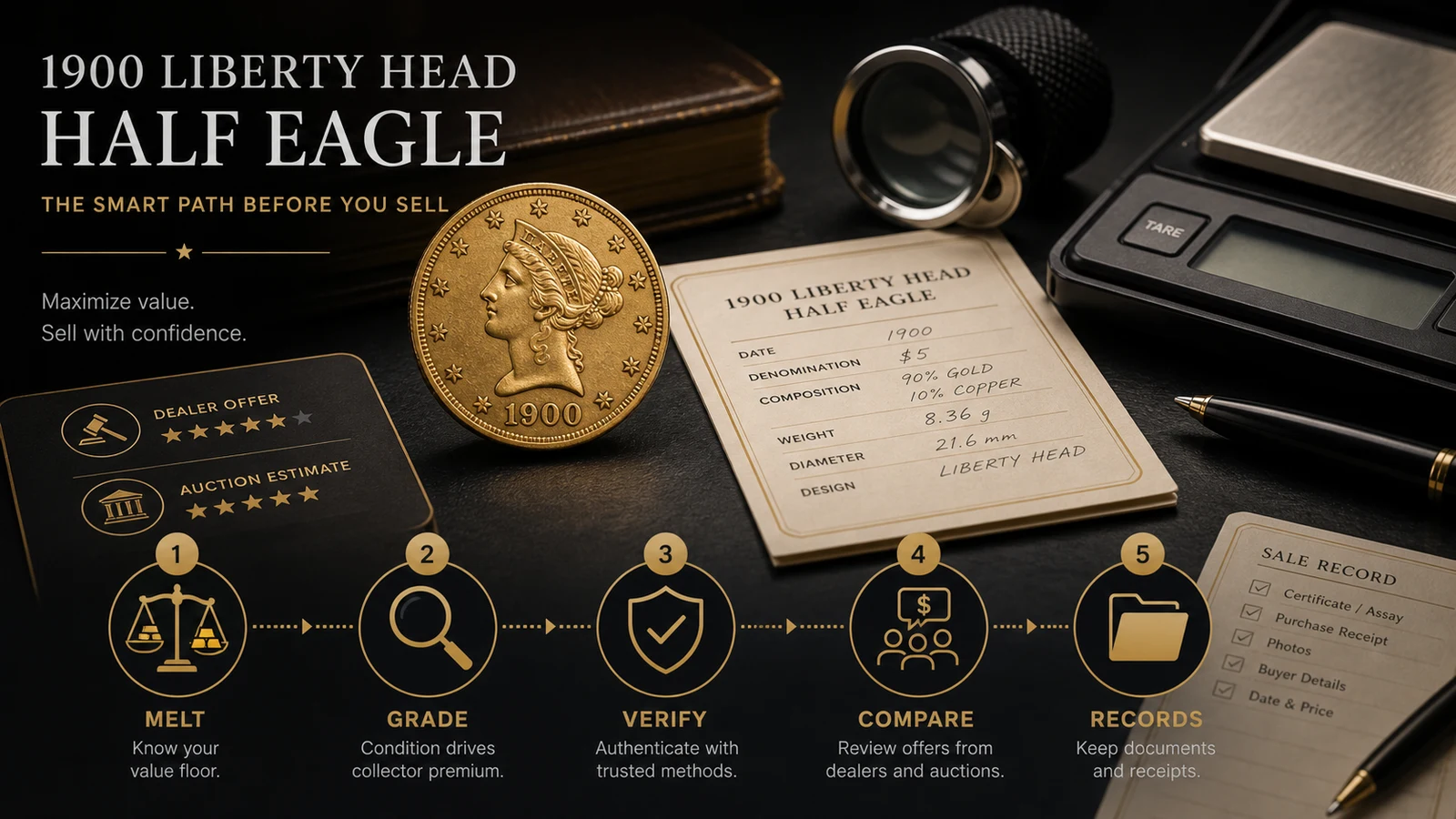
For a 1900 Liberty Head Half Eagle, PCGS CoinFacts lists the standard specifications: 8.36 grams, 90% gold and 10% copper, 21.65 mm diameter, and 0.24187 troy ounces of actual gold weight. The Philadelphia issue has no mint mark and a reported mintage of 1,405,500.
Melt-value formula
current gold spot price per troy oz x 0.24187 = approximate melt valueUse the live spot context on GoldConsul’s live gold price page, then treat the result as a floor, not a guaranteed offer.
Why the buyer may not pay that number
- Dealers need a resale spread.
- Auction houses charge seller and buyer fees.
- Shipping and insurance can reduce net proceeds.
- Condition can either add premium or limit interest.
| Specification | 1900 Liberty Head Half Eagle | Why it matters before selling |
|---|---|---|
| Denomination | $5 Half Eagle | Confirms the coin type and avoids confusing it with a $10 Eagle. |
| Design | Liberty Head | Do not market it as an Indian Head Half Eagle. |
| Composition | 90% gold, 10% copper | Explains why weight and gold content differ from pure gold. |
| Actual gold weight | 0.24187 troy oz | The key number for melt-value math. |
| Weight | About 8.36 grams | A useful non-destructive screen before professional review. |
| Mint mark | Philadelphia examples normally have no mint mark | Check the reverse before assuming another mint. |
Melt value is the floor, not the full offer.
The melt calculation tells you what the gold content is roughly worth at spot. It does not tell you what a collector, dealer, or auction bidder will pay for your exact coin.
A buyer will usually separate three questions: is the coin genuine, what grade or condition is it, and what can the buyer realistically resell it for after fees and risk. That is why a simple calculator should lead into evidence, not replace it.
Practical rule
If the best offer is below melt value, ask why. If the offer is far above melt value, ask what numismatic evidence supports it. Either way, the seller’s job is to understand the spread between gold content and collectible premium.
Sell now, grade first, or use an auction?
Choose the path based on condition, documentation, and the size of the potential premium. The goal is not to spend money on grading automatically; it is to avoid selling a better coin like common bullion.
Sell directly if it is common and worn.
For a heavily circulated, problem coin, compare dealer offers against melt value and keep the process simple.
Consider grading if condition looks strong.
If the coin appears uncleaned, sharply struck, or potentially Mint State, PCGS or NGC review can improve buyer confidence.
Use auctions for better collector interest.
If the coin is certified, attractive, or scarce in higher grade, auction exposure may outperform a quick dealer bid after fees.
Condition is where a Half Eagle stops behaving like a simple gold-weight item. The same date can have different results depending on wear, luster, marks, eye appeal, cleaning, and certification.
Use NGC Coin Explorer and PCGS CoinFacts to compare how the issue is described before you rely on a buyer’s verbal estimate. If the coin is already certified, check the certification number with the grading service.
- Do not clean the coin. Cleaning can reduce collector value and may make a buyer treat the coin as a problem piece.
- Photograph both sides clearly. Include edge shots, weight, and any holder or paperwork.
- Separate damage from normal wear. Scratches, jewelry mounts, polishing, and environmental damage can lower bids.
- Ask whether grading pays for itself. Certification costs, shipping, turnaround time, and likely grade should all be part of the decision.
Useful tools before comparing offers.
These tools can help you document simple clues before speaking with a dealer, auction house, or grading service. They do not replace PCGS, NGC, or a qualified numismatic review.
Affiliate disclosure: As an Amazon Associate, GoldConsul may earn from qualifying purchases. Prices are not shown here and can change on Amazon.

New Personal Coin Scale Pro
Best for: documenting weight before comparing dealer or auction offers.
Caveat: correct weight is useful, but it does not prove authenticity, grade, or market value by itself.
Check current price on Amazon
Coin Ping Tester
Best for: an extra sound-check signal before you seek a professional opinion.
Caveat: a ping test is not a grading service and should not decide a high-value or collectible sale.
Check current price on AmazonUse note: Never clean, scratch, acid-test, or alter a potentially collectible Half Eagle before asking for a professional opinion.
Where to sell a 1900 Half Eagle.
The Gold Bars guide covers the practical checks that matter when purity, premiums, storage, and resale are part of the decision.
There is no single best buyer for every coin. Your best path depends on how much numismatic premium is plausible and how much convenience, speed, and certainty you need.
Compare selling channels by net result.
The strongest offer is the one you can document after fees, shipping, insurance, timing, and payment risk.
Best for speed and simple coins.
Useful for a fast bid and in-person inspection. Ask how the offer relates to spot gold, grade, and resale spread.
Best for numismatic evaluation.
Use recognized dealers, ideally with clear affiliations, transparent buy/sell terms, and experience with U.S. gold type coins.
Best for certified or stronger coins.
Heritage Auctions and Stack’s Bowers can be relevant when collector competition may exceed a direct bid.
Best only if you can manage risk.
Listings need excellent photos, buyer screening, insured shipping, returns policy, and clear handling of fees and disputes.
Buyer checklist before you accept an offer.
Use this sequence before shipping or handing over the coin. It keeps the conversation focused on facts instead of pressure.
| Check | What to ask | Why it matters |
|---|---|---|
| Identity | Who is the buyer, and how can you verify them? | Reduces payment, shipping, and counterfeit-return risk. |
| Valuation basis | Is the offer based on melt, wholesale, retail, or auction estimate? | Shows whether the buyer is valuing gold content or collector premium. |
| Fees | What commissions, shipping, insurance, or payment fees apply? | Net proceeds matter more than headline price. |
| Payment | When and how will payment clear? | A high offer is weak if payment terms are risky. |
| Documentation | Will you receive a written invoice, sale record, or auction settlement? | Records help with tax basis and future questions. |
Taxes and records to check before selling.
Gold coins can create tax questions because they may be treated as collectibles. In the United States, IRS Topic 409 notes that net capital gains from collectibles can be taxed at a maximum 28% rate, depending on your situation.
This is not tax advice. Keep purchase receipts, grading paperwork, buyer correspondence, shipping records, and the final settlement statement. If the coin was inherited, gifted, or part of an estate, ask a qualified tax professional how basis and reporting should be handled.
Common selling mistakes.
- Using a stale gold price. Recalculate melt value with the current spot price before comparing offers.
- Calling every premium “profit.” Fees, grading, shipping, and taxes can change the net result.
- Cleaning or polishing the coin. Surface alteration can hurt collector value.
- Trusting one buyer only. Get at least two offers when the coin is not obviously a low-grade bullion sale.
- Ignoring mint and series details. Confirm Liberty Head, date, mint mark status, weight, and diameter.
- Shipping without insurance rules. Know what the carrier will actually cover for coins and precious metals.
What to read next.
Use these guides to check the gold, price, and selling context before making a final decision.
Sources and further reading.
Use primary coin references and official tax guidance when a buyer’s claim depends on specifications, grade, or reporting rules.
PCGS CoinFacts
Specifications, mintage, and market context for the 1900 $5 Liberty Head Half Eagle.
Open sourceNGC Coin Explorer
Independent grading-service context for the 1900 Liberty Head Half Eagle issue.
Open sourceIRS Topic 409
U.S. capital-gain and collectibles tax context. Confirm your own situation with a professional.
Open sourceDealer directories
Compare recognized numismatic dealers through ANA and PNG before relying on one buyer.
ANA | PNGFAQ: selling a 1900 Half Eagle gold coin.
How much gold is in a 1900 Half Eagle?
A 1900 Liberty Head Half Eagle contains about 0.24187 troy ounces of actual gold weight. The coin weighs about 8.36 grams and is struck in 90% gold and 10% copper.
Should I sell a 1900 Half Eagle for melt value?
Melt value is the starting floor, not the whole decision. Grade, condition, authenticity, buyer fees, and collector demand can make the selling price higher or lower than a simple melt-value estimate.
Should I get a 1900 Half Eagle graded before selling?
Consider grading if the coin appears uncleaned, higher grade, unusual, or likely to attract collectors. If the coin is heavily worn and common, compare grading costs with the likely premium first.
Where is the mint mark on a 1900 Half Eagle?
A Philadelphia 1900 Half Eagle normally has no mint mark. Check the reverse carefully before assuming the coin is from another mint.
Can I clean a 1900 Half Eagle before selling it?
No. Cleaning can reduce numismatic value and make buyers suspicious. Photograph and protect the coin instead of polishing or chemically treating it.
Do I owe tax when selling a gold coin?
Tax treatment depends on your cost basis, holding period, location, and sale details. In the United States, IRS guidance treats coins and other collectibles under special capital-gain rules, so keep records and consult a tax professional.
Bottom line.
Selling a 1900 Half Eagle should begin with the coin’s 0.24187 troy ounces of gold, but it should not end there. Verify the coin, protect its condition, compare net offers, and use grading or auction exposure only when the likely premium justifies the extra cost and time.
 When you purchase a service or a product through our links, we sometimes earn a commission, at no extra cost to you.