
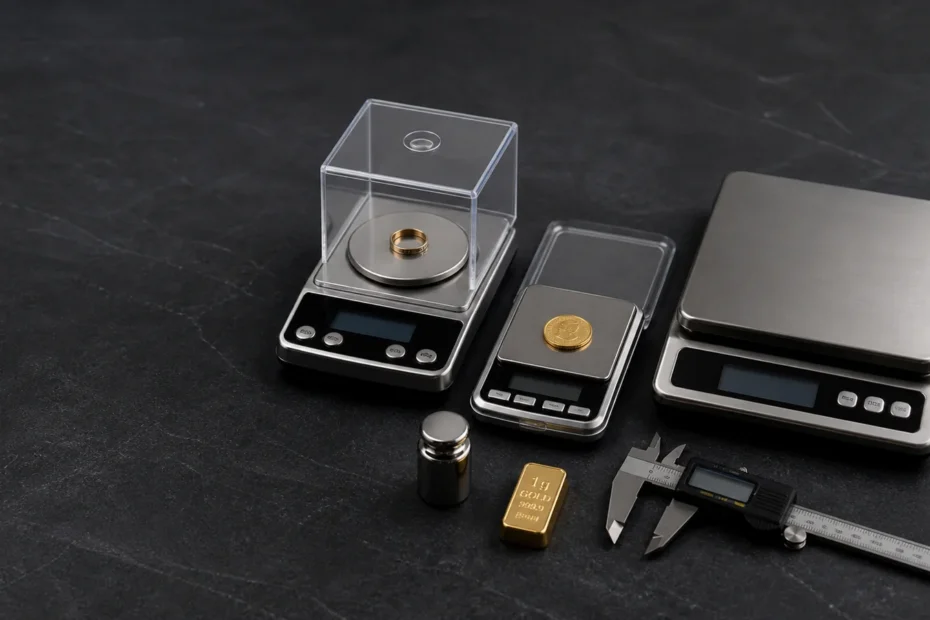
Choose a scale for gold jewelry, coins or bars by readability, capacity, calibration and platform size. Compare three current options.
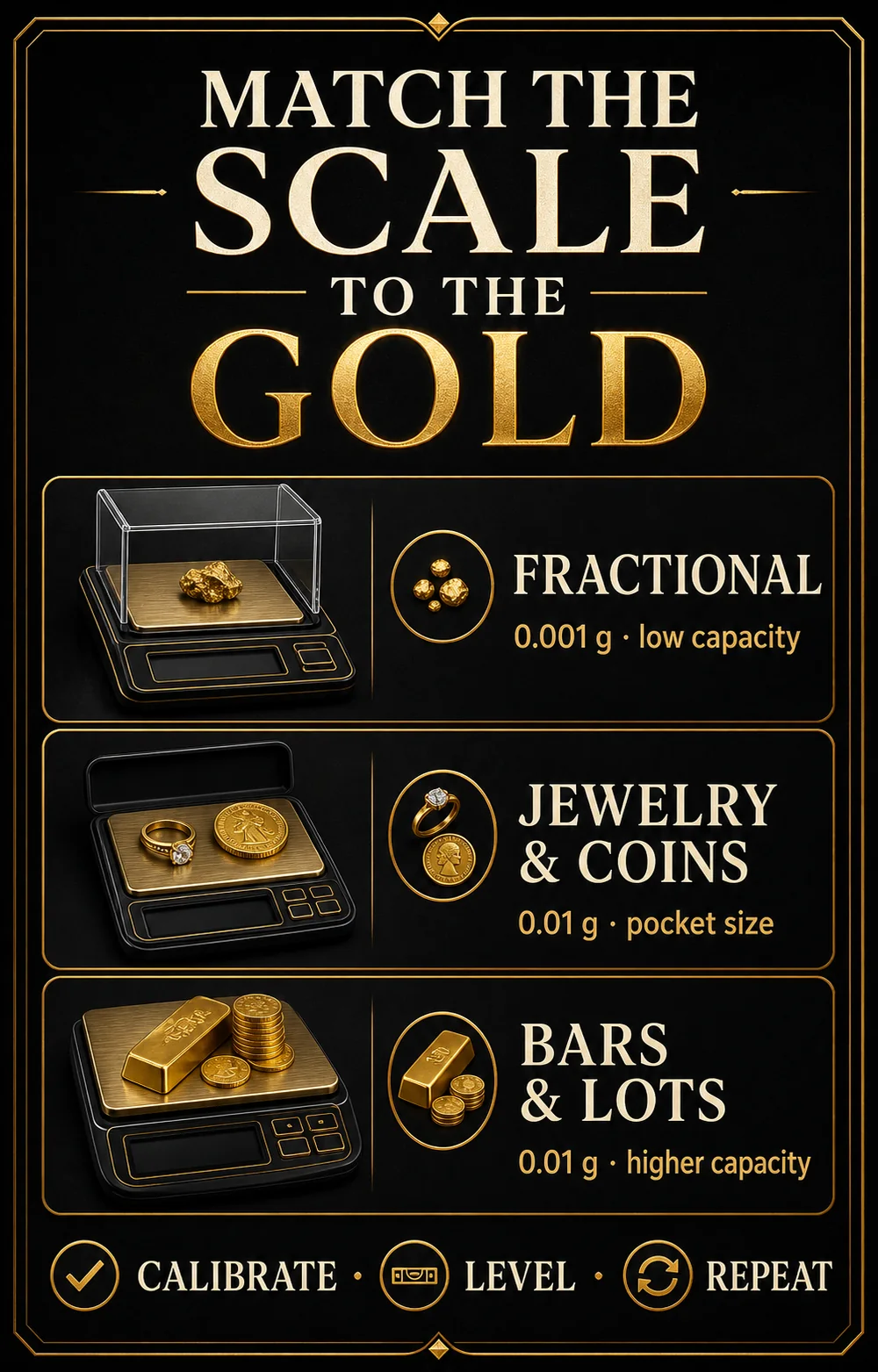
- Use 0.001 g only for very small items that fit the low capacity
- A 0.01 g pocket scale covers many coins, jewelry pieces, and small bars
- Calibration and repeated readings matter more than extra display digits
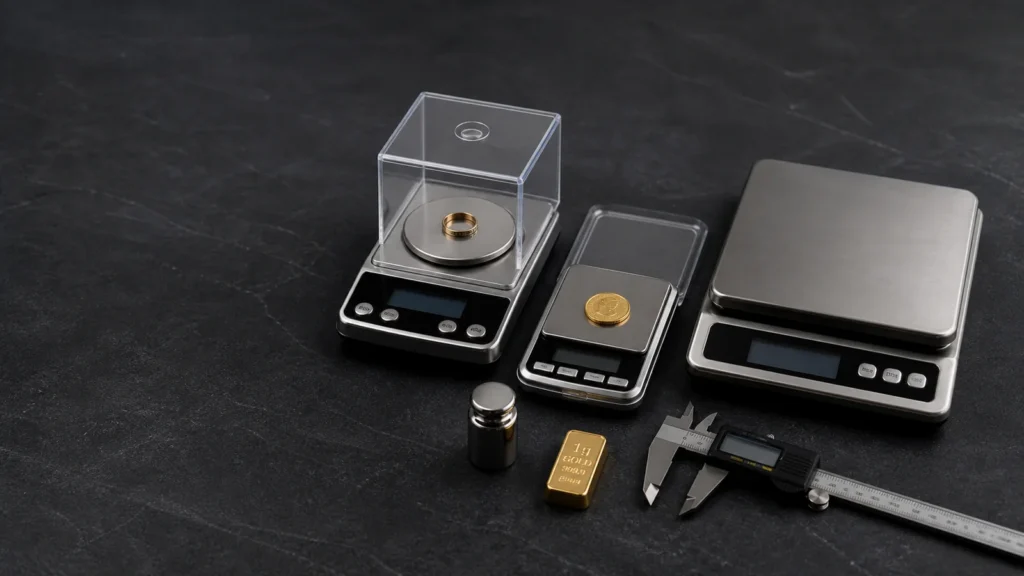
A 500 g × 0.01 g pocket scale is the most versatile starting point for individual jewelry pieces, coins and small bars. Choose 0.001 g readability only for tiny items, or a higher-capacity platform when you regularly weigh lots; more decimal places do not guarantee better accuracy.
See the top pick on Amazon →Smart Weigh GEM20 20 g × 0.001 g Scale

Smart Weigh GEM20 20 g × 0.001 g Scale
Best for: Very small fractional pieces, flakes or gems where 0.001 g readability matters more than capacity.
Avoid if: You need to weigh pieces or lots above 20 g.
Verify before buying: Use the supplied calibration weights, a stable level surface and repeat readings before trusting the last digit.

500 g × 0.01 g Dual-Powered Pocket Scale
Best for: Coins, jewelry and small bars when portability, a case and 0.01 g readability are the priority.
Avoid if: You need legal-for-trade certification or milligram-level work.
Verify before buying: Confirm capacity, included calibration weight, unit modes and current listing variant.

BOMATA 1 kg × 0.01 g Compact Scale
Best for: Larger jewelry lots, multiple coins or bars that exceed pocket-scale capacity.
Avoid if: You primarily weigh single tiny fractions and need a draft shield or 0.001 g readability.
Verify before buying: Check platform size, maximum capacity, calibration method and whether the hold function fits your workflow.
Readability, Accuracy, and Capacity Are Different
A display that changes in 0.001 g increments has finer readability than one that changes in 0.01 g increments. It does not automatically guarantee that every displayed milligram is accurate under real conditions.
Capacity is the maximum load. A 20 g milligram scale can suit flakes, small gems and tiny fractions but cannot handle a one-ounce coin. Platform size, draft shielding, calibration and stability determine whether the specification is useful.
Gold Scale Comparison
| Use case | Practical readability | Suggested capacity | Main risk |
|---|---|---|---|
| Flakes and very small fractions | 0.001 g | 20–50 g | Drafts, vibration and overload |
| Rings, chains and coins | 0.01 g | 200–500 g | Small platform or missing calibration |
| Several pieces or small bars | 0.01 g | 500–1,000 g | Object overhang and corner loading |
| Commercial buying/selling | Defined by law and transaction | Use-case specific | Consumer scale may not be legal for trade |
How to Check a New Scale
- Place it on a rigid, level, vibration-free surface.
- Allow the scale to reach room temperature.
- Calibrate with the specified certified or supplied weight.
- Check zero before each object.
- Center the item and avoid touching the platform.
- Repeat the reading after removing and replacing the item.
A correct reading cannot rule out a plated object or counterfeit with a similar mass. Compare weight with diameter, thickness and a trusted specification, then add another test.
Worked Example: Why Capacity Matters
A one-ounce bullion coin can weigh more than 31.1 g because “one ounce” may refer to contained fine gold rather than total alloy weight. It will overload a 20 g milligram scale even though that scale shows more decimal places.
A 500 g × 0.01 g model fits the coin and provides a useful repeatable reading. Check the exact reference specification in our Gold Eagle weight guide and pair the result with calipers and the methods in testing gold coins.
Buy or Skip Checklist
- Buy when capacity comfortably exceeds the largest normal object.
- Buy when a calibration method and suitable weight are included.
- Skip vague listings that use “accuracy” without tolerance or repeatability details.
- Skip an undersized platform that forces coins or bars to overhang.
- Escalate commercial use to a compliant legal-for-trade setup.
For gold-value calculations, weigh in grams and use the gold weight estimator or purity calculator only after confirming the item description.
Do You Need 0.001 g or 0.01 g?
The difference matters only when it changes the decision. If a chain weighs 12.43 g, a third decimal rarely changes a practical comparison. If a tiny gold flake weighs less than 0.05 g, a typical pocket scale may not register it consistently at all.
Fine readability also increases sensitivity to air movement, temperature, vibration and static. A draft shield and careful setup may add more value than another display digit. Choose a model whose capacity leaves headroom above the heaviest object you normally weigh.
Platform and Power Details Buyers Miss
- A coin or bar must sit fully on the platform without touching the housing.
- A removable cover can double as a tray, but tare it before adding the item.
- USB power is convenient, yet cable tension can disturb a very sensitive scale.
- Auto-off can interrupt repeated sorting or density-test workflows.
- A hold function helps with large objects that hide the display.
- Replacement calibration weights must match the required mass and tolerance.
Delivery-Day Accuracy Screen
Inspect the platform for shipping damage and make sure the feet sit evenly. Calibrate according to the manual, then weigh the reference mass at the center several times. Remove it completely between readings rather than watching the same displayed number.
Next, move the reference weight to several positions on the platform. Large changes can reveal corner-load problems. Record the results and return a unit that cannot repeat a known mass within the tolerance you need.
Density Testing Needs More Than a Scale
A density setup compares dry weight with apparent weight in water. The calculation is sensitive to trapped air, water temperature, suspension contact and scale resolution. Hollow jewelry, stones and mixed materials make the result difficult to interpret.
Use density as one screen for simple objects, not a magic authentication test. A plausible density cannot rule out every counterfeit, and an implausible result may come from poor technique rather than the metal.
For most owners, a calibrated 0.01 g scale with enough capacity beats a fragile milligram scale. Choose 0.001 g only when the object is small enough and the extra digit changes the decision.
FAQ: Scales for Weighing Gold
What accuracy scale do I need for gold?
A 0.01 g scale is practical for many jewelry pieces, coins and small bars. A 0.001 g scale helps with very small fractional pieces but usually has much lower capacity and is more sensitive to drafts and vibration.
Can a scale tell if gold is real?
No. Weight only becomes useful when paired with the correct dimensions, design, stated alloy and known reference specification. Counterfeits can be made to match weight.
Should a gold scale display troy ounces?
It is convenient, but grams provide a clear common unit and reduce confusion between regular ounces and troy ounces. You can convert after recording the gram reading.
How often should I calibrate a pocket scale?
Check calibration before an important session, after moving the scale, after a battery change, or whenever a known weight reads incorrectly. Follow the model instructions.
Are Amazon pocket scales legal for buying gold by weight?
A consumer pocket scale should not be assumed legal for trade. Commercial transactions may require a certified scale and local weights-and-measures compliance.
Sources
 When you purchase a service or a product through our links, we sometimes earn a commission, at no extra cost to you.