
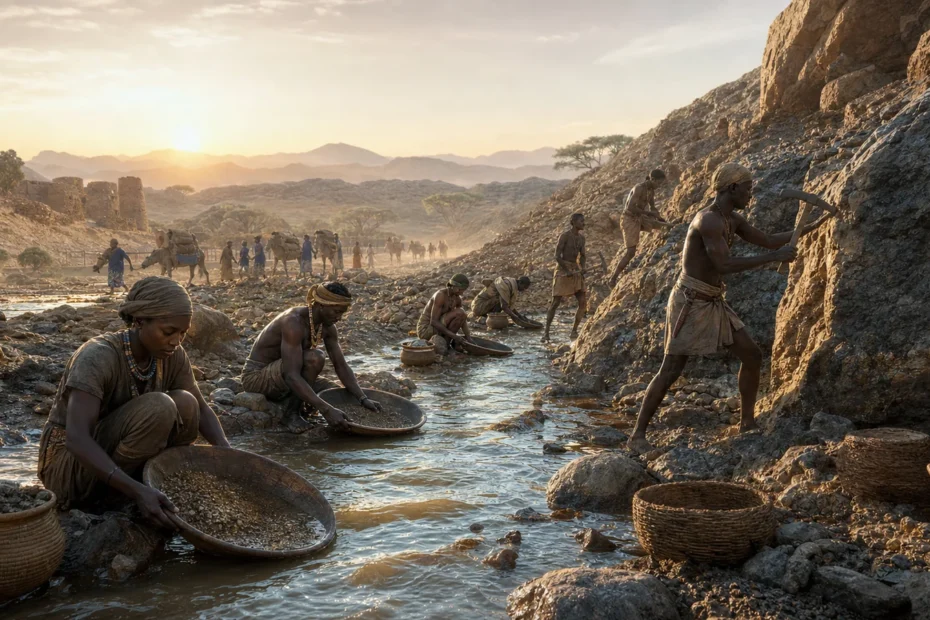
See ancient African gold mining across Nubia, West Africa, and southern Africa, with methods, trade routes, artifacts, dates, and evidence limits.
- Ancient African gold production was regional: Nubian hard-rock and wadi mining differed from West and southern African placer and lode systems.
- Gold moved through Nile, trans-Saharan and Indian Ocean networks, but trade records do not always identify the exact mine.
- Archaeology, mining remains, artifacts and texts carry different evidentiary weight; colonial myths must not replace African authorship and agency.
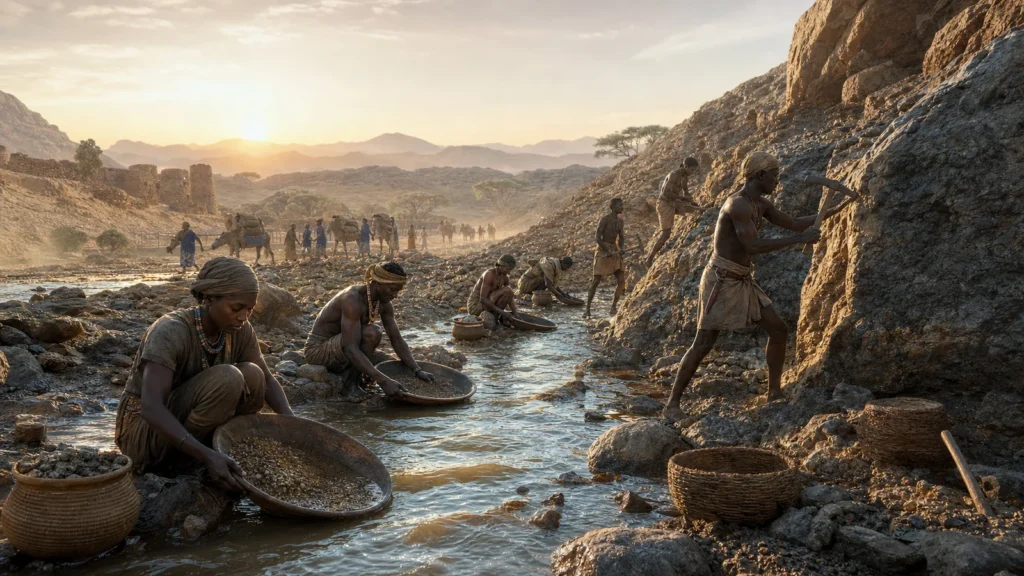
- Nubia and the Eastern Desert preserve some of Africa’s clearest ancient mining evidence.
- West African Bambuk, Buré and Akan goldfields fed medieval trade and states.
- Great Zimbabwe belongs mainly to the 11th–15th centuries, not classical antiquity.
- African miners used both alluvial washing and hard-rock extraction.
- Modern scholarship rejects colonial myths that denied African authorship and skill.
Three regional systems, several chronologies
The search phrase “ancient Africa” is broad. In this guide, ancient is used precisely for Nile Valley and northeastern contexts, while West and southern African sections are labeled medieval or precolonial where the evidence demands it. That avoids forcing the whole continent into Egypt’s chronology.
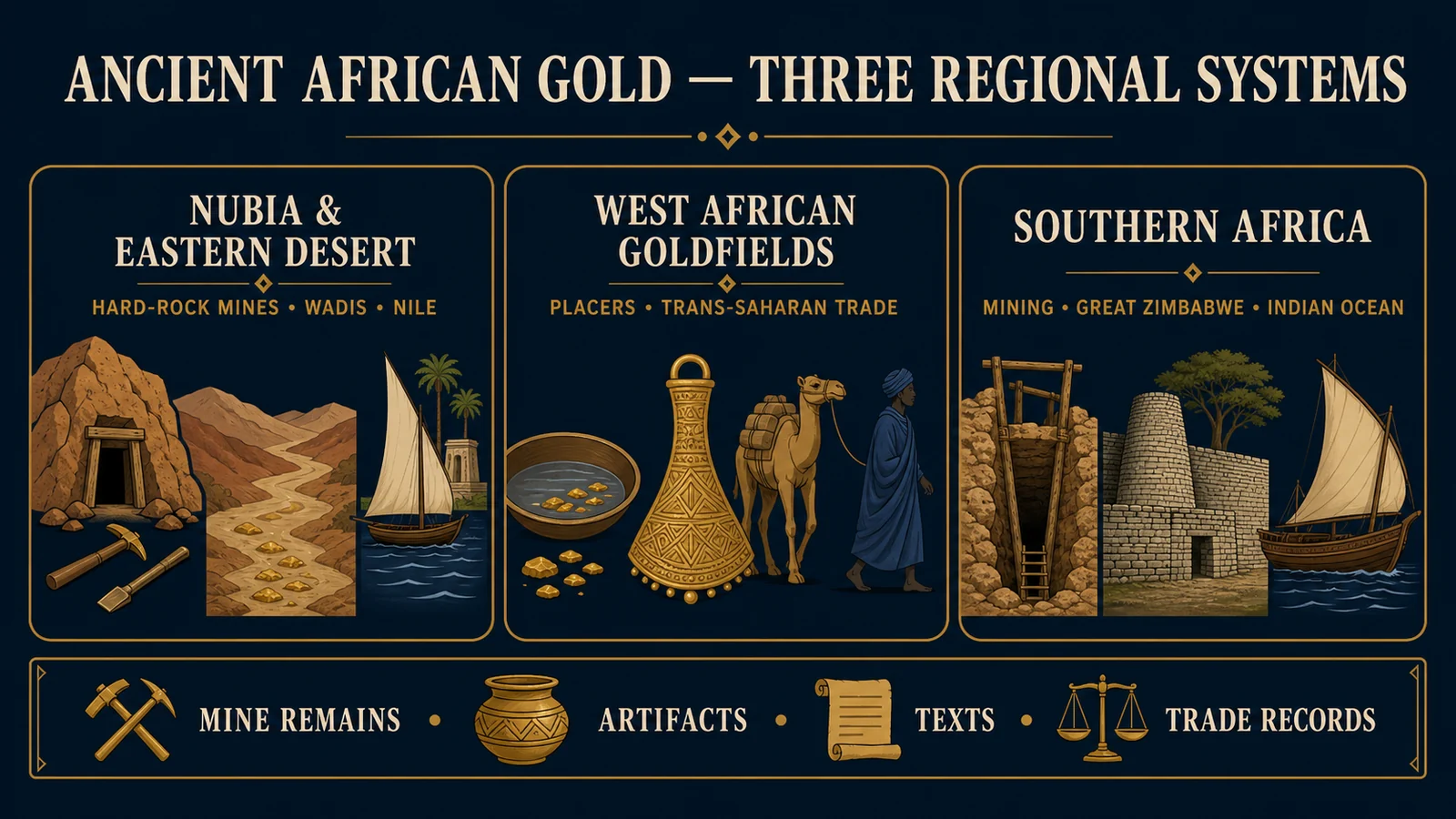
Evidence has four different strengths
| Evidence | What it can establish | What it cannot establish alone |
|---|---|---|
| Mine and processing remains | Extraction location, tools, crushing or washing activity | Every destination or political controller |
| Artifacts and burials | Goldworking, status, consumption and style | The exact geological source without scientific linkage |
| Written sources | Named routes, taxes, rulers or regions from an author’s perspective | Neutral, complete or precisely mapped production |
| Trade archaeology | Connections among settlements, ports and exchange systems | That every gold object came from the nearest field |
This distinction prevents a common error: finding gold at a city proves exchange or use, not necessarily mining beside that city.
Nubia and the Eastern Desert: antiquity’s best-documented system
Nubia—across parts of modern Egypt and Sudan—was closely associated with gold in Egyptian and later sources. Desert mining zones, quartz veins, grinding stones, settlements and routes show organized extraction over long periods. Alluvial material in wadis and hard-rock veins required different techniques.
Workers located mineralized rock, broke and sorted it, crushed ore with stone tools and ground it before concentration or further processing. Water logistics were critical in arid landscapes. Administrative control, labor organization and technology changed between Pharaonic, Kushite, Ptolemaic and Roman periods, so “the Egyptian method” is not a timeless single process.
For a focused account, see gold mining in ancient Nubia and UCL’s Digital Egypt gold-mine overview.
West African goldfields and trans-Saharan exchange
West African production is central to medieval histories of Ghana, Mali and later trading systems. Gold from areas conventionally associated with Bambuk, Buré and Akan zones moved through layered networks of miners, local traders, market towns, political authorities and long-distance merchants. Salt, textiles, metals and other goods moved in return.
Arabic geographical accounts and later traditions describe the importance of gold, but their place names and production claims must be matched cautiously to archaeology. Timbuktu’s importance, recognized by UNESCO, was intellectual and commercial; it should not be mistaken for proof of a mine beneath the city.
Mansa Musa’s 14th-century pilgrimage demonstrates the extraordinary visibility of Mali’s gold economy, but it does not by itself map mine ownership or production totals. For the economic role beyond extraction, read gold trade and ancient economies.
Southern Africa, Mapungubwe and Great Zimbabwe
Gold mining and trade in southern Africa developed within regional farming, cattle, craft and political economies. Mapungubwe and later Great Zimbabwe were connected to coastal and Indian Ocean exchange through intermediary routes. Imported glass beads, ceramics and other finds help reconstruct those connections.
UNESCO dates Great Zimbabwe’s major florescence to roughly the 11th–15th centuries. Calling it “ancient” in the classical sense is inaccurate. The site’s stone architecture and trade role were achievements of African societies; colonial claims that outsiders must have built it are rejected by archaeology. The Metropolitan Museum’s Great Zimbabwe overview summarizes its regional and commercial context.
The 19th-century Witwatersrand gold rush is a much later industrial history and should not be projected backward onto precolonial mining.
Mining and processing techniques
| Stage | Likely technique | Archaeological trace |
|---|---|---|
| Prospecting | Following visible veins, float, old workings and placer concentrations | Test pits and activity near mineralized geology |
| Extraction | Open cuts, shafts, galleries, hammering and fire-setting in some contexts | Workings, tool marks, hammerstones, charcoal |
| Comminution | Breaking, crushing and grinding ore | Grinding stones, mortars and waste piles |
| Concentration | Washing and gravity separation | Processing areas and sediment residues |
| Goldworking | Melting, casting, hammering, wire or sheet work | Crucibles, molds, droplets and finished artifacts |
Techniques varied by geology and period. “Ancient miners used fire-setting” is only responsible where local evidence supports it; it should not be treated as a continent-wide default. See early gold-mining techniques for the process distinctions.
A chronology that prevents category errors
| Broad period | Illustrative region | Responsible claim |
|---|---|---|
| Pharaonic and Kushite antiquity | Nubia and Eastern Desert | Direct mine, processing and administrative evidence spans changing Nile Valley states. |
| Early and high medieval centuries | West African savanna and goldfields | Gold moved through evolving trans-Saharan networks associated with Ghana and Mali. |
| 11th–15th centuries | Great Zimbabwe and southern networks | African urbanism and trade linked inland production with Indian Ocean exchange. |
| 19th century onward | Industrial goldfields | Colonial-capital mining systems belong to a separate modern history. |
The dates overlap only partly, and evidence quality varies. A technology known in one region should not be copied onto another without excavation or a well-supported comparison. Gold’s religious meaning also changed across cultures; see gold in ancient religions without assuming a universal symbolism.
Goldworking reveals knowledge beyond extraction
Mining produced a raw material; craftspeople transformed it through controlled heating, hammering, joining, casting and surface work. Finished objects can reveal technical choices and social value even when the source mine is uncertain. Composition studies may identify alloying or recycling, but provenance claims require appropriate sampling and comparison data.
Gold’s malleability allowed sheet, wire and small ornaments with relatively little metal. That physical advantage helped gold circulate as portable wealth and visual authority. It did not erase local meanings: burial goods, regalia, trade pieces and workshop debris belong to different contexts.
Why exact mine-to-object provenance is difficult
Gold can be melted, alloyed and recycled repeatedly without preserving an obvious visual record of its route. Geological sourcing may use trace elements or isotopes, but comparison collections are incomplete and manufacturing can mix material. A stylistic match identifies cultural relationships more readily than a mine.
Written accounts add another filter: authors often described markets or rulers far from production and used names whose modern geographic boundaries are uncertain. Archaeologists therefore combine landscape survey, radiocarbon dating, ore and slag analysis, settlement evidence and trade goods. The result is usually a probability-based network, not a shipment ledger.
This evidentiary caution also protects sites. A dramatic “lost mine” claim can encourage looting while contributing little knowledge. Context—the position, layer, tools and associated material—is often more historically valuable than the gold object alone.
Responsible history therefore favors excavated context and published methods over sensational certainty. Where scholars disagree, the disagreement should remain visible instead of being converted into one confident tourism narrative.
Museum labels, school summaries and older books should be checked against current archaeological publication dates.
Who controlled the gold?
Control could be distributed across households, specialist groups, local authorities, merchants and states. A ruler taxing trade is not necessarily a ruler directly managing every mine. Secrecy around production zones, seasonal labor and decentralized exchange make simple imperial maps misleading.
The strong evidence supports a powerful African center embedded in cattle, farming, craft and long-distance trade networks in which gold mattered. The weak leap is reducing the city to a single mine or external colonizers. A credible explanation separates excavated architecture and trade goods from speculation about exact mine-to-palace control.
Colonial myths and the “Ophir” problem
European writers once tried to identify southern African ruins with biblical Ophir or non-African builders. These stories served colonial assumptions that complex architecture and long-distance commerce required outsiders. Archaeological dating, material culture and settlement history establish African authorship.
That correction is not cosmetic. It changes the unit of analysis from “foreigners obtaining African gold” to African communities making technological, political and trading decisions. The same care is needed when reading older museum labels or mining histories.
Environmental and human realities
Mining meant hard physical labor, dust, rockfall risk, heat and water scarcity. Placer washing altered sediment locally; wood and charcoal demands could shape landscapes around processing areas. Evidence for labor status varies. It is unsafe to label every worker enslaved—or entirely free—without site- and period-specific support.
- Identify the region and use a period-accurate date label.
- Separate a mine, workshop, market, political center and trade port.
- Ask whether the claim rests on excavation, an artifact, a text or later tradition.
- Check who dated the evidence and which method was used.
- Do not infer an exact mine from a traded gold object alone.
- Reject outsider-builder or “lost civilization” claims that contradict current archaeology.
Popular summaries jump from Nubian antiquity to Mansa Musa to Great Zimbabwe as though they were one synchronized “African gold age.” The more accurate story is a set of regional systems separated by thousands of kilometers and, often, more than a millennium.
Africa’s gold history becomes more impressive, not less, when myths are removed. The evidence shows repeated local innovation, adaptation to difficult environments and participation in far-reaching exchange—without needing a single lost mine or outsider-builder legend.
Chronologies and interpretations change with new excavations and dating. This overview distinguishes direct evidence from inference and uses “ancient,” “medieval” and “precolonial” deliberately rather than as interchangeable labels.
Selected explainer This video adds a concise visual explanation to the evidence and decision framework above.
Bottom Line
Gold mining in Africa developed through distinct regional systems. Ancient Nubia and the Eastern Desert, medieval West African goldfields and precolonial southern African networks each combined local mining knowledge with trade and political organization. Mine evidence, artifacts, texts and routes must be evaluated together.
FAQ: Gold Mining in Ancient and Precolonial Africa
Where was gold mined in ancient Africa?
Major evidence comes from Nubia and the Eastern Desert, with later important systems in West African goldfields and southern Africa.
How did ancient African miners extract gold?
Methods included alluvial washing, open cuts and underground hard-rock work, followed by crushing, grinding and gravity concentration. Techniques varied by region and period.
Did Great Zimbabwe control gold mines?
Gold mining and trade were important to its regional economy, but evidence does not reduce the state to one mine or prove direct control of every production site.
Was Mansa Musa part of ancient Africa?
He ruled Mali in the 14th century, so medieval is the more precise label. His pilgrimage shows gold wealth and exchange, not the location of every mine.
Did outsiders build Great Zimbabwe to obtain gold?
No. Archaeology establishes Great Zimbabwe as an African-built center. Outsider and Ophir theories are colonial-era myths, not current scholarship.
Sources and verification
Values, rules and historical interpretations were checked against the linked primary or specialist sources. Recheck any current rule or market data before acting.
- UNESCO — Great Zimbabwe National Monument — Archaeological finds, long-distance trade and African cultural significance.
- UNESCO — Timbuktu — Timbuktu as a major market linking Saharan salt and gold from the south.
- The Metropolitan Museum of Art — Great Zimbabwe — Museum synthesis of the Shona-built city and Indian Ocean trade.
- British Museum — Gold Mining in Ancient Egypt and Nubia — Collection bibliography and objects connected to ancient Egyptian and Nubian gold-mining sites.
- British Museum — Gold and Gold Mining in Ancient Egypt and Nubia — Bibliographic record for geoarchaeological study of mining sites.
- UCL Discovery — Centres of Goldworking in Ancient Egypt — Open-access archaeological review of procurement, mining traces, production and use.
- UNESCO — African Cultural Heritage and the World — Gold and ivory trade in Late Iron Age southern African societies.
- UNESCO — General History of Africa — Multi-volume scholarly framework emphasizing African sources and perspectives.
- SAIMM — Ancient Mining and Zimbabwe — Historical review of archaeological debates on mining and Great Zimbabwe.
- TED-Ed — Who Built Great Zimbabwe? — Accessible visual history of African authorship, wealth and colonial denial.
 When you purchase a service or a product through our links, we sometimes earn a commission, at no extra cost to you.