
Start gold prospecting with legal-access checks, simple placer geology, a lean tool kit, and a low-impact first-trip plan.
- Confirm land status and claims before touching gravel.
- Sample natural heavy-material traps, not random sand.
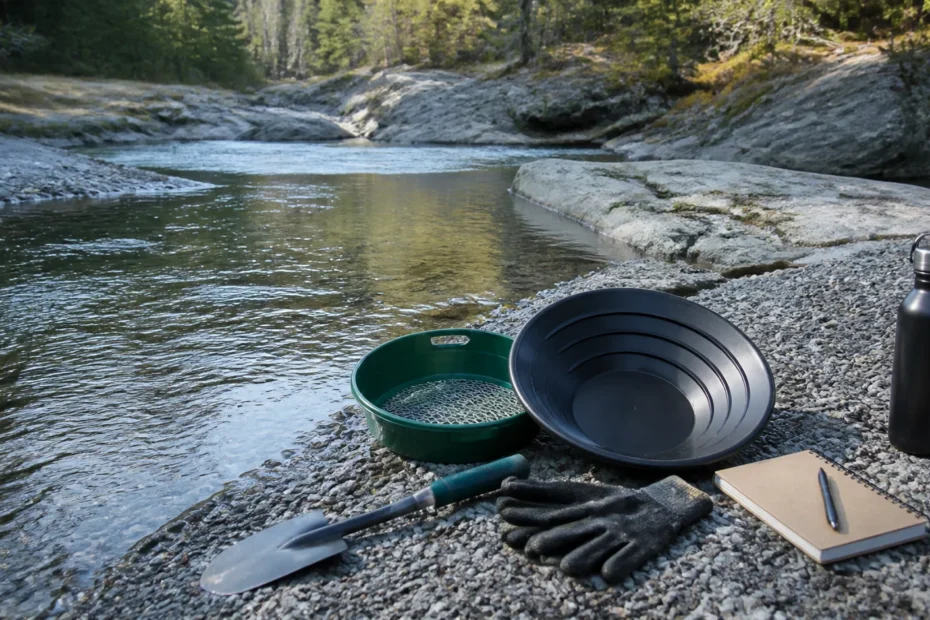
- Start with a pan, classifier, hand tool, and notebook.
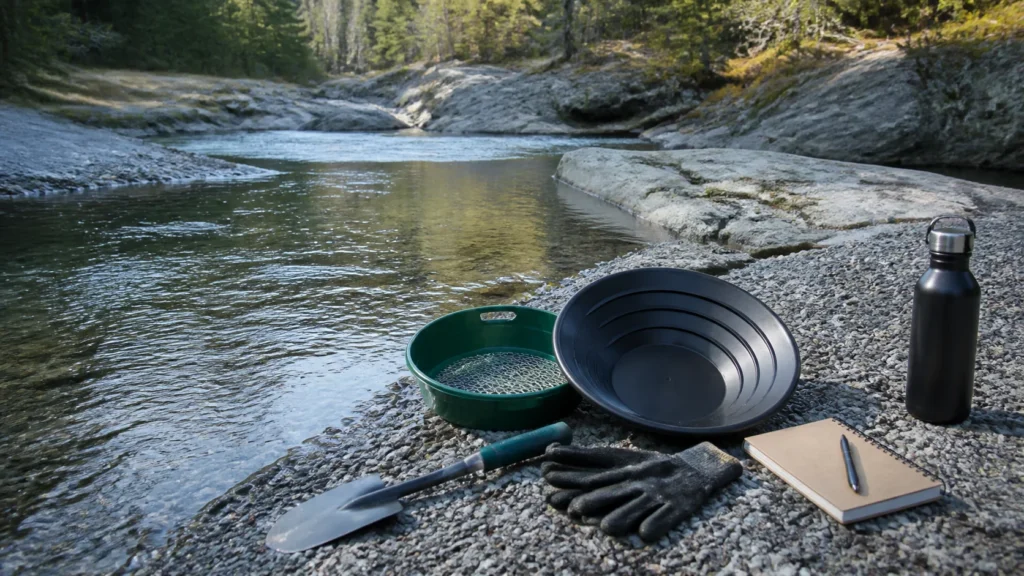
Start gold prospecting by confirming that the exact land, mineral rights, and activity are open to you—before buying equipment or disturbing gravel. For a first trip, use a pan, classifier, small hand tool, bucket, snuffer bottle, vial, gloves, and notebook. Sample several natural heavy-material traps, keep the disturbance small, and treat every result as evidence about the location rather than a promise of profit.
A useful beginner kit combines a riffled gold pan, a bucket-fitting classifier, a snuffer bottle, vials, and a small hand tool. Choose simple hand equipment you can practice with at home; extra gadgets do not replace legal access or good sampling.
Affiliate disclosure: As an Amazon Associate, GoldConsul earns from qualifying purchases. You pay no additional cost.
- Prioritize: one comfortable pan, a classifier that fits your bucket, and basic recovery tools.
- Skip: oversized bundles filled with duplicate pans or tools you cannot legally use.
- Add separately: gloves, eye protection, first aid, drinking water, and suitable boots.
Gold prospecting for beginners is easiest when three questions stay in the correct order: May I be here? Could placer gold reasonably concentrate here? What is the smallest useful test?
Reversing that order leads to wasted purchases, trespass risk, and hours of panning random sand.
- Verify access: identify the land manager, ownership, mineral status, existing claims, closures, and allowed methods.
- Choose placer geology: start downstream of known gold-bearing terrain, not at a convenient random creek.
- Sample traps: bedrock cracks, natural riffles, low-pressure zones, and layers where heavy material settles.
- Pack light: hand tools are enough to learn whether a site deserves more time.
- Restore the site: refill small holes, avoid unstable banks and vegetation, and remove all trash.
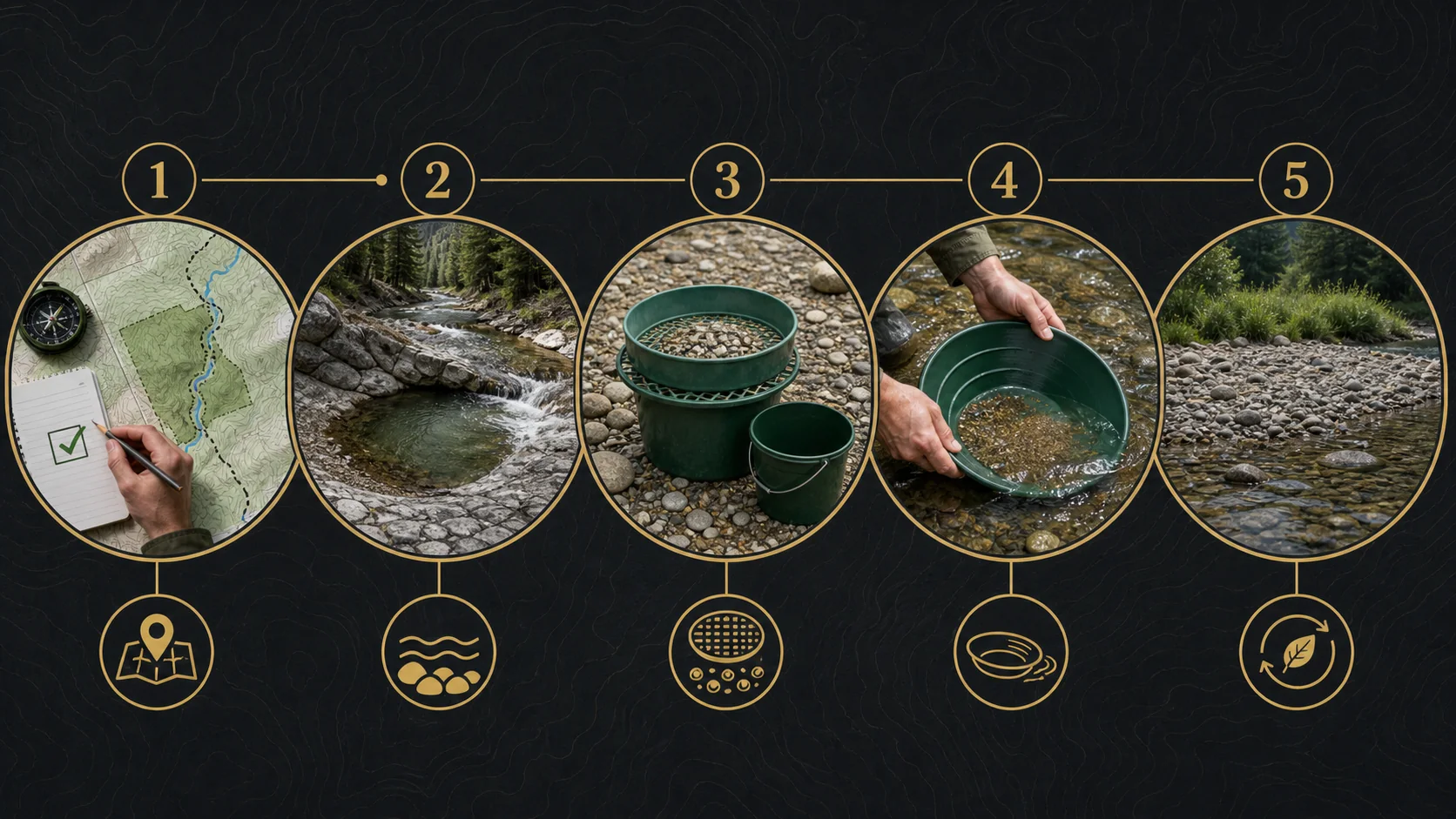
Reusable GoldConsul visual
Reuse this visual
You may reuse Gold Prospecting for Beginners: Five-Step Field Workflow in an editorial or educational article under GoldConsul’s visual reuse terms. Credit the visual, link to this source page, and keep its facts and labels unchanged.
Copy the suggested embed code
<figure>
  <a href="https://goldconsul.com/gold-prospecting-for-beginners/"><img src="https://goldconsul.com/wp-content/uploads/2026/08/gold-prospecting-for-beginners-infographic.webp" alt="Five-step gold prospecting workflow: verify access, read creek geology, classify gravel, pan gently, and restore the site" width="1672" height="941" loading="lazy"></a>
  <figcaption>Source: <a href="https://goldconsul.com/gold-prospecting-for-beginners/">GoldConsul — Gold Prospecting for Beginners: Five-Step Field Workflow</a></figcaption>
</figure>
Is gold prospecting legal?
Gold prospecting can be legal, but there is no universal “public land means open” rule. Ownership, mineral estate, withdrawals, existing mining claims, protected status, seasonal closures, water rules, cultural-resource protections, and the equipment you use can all change the answer.
The Bureau of Land Management explains that mining claims concern locatable minerals on eligible federal land. Its claim-location guidance also notes that land and mineral status are not identical.
Knowledge Gap: a map pin is not permission
A historical occurrence, old mine symbol, or social-media location can show that gold existed nearby. It does not prove current access, open mineral status, permission to enter, or permission to use a particular tool. Confirm the parcel and activity with the managing agency and current records.
A legal-access checklist for the United States
- Identify the exact parcel. Do not rely on a broad county map or verbal description.
- Identify surface ownership and mineral status. They can be managed or owned separately.
- Search current mining-claim records. If a valid claim exists, do not prospect without the claimant’s permission.
- Ask the managing office what is allowed. Hand panning, sluicing, dredging, powered equipment, excavation, and camping can have different rules.
- Check state and local requirements. Water, fish habitat, stream alteration, collecting limits, fire restrictions, and seasonal access may apply.
- Obtain written private permission. A creek being physically accessible does not make it public.
Never remove artifacts, disturb historic structures, or prospect on tribal land, private property, or protected land without the required authority. When information conflicts, the responsible land manager and current law—not a forum post—control the decision.
Understand lode gold and placer gold
Lode gold remains in or near the rock system where mineralizing fluids deposited it. Placer gold has weathered from a source, moved through erosion and water, and become concentrated with other dense material.
The US Geological Survey describes placer particles collecting on or near bedrock, in depressions, and in stream locations where current energy allows heavy material to settle. That relationship is more useful than memorizing a list of “gold rocks.”
For the deeper formation story, read Gold in the Earth. Beginners who understand how source, transport, and gravity connect will choose better sample locations.
Where placer gold tends to hide in a creek
The USGS report on gold in placer deposits connects placers to weathering, transport, and concentration in stream gravels. Use regional geology and documented occurrences to choose the watershed, then field observations to choose the sample.
What tools does a beginner actually need?
| Tool | Job | Beginner guidance |
|---|---|---|
| Gold pan | Separates dense concentrate from lighter material | One properly sized pan is enough; practice with known lead-free weights or purchased practice material at home. |
| Classifier | Removes oversized rocks and creates a more uniform feed | Choose a size that fits the bucket and local material. |
| Small hand shovel or trowel | Collects controlled samples | Use only where hand disturbance is allowed; avoid bank undercutting. |
| Bucket | Keeps samples separate and controls the work area | Label or sequence samples so results remain tied to location. |
| Snuffer bottle and vial | Recovers and stores tiny dense particles | Do not assume every yellow particle is gold; inspect it later under magnification. |
| Gloves, boots, eye protection, water, and first-aid kit | Basic field safety | Cold water, slippery rock, heat, wildlife, and changing flows are more immediate risks than equipment choice. |
| Notebook, map, and phone/GPS backup | Records sample location, layer, depth, and result | A zero result is useful only when you know exactly what and where you tested. |
Compare current pans, classifiers, snuffer bottles, and compact hand-tool sets together. Check dimensions carefully so the classifier fits your bucket and avoid paying for duplicate accessories.
Compare gold-panning equipment on Amazon
Affiliate link: GoldConsul may earn from qualifying Amazon purchases.
A metal detector solves a different task. If the site and gold size justify one, compare operating frequency, mineralized-ground handling, coil, and target type in the gold-prospecting detector guide. You can also learn how to detect gold without a metal detector by improving sampling logic.
A five-stage first prospecting trip
How to pan without washing out the evidence
- Remove oversized material with the classifier and inspect large rocks before discarding them.
- Submerge the pan and shake side to side so dense material settles to the bottom.
- Tilt the pan slightly and let water wash the top layer away in controlled passes.
- Re-stratify repeatedly. Do not rush the last small amount of black sand and concentrate.
- Move suspected gold with a snuffer bottle and verify it later; mica can flash but behaves differently.
Practice is cheaper than losing a promising sample. The embedded video below demonstrates the physical motion, but its location-specific rules do not replace the legal check for your own site.
The GoldConsul Editorial Perspective
A beginner’s best result is a repeatable method, not a dramatic nugget. If you can document legal access, explain why you sampled a trap, pan without losing dense material, and restore the site, you have built a process that can improve with each trip.
Common beginner mistakes
- Buying a detector, sluice, or dredge before confirming access and expected gold size
- Sampling attractive loose sand instead of compact heavy-material layers
- Assuming black sand or quartz guarantees gold
- Mixing samples from different locations and losing the evidence trail
- Chasing social-media coordinates without checking claims or private property
- Undercutting banks, leaving holes, muddying sensitive habitat, or using prohibited equipment
- Using mercury or hazardous chemicals for recreational recovery
GoldConsul’s Gold Panning Sites guide explains how to evaluate access rather than treating a location list as permission. State-level starting points include Arizona, Montana, and Virginia.
Is gold prospecting profitable?
Recreational prospecting is usually better treated as field learning and outdoor recreation than dependable income. Travel, time, permits, access, safety equipment, processing, and low recovery can exceed the gold found.
A useful stop rule is to evaluate information gained per sample: if repeated samples from the best plausible traps show nothing, change the micro-location, deposit layer, or watershed rather than processing more random volume.
This guide is general US educational information, not legal permission for a location or method. Confirm current rules with the landowner, managing agency, state authorities, and claim records before prospecting.
Video: beginner gold-panning technique
This demonstration shows a controlled panning motion and concentrate reduction. The creator discusses a different jurisdiction, so check your own land and activity rules separately.
Bottom line
Gold prospecting for beginners works best as a disciplined sampling exercise. Verify legal access, choose a plausible placer setting, use a lean hand-tool kit, compare small labeled samples, and leave the site as you found it.
Your next useful step is not necessarily more equipment. Pick one verified location, rehearse the pan technique, print the access notes, and define what you will record before the first shovel of gravel.
FAQ: Gold prospecting for beginners
Can you still prospect for gold in the United States?
Yes, in locations where ownership, mineral status, claims, closures, and activity rules allow it. Confirm the exact parcel and method with current official sources before entering or collecting.
Do I need a permit to pan for gold?
It depends on the location and method. Simple hand panning may be allowed in some places, restricted in others, and prohibited on protected, private, claimed, or sensitive land.
What rocks should I look for when gold prospecting?
Regional gold geology matters more than one rock type. For placers, connect a documented source area with erosion, transport, and stream traps where dense material can concentrate.
Does black sand mean there is gold?
No. Black sand shows that dense minerals concentrated under similar hydraulic conditions. It makes a sample interesting, but only recovered and verified gold confirms gold.
How much does it cost to start gold prospecting?
A basic hand-panning setup can remain modest if you already own outdoor safety gear. Travel, access, permits, and specialized equipment often cost more than the pan itself.
 When you purchase a service or a product through our links, we sometimes earn a commission, at no extra cost to you.