
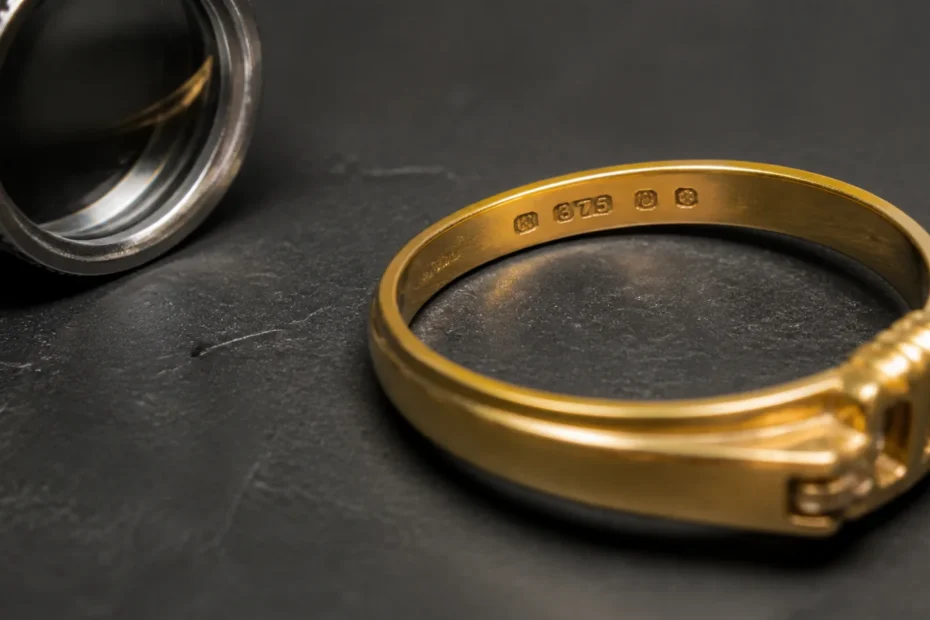
Decode 10K, 14K, 18K, 925, GP, GF, RGP, and HGE jewelry marks—and learn why a stamp is a clue, not proof.
- Bare karat or fineness marks indicate purity claims.
- GP, GF, RGP, and HGE describe layered products.
- A stamp is evidence to verify—not final proof.
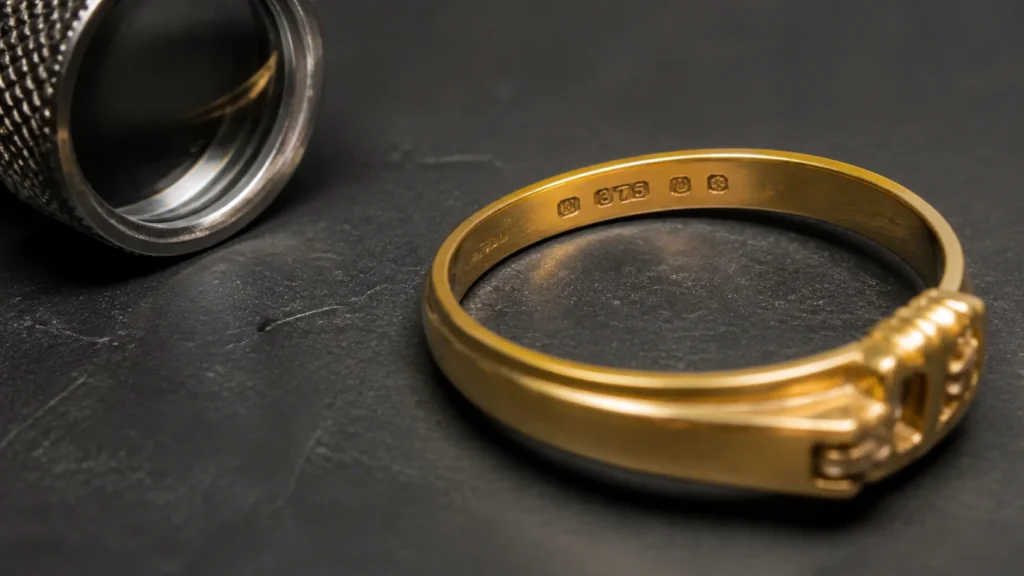
Gold jewelry markings tell you what the maker or seller claims about metal content; they do not prove authenticity by themselves. A bare mark such as 14K, 585, 18K, or 750 usually states gold fineness. Letters such as GP, GEP, HGE, GF, or RGP describe a gold layer over another metal, while 925 identifies sterling silver—not solid gold.
A tiny stamp can combine several jobs: purity, manufacturer identity, assay control, country system, or construction. Reading only the largest number is how a gold-colored silver piece or a plated piece gets mistaken for solid gold.
Use the complete group of marks, the piece itself, and an appropriate test before making a purchase, appraisal, or sale decision.
- 10K/417, 14K/585, 18K/750, 22K/916: common karat and fineness equivalents.
- GP, GEP, HGE: electroplated or plated gold layer, not solid gold throughout.
- GF and RGP: mechanically bonded gold-layer products; the fraction and karat describe the layer.
- 925: 92.5% silver fineness. A gold-colored 925 piece may be vermeil or gold-plated silver.
- No stamp: not automatic proof of fake or real gold; age, repair, wear, size, and jurisdiction can explain missing marks.
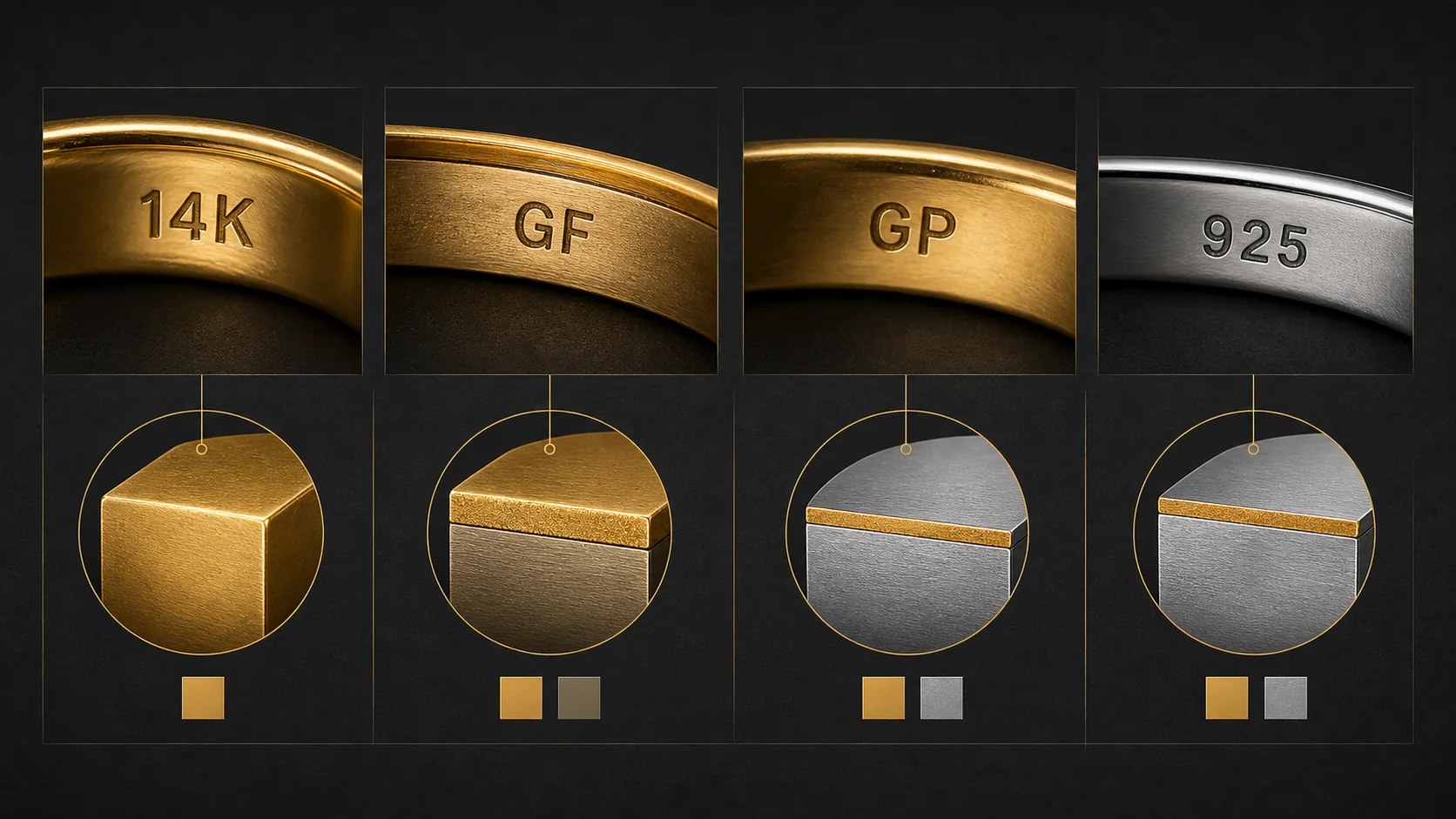
Reusable GoldConsul visual
Reuse this visual
You may reuse Gold Jewelry Markings: Solid, Filled, Plated, and 925 Silver in an editorial or educational article under GoldConsul’s visual reuse terms. Credit the visual, link to this source page, and keep its facts and labels unchanged.
Copy the suggested embed code
<figure>
  <a href="https://goldconsul.com/gold-jewelry-markings/"><img src="https://goldconsul.com/wp-content/uploads/2026/08/gold-jewelry-markings-infographic.webp" alt="Visual comparison of 14K solid gold, gold-filled, gold-plated, and gold-colored 925 silver construction" width="1672" height="941" loading="lazy"></a>
  <figcaption>Source: <a href="https://goldconsul.com/gold-jewelry-markings/">GoldConsul — Gold Jewelry Markings: Solid, Filled, Plated, and 925 Silver</a></figcaption>
</figure>
Start by identifying the mark family
Claims how much gold is in an alloy.
Explains that gold is a surface layer over another metal.
In everyday US usage, people often call every jewelry stamp a hallmark. More precisely, a fineness mark states purity, a maker’s or responsibility mark identifies who stands behind it, and an official hallmark may indicate independent assay under a specific legal system.
Knowledge Gap: the same-looking number can mean a different metal
Millesimal fineness is a parts-per-thousand system. The number 750 commonly describes 75% gold, while 925 commonly describes 92.5% silver. Read the number with the metal, neighboring letters, hallmark shape, construction, and country context rather than converting every three-digit stamp into gold purity.
Gold karat and fineness marks
Karat expresses gold content in 24 parts. Millesimal fineness expresses precious metal in 1,000 parts. Small rounding differences are normal when converting between systems.
| Common mark | Approximate gold content | Plain-language meaning | Important caveat |
|---|---|---|---|
| 9K or 375 | 37.5% | Nine parts gold out of 24 | Common in some markets; legal standards and labeling rules vary by country. |
| 10K or 417 | About 41.7% | Ten parts gold out of 24 | Read any following letters before assuming the piece is gold alloy throughout. |
| 14K or 585 | About 58.3%–58.5% | Fourteen parts gold out of 24 | Alloy color and hardness depend on the remaining metals. |
| 18K or 750 | 75% | Eighteen parts gold out of 24 | An “18K GP” mark describes 18K gold in the plated layer, not an 18K solid-gold object. |
| 22K or 916 | About 91.6%–91.7% | Twenty-two parts gold out of 24 | Higher purity does not automatically make a design more durable; see the 22K durability guide. |
| 24K or 999 | Approximately 99.9% | Fine or near-pure gold | Jewelry labeled 24K may still require tolerance, testing, and jurisdiction context. |
You can convert a mark and weight with the Gold Purity Calculator. The result estimates contained gold only after the mark or test result is trustworthy.
What GP, GEP, HGE, GF, and RGP mean
| Mark | Typical meaning | Gold throughout? | How to read it |
|---|---|---|---|
| GP | Gold plated | No | The preceding karat usually describes the gold used in the coating. |
| GEP or GE | Gold electroplate / gold electroplated | No | A gold layer was applied by an electrolytic process. |
| HGE | Heavy gold electroplate | No | Still a plated construction; the full description and applicable rules matter. |
| GF | Gold filled | No | A mechanically bonded gold-alloy layer over a base metal; look for a fraction and karat. |
| RGP | Rolled gold plate | No | A mechanically applied gold-alloy layer, often accompanied by a fraction. |
| Vermeil | Gold over sterling silver | No | The base is silver rather than ordinary base metal; applicable thickness and fineness definitions depend on the market. |
The US Federal Trade Commission explains that “gold filled,” “gold overlay,” and “rolled gold plate” describe gold alloy mechanically applied over a base metal. The FTC also distinguishes electroplating and vermeil.
For a practical ownership comparison, see what gold filled means and the guide to whether gold-plated jewelry is waterproof.
Does 925 mean gold?
No. The mark 925 is a silver fineness claim: 925 parts per thousand are silver. A yellow or rose-colored 925 piece may be sterling silver covered with gold, but the 925 stamp does not identify that surface layer by itself.
This distinction matters when valuing jewelry. The recoverable precious-metal value is primarily silver unless the gold layer is substantial and separately documented; appearance alone cannot convert a sterling-silver piece into solid gold.
What does 14KP mean?
In a mark such as 14KP, the P commonly means “plumb”: the alloy meets the stated karat rather than being a plating abbreviation. That is different from 14K GP, where GP identifies gold plating.
Spacing, neighboring letters, stamp quality, country, and maker context help. When the mark is cramped or worn, magnification and professional testing are safer than guessing one letter.
Maker’s marks and official hallmarks
A maker’s or responsibility mark can be a name, initials, logo, or registered trademark. In its US consumer guidance, the FTC advises looking for the company name or registered trademark near the karat quality mark so someone stands behind the claim.
Other countries may use independent assay offices and multi-part hallmark systems. The Hallmarking Convention describes its Common Control Mark as part of an international third-party control system recognized by contracting states.
The FTC Jewelry Guides are US marketing guidance, not a worldwide dictionary. An Italian registration mark, a British assay-office mark, a French control mark, and a US trademark should be researched in the system that issued it.
The GoldConsul Editorial Perspective
Use a stamp to choose the next verification step, not to skip verification. A clear fineness mark plus a responsibility or assay mark is stronger evidence than color alone, but high-value, altered, vintage, foreign, or suspicious pieces still deserve testing or expert identification.
Can real gold jewelry be unmarked?
Yes. A mark can be absent because the piece is old, handmade, repaired, resized, heavily worn, too small for the expected mark, or made under a different system. An unmarked piece can also be base metal or counterfeit.
The absence of a stamp leaves the composition unresolved. Start with visual inspection and non-destructive checks, then use the methods in Testing Gold Purity or consult a qualified jeweler, assay service, or appraiser.
A five-step jewelry-mark verification path
- Photograph the entire piece and every mark in focus, with scale and location visible.
- Read the complete sequence, including fractions, letters, logos, border shapes, and separate stamps.
- Classify each mark as purity, construction, maker/responsibility, official control, model, or unknown.
- Check physical consistency: wear-through, color at edges, density, magnet response, construction, and solder areas.
- Escalate appropriately: professional testing for financial decisions; specialist appraisal for signed, antique, or stone-set jewelry.
A magnet result cannot prove gold by itself, and an acid scratch can damage a finish or leave an incomplete answer. The home gold-testing guide explains what common checks can and cannot establish.
This guide explains common marks but cannot authenticate a specific item. Marks can be counterfeit, altered, worn, incomplete, or governed by a different jurisdiction.
Video: karat and fineness numbers explained
This short visual explanation covers the relationship between common marks such as 375, 585, 750, and 999. Use the full mark group—not the number alone.
Bottom line
Gold jewelry markings are a compact claim system. Bare karat or fineness marks usually describe alloy purity; GP, GF, RGP, and related letters describe layered products; 925 describes sterling silver; and maker or assay marks add identity and control context.
When money or authenticity matters, confirm the mark with the physical piece and an appropriate test. Continue with the Gold Jewelry Guide to compare construction, wear, care, and buying checks.
FAQ: Gold jewelry markings
Does all real gold jewelry have a stamp?
No. Wear, age, repair, size, craftsmanship, and jurisdiction can explain a missing mark. The piece remains unverified until its material is tested or professionally identified.
Is jewelry marked 925 real gold?
925 is a sterling-silver fineness mark, not a solid-gold mark. A gold-colored 925 piece may be vermeil or gold-plated silver.
What does 14K GP mean?
It commonly means the piece is gold plated with 14-karat gold over another metal. It does not mean the entire object is 14K gold.
Is 14KP gold plated?
Usually no. In this context P commonly means plumb, indicating the alloy meets the stated karat. That differs from GP, GEP, or HGE plating abbreviations.
Can a gold stamp be fake?
Yes. A counterfeit or altered piece can carry a convincing mark. Check the complete mark group, physical construction, seller documentation, and appropriate test results.
 When you purchase a service or a product through our links, we sometimes earn a commission, at no extra cost to you.