
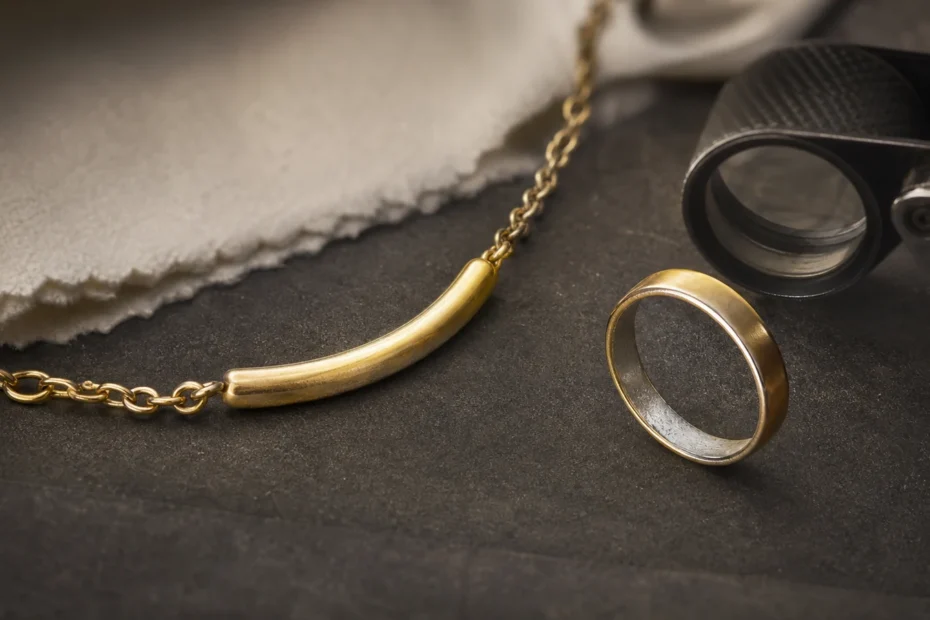
Gold vermeil can discolor as its coating wears or the silver beneath reacts. Learn the causes, safe care, buying checks, and repair limits.
- Yes—gold vermeil can dull, discolor, or reveal tarnished sterling silver as its gold coating thins.
- In U.S. guidance, vermeil means sterling silver under gold of at least 10K and an equivalent 2.5-micron fine-gold thickness.
- Rings and bracelets wear fastest; keep pieces dry, avoid chemicals and abrasives, and ask about thickness and replating.
- Vermeil is gold over sterling silver, not solid gold.
- Under current U.S. guidance, the gold is at least 10K with an equivalent minimum thickness of 2.5 microns of fine gold.
- Friction, water, sweat, cosmetics, cleaners, and poor storage accelerate visible change.
- Rings and bracelets usually wear faster than earrings and occasional-wear pendants.
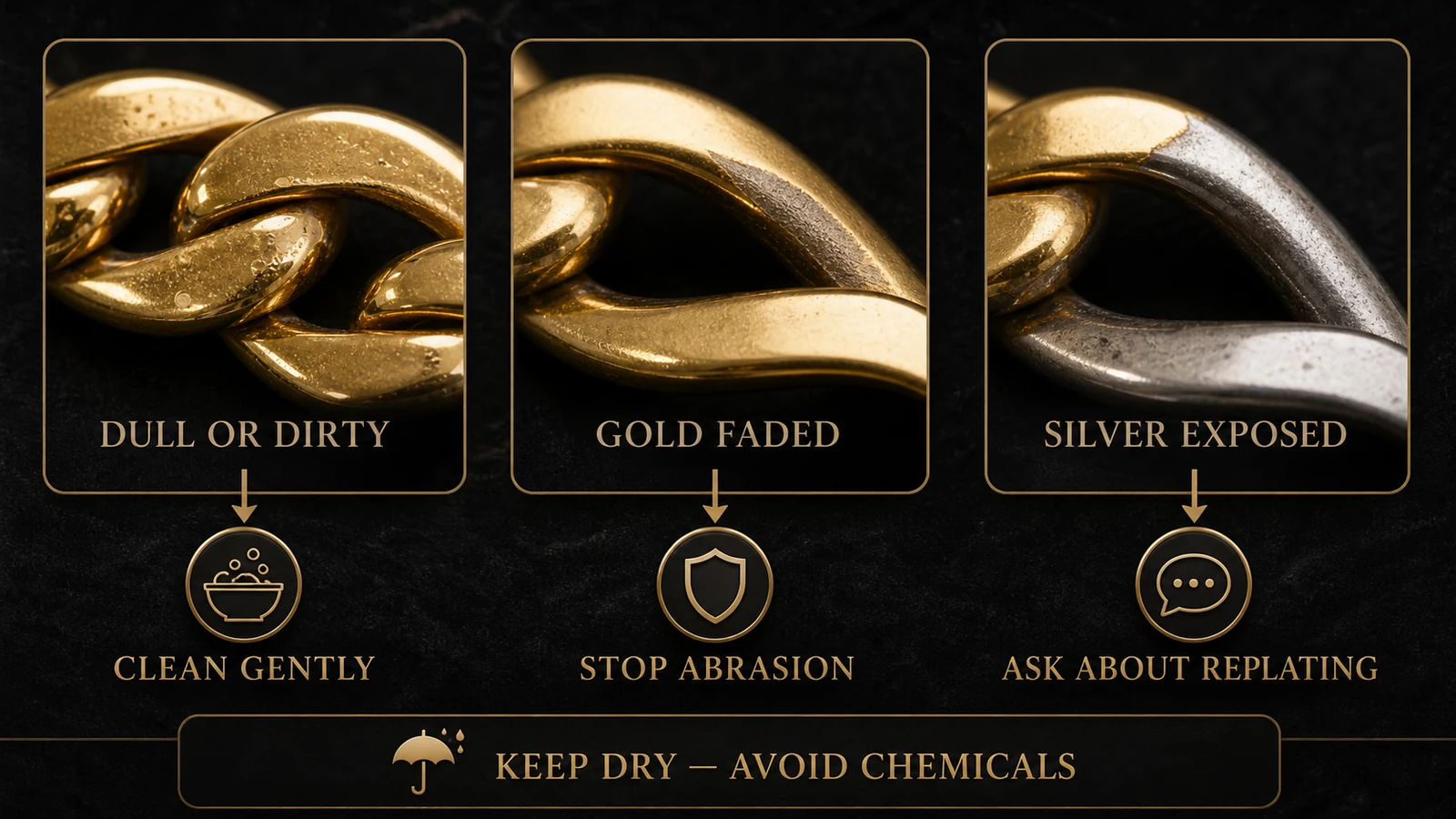
- Clean gently; abrasive polishing can remove the gold you are trying to preserve.
Diagnose the surface before cleaning it
Consumers often call every change “tarnish,” but three different things may be happening. Surface residue can make intact gold look dull, the coating can fade from abrasion, or exposed silver can react with sulfur compounds and darken.
What gold vermeil means in the United States
Current 16 CFR §23.4 says vermeil has a sterling-silver base coated on significant surfaces with gold or gold alloy of at least 10-karat fineness. The coating must have reasonable durability and a minimum thickness equivalent to 2.5 microns of fine gold.
Sterling silver is at least 925 parts per thousand silver under the same guides. If a base-metal layer such as nickel sits between silver and gold, the guides call for disclosure.
| Term | Construction | What the label tells you | What still varies |
|---|---|---|---|
| Gold vermeil | Gold coating over sterling silver | U.S. minimum composition and equivalent thickness standard | Exact thickness, karat, underlayer, finish quality, wear |
| Gold plated | Gold coating over a disclosed base | A surface application | Base metal and coating thickness can vary widely |
| Gold-filled | Mechanically bonded gold-alloy layer over a base | A regulated construction and weight relationship in U.S. guidance | Wear, karat, construction, and repairability |
| Solid gold alloy | Gold alloy throughout the part | Karat or fineness applies through the metal | Alloy composition, scratching, and polish wear |
Tarnish, fading, and dirt are different
Pure gold is highly resistant to tarnish, but vermeil is a layered object. Its visible performance depends on gold alloy, thickness, adhesion, surface preparation, underlayers, jewelry geometry, and wear.
Why the sterling-silver base matters
Silver can react with sulfur-containing compounds in air, skin products, rubber, wool, paper, pollution, and some storage materials. When the gold layer remains intact, it separates the silver from much of that exposure.
As microscopic wear and porosity increase, discoloration can appear at edges, clasps, chain links, ring undersides, and raised details. Cleaning exposed silver without removing adjacent gold becomes delicate.
What makes vermeil wear faster?
- Daily friction against skin, desks, clothing, bags, and other jewelry.
- Rings and bracelets that strike hard surfaces.
- Showering, swimming, salt water, and chlorinated water.
- Sweat, perfume, sunscreen, lotion, hair products, and household chemicals.
- Abrasive cloths, toothpaste, baking soda, dips, brushes, and ultrasonic cleaning used without material guidance.
- Thin or uneven coating, poor surface preparation, sharp edges, and weak adhesion.
- Humid, sulfur-containing, or unventilated storage materials.
How long does gold vermeil last?
There is no defensible universal number of months or years. An occasional-wear pair of earrings can retain color far longer than a ring worn through handwashing, exercise, and desk work.
| Piece type | Typical friction | Relative wear concern | Practical choice |
|---|---|---|---|
| Stud or drop earrings | Low | Lower | Good vermeil use when kept dry and stored separately |
| Pendant | Low to moderate | Moderate at bail and chain contact | Inspect moving joints and chain material |
| Chain | Repeated link and skin contact | Moderate to high | Ask whether every component is vermeil |
| Bracelet | Desk and clothing contact | High | Expect edge and clasp wear |
| Ring | Water, chemicals, impact, continuous friction | Highest | Choose solid gold for low-maintenance daily wear when budget allows |
Coating thickness beyond the minimum, good workmanship, and careful use can improve durability. A retailer promising a fixed lifespan should state the assumptions and warranty.
How to clean gold vermeil safely
- Check the seller’s care instructions and gemstone restrictions first.
- Use clean dry hands and inspect for loose stones, lifting coating, or exposed silver.
- Wipe lightly with a soft, non-abrasive, lint-free cloth.
- If permitted, use brief contact with lukewarm water and a tiny amount of mild soap; do not soak.
- Rinse quickly and dry completely with a soft cloth.
- Stop if color transfers, dark patches spread, or the surface looks thinner.
- Use a qualified jeweler for uncertain construction, valuable pieces, or restoration.
Do not use silver dip on intact vermeil unless the manufacturer or a qualified conservator specifically approves it. A product designed to attack silver tarnish may affect coatings, underlayers, solder, or gemstones.
Storage that slows visible change
Store each piece clean, dry, and separated to reduce scratching. Use an inert soft pouch or lined compartment, and avoid rubber bands, newspaper, cardboard, and unknown foams that may release sulfur or acids.
Anti-tarnish materials can help the silver environment, but they do not replace dry storage and gentle handling. Replace them according to the supplier’s instructions.
Is gold vermeil replating worth it?
It can be worth replating a well-made, sentimental piece with an intact sterling-silver base. For inexpensive, heavily worn jewelry, a professional quote may exceed the cost of a suitable replacement. Cleaning helps surface residue; it cannot restore a worn-away gold layer.
| Choice | Usually makes sense when | Check first |
|---|---|---|
| Clean only | Gold layer remains, but oils or residue dull the surface | Use a gentle method appropriate to the maker’s instructions |
| Replate | Base is sound and design or sentimental value warrants service | Written quote, surface preparation, gold karat, target thickness and warranty |
| Replace or keep as-is | Repair plus plating costs more than the value you place on the piece | Whether sterling base, stones and construction are repairable |
Ask whether the service will meet the U.S. vermeil description, including a sterling-silver base and the required gold-layer thickness under the FTC jewelry guidance. Get the preparation and coating specification in writing. Compare a real quote with a new item, rather than relying on an old online “starting at” price. For nearby material choices see gold-filled construction and rhodium maintenance on white gold.
When to clean, return, or replate
| Observation | Best next step |
|---|---|
| Dull but color is even | Try the approved gentle-cleaning sequence |
| Wear at expected friction points after use | Ask a jeweler whether replating is economical |
| Dark patch appears very quickly | Document it and ask the seller to inspect under the warranty |
| Peeling, bubbling, or widespread early failure | Stop wearing; request remedy and composition/thickness documentation |
| Sentimental or complex piece | Use a bench jeweler experienced with plated silver before any dip or polish |
Replating normally requires cleaning, polishing, and renewed electroplating. Excessive pre-polishing can soften details, and stones or mixed components may limit the process.
Buying checks that predict durability
- Is the base confirmed sterling silver, such as 925?
- What is the gold karat and actual coating thickness in microns?
- Is there a disclosed nickel or other base-metal underlayer?
- Are the clasp, posts, jump rings, solder areas, and chain also vermeil?
- Is the piece intended for daily wear, water exposure, or only occasional wear?
- What does the warranty cover if color changes unusually early?
- Can the seller or a local jeweler replate it, and at what approximate process cost?
A “925” mark speaks to the silver base, not the thickness of gold. A karat label for the coating does not prove the piece is solid gold.
Vermeil versus nearby choices
Vermeil can be a sensible middle option for occasional-wear designs when a sterling-silver base is preferred. Gold-filled construction may suit some high-contact pieces better, while solid gold removes the coating-wear problem but costs more.
Compare what gold-filled means, gold-filled lifespan, why plated jewelry can turn green, whether plated jewelry is waterproof, and whether solid 14K gold tarnishes.
Most product listings state “18K vermeil” but omit measured micron thickness, underlayers, component-by-component construction, abrasion testing, and replating access. Those missing facts predict wear better than the marketing adjective alone.
Buy vermeil as a serviceable layered finish, not as maintenance-free solid gold. It is a strong value when the construction is documented, the piece suits lower-friction wear, and the seller supports early failure and future replating.
Watch: What is Gold VERMEIL?!
This jewelry-focused explanation provides visual context for the layered construction. Use the current eCFR definition and seller-specific thickness documentation as the decisive standard.
Video: JACOJE LYNX. YouTube oEmbed availability validated July 17, 2026.
Bottom Line
Gold vermeil can tarnish in appearance because residue dulls the gold, the coating wears, or exposed sterling silver reacts. Gentle care, dry storage, lower-friction use, and documented thickness extend useful life; abrasives and vague product claims shorten it.
FAQ: Does Gold Vermeil Tarnish?
Can you shower with gold vermeil?
It is better to remove it. Repeated water, soap, heat, and friction can shorten the coating’s life even if one shower causes no visible change.
Can tarnished gold vermeil be restored?
Dirt may clean off gently; exposed or worn coating usually needs professional replating rather than aggressive polishing.
Is 18K vermeil better than 14K vermeil?
Higher karat changes color and alloy composition, but durability also depends on thickness, adhesion, geometry, and wear. Karat alone does not decide lifespan.
Does a 925 stamp prove an item is vermeil?
No. It supports a sterling-silver claim but does not prove the gold coating’s karat, thickness, or presence on all significant surfaces.
Is gold-filled more durable than vermeil?
Often it can tolerate repeated wear better because of its mechanically bonded construction, but quality, part type, thickness, and use still matter.
Sources and verification
Use the primary documents below to verify rules, data, definitions, and evidence. Product terms, market conditions, and research conclusions can change.
- eCFR — 16 CFR Part 23, Jewelry Guides
- FTC — Buying platinum, gold, and silver jewelry
- FTC — Revised Jewelry Guides statement of basis and purpose
- Jewelers Mutual — Vermeil vs gold-filled vs gold-plated
- World Gold Council — Gold jewellery
- GIA — Tips on caring for jewelry
- Canadian Conservation Institute — Care of silver
- National Park Service — Silver care and preservation
- U.S. Code — Gold and silver stamping provisions
- Jewelers Vigilance Committee — Jewelry advertising guidance
 When you purchase a service or a product through our links, we sometimes earn a commission, at no extra cost to you.