
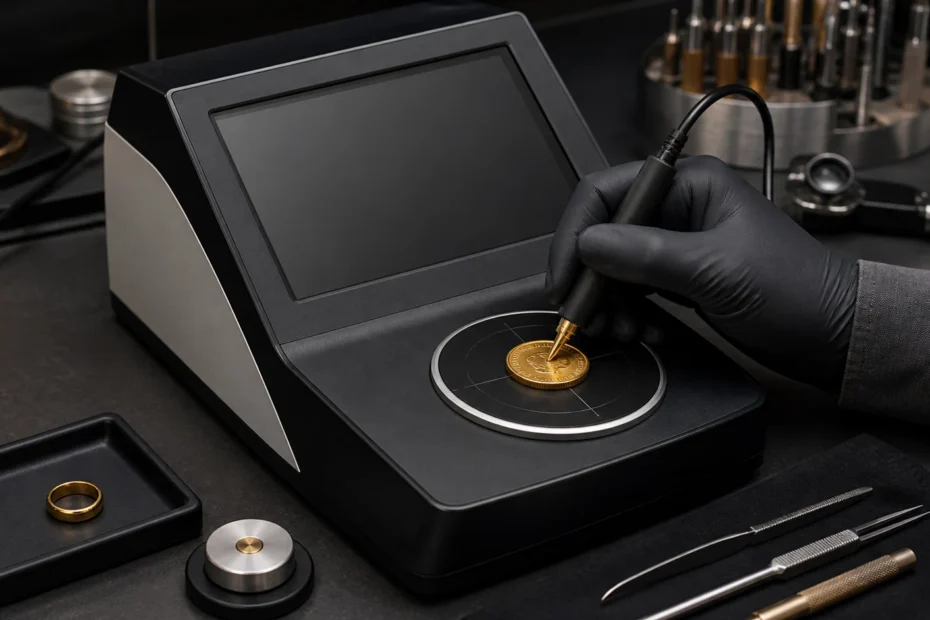
Compare electronic gold testers for jewelry and coins, understand measurement limits, and build a safer multi-test verification workflow.
- Choose the tester by sample type: jewelry or bullion.
- Calibration and surface condition can change a reading.
- Confirm valuable items with a second independent method.
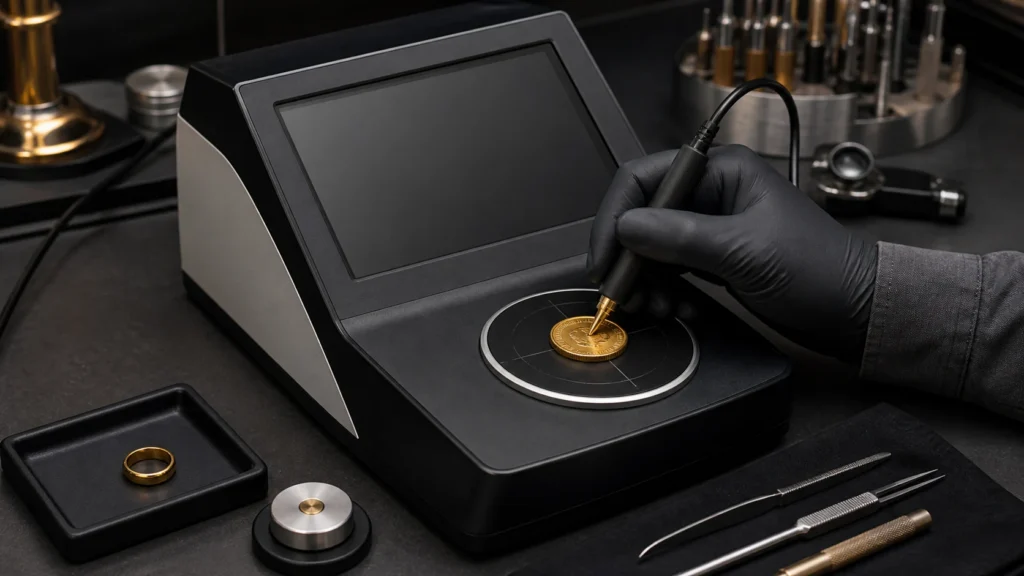
The best electronic gold tester depends on whether you test jewelry or bullion. Jewelry testers estimate karat from an electrical or electrochemical response at a contact point; bullion verifiers compare conductivity or resistivity through a larger sample; density systems and XRF answer different questions. No single reading should carry a high-value purchase by itself.
Compare electronic gold testers on Amazon →Filter out diamond pens and acid-only kits
- Choose a jewelry tester for rings and chains; choose a bullion verifier for coins and bars.
- A diamond or moissanite pen does not test gold purity.
- Calibration, contact, plating, geometry, and sample size can change electronic readings.
- Use mass, dimensions, magnet response, documentation, and a second test before a costly decision.
- GoldConsul did not hands-on test the devices in this guide.
Recommended options

RS Mizar M-18A9 Gold Tester
Best for: Screening common yellow- and white-gold jewelry claims with a purpose-built electronic meter and compatible testing chemical.
Avoid if: You primarily test bullion coins or bars, need a no-consumables method, or expect one surface reading to identify plating and every alloy.
Verify before buying: Confirm the current model, karat range, chemical kit, calibration procedure, replacement consumables, sample restrictions, warranty, and seller.
Amazon search results for “electronic gold tester” contain several tools that do not measure gold at all: diamond pens, magnets, microscopes, scales, and ordinary acid kits. Those may support a workflow, but a product title that mentions gold does not turn every instrument into a karat meter.
Start by defining the sample. A thin ring, plated chain, one-ounce bullion coin, assay-card bar, scrap lot, and stone-set antique need different contact areas, depth, geometry, and damage tolerance.
Choose the tester by sample type
Knowledge Gap: electronic does not mean non-destructive or definitive
Some electronic jewelry testers use a conductive gel or chemical and require clean contact. Some bullion instruments read through packaging only within stated limits. Density systems require suspension in liquid. XRF is surface-weighted and needs trained interpretation. “Digital” describes the interface, not the depth or certainty of the result.
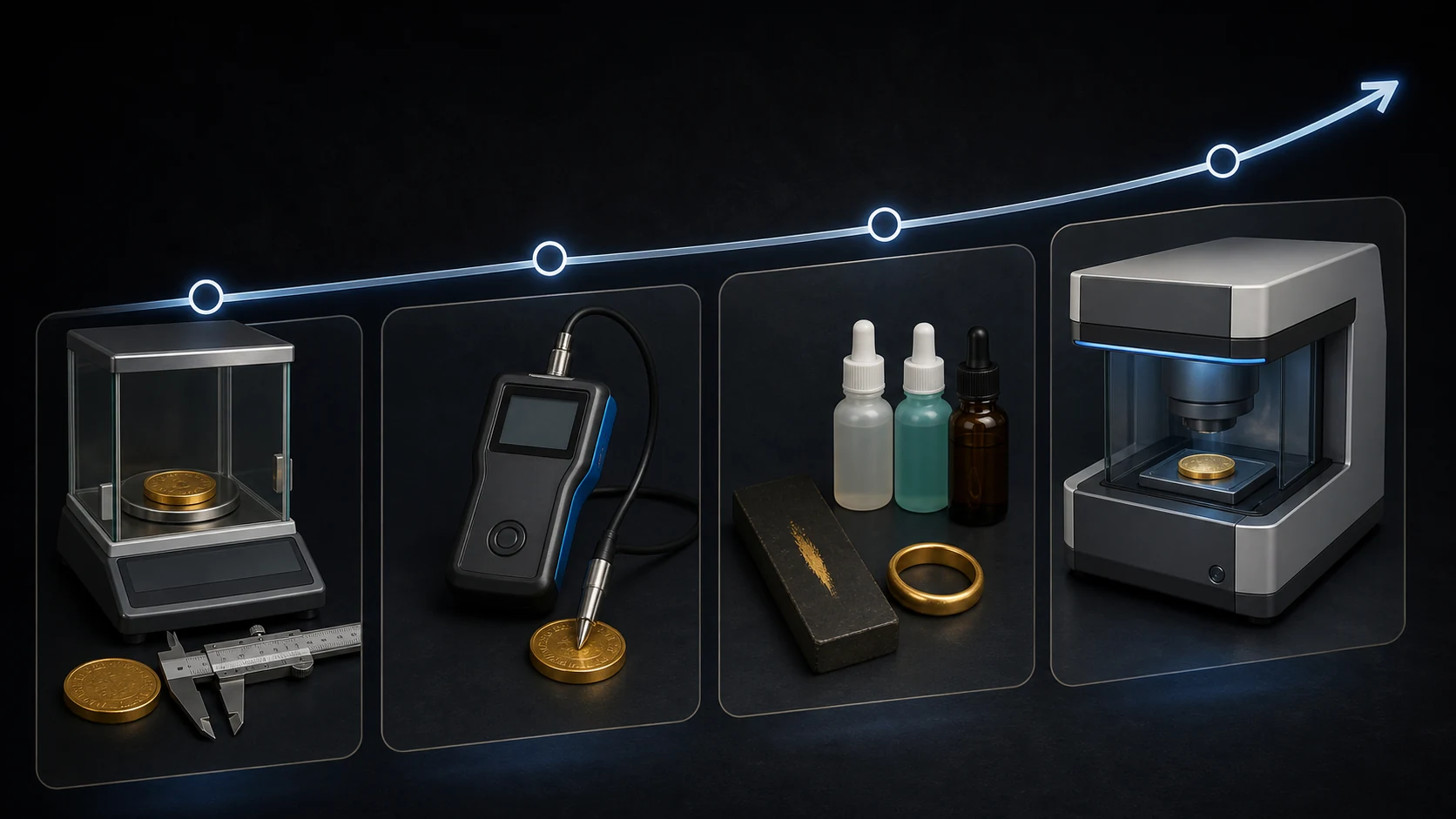
Gold testing technologies compared
| Method | Best use | Main strength | Important limit |
|---|---|---|---|
| Electronic jewelry karat tester | Common gold jewelry alloys | Fast point estimate with purpose-built karat scale | Surface, calibration, plating, solder, and unusual alloys can mislead |
| Bullion conductivity/resistivity verifier | Known coin and bar formats | Non-destructive comparison with expected alloy range | Sample size, thickness, packaging, geometry, and overlapping materials matter |
| Density balance | Solid objects without cavities or stones | Compares mass to displaced volume | Hollow construction, inclusions, attached parts, and alloy overlap reduce usefulness |
| Touchstone and acid | Jewelry and scrap screening | Low-cost comparison across karat reactions | Requires technique and consumables; surface/plating and scratch selection matter |
| XRF | Professional elemental screening | Fast multi-element surface composition | Expensive, surface-biased, geometry-sensitive, and operator dependent |
| Fire assay | Reference analysis of suitable sample | High-confidence quantitative assay | Destructive, slower, and requires professional laboratory handling |
The Sigma Metalytics user guide explicitly describes its readings as informational and documents special conditions that can move a reading into or out of an expected range. That boundary is useful for every electronic tester: read the instrument manual as part of the measurement.
For jewelry methods, Arden Jewelers’ test demonstration explains how an electronic tester estimates purity from electrical resistance while warning that calibration and test location affect the result. A comparative review from Quicktest shows why different pen-probe and meter designs should not be treated as interchangeable.
What to verify before buying an electronic tester
- Sample family: jewelry, coins, bars, scrap, plated items, white-gold alloys, or several of these.
- Measurement principle: electrical contact, electrochemical response, conductivity, resistivity, density, or XRF.
- Supported range: karats, alloys, metals, sample thickness, and dimensions explicitly listed by the maker.
- Consumables: gels, chemicals, probes, calibration pieces, replacement sensors, batteries, and cleaning supplies.
- Calibration: how often it is required, what reference is used, and how the device signals a failed setup.
- Evidence output: whether the reading can be documented and combined with mass, dimensions, photographs, and seller records.
- Service path: warranty, technical support, manuals, repair, and current replacement parts.
A safer multi-test workflow
- Identify and document. Photograph marks, packaging, serials, dimensions, and the complete object.
- Measure mass and dimensions. Use a suitable scale and caliper; the gold scale guide explains capacity and resolution.
- Inspect construction. Look for plating wear, solder, hollow sections, seams, inserts, stones, and magnetic components.
- Run the electronic test correctly. Calibrate, clean the contact, select the right alloy or sensor, and observe sample restrictions.
- Add an independent signal. Use the appropriate method from Best Gold Testing Kits or seek professional XRF/assay.
- Resolve disagreement. Do not average conflicting results. Stop the transaction and escalate the test.
Jewelry and bullion are not the same test problem
A jewelry karat meter may be designed for 10K through 24K alloys at a prepared contact. That does not make it a bullion verifier. Conversely, a conductivity device built around recognized coin and bar alloys may not identify a narrow curved ring or mixed solder joint.
Also distinguish a screening result from an identification result. A reading inside an expected range can support consistency with a claimed alloy, but it does not establish provenance, ownership, weight accuracy, or the absence of a sophisticated composite construction. Record the exact device, setting, calibration check, sample location, packaging condition, and every reading. That record makes disagreement easier to investigate and prevents a later number from being remembered as stronger evidence than it was.
For recurring buying or resale work, create an escalation rule before testing: a low-value item may stop after two agreeing screens, while an unfamiliar or high-value item moves to a trained professional regardless of an apparently normal meter reading. A tester is most useful when it consistently tells you when to pause—not when it is treated as a machine that approves a transaction.
For coins, continue with How to Test Gold Coins. For jewelry marks and layered construction, use Gold Jewelry Markings. For broader method limitations, see Testing Gold Purity and How to Test Gold at Home.
Editorial Perspective
Buy a tester only after defining the decisions it must support. If a wrong answer could cost more than the device, budget for training, reference samples, maintenance, and professional confirmation—not just the purchase price.
This guide is educational and cannot authenticate a specific item. Instrument readings depend on the sample, setup, calibration, operator, and method limits. High-value decisions deserve professional verification.
Video: electronic gold testers compared
This comparison shows how electronic jewelry testers differ in setup and reading style. Use it as visual context, then follow the exact manual for the model you select.
Bottom line
The best electronic gold tester is the one designed for your sample type and backed by a second independent method. Filter out mislabeled diamond pens and generic gadgets, then compare measurement principle, supported alloys, calibration, consumables, and service.
Use the Gold Buyer Guides & Tools hub to connect testing with weighing, buying, and storage decisions.
FAQ: best electronic gold tester
Can an electronic gold tester detect gold plating?
It may reveal an inconsistent reading, but many electronic methods are surface-influenced. Plating, solder, contact location, and base metal can still mislead.
Is a diamond tester also a gold tester?
No. A diamond or moissanite pen tests a gemstone-related property and does not determine the gold purity of the setting.
Which electronic tester is best for gold coins?
Use a verifier specifically designed for bullion sample size, thickness, and expected alloy ranges. A jewelry karat meter is a different instrument family.
Are electronic gold testers accurate?
They can be useful within their stated method and sample limits, but calibration, geometry, surface condition, plating, and operator technique affect results.
Do I still need an acid or professional test?
For high-value or conflicting results, use a second independent method. Acid, XRF, density, or assay may be appropriate depending on the item and damage tolerance.
 When you purchase a service or a product through our links, we sometimes earn a commission, at no extra cost to you.