

Choose capsules, tubes, boxes, and secure storage for gold coins while reducing scratches, PVC exposure, moisture, and handling risk.
- Match every capsule to the coin's exact diameter.
- Use PVC-free, acid-free materials and stable conditions.
- A holder protects surfaces; a safe controls access risk.

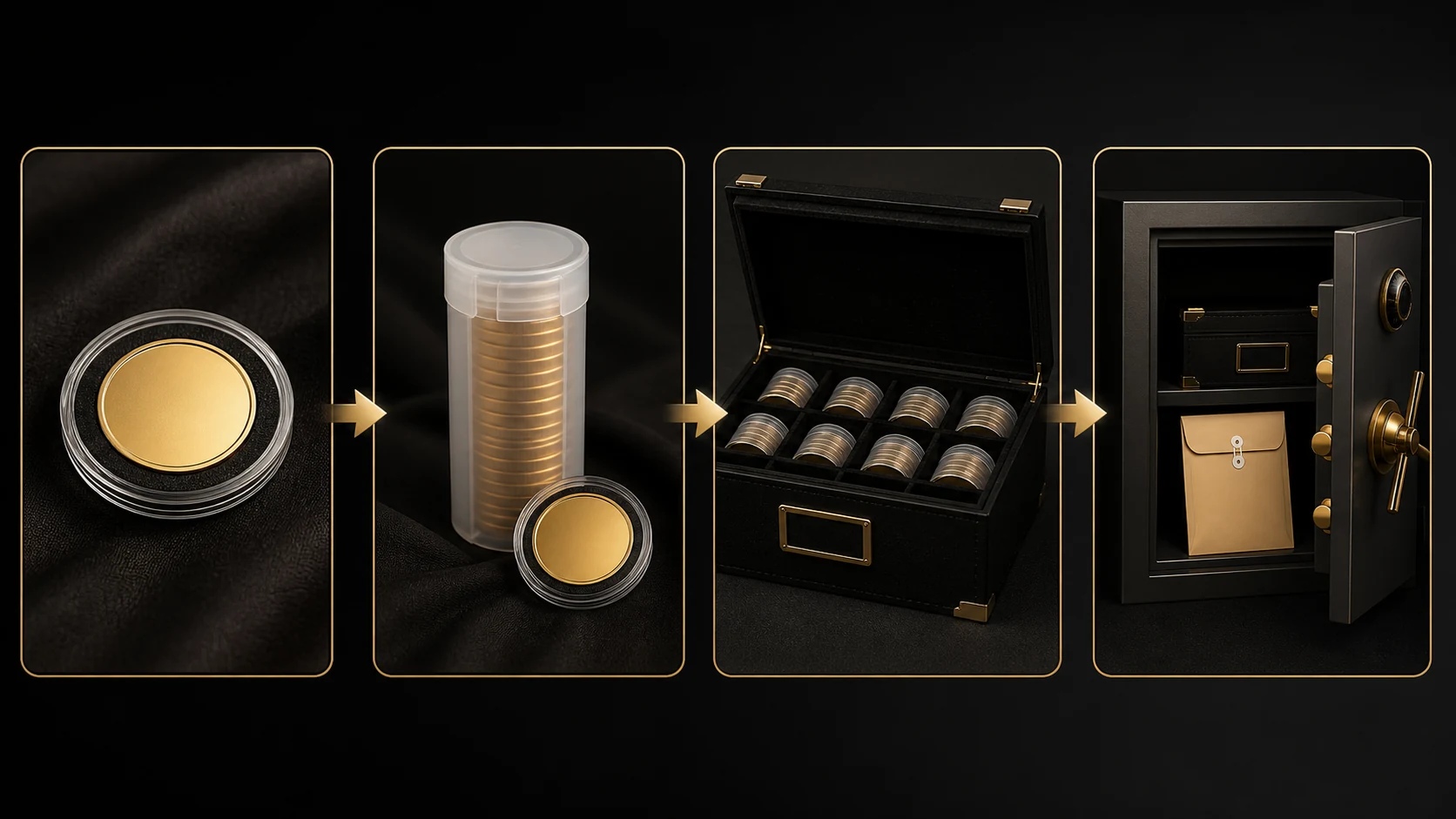
The best gold coin storage is layered: a correctly sized, PVC-free holder for each coin; an organizer for groups; and a secure location for access control. Capsules, tubes, and boxes protect surfaces and keep inventory orderly, but they do not replace a rated safe, insurance review, documentation, or controlled humidity.
Compare gold coin capsules and storage on Amazon →Match the holder to the exact diameter
- Use the original mint capsule or a correctly sized hard capsule when possible.
- Choose PVC-free plastic and acid-free paper or cardboard.
- Tubes organize multiples; boxes organize capsules or slabs; neither is a security safe.
- Record coin, quantity, serial or certificate details, purchase evidence, and storage location separately.
- Do not clean or polish a coin before storage simply to make it look brighter.
Recommended options

Air-Tite 25 mm Black-Ring Capsules
Best for: A specific 25 mm use case such as compatible half-ounce Gold Maple Leaf or Nugget variants named in the listing.
Avoid if: Your coin diameter is different or the piece should remain in original mint packaging.
Verify before buying: Measure the coin and confirm year, denomination, diameter, ring opening, capsule depth, quantity, and current compatibility before ordering.

Guardhouse Single-Row Box for H Capsules
Best for: Organizing up to 25 compatible large H-size capsules in a simple single-row format.
Avoid if: You need capsules included, slab storage, a lock, or protection against theft, fire, or water.
Verify before buying: The listing is for a box, not a universal coin holder. Confirm external and internal dimensions and the exact capsule family it accepts.

GWCASE 52-Piece Multi-Size Coin Capsule Case
Best for: A mixed raw-coin collection that needs several foam-ring diameters and a portable organizer.
Avoid if: You want archival proof for every component, hold only one standard coin size, or need a rated security container.
Verify before buying: Confirm the foam material, usable diameter range, capsule depth, included quantity, case dimensions, and fit before inserting valuable coins.
A holder prevents fingerprints, rubbing, and accidental drops. An organizer keeps holders from moving around. A safe, vault, or safe-deposit arrangement reduces unauthorized access. Treat those as separate layers instead of expecting one attractive box to solve every risk.
The U.S. Mint recommends original holders where applicable, hard plastic for high-value coins, acid-free cardboard, and plastic free of polyvinyl chloride. The Mint also warns that PVC can leave damaging residue and that cleaning or polishing may reduce value.
Choose storage by coin state
Knowledge Gap: “airtight” is not a complete storage plan
A capsule may reduce routine contact, but it does not prove a perfect long-term seal, remove existing moisture, control room humidity, document ownership, insure the coin, or prevent theft. Storage is a chain of controls, not a single plastic accessory.
Capsules, tubes, boxes, and slabs compared
| Format | Best use | Main strength | Main limitation |
|---|---|---|---|
| Direct-fit hard capsule | One raw coin of known diameter | Compact surface protection with minimal movement | Wrong size can pinch, rattle, or fail to close |
| Ring-fit capsule | Multiple diameters within one capsule family | Inert ring can center a coin and improve presentation | Ring material and opening must be verified |
| Coin tube | Many identical bullion coins | Efficient group storage | Bare coins may contact one another; inventory is less visible |
| Capsule box | Organized capsuled collection | Separates and inventories units | Not automatically fire-, water-, or theft-resistant |
| Grading slab box | PCGS, NGC, or similar sealed holders | Protects the slab and label organization | Must match slab dimensions and does not validate the grade |
| Home safe or private vault | Access and security layer | Controls who can reach the collection | Requires rating, installation, insurance, and recovery planning |
PCGS guidance on proper coin storage also highlights the risk from soft PVC holders and reactive storage materials. For higher-value items, use products made for numismatic storage and do not assume that a generic craft organizer is chemically suitable.
How to match a capsule to a gold coin
- Identify the exact coin. Record denomination, mint, year, weight, and whether it is already in original packaging.
- Confirm official dimensions. Use the mint or a recognized numismatic reference; do not estimate from the ounce size alone.
- Choose the fit system. Direct-fit uses the exact internal diameter; ring-fit uses an inert insert within a capsule family.
- Check depth and closure. High-relief or unusually thick coins may need more clearance.
- Test with a low-risk item first. The coin should not rattle, bind, bow the capsule, or require force.
- Label the outer system. Put inventory data on the box or separate record, never on the coin.
Common one-ounce gold coins do not all share one diameter. Before ordering, check the official specifications for your American Gold Eagle, Gold Buffalo, Canadian Maple Leaf, Krugerrand, Britannia, Philharmonic, or other coin. Continue with Weight of Gold Eagle Coins and the American Gold Eagle buying guide for product-specific context.
Control handling and environment
- Handle edges only. Work over a soft clean surface and use clean gloves when appropriate.
- Keep conditions stable. Avoid sharp temperature and humidity swings, direct sunlight, fumes, damp basements, and hot attics.
- Separate incompatible materials. Do not place gold coins against rubber bands, unknown foam, soft vinyl, tape, or ordinary paper envelopes.
- Preserve documentation. Certificates, invoices, grading numbers, photographs, and insurance records should remain retrievable even if the physical location is inaccessible.
- Keep storage discreet. Avoid publishing exact quantities or locations and limit who knows the access procedure.
A holder is not a safe
A lockable display case can slow casual access, but it is not a tested burglary safe. Compare fire, burglary, anchoring, access, and insurance tradeoffs in Home Safe vs Private Vault for Gold and the broader Where to Store Gold guide.
For authentication risk, storage cannot replace verification. Record mass and dimensions and follow the non-destructive checks in How to Test Gold Coins before treating an unfamiliar item as genuine.
Editorial Perspective
Spend first on correct fit, inert materials, and a recoverable inventory. Decorative wood, carbon-fiber patterns, and display windows are secondary. When coin value becomes material to your finances, review security ratings and insurance rather than simply buying a larger organizer.
This guide is educational and does not replace professional conservation, insurance, legal, or security advice. Product compatibility and policy coverage must be verified for your collection.
Video: how coin capsules protect a collection
This overview compares capsule materials and use cases. Gold bullion owners should still verify exact diameter, depth, and chemical suitability for each coin.
Bottom line
The best gold coin storage combines a correctly fitted holder, orderly outer box, stable environment, clear records, and an appropriate security location. Buy the capsule by exact coin dimensions—not by color, ounce label, or appearance.
Browse the Gold Buyer Guides & Tools hub for the next buying, testing, weighing, and storage decision.
FAQ: best gold coin storage
Should gold coins be kept in capsules?
For raw bullion or collector coins, a correctly sized inert hard capsule can reduce handling and surface damage. Original mint packaging may be preferable when already present.
Are all coin capsules PVC-free?
No. Verify the manufacturer material statement. Avoid soft vinyl and unknown plastics for long-term contact with valuable coins.
Can I store different gold coins in the same tube?
Only when the tube and any internal holders fit every coin without movement or rubbing. Mixed diameters are usually better organized in individual capsules.
Should I clean a gold coin before storing it?
Usually no. Cleaning or polishing can alter surfaces and reduce numismatic value. Seek professional conservation advice for contamination or residue.
Is a lockable coin box enough security?
No. A collector box organizes holders; it is not automatically a rated safe. Review access, burglary, fire, installation, documentation, and insurance separately.
 When you purchase a service or a product through our links, we sometimes earn a commission, at no extra cost to you.