
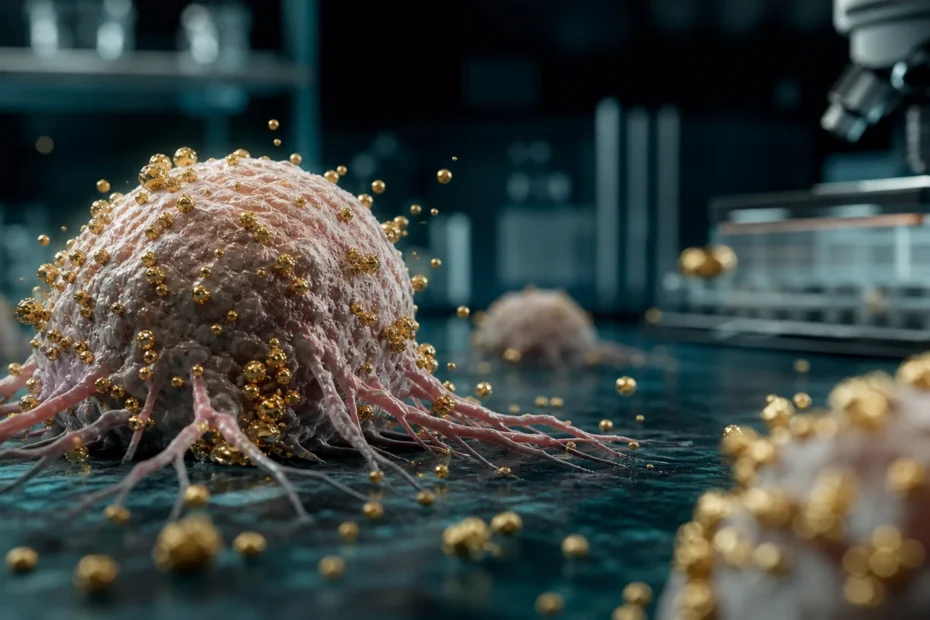
Explore how gold nanoparticles are studied for cancer imaging, drug delivery, photothermal therapy, radiation enhancement, and their limits.
- Gold nanoparticles can be engineered for imaging, drug delivery, heat generation, and radiation response.
- Promising laboratory results do not automatically mean an approach is clinically proven.
- Safety, biodistribution, manufacturing consistency, and trial evidence remain decisive barriers.
Gold nanoparticles are being studied as tools for cancer imaging, targeted delivery, heat-based tumor treatment, and radiation enhancement. Their behavior can be tuned by changing particle size, shape, and surface coating. Most gold-based cancer technologies remain experimental or in limited clinical research; they are not a general cure and should not replace evidence-based care from an oncology team.
Gold in cancer research does not mean inserting ordinary jewelry gold into the body. Researchers work with engineered particles measured in billionths of a meter. At that scale, gold interacts with light, biological molecules, and radiation in ways that bulk metal does not.
Those properties create several possible medical tools. The difficult part is turning a promising laboratory effect into a treatment that reaches the right tumor, avoids healthy tissue, can be manufactured consistently, and leaves the body safely.
This guide explains research, not personal treatment options. A published experiment, an active clinical trial, and an approved therapy are different evidence stages. Patients should discuss diagnosis and treatment decisions with qualified oncology professionals who know their medical history.
- Gold nanoparticles can carry molecules, absorb light, enhance imaging signals, and interact strongly with X-rays.
- Photothermal therapy uses selected light to heat particles near a tumor; reaching deep or dispersed disease remains challenging.
- Targeting a tumor in a dish is much easier than achieving safe, predictable distribution in a human body.
- Particle clearance, toxicity, immune response, manufacturing, and trial evidence determine clinical usefulness.
- Gold-based methods should be described by their evidence stage, not by headline potential.
What Is a Gold Nanoparticle?
A gold nanoparticle is a small gold structure whose dimensions, geometry, and surface chemistry are deliberately controlled. Common research forms include spheres, rods, shells, cages, stars, and clusters. A coating such as polyethylene glycol may be added to change how the immune system sees the particle, while antibodies, peptides, or other ligands may be attached to recognize a biological target.
Shape and size affect how a particle absorbs and scatters light. Surface chemistry affects stability, circulation time, protein binding, cell uptake, and clearance. Two studies using “gold nanoparticles” may therefore be testing very different medical products.
GoldConsul’s introductions to gold nanoparticles and gold in nanotechnology explain the broader material science behind these designs.
The Evidence Ladder: From Laboratory Result to Patient Care
The U.S. National Cancer Institute describes cancer nanotechnology as an active research area intended to improve prevention, diagnosis, and treatment. Its overview emphasizes both diagnostic devices and the challenge of delivering therapies to biological targets in the body. That is a more accurate frame than saying gold has already revolutionized routine cancer care.
The NCI cancer nanotechnology program is a useful starting point for understanding how research moves from material design toward clinical translation.
Photothermal Therapy: Turning Light into Local Heat
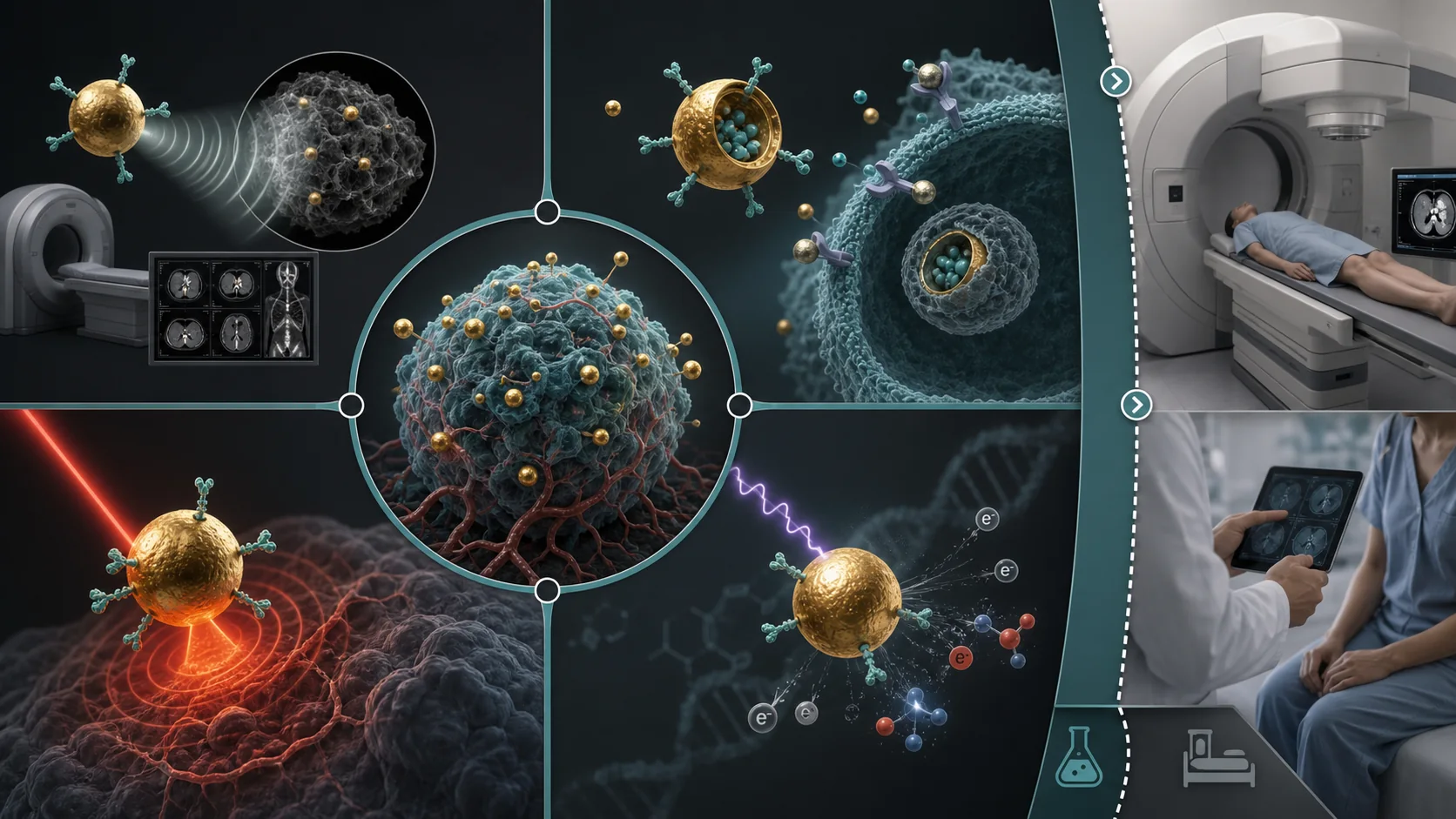
Some gold nanostructures absorb near-infrared light and convert part of that energy into heat. If enough particles reach a tumor and the light reaches the same location, the temperature increase may damage cancer cells. Researchers call this photothermal therapy.
The attraction is spatial control: the particle, the tumor, and the light source can in principle define where heating occurs. Reviews of gold nanoparticle photothermal therapy describe combinations with drug delivery, imaging, chemotherapy, immunotherapy, and other treatments.
A peer-reviewed review of gold nanoparticles for photothermal cancer therapy describes why particle geometry and near-infrared activation are central to the method, while also emphasizing that treatment design and delivery determine performance.
The limitation is equally important. Light penetration depends on wavelength, tissue type, tumor depth, and delivery method. Particle distribution can be uneven. Excess heat may affect nearby healthy tissue, while insufficient heat may leave viable tumor regions.
Photodynamic Therapy Is Related but Different
Photodynamic therapy uses a light-activated photosensitizer to produce reactive oxygen species that damage cells. Gold structures can carry a photosensitizer, alter local optical fields, or be combined with photothermal effects, but gold itself should not be confused with every approved photodynamic treatment.
The National Cancer Institute’s patient guide explains that approved photodynamic therapy is generally local and that light penetration limits its use in deeper tissue. A gold-containing research platform must be evaluated as its own product, not assumed effective because a broader treatment category exists.
Targeted Drug and Gene Delivery
A gold nanoparticle can act as a scaffold for a drug, protein, nucleic acid, or targeting molecule. The goal is to protect the payload, change where it travels, release it under a chosen condition, or increase concentration near a tumor.
Targeting is not a magic address label. Tumors contain different cell populations and blood-vessel structures. The body can coat nanoparticles with proteins, remove them through the liver or spleen, or prevent them from penetrating deeply into tumor tissue.
The NCI drug dictionary includes colloidal gold-bound tumor necrosis factor as a nanoparticle delivery concept with potential antineoplastic activity. The careful word is potential: a defined mechanism and a trial program do not establish broad clinical benefit.
Imaging, Diagnostics, and Theranostics
Gold’s high atomic number and optical properties can increase contrast in experimental X-ray, computed tomography, photoacoustic, Raman, and optical imaging systems. Surface molecules may help a particle bind to a biomarker, while the gold core produces a detectable signal.
A theranostic system combines diagnosis and therapy. For example, one platform might help locate a tumor, deliver a drug, and provide heat under external illumination. Combining functions can be useful, but it also makes manufacturing, dosage, quality control, and regulatory evaluation more complex.
Related GoldConsul coverage includes gold nanoparticles in medicine, gold in biotechnology, and gold in wearable health technology.
Gold Nanoparticles and Radiation Therapy
Gold interacts strongly with X-rays because of its high atomic number. Researchers investigate whether particles concentrated in a tumor can increase local energy deposition, produce secondary electrons, or influence biological responses during radiotherapy.
The intended benefit is a stronger tumor effect without proportionally increasing damage to surrounding tissue. Real performance depends on photon energy, particle concentration, intracellular location, tumor oxygenation, and treatment geometry. A positive cell experiment does not prove that a clinically achievable particle dose will produce the same effect in a patient.
| Approach | Role of gold | Potential benefit | Core limitation |
|---|---|---|---|
| Photothermal therapy | Converts selected light into heat | Localized thermal damage and combination treatment | Light access, particle distribution, and heat control |
| Drug or gene delivery | Carries or anchors a therapeutic payload | Changed distribution or controlled release | Targeting efficiency, immune uptake, and clearance |
| Imaging and sensing | Produces optical, photoacoustic, Raman, or X-ray contrast | Improved detection or treatment guidance | Signal specificity and clinically practical dosing |
| Radiation enhancement | Increases local interaction with ionizing radiation | Potential radiosensitization | Translation from physical dose effects to patient outcomes |
| Theranostics | Combines detection and therapy in one platform | Coordinated diagnosis, delivery, and response monitoring | Greater manufacturing and regulatory complexity |
What Most Breakthrough Headlines Miss
A particle cannot help if a safe dose fails to reach enough of the tumor.
Gold is not readily biodegradable, so long-term distribution and clearance require evidence.
Size, shape, coating, purity, and storage must remain consistent from batch to batch.
A better scan or stronger cell-killing signal is not automatically longer survival or better quality of life.
Safety, Biodistribution, and Clearance
Gold is often described as biocompatible, but that word does not guarantee that every gold nanoparticle is harmless. Toxicity depends on particle dimensions, shape, coating, contaminants, dose, route of administration, breakdown products, and exposure time.
After administration, particles can accumulate in the liver, spleen, kidneys, tumors, or other tissues. Very small clusters may clear differently from larger particles. Surface coatings can change circulation and immune recognition, but they may also introduce their own biological effects.
A strong safety assessment therefore asks where the complete formulation travels, how long it remains, what dose reaches the target, what happens to the coating and payload, and whether repeated treatment changes risk.
The GoldConsul Editorial Perspective
Judge a cancer technology by the evidence for the exact particle and indication, not by the reputation of gold as a material. Shape, coating, dose, delivery route, tumor type, and activation method can change the result. If a claim does not identify the study stage, treat it as incomplete.
Why Promising Research Can Fail in Clinical Translation
Laboratory models simplify a disease that is highly variable in people. Human tumors evolve, contain diverse cells, interact with immune and blood-vessel systems, and may sit in locations that are difficult to reach with particles or light.
Manufacturing is another filter. A clinical product must be produced consistently, sterilized without changing performance, stored safely, measured accurately, and delivered through a repeatable procedure. Regulators need evidence that benefits outweigh risks for a defined group of patients.
Recent reviews continue to describe gold nanoparticles as promising platforms for photothermal, photodynamic, drug-delivery, and imaging combinations. The useful conclusion is that research is active, not that one universal gold treatment is ready.
A 2024 review indexed by PubMed surveys combined photothermal and photodynamic strategies and reinforces the need to distinguish engineered research platforms from established clinical treatment.
- Model: Was the result shown in cells, animals, or people?
- Product: Are particle size, shape, coating, payload, and dose stated?
- Comparator: Was it compared with current standard care or only with no treatment?
- Outcome: Is the result a laboratory signal, tumor response, side-effect reduction, survival, or quality of life?
- Status: Is the method approved for this cancer, being tested in a trial, or still preclinical?
Video walkthrough: Video context: this TEDx overview introduces gold-nanoparticle research. Use the evidence ladder above to separate scientific mechanisms from clinical readiness.
Questions to Discuss with an Oncology Team
- Is the proposed gold-based method approved for this exact diagnosis, or available only through a clinical trial?
- What human evidence supports the expected benefit?
- How is the particle delivered and activated, and which tissues are exposed?
- What short- and long-term safety information is available?
- What established treatment would it supplement or replace?
These questions do not determine treatment on their own. They help separate a defined medical option from vague claims that use words such as “nano,” “targeted,” or “gold” as proof.
Bottom Line
Gold nanoparticles give researchers a flexible platform for moving drugs, producing heat, enhancing signals, and interacting with radiation. That flexibility has created serious work in imaging, photothermal therapy, targeted delivery, radiosensitization, and theranostics.
The clinical challenge is not proving that gold can do something interesting in a controlled experiment. It is proving that a specific formulation can be manufactured reliably, delivered safely, improve meaningful patient outcomes, and offer a better benefit-risk balance than available care.
FAQ: Gold-Based Cancer Treatments
Are gold nanoparticles approved to cure cancer?
No gold nanoparticle is a universal cancer cure. Specific nanoparticle approaches may be studied in trials or used in limited research settings, but approval and evidence depend on the exact product, cancer type, and intended use.
How does gold kill cancer cells?
Gold does not automatically kill cancer cells. Engineered particles may convert light into heat, carry a therapeutic payload, enhance radiation effects, or support another treatment mechanism under controlled conditions.
Is photothermal therapy the same as photodynamic therapy?
No. Photothermal therapy primarily uses absorbed light to generate heat. Photodynamic therapy activates a photosensitizer that creates reactive oxygen species. Research platforms may combine both effects.
Are gold nanoparticles safe in the body?
Safety cannot be answered for gold alone. Particle size, shape, coating, dose, route, contaminants, tissue distribution, and clearance all matter, so each formulation requires its own evidence.
How can I find legitimate clinical trials?
Use recognized trial registries and discuss eligibility with an oncology team. Verify the sponsor, study phase, location, inclusion criteria, risks, and whether participation changes access to established treatment.
This content is educational and is not medical advice. Seek guidance from qualified healthcare professionals for diagnosis and treatment decisions.
 When you purchase a service or a product through our links, we sometimes earn a commission, at no extra cost to you.