
Understand medieval gold through supply, trade routes, florins, ducats, churches and courts—without mistaking elite gold for everyday money.
- Medieval gold was strategic, scarce, and concentrated—not ordinary pocket money.
- Follow supply, routes, mints, and institutions to see how gold became power.
- Use the focused guides for gold's uses, trade, economy, society, and religion.
Gold in the Middle Ages was a scarce, high-value material used for major payments, international trade, royal gifts, sacred objects and visible status. It did not function as the ordinary coin in every medieval market. West African supply, Islamic and Mediterranean trade, reliable mints and the revival of European gold coins such as the Florentine florin in 1252 and Venetian ducat in 1284 made gold increasingly important to long-distance commerce and political power.
- Gold remained important after Rome, but its monetary role differed sharply by region and century.
- Western European daily exchange relied heavily on silver and lower-value money.
- West African gold moved through Saharan and Mediterranean networks into connected markets.
- The florin and ducat turned trusted weight and purity into widely accepted high-value coins.
- Courts and churches used gold to make authority, devotion and wealth visible.
The simplest medieval-gold story is usually the wrong one. Gold did not disappear after the western Roman Empire, suddenly return with Mansa Musa, and then become Europe’s everyday money. The real history is a connected system whose parts changed at different speeds.
This overview focuses on roughly 500–1500 CE, especially Europe and the African, Islamic, Byzantine and Mediterranean networks that supplied or moved gold into European markets. For the larger chronology before and after this period, start with the Gold History timeline.
Choose the medieval gold question you actually have
This page: how the system connected
Use it to understand supply, routes, coinage and institutions without treating the Middle Ages as one uniform economy.
What was gold used for?
Coins, gifts, sacred objects, manuscripts and luxury display—the object and use-case guide.
How did medieval gold trade work?
Supply zones, caravan routes, ports, merchants and the practical movement of bullion and coin.
What did gold change economically?
High-value settlement, coinage, banking, mints, royal finance and the limits of gold’s economic reach.
Who encountered gold—and how?
Rank, access, law, labor, display and the distance between elite treasuries and ordinary life.
Why did religion use gold?
Reliquaries, altars, sacred light, patronage and institutional power in object-level context.
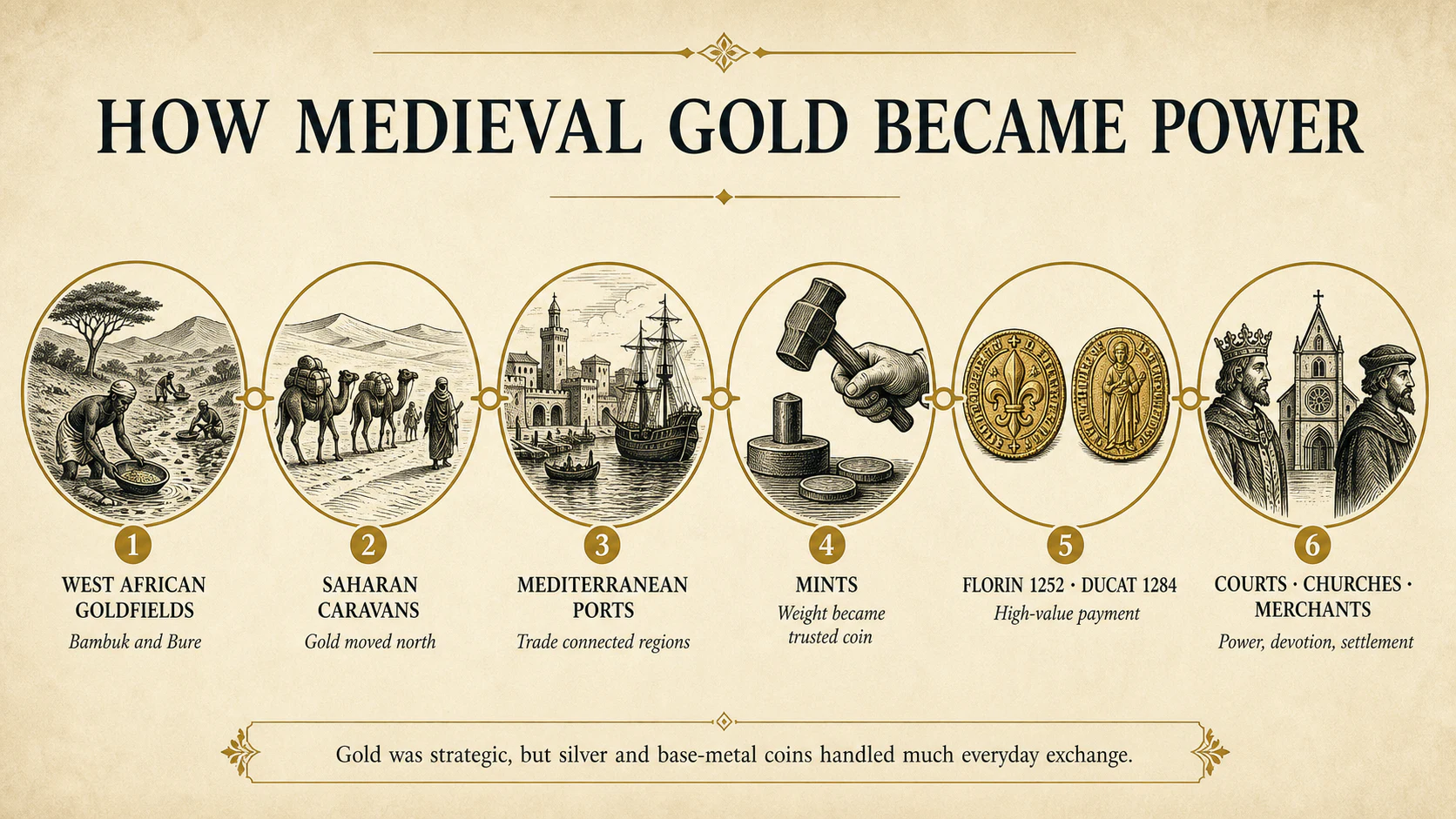
The five-part system behind medieval gold
Mining regions supplied metal, but production estimates remain uncertain.
Transport connected producers with Saharan, Islamic and Mediterranean markets.
Authorities turned metal into coins with declared weight, fineness and imagery.
Merchants valued coins they could recognize, weigh and use across borders.
Courts, churches and merchant networks concentrated gold and made it visible.
Each link mattered. A rich source without secure transport could not supply distant mints. A mint without confidence in weight and purity produced a coin that merchants discounted. Gold in a treasury stored wealth, but gold circulating as a trusted coin could settle a payment across jurisdictions.
Gold never vanished—but its roles changed
After late antiquity, gold coinage continued strongly in the Byzantine and Islamic worlds while much of early medieval western Europe shifted toward silver-based systems. Cambridge’s overview of early medieval money describes how western European gold coinages largely gave way to the silver penny by the eighth century. That was a change in monetary structure, not proof that gold ceased to exist.
Gold still appeared in diplomacy, tribute, elite jewelry, church treasuries and exceptional coinage. The Byzantine gold system preserved a powerful coin tradition, while the Carolingian economy shows why prestige gold and dominant silver money can coexist.
This distinction prevents a common category error: “valuable” does not mean “used for every transaction.” A material can sit at the top of a value hierarchy without being the medium most people handle at a food stall, pay in rent or receive for routine labor.
West African gold connected regions
Gold from the western and central Sudan was central to trans-Saharan exchange. The Metropolitan Museum of Art’s history of the trans-Saharan gold trade connects gold-producing regions south of the Sahara with caravan routes, North African commercial centers and demand for coinage in Mediterranean economies.
The route was not a simple line from “Africa” to “Europe.” Producers, local rulers, caravan organizers, Berber and Muslim merchants, cities such as Sijilmasa, North African mints and Mediterranean traders all occupied different positions in the chain. Control over a mine was not the same as control over transport, and control over transport was not the same as authority to mint.
Smarthistory’s account of medieval materiality across the Mediterranean places West African gold inside a wider network linking Africa, the Islamic world, Byzantium and western Europe. That connected view is more accurate than treating medieval Europe as economically self-contained.
Mansa Musa is evidence of the network, not the whole story
Mansa Musa’s pilgrimage to Mecca in 1324–25 became famous because accounts describe conspicuous distributions and spending of gold in Cairo. The episode demonstrates the resources and diplomatic visibility of the Mali Empire and shows how a large influx could affect a regional market.
It should not be used as a precise measurement of Mali’s total production, Musa’s personal net worth or the gold supply of an entire century. Medieval quantities often come through later texts, translation choices and rhetorical conventions. The strongest conclusion is narrower: Mali was a major political power linked to long-distance gold exchange, and contemporaries understood that wealth as geopolitically significant.
History Claim Credibility Check
Claim: “Mansa Musa was the richest person ever, and his gold crashed the entire medieval world economy.”
His pilgrimage displayed exceptional gold wealth and affected gold’s value in Cairo.
A modern net-worth ranking cannot be calculated reliably from medieval evidence.
Musa’s journey revealed Mali’s extraordinary wealth and its place in connected gold markets.
Why the florin and ducat mattered
Western European gold coinage expanded again in the commercial world of the High and Late Middle Ages. Florence introduced its gold florin in 1252. The British Museum’s example weighs 3.48 grams and dates to 1252–1303. Venice authorized the ducat in 1284 on a closely comparable high-purity standard.
The coins mattered because they packaged metal into recognizable units. A merchant still had to consider clipping, wear, imitation, exchange rates and local rules, but a familiar design and stable standard reduced friction. Cambridge’s history of European money around 1400 describes florins and ducats as important instruments for large international payments.
| Form | Typical strength | Main limitation | Best historical question |
|---|---|---|---|
| Gold coin | Large payment in compact, recognizable form. | Too valuable for much routine exchange; needed trusted weight and fineness. | Who accepted it, and at what valuation? |
| Silver or billon coin | More suitable for many market and wage payments. | Standards and purchasing power varied. | What did ordinary transactions actually use? |
| Bullion or plate | Stored or transferred material value. | Required weighing, testing and sometimes conversion. | Was the object valued as art, metal or both? |
| Credit or bill of exchange | Reduced the need to move heavy or risky coin. | Depended on networks, records and counterparties. | Which institutions made distant settlement credible? |
Minting was political as well as technical. A coin carried a ruler, saint, emblem or civic identity. Quality control protected both revenue and reputation. The Bank of England’s history of the Trial of the Pyx traces formal testing of English coin quality to the late thirteenth century.
Gold’s impact cannot be reduced to coinage. Rulers used it in crowns, seals, gifts and regalia. Churches used gold and gilding for reliquaries, vessels, altars and manuscript illumination. Merchant and urban elites used jewelry, plate and donations to display status and build institutional relationships.
The Metropolitan Museum’s guide to medieval relics and reliquaries explains why sacred remains were enclosed in precious containers: the material expressed honor while the object’s ritual use concentrated attention and prestige. Gold was therefore not merely decoration; it participated in a social act.
For object-level examples, see famous medieval gold artifacts. For workshops, patronage and techniques, use the guide to medieval goldsmithing. Political decentralization and regalia are treated separately in gold in the Holy Roman Empire.
What ordinary medieval people actually encountered
Most people were more likely to encounter silver coins, lower-value denominations, payment in kind, rents, dues, credit or accounting units than gold coins. The mix depended on place, century, occupation and access to markets. Even when a price was expressed in a money of account, settlement did not necessarily use a matching physical coin.
Gold could still affect ordinary lives indirectly. Taxes and war finance shaped demands on communities. Mints and trade supported towns. Church treasuries attracted gifts and patronage. Mining and transport relied on labor. Yet indirect influence is not evidence that gold circulated evenly through society.
Knowledge Gap: production totals are reconstructed, not counted
Medieval gold output cannot be read from one complete ledger. Historians combine texts, coin finds, mint records, archaeology, metal analysis and surviving objects. Each record favors what survived and what institutions chose to document. Responsible estimates should therefore name a region and period, distinguish mined metal from coined metal, and state uncertainty.
Video context: reading medieval history through coins
This museum lecture from Chhatrapati Shivaji Maharaj Vastu Sangrahalaya examines what coins can reveal about the medieval period. It is useful as a methods companion: coins preserve authority, language, weight standards and circulation clues, but they do not describe the whole economy by themselves.
The GoldConsul Editorial Perspective
The best way to understand medieval gold is to follow relationships rather than isolated treasures. Ask where the metal came from, who transported it, who certified it, who could access it and what act it performed. That method explains both gold’s extraordinary power and its limited presence in everyday exchange.
Bottom line
Gold in the Middle Ages was a strategic layer of connected economies. West African supply and long-distance routes fed markets; mints made some of the metal legible as coin; merchants used trusted coins for high-value settlement; rulers and churches used gold to materialize power.
The key correction is simple: medieval gold was important without being ordinary. Use this page as the map, then choose the dedicated guide on uses, trade, economic impact, society, religion or craft for the question you want to answer.
FAQ: gold in the Middle Ages
What was gold used for in the Middle Ages?
Gold was used for high-value coins and payments, royal and diplomatic gifts, jewelry, regalia, sacred vessels, reliquaries, manuscript decoration and stored wealth. Its role varied by region and century.
Did ordinary medieval people use gold coins?
Usually not for routine exchange. Silver, billon, base-metal coins, credit, rents and payment in kind were more relevant to many everyday transactions.
Where did medieval Europe get its gold?
Sources changed over time. Important flows came through Byzantine and Islamic networks, West African goldfields and trans-Saharan trade, recycled objects and coins, and later European mining regions.
Why were the florin and ducat important?
The Florentine florin and Venetian ducat combined high-value gold with recognizable designs and trusted standards, making them useful for large and international payments.
Did Mansa Musa cause medieval inflation?
Accounts support a significant effect on gold’s value in Cairo after his 1324 pilgrimage. Claims about the entire medieval world or a precise modern net worth go beyond what the evidence can measure.
 When you purchase a service or a product through our links, we sometimes earn a commission, at no extra cost to you.