

Learn how gold shaped medieval coinage, credit, mints, royal finance and long-distance settlement while silver remained central to everyday exchange.
- Gold mattered most in high-value settlement, reserves, royal finance, and trusted coinage.
- Silver, credit, rents, and obligations carried much of the wider medieval economy.
- Measure impact through institutions and payment systems, not treasure alone.

Gold played a real economic role in medieval Europe, but that role is often explained badly. Gold did not function like pocket money for most people. For much of the Middle Ages, daily exchange was dominated by silver pennies, local credit, barter-like obligations, and accounting systems.
Gold played a real economic role in medieval Europe, but that role is often explained badly. Gold did not function like pocket money for most people. For much of the Middle Ages, daily exchange was dominated by silver pennies, local credit, barter-like obligations, and accounting systems.
Gold mattered most at the higher layers of the economy: long-distance trade, royal finance, elite wealth storage, high-value settlement, and trusted international coinage. That distinction is the key to understanding why medieval gold changed Europe without becoming the everyday money of ordinary households.
TL;DR
- Gold shaped medieval Europe mainly as a high-value settlement and prestige metal, not as ordinary daily spending money.
- Silver remained the backbone of most everyday medieval European coinage for centuries.
- The 13th-century rise of gold coins such as the florin and ducat reduced friction in international trade.
- Gold supported merchant banking, bills of exchange, royal finance, and cross-border credibility.
- The biggest knowledge gap is treating gold as one simple currency instead of a layered monetary tool.
Animated Summary: How Gold Moved Through the Medieval Economy
This short animation shows the core idea of the article: gold created the most value when it moved through supply routes, mints, merchant networks, banking systems, and political power.
What Most Readers Miss
The mistake is imagining medieval Europe as a fantasy economy where everyone paid with gold coins. In reality, gold sat above the normal retail economy and helped connect merchants, rulers, mints, and banking houses.
Gold Was Important, But It Was Not Everyday Money
The first correction is simple: medieval Europe was not a gold-coin economy for most people. In early and high medieval Western Europe, silver coinage was far more important for normal exchange.
That is why medieval gold needs a layered economic explanation. Gold mattered less at the village market and more in wholesale trade, diplomacy, taxation, tribute, church wealth, and elite payments.
This also explains why gold can feel both central and rare in medieval sources. A gold coin might appear in a treaty, royal account, ransom, banking contract, or international purchase, while most routine buying and selling still depended on smaller denominations.
For wider historical context, GoldConsul’s guide to gold in medieval Europe covers the broader cultural and political setting. This article focuses specifically on the economic mechanism.
Chart 1: Medieval Money Hierarchy
Interpretation: Gold was powerful because it sat at the top of the monetary hierarchy, not because everyone used it daily.
The Shift From Silver Dominance to Gold Coin Expansion
Early medieval Western Europe relied heavily on silver-based systems. Charlemagne’s monetary reforms helped anchor a silver penny framework that influenced European coinage for centuries.
Gold coinage did not disappear entirely, especially in Byzantine, Islamic, Mediterranean, and southern European contexts. But in much of Western Europe, gold became much more economically visible from the 13th century onward.
The 1252 Florentine florin and the 1284 Venetian ducat became especially important. Rutgers’ Medieval and Early Modern Data Bank notes that late medieval Europe used multi-denominational currency systems involving billon, silver, and gold, while the florin and later the ducat became major reference coins in international exchange.
This was not just a numismatic detail. A stable, recognizable, high-purity gold coin reduced the amount of trust merchants needed to place in unfamiliar local currencies.
Chart 2: Timeline of Gold’s Economic Role
Western European everyday coinage relies mainly on silver pennies and local monetary systems.
Urban growth, fairs, Mediterranean exchange, and merchant networks increase demand for reliable settlement.
Florence issues the gold florin, giving merchants a trusted high-value coin.
Venice introduces the gold ducat, later a major international trade coin.
Gold coins, exchange rates, banking ledgers, and bills of exchange connect European markets.
Interpretation: Gold’s influence rose as medieval Europe became more urban, commercial, and internationally connected.
Why Florins and Ducats Changed Trade
Long-distance trade creates a trust problem. A merchant in Bruges, Venice, Genoa, Florence, London, or the Champagne fairs needed to judge whether a coin was acceptable, what it contained, and how it converted into local money of account.
Trusted gold coins solved part of that problem. The florin and ducat became useful because they were recognized beyond their home cities and because merchants could price, settle, and account for larger transactions more efficiently.
The Bundesbank’s publication on gold coins of the Middle Ages shows how medieval gold coins reflected political authority, trade competition, and monetary reputation. A coin was not merely metal; it was a portable signal of issuer credibility.
That is also why gold coinage had a political edge. A ruler or city that issued a trusted gold coin could project financial seriousness across borders.
Gold as a High-Value Settlement Layer
The best modern analogy is not a wallet full of coins. It is a settlement layer used when the transaction was too large, too distant, or too politically sensitive for small local money.
Gold helped settle wholesale trade, luxury imports, diplomatic payments, ransoms, high-level rents, and elite obligations. It was valuable because it compressed purchasing power into a portable and widely understood form.
That does not mean gold eliminated local complexity. Medieval Europe still had many currencies, money-of-account systems, local mint practices, exchange rates, and credit relationships.
This is where many simple articles miss the point. Gold did not make medieval money simple; it made some high-value transactions easier inside a complicated system.
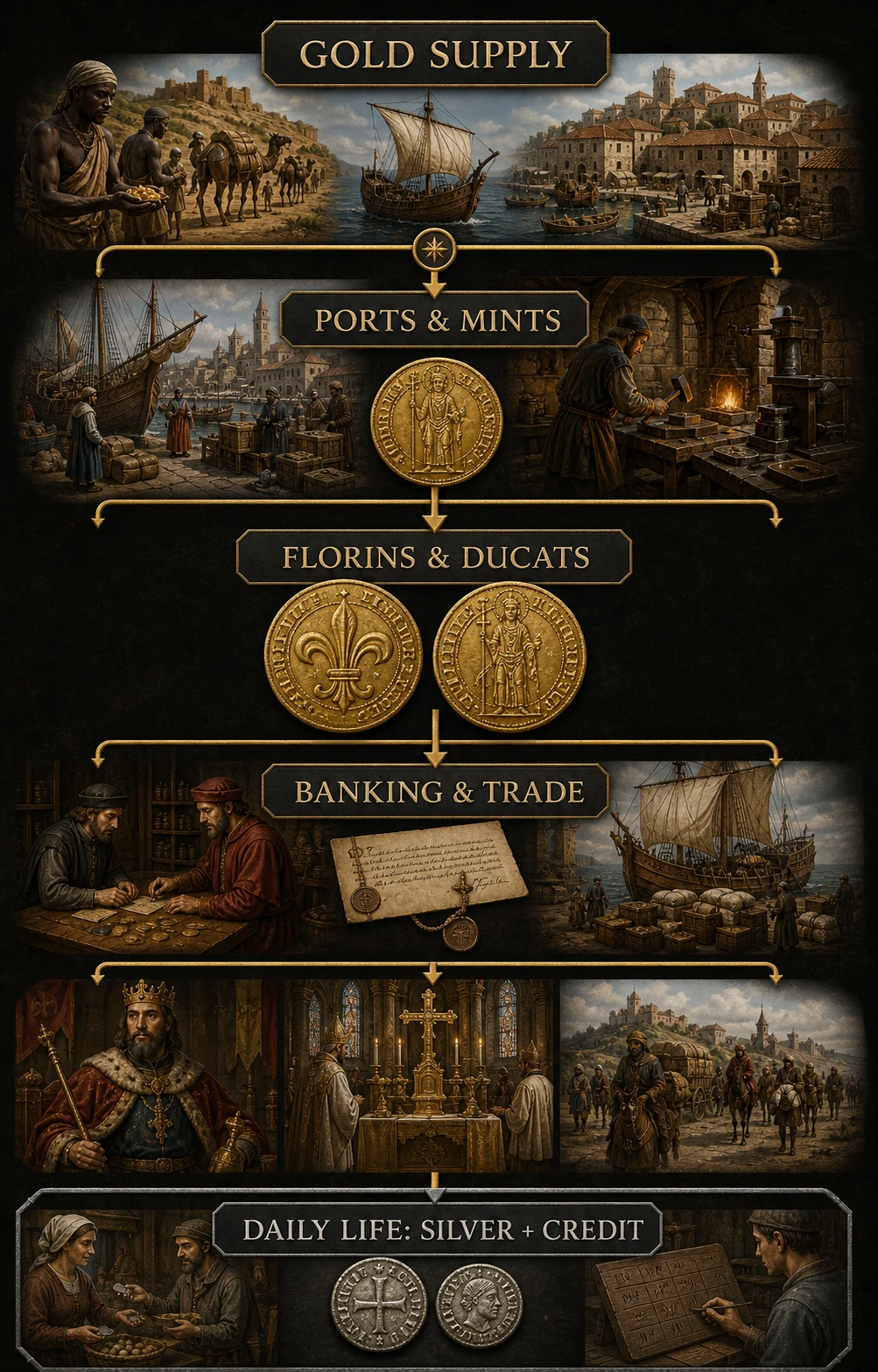
Chart 3: Gold Impact Channel Map
African routes, Mediterranean trade, mining regions, and recycled bullion.
Cities and rulers turn metal into recognizable coins with political backing.
Florins, ducats, and exchange rates reduce friction in long-distance trade.
Deposits, bills of exchange, and account transfers reduce the need to move metal physically.
Tax, war finance, diplomacy, and prestige depend partly on monetary credibility.
Interpretation: Gold’s impact moved through institutions. The coin was only one visible part of the system.
Gold, Banking, and Bills of Exchange
Gold’s medieval economic role became stronger when combined with merchant banking. Italian cities did not only mint famous coins; they also built financial practices that helped merchants manage distance, risk, and currency conversion.
By the late Middle Ages, merchants increasingly used bills of exchange, correspondent networks, account books, and banking relationships. These tools mattered because moving physical gold was costly and dangerous.
The London School of Economics project on late medieval financial markets highlights the importance of exchange-rate data in 14th- to 16th-century Europe. That matters because gold’s role was tied to conversion, not just possession.
In other words, gold helped create a trusted reference point, while financial instruments helped merchants avoid carrying gold everywhere. The economic breakthrough was the combination.
Supply Routes: Where Medieval Europe Got Its Gold
Europe’s access to gold was not evenly distributed. Some gold came from European mining regions, but important flows also arrived through Mediterranean, Islamic, Byzantine, and African trade networks.
West African gold was especially important to Mediterranean and European commerce over long periods. Gold could move north through trans-Saharan routes, then into North Africa and Mediterranean trade circuits.
Later medieval Hungarian gold production also mattered. Central European mining helped increase the supply available to European mints and rulers.
For a mining-focused angle, GoldConsul’s article on gold mining techniques in medieval Europe explains the production side. The economic point here is that supply access shaped which cities and rulers could credibly support gold coinage.
Political Impact: Mints, Debasement, and Trust
Gold influenced politics because money is never only technical. A trusted coin strengthened the issuer’s reputation, while debasement, clipping, inconsistent weight, or weak enforcement could damage confidence.
Cambridge’s work on coinage debasements in medieval and early modern Europe is useful here because it shows how monetary changes could affect exchange rates and the wider economy. Debasement was not a small minting detail; it could reshape trust.
Gold coinage therefore became a political communication tool. A stable coin told merchants that the issuer could defend a standard, enforce mint rules, and participate in high-value trade.
That does not mean medieval gold created modern monetary policy. But it did create a credibility contest among rulers, cities, and trading powers.
Video Context: Why Debasement Damaged Monetary Trust
This short historical video is useful context for the debasement problem. It focuses on England’s later Great Debasement, but the underlying lesson fits the medieval money story: when coin content and public trust diverge, the economic damage can spread beyond the mint.
Comparison: Gold, Silver, Billon, and Credit
| Money form | Main medieval role | Economic strength | Common mistake |
|---|---|---|---|
| Gold coins | High-value trade, elite settlement, diplomacy, reserves, large payments. | Portable value and international credibility. | Assuming everyone used gold for daily shopping. |
| Silver coins | Everyday market exchange and core Western European coinage. | More practical for ordinary transactions. | Underestimating silver because gold sounds more glamorous. |
| Billon/copper | Small change and local low-value payments where systems supported it. | Useful for small transactions. | Ignoring the need for low-denomination money. |
| Credit/accounts | Merchant settlement, bills of exchange, banking relationships, account transfers. | Reduced transport risk and helped bridge currency systems. | Thinking medieval commerce relied only on physical coins. |
What Gold Actually Changed
Gold changed medieval Europe’s economy by improving the upper layer of exchange. It gave merchants and rulers a high-value medium that was easier to recognize across borders than many local currencies.
It also helped support the rise of financial centers. Cities with credible mints, banking families, trade networks, and accounting practices could use gold coinage as part of a broader financial system.
Gold supported three practical changes:
- Trade scale: Larger transactions became easier to price and settle.
- Financial trust: Reliable coins helped merchants compare value across regions.
- Political finance: Rulers and cities could store, display, tax, borrow, and pay in a prestigious high-value metal.
GoldConsul’s guide to gold trade in medieval Europe goes deeper into the exchange routes. This article’s key point is that exchange corridors mattered because they fed monetary and financial systems.
What Gold Did Not Change
Gold did not instantly monetize all of Europe. Many people still lived in local economies where obligations, rents, labor dues, agricultural payments, and silver coinage mattered more than gold.
Gold also did not remove monetary instability. Medieval Europe still dealt with shortages of small change, coin debasement, exchange-rate complexity, and regional differences in coin acceptance.
Finally, gold did not make all states equally powerful. Access to gold helped, but institutions decided how effectively that metal became coinage, credit, taxation, and trade influence.
The GoldConsul Editorial Perspective
Gold’s medieval power came from trust density. It compressed value, reputation, and political authority into a small object, but its real economic force appeared only when merchants, mints, and banking networks could use it reliably.
Knowledge Gap: The Better Way to Understand Medieval Gold
The strongest article on this topic should not say simply that gold made Europe rich. It should explain where gold sat in the monetary stack and why that position mattered.
- Gold was a top-layer money: It was most useful when transactions were large or international.
- Silver carried daily commerce: Ordinary medieval exchange depended far more on smaller denominations.
- Coins were trust products: Weight, fineness, issuer reputation, and convertibility mattered.
- Banking multiplied gold’s usefulness: Bills and accounts reduced the need to physically move metal.
- Political power followed monetary credibility: A trusted coin could strengthen a city or ruler’s commercial influence.
Bottom Line
Gold did not shape medieval Europe because peasants walked around spending gold coins. The deeper impact was that gold helped build the high-value infrastructure of trade, banking, royal finance, and political credibility.
Gold mattered because it connected local economies to wider systems. Florins, ducats, bullion flows, mints, exchange rates, and banking networks made medieval Europe more commercially integrated than a simple barter-vs-coin story suggests.
For adjacent reading, see gold in the Middle Ages and gold in medieval society. Together, they show why gold was economic, political, religious, and symbolic at the same time.
FAQ: Economic Impact of Gold in Medieval Europe
How did gold affect medieval Europe’s economy?
Gold affected medieval Europe by supporting high-value trade, trusted international coinage, merchant banking, royal finance, and elite wealth storage. Its biggest impact was at the upper layer of the economy.
Did ordinary medieval people use gold coins?
Usually not for everyday purchases. Silver coins and smaller forms of local money were far more practical for normal transactions, while gold was more common in large payments and elite contexts.
Why were the florin and ducat important?
The florin and ducat became trusted gold coins used in long-distance trade. Their reputation helped merchants compare value across regions and reduced friction in international commerce.
Was medieval Europe on a gold standard?
No, not in the modern sense. Medieval Europe used complex combinations of gold, silver, billon, money of account, credit, and local coinage systems.
Why did gold give medieval rulers power?
Gold gave rulers power because it helped finance war, diplomacy, taxation, and prestige spending. A reliable gold coin also signaled political credibility and mint discipline.
 When you purchase a service or a product through our links, we sometimes earn a commission, at no extra cost to you.