
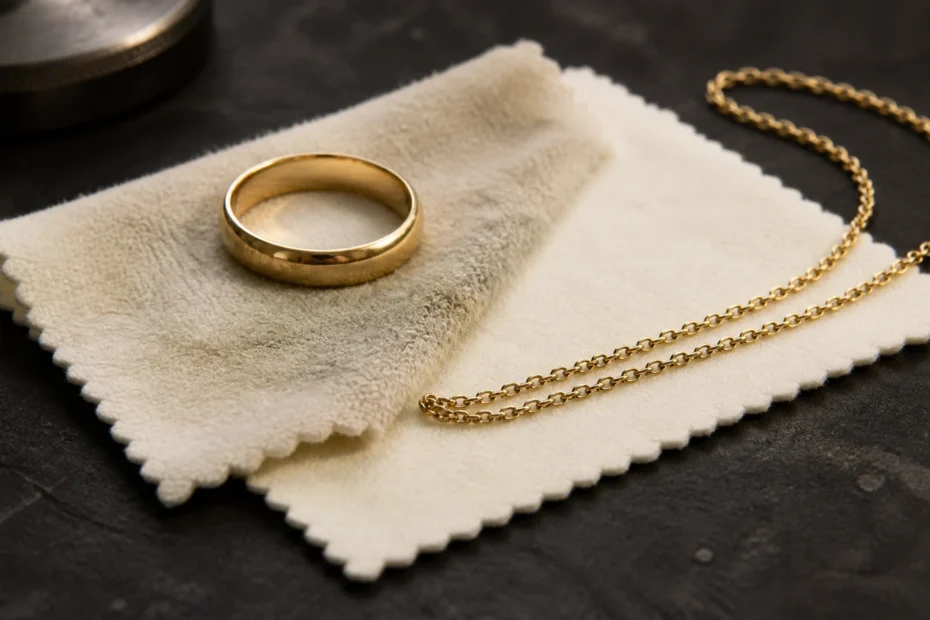
Compare gold polishing cloths for yellow, white, and plated gold, and learn when polishing can remove finishes or worsen damage.
- Use light pressure and stop when the cloth lifts visible metal.
- White gold and plated jewelry need extra caution.
- A cloth cannot repair deep scratches or loose settings.
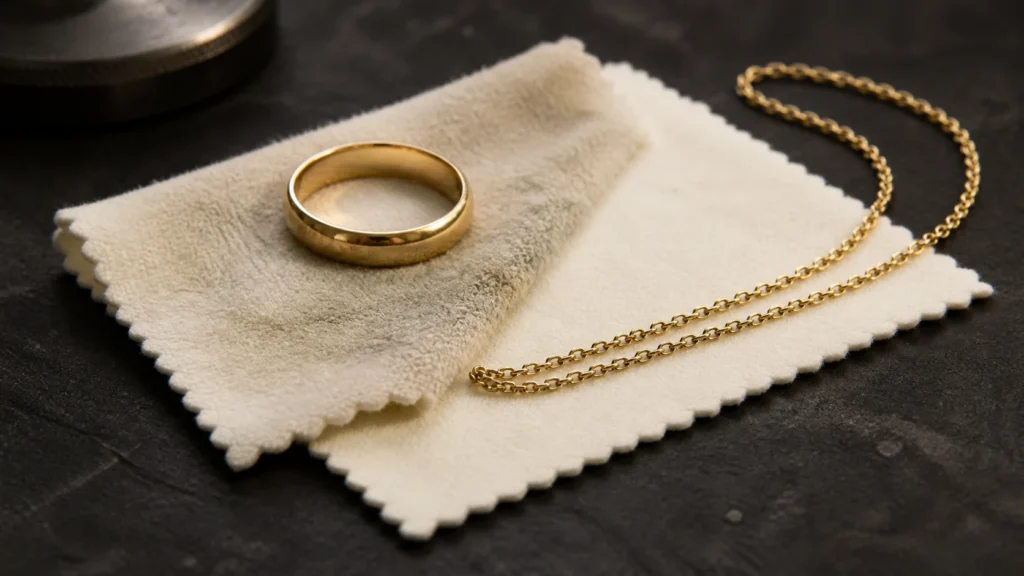
The best gold polishing cloth is a soft, clearly labeled cloth matched to the jewelry’s actual construction and finish. Two-step treated-and-buffing cloths are convenient for plain solid yellow gold, but white gold, vermeil, gold-filled, and plated pieces need lighter pressure or no polishing. A cloth can improve surface brightness; it cannot restore missing plating or erase deep scratches.
See the leading gold polishing cloth on Amazon →Connoisseurs extra-large cloth listing
- Identify solid gold, rhodium-finished white gold, gold-filled, vermeil, or plating before rubbing.
- Use very light pressure and a clean section of cloth.
- Do not wash a chemically treated cloth unless the manufacturer explicitly allows it.
- Stop if color transfers, plating appears thin, stones move, or scratches are deep.
- These are listing-based selections, not hands-on GoldConsul tests.
Recommended options

Connoisseurs Extra-Large Gold Polishing Cloth
Best for: Routine light polishing of suitable plain gold jewelry with a large two-step cloth format.
Avoid if: The piece is plated, matte-finished, oxidized by design, stone-set with damage, or needs scratch removal or replating.
Verify before buying: Confirm the listing is the gold version, review current care directions, and check whether the cloth is treated and intended to remain unwashed.

Mayflower Pro Size Polishing Cloth Set
Best for: Households that want two large cotton cloths for separately managed suitable gold, silver, and platinum items.
Avoid if: You may cross-contaminate metals, need a pocket cloth, or cannot keep treated surfaces separate from delicate finishes.
Verify before buying: Confirm pack quantity, cloth dimensions, supported metals, treated sides, washing instructions, and current manufacturer directions.

Sunshine Polishing Cloths, Five-Pack
Best for: Small-item maintenance when you want several individually manageable cloths stored together.
Avoid if: You need a gold-only formulation, a very large working surface, or plan to polish plated and delicate pieces without material checks.
Verify before buying: Check current pack count, cloth size, compatible materials, tube contents, and maker instructions before use.
Polishing is controlled abrasion or chemical-assisted surface cleaning. That can remove oils, tarnish from alloying metals, and very fine surface haze, but it may also remove a microscopic amount of metal or finish. The correct question is not “Will it make gold shine?” but “What surface am I willing to alter?”
Start with the markings and construction. The Gold Jewelry Markings guide explains why 14K, 585, GP, GF, RGP, vermeil, and 925 describe different materials. A cloth suitable for a plain 14K band may be the wrong choice for 14K GP.
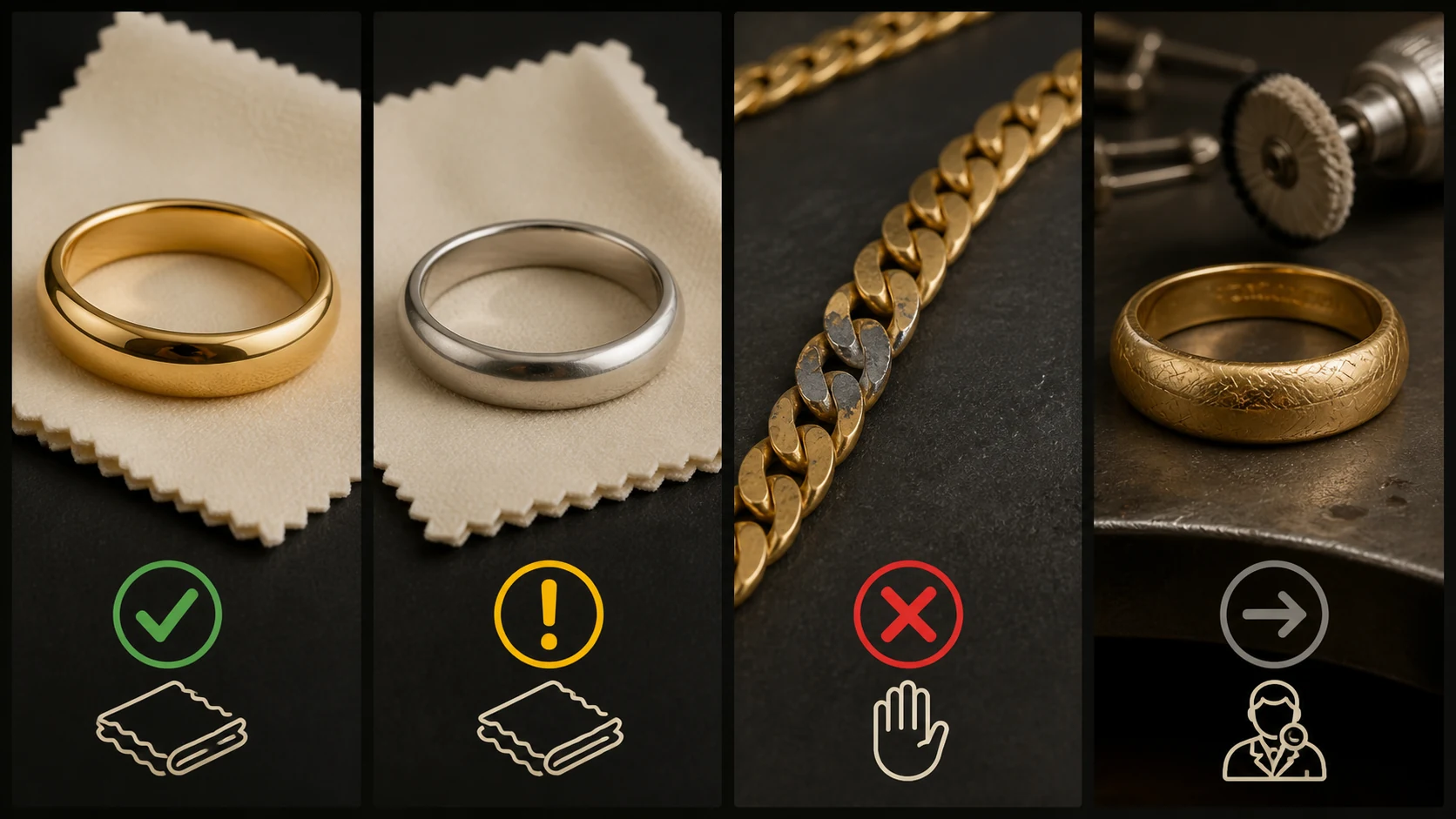
Choose a cloth by the job
Knowledge Gap: “scratch remover” often means “surface remover”
A cloth does not fill a scratch. It may reduce the visual contrast of microscopic marks by removing or smoothing surrounding material. Deep scratches, dents, pits, loose settings, and missing plating need professional evaluation rather than more rubbing.
Gold polishing cloths compared
| Cloth type | Best use | How it works | Main caution |
|---|---|---|---|
| Two-step treated cloth | Plain suitable gold with light film or haze | Inner or first cloth cleans/polishes; outer cloth buffs | Do not confuse sides or use aggressively on finishes |
| Untreated microfiber | Dust, fingerprints, and routine wiping | Lifts surface contamination with minimal chemistry | Dirty cloth or trapped grit can still scratch |
| Jeweler’s rouge cloth | Controlled polishing on compatible metals | Fine abrasive compound refines the surface | Can alter finish and remove material; avoid plating |
| Disposable jewelry wipe | Convenient travel cleaning for listed materials | Pre-treated single-use surface wipe | Formula, residue, gemstones, and finish compatibility vary |
| Professional buffing system | Refinishing and scratch work | Motorized wheels and graded compounds | Not a beginner substitute; can change shape, edges, and detail |
The Gemological Institute of America notes that a soft cloth is a generally safe way to remove dust and oils, while warning that jewelry materials and treatments require different cleaning methods. That is a better baseline than assuming a treated cloth is universal.
The Federal Trade Commission’s jewelry guidance distinguishes solid-gold alloy from gold-filled, gold-plated, and vermeil products. The construction tells you how much surface layer exists to wear through.
For a product-specific chemistry reference, Connoisseurs publishes a safety data sheet for its gold and silver polishing kit. Read the current package directions and safety information for the exact cloth you buy.
How to use a gold polishing cloth safely
- Identify the construction. Confirm solid gold, white-gold finish, gold-filled, vermeil, or plating.
- Inspect the jewelry. Stop for loose stones, cracked enamel, lifted plating, bent links, deep scratches, or unknown antique finishes.
- Remove loose grit. Follow the jewelry maker’s gentle cleaning advice before rubbing a dusty surface.
- Test a hidden area. Use a clean section with very light pressure and inspect both jewelry and cloth.
- Polish briefly. Work in small areas; do not chase every mark or press harder when progress stops.
- Buff and inspect. Use the clean finishing side as directed, then check color, finish, edges, and settings under good light.
- Store separately. Keep the used cloth away from jewelry surfaces and do not mix residues between metals.
When not to polish
- The plating is already thin, patchy, or showing another color.
- The white-gold ring looks yellow because its rhodium finish is worn; read Does White Gold Turn Yellow?.
- The piece has a deliberate matte, brushed, oxidized, antique, engraved, or patinated finish.
- A stone is loose, glued, fracture-filled, porous, or of unknown treatment.
- The surface has deep scratches, dents, cracks, porosity, or damaged solder.
- The item is historically or artistically important and conservation value matters.
For routine chain care, use How to Clean Gold Chains Safely. For white-gold-specific care, use How to Clean White Gold. For layered jewelry, see Does Gold Vermeil Tarnish? and How Long Does Gold-Filled Jewelry Last?.
Keep a simple care record for valuable pieces: note the cloth, date, surface condition, and any color transfer before and after use. Repeated polishing that seems harmless in one session can gradually soften crisp edges, engraving, hallmarks, or a contrasting finish. Photographs under the same light make that cumulative change easier to notice.
Editorial Perspective
Stop polishing when the improvement becomes slow. That is often the point where more pressure changes the finish instead of removing ordinary film. For a valuable, plated, white-gold, antique, or stone-set piece, professional inspection is cheaper than correcting an over-polished surface.
Video: how a jeweler’s polishing cloth is used
This demonstration shows the light-pressure technique and how a treated cloth differs from an ordinary rag. Apply the material and finish checks above first.
Bottom line
The best gold polishing cloth is the one matched to the real surface in front of you. Use a clean, clearly labeled cloth with light pressure on suitable solid gold, and treat white-gold finishes, gold-filled, vermeil, and plating as limited surfaces.
Continue with the Gold Jewelry Guide for construction, buying, wear, cleaning, and resale decisions.
FAQ: best gold polishing cloth
Can a polishing cloth remove scratches from gold?
It may reduce very fine surface haze, but it does not fill scratches. Deep marks require professional refinishing, which removes and reshapes material.
Can I use a gold polishing cloth on white gold?
Use caution. Many white-gold pieces have a rhodium finish. A cloth cannot replace worn plating and aggressive polishing may alter the surface.
Can I polish gold-plated jewelry with a treated cloth?
Gentle cleaning is usually safer. Treated or abrasive cloths can accelerate wear of a thin plated layer, especially at edges and high-contact areas.
Should I wash a gold polishing cloth?
Do not wash a chemically treated cloth unless the manufacturer explicitly says it is washable. Washing may remove the active treatment.
Why does a polishing cloth turn dark?
The cloth can collect removed contamination, tarnish products, compound, and tiny amounts of surface material. Darkening is not by itself proof that the jewelry is fake.
 When you purchase a service or a product through our links, we sometimes earn a commission, at no extra cost to you.