

Gold as a Service explained: how shared digital gold infrastructure could work, what it may improve and which risks remain.
- Shared infrastructure—not a retail token or product
- Physical gold, operations and issuers remain separate layers
- Legal rights and redemption still require due diligence

Gold as a Service is a proposed shared market infrastructure that connects identifiable physical gold in custody with standardized digital records, operations and product issuance. It is not itself a retail token or investment product. It could make reconciliation and transfers more efficient, but it would not remove legal, custody, issuer, liquidity or redemption risk.
TL;DR
- Gold as a Service separates the physical gold layer, a shared operational layer and the products built by banks or issuers.
- The World Gold Council proposal aims to reduce duplicated records and fragmented processes across custody, ownership and settlement.
- Investors would still need to check title, allocation, audits, fees, redemption rights and insolvency treatment for the specific product they buy.
Digital gold is often described as if adding a token to a blockchain solves every old market problem. It does not. A digital record is useful only when it corresponds to enforceable rights over identified metal and when the organizations behind it can reconcile, transfer and redeem those rights reliably.
The World Gold Council’s Gold as a Service concept approaches the issue from below the product layer. Instead of proposing one more coin or app, it describes common infrastructure that multiple financial firms could use.
What is Gold as a Service?
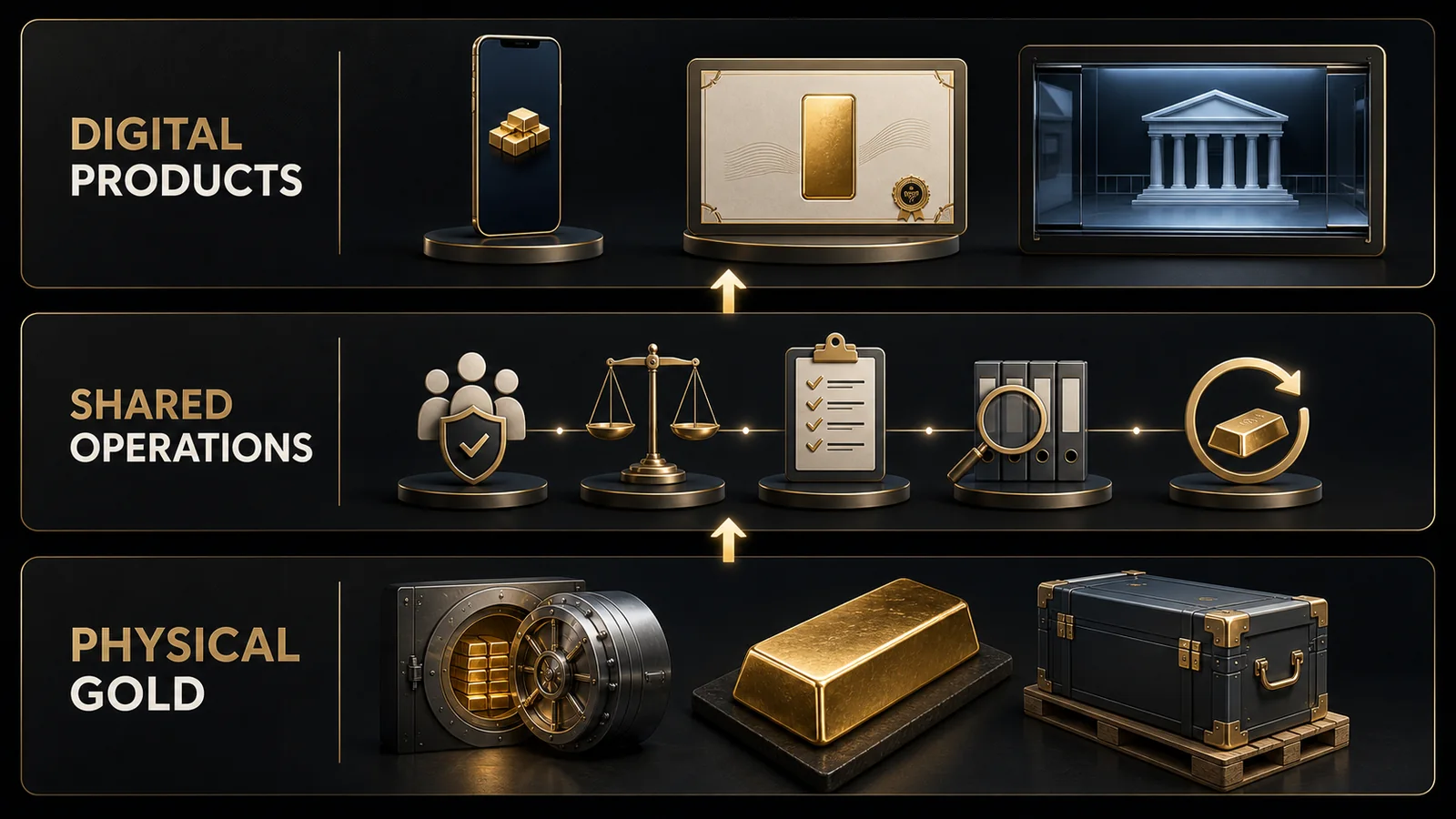
Gold as a Service, or GaaS, is a shared infrastructure model for recording and operating gold ownership and transfers. Physical bars remain in professional custody; standardized data and workflows sit above them; regulated issuers can then create distinct wholesale or retail products using that common foundation.
The name can be confusing because “as a service” usually suggests a subscription. Here, the service is institutional infrastructure. A consumer would not normally buy GaaS directly any more than a cardholder buys the payment network beneath a bank card.
The problem it is trying to solve
The wholesale gold market already moves large values securely, but records can be distributed across vaults, banks, brokers, product issuers and settlement systems. Each organization may maintain its own view of the same asset or transaction. Matching those records takes time, integrations and human controls.
Digital-gold providers frequently rebuild similar custody, ledger, compliance and reporting functions. That duplication can create inconsistent data formats and makes it harder for products from different issuers to interact. The World Gold Council’s case for shared infrastructure argues that common rails could improve trust and efficiency without eliminating competition at the product layer.
The three layers in plain English
| Layer | What sits there | The key question |
|---|---|---|
| Physical gold | Standard bars, vaults, custodians, inspection and bar-level information | Does the metal exist, meet the required standard and remain securely controlled? |
| Shared operations | Ledger records, reconciliation, permissions, compliance events and transfers | Do all authorized participants agree on ownership and status? |
| Products and issuers | Bank accounts, securities, tokens or other customer-facing claims | What legal right does the buyer receive, and from whom? |
This separation is important. Perfect software at the operational layer cannot repair a weak legal claim at the product layer. Likewise, a carefully drafted product is still vulnerable if the underlying metal is missing, double-counted or inaccessible.
How a transaction could work
- Eligible gold enters custody. A professional vault records the bar and its required attributes.
- The infrastructure recognizes the metal. Authorized data links the physical holding to an operational record.
- An issuer creates a product. A bank or regulated provider defines the customer’s contractual or property rights.
- A customer buys or receives an interest. Cash, identity checks and permissions are handled according to the product rules.
- Records and ownership are reconciled. The shared layer updates the relevant participants rather than relying on separate manual ledgers.
- The interest is sold, transferred or redeemed. The product rules determine whether settlement occurs in cash, digital units or physical gold.
This is a conceptual workflow, not evidence that every provider currently follows it. The World Gold Council has announced its intention to develop shared infrastructure, but standards, participating firms and product rights still require specific documentation.
Gold as a Service is not the same as tokenized gold
A tokenized-gold product gives its holder a particular digital unit and a defined claim—ideally backed by vaulted metal. GaaS is the infrastructure that could support multiple such products. One is the vehicle a customer may own; the other is the road beneath it.
| Format | What the holder owns | Typical access | Main diligence issue |
|---|---|---|---|
| Physical bullion | The bar or coin itself | Dealer, vault or direct possession | Authenticity, premium, storage and resale |
| Gold ETF | Shares in a fund or trust | Brokerage account | Fund structure, fees and market price |
| Vaulted digital account | A contractual or property interest defined by the provider | App or web platform | Allocation, custody, audit and withdrawal |
| Tokenized gold | A token with issuer-defined rights | Wallet, platform or exchange | Issuer, smart contract, backing and redemption |
| Gold as a Service | Nothing by itself; it is infrastructure | Used by institutions and product issuers | Governance, standards and participant responsibilities |
Read our separate explanations of gold-backed cryptocurrencies, blockchain in the gold trade and gold ETFs before comparing products that use similar marketing language but provide different legal rights.
Allocated versus unallocated still matters
Technology does not erase the oldest distinction in professional bullion accounts. The London Bullion Market Association explains that an allocated account identifies specific bars held for a customer, while an unallocated balance is generally a claim against the account provider for a quantity of metal.
If a digital product says it is “backed by gold,” ask whether your interest is allocated, pooled, beneficial, contractual or merely an unsecured obligation. Also ask when allocation occurs: continuously, once per day, or only after a redemption request.
Our guide to allocated versus unallocated gold explains how custody and counterparty exposure can differ. The product’s legal documents outrank its interface or marketing label.
Shared standards could also improve bar provenance and reporting. If permissions and data history are designed well, authorized participants may see a clearer chain from physical custody to the current product claim.
Efficiency gains are not automatic. Common infrastructure concentrates governance questions: who can write or correct records, who validates custodians, how errors are resolved and what happens when a participant fails?
What Gold as a Service cannot guarantee
- Solvency: an issuer or service provider can still fail.
- Legal ownership: rights depend on contracts, jurisdiction and account structure.
- Immediate redemption: minimum sizes, delivery locations, fees and waiting periods may apply.
- Perfect liquidity: a product still needs willing buyers, market makers or a functioning redemption mechanism.
- Cybersecurity: shared digital systems introduce access-control, key-management and software risks.
- Price stability: gold exposure can rise or fall regardless of the quality of its infrastructure.
The London Bullion Market Association’s analysis of tokenisation challenges and blind spots reinforces the basic point: technology must connect cleanly to legal title, market practice and physical settlement.
Knowledge Gap: the token is not the trust layer
Most digital-gold explainers focus on blockchain speed or fractional ownership. The harder problem is the chain of responsibility between a digital entry and a bar in a vault. Who owns the gold during insolvency? Who verifies the bar list? Who absorbs a reconciliation error? Can a small holder redeem economically?
Gold as a Service is interesting because it targets this hidden operational layer. It should still be judged by governance and enforceable rights—not by the word “digital.”
A nine-point due-diligence checklist
- Legal right: identify whether you own metal, a security, a token or a claim against a company.
- Backing: confirm whether the product is fully backed and how often balances are reconciled.
- Custody: find the custodian, vault jurisdiction and permitted sub-custodians.
- Evidence: look for independent audits, assurance reports and usable bar lists.
- Redemption: check minimum quantities, locations, delivery form, timing and charges.
- Fees: include trading spreads, storage, platform, network and withdrawal costs.
- Insolvency: understand whether customer assets are segregated from company creditors.
- Liquidity: identify who provides a bid and what happens during stressed markets.
- Technology: review wallet custody, account recovery, smart-contract controls and incident history.
Compare these answers with the simpler routes in our guides to ways to invest in gold and where to store physical gold. A sophisticated structure is useful only if its extra convenience justifies its extra dependencies.
The GoldConsul Editorial Perspective
Gold as a Service is a credible attempt to modernize the plumbing beneath digital gold, but it should not be treated as proof that every future product is safe. The reader’s shortcut is simple: trace the claim from screen to issuer, from issuer to custodian, and from custodian to identifiable metal. If any link is vague, the product is not yet easy enough to trust.
Video context: This short explainer shows what a consumer-facing tokenized-gold product can look like. Gold as a Service would sit beneath such products as shared infrastructure; it is not the token shown in the video.
Bottom line
Gold as a Service proposes a common operational bridge between vaulted metal and multiple digital products. Its potential benefits are better reconciliation, standardized records and easier product development.
Its limits are equally important. Infrastructure cannot replace legal ownership, independent verification, reliable custody or practical redemption. Evaluate the specific product and issuer, not the architecture label alone.
This article is educational and does not constitute financial, investment, legal, tax or technology advice. Digital-gold products can involve market, issuer, custody, liquidity, cybersecurity and regulatory risk.
FAQ: Gold as a Service
Can an individual investor buy Gold as a Service?
Not as a standalone asset. GaaS is proposed infrastructure for institutions and issuers. An individual might buy a product built on it, subject to that product’s own availability and rules.
Is Gold as a Service a cryptocurrency?
No. It is an infrastructure model and does not require the buyer to own a cryptocurrency. Issuers could potentially use it to support tokens, securities, accounts or other forms of gold exposure.
Does GaaS mean every unit is backed by a specific bar?
Not automatically. Bar identification, allocation and ownership depend on how the infrastructure and customer product are designed. Buyers must verify the specific product documentation.
Could I redeem a digital holding for physical gold?
Possibly, but redemption is a product-level right. Minimum sizes, fabrication, delivery location, fees and identity checks can make physical withdrawal impractical for small balances.
What is the biggest risk in digital gold?
There is no single risk. The critical chain includes legal title, issuer solvency, custody, evidence of backing, cybersecurity, liquidity and redemption. A failure at any link can matter.
 When you purchase a service or a product through our links, we sometimes earn a commission, at no extra cost to you.