
Compare nugget specialists, dealers, auctions and refiners. Learn valuation, provenance, fees, safe payment and the net-offer formula.
- Natural-gold specialists and collector auctions may recognize specimen value that a refiner will not.
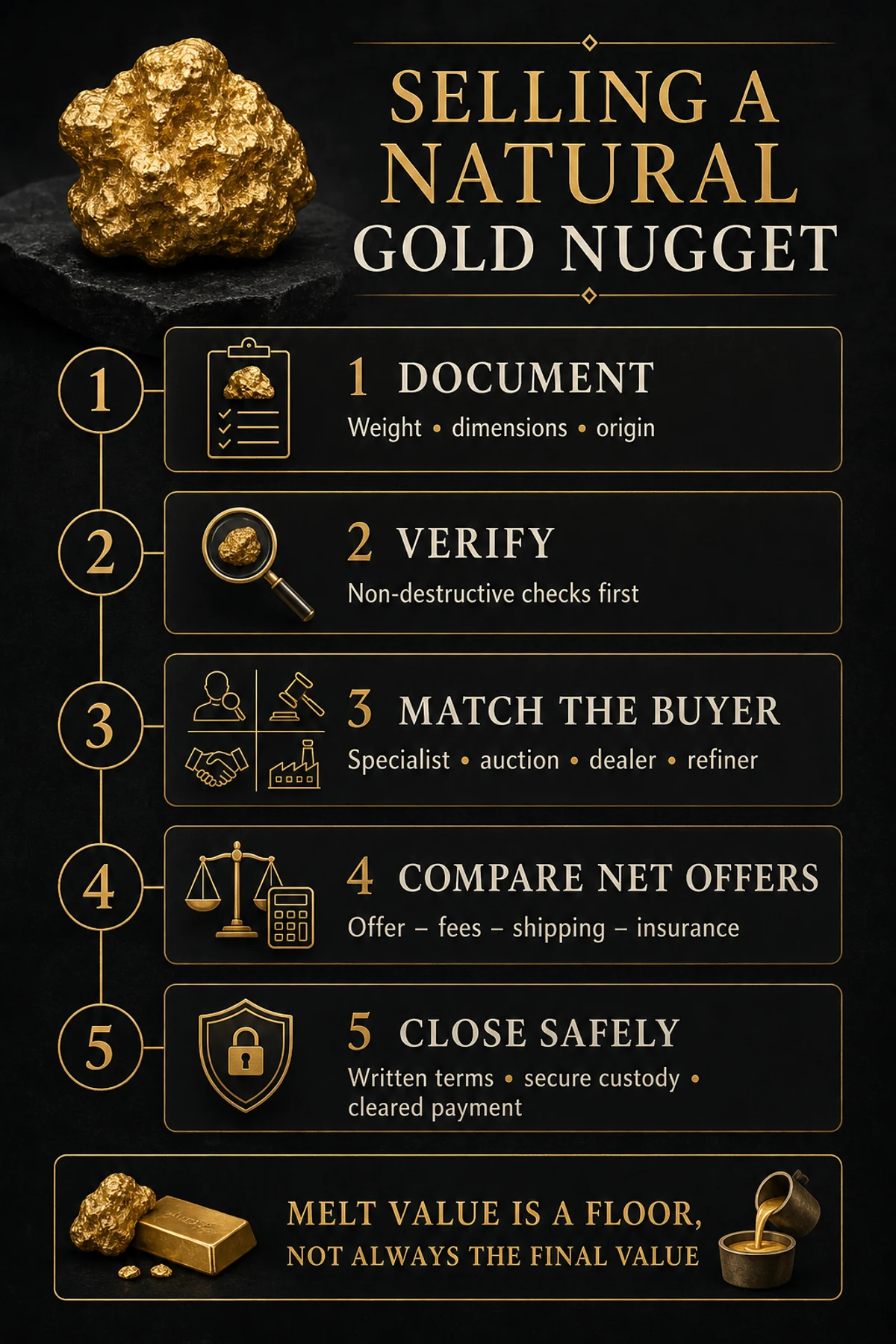
- Document weight, dimensions, origin and ownership before requesting comparable written offers.
- Choose by verified net proceeds and transaction safety – not the highest unsupported headline quote.
- Melt value is a useful floor, not automatically the final value of a natural specimen.
- Shape, size, quartz matrix, locality and documented ownership can affect collector demand.
- Request comparable offers: same weight, same assumed fineness and every fee shown.
- Use insured shipping or an established in-person counter with a written intake record.
- Keep acquisition and sale records; ownership and tax treatment depend on facts and jurisdiction.
The best buyer depends on the nugget
A refiner sees recoverable metal. A specimen collector may see an unusual natural form that should never be melted. That difference is why “who pays the highest percentage of spot?” is the wrong first question when deciding where to sell natural gold nuggets.
Your first job is to classify the piece well enough to choose a market. Your second is to compare what you would actually receive after commissions, testing, shipping, insurance and possible return costs.
Where to sell natural gold nuggets
| Channel | Best fit | Main advantage | Main trade-off |
|---|---|---|---|
| Natural-gold specialist | Distinctive placer nuggets, crystalline pieces or specimens with quartz | Understands specimen appeal and specialist buyers | Offer quality varies; provenance and clear photographs matter |
| Collector auction | Rare, aesthetic, large or well-documented specimens | Competitive bidding may reveal collector value | Commission, photography, insurance, reserve and settlement delay |
| Established local bullion/coin dealer | Ordinary nuggets when speed and face-to-face settlement matter | Immediate inspection and simpler custody | May value mainly on recoverable gold rather than natural form |
| Precious-metals refiner | Small mixed placer lots, unattractive pieces or material intended for melt | Transparent focus on recoverable fine gold | Collector premium is normally lost; assay and refining terms apply |
| Direct private sale | Seller already knows a qualified collector | Potentially fewer intermediary fees | Highest burden for authentication, payment, security and disputes |
Melt value and specimen value are different
Native gold is rarely assumed to be 24K without evidence. The U.S. Geological Survey explains fineness as parts of gold per thousand and gives the example of an 885-fine nugget containing 885 parts gold and 115 parts other metals. A broader USGS review of native-gold composition notes that fineness can vary among localities and even within a nugget.
That means weight alone does not establish fine-gold content. Use a documented professional result when the value justifies it, and avoid destructive drilling, filing or acid testing on a specimen that may carry collector value.
The result is a reference, not a guaranteed payout. A commercial buyer still accounts for uncertainty, processing, margin and transaction cost. A collector may instead pay for form, rarity and locality—but only if those attributes are credible and desirable.
What can create collector value?
- Natural form: crystalline structure, branching, wire-like form, unusual texture or an appealing silhouette.
- Size: larger intact nuggets are scarcer, but size does not guarantee aesthetic or locality value.
- Matrix: well-balanced gold in quartz can be a mineral specimen; excess host rock also complicates net-gold estimates.
- Locality: a specific, documented mining district may matter more than a vague regional claim.
- Provenance: dated find notes, photographs, claim permission, prior invoices and a consistent ownership trail reduce uncertainty.
- Condition: polishing, acid cleaning, solder, repair or removed matrix can damage natural and evidentiary value.
Do not invent a rarity story. A buyer should be able to distinguish what you know, what another person reported and what remains unverified.
Prepare a decision-grade nugget file
- Weigh the dry nugget on a calibrated scale and record the unit.
- Photograph every side in diffuse light beside a millimeter scale.
- Record maximum dimensions and whether quartz or other matrix is present.
- Write down when, where and how it was acquired, without publishing a sensitive claim location.
- Preserve receipts, find photographs, claim permission and prior test reports.
- Ask whether the buyer’s test is destructive and who pays if you reject the offer.
- Number the package and photographs so the returned object can be matched.
For authenticity, follow a layered process rather than one trick. GoldConsul’s guide to telling whether gold is real explains why hallmarks, density, XRF and assay answer different questions. A magnet or color impression cannot establish the fineness of native gold.
Worked example: compare net proceeds, not headlines
Assume a 20.0-gram nugget is professionally estimated at 900 fine. Its fine-gold weight is about 0.5787 troy ounce. Using a deliberately round, non-live reference price of $2,000 per troy ounce, the reference melt value would be about $1,157.
| Offer | Headline | Costs | Illustrative net |
|---|---|---|---|
| Local dealer | $1,100 immediate offer | No listed fee | $1,100 |
| Specialist consignment | $1,500 sale | 10% commission + $75 insured logistics | $1,275 |
| Refiner | 98% of confirmed fine-gold value | $45 assay/processing | About $1,089 |
The specialist route wins in this scenario, but only after a buyer actually pays $1,500. Estimates are not settlements, and a reserve that is too high can produce no sale.
How to compare buyers safely
Ask each buyer to state the assumed weight, fineness, valuation basis, all fees, payment timing and return procedure. The CFTC and FINRA physical-metals advisory recommends checking a dealer’s real address and history, getting costs in writing and understanding the spread. Although written for buyers, the same counterparty checks protect a seller handing over an irreplaceable object.
- Reject pressure to ship immediately or accept a quote that expires in minutes.
- Do not mail to a personal name or unrelated payment entity.
- Use insurance that actually covers precious metals and natural specimens; ordinary carrier limits may not.
- For in-person sales, meet at an established commercial location with documented intake—not a car, hotel room or private home.
- For remote sales, keep packing photographs, weight records, tracking and the signed receipt.
- Confirm whether payment can be reversed and wait for cleared funds before treating the transaction as final.
Ownership, claims and tax records
A beautiful nugget is not marketable if ownership is doubtful. The Bureau of Land Management explains that a mining claim asserts a possessory right to develop and extract a valuable mineral deposit. Its rockhounding guidance also warns that collection on active claims is restricted and generally describes casual public-land collecting as noncommercial. State, federal, tribal, private-land and claim rules can differ.
In the United States, IRS Publication 544 distinguishes metals held as capital assets from inventory held by a dealer. Your acquisition method, holding purpose and business activity can change reporting. Keep the find or purchase record, testing cost, selling fees and settlement statement, then use a qualified tax professional for your facts.
This guide is general education, not a personalized appraisal, financial recommendation, legal opinion or tax advice. Market demand, land rights, reporting and transaction rules vary. Verify title to the material and use qualified local professionals when the value or uncertainty is material.
There is no universal published premium schedule for natural gold nuggets. Collector value is negotiated specimen by specimen, while fineness may be heterogeneous and visible matrix changes the relationship between gross weight and gold content. Treat fixed premium percentages without comparable evidence as marketing, not a valuation rule.
The practical takeaway is to preserve optionality. Document and show an attractive nugget to a specialist before any destructive test or melt decision. If the extra specimen offer does not survive commissions, logistics and payment risk, the simpler metal-value route may still be the better sale.
Video walkthrough: Video context: a prospector compares practical routes for selling placer gold.
Bottom Line
The best place to sell a natural gold nugget is the buyer whose expertise matches the piece and whose written net offer survives verification. Establish ownership, preserve the natural surface, document the nugget, compare at least two relevant channels and control custody through cleared payment.
FAQ: Selling Natural Gold Nuggets
Do gold nuggets sell for more than melt value?
Some do, especially attractive, large, crystalline or well-documented specimens. Ordinary small placer pieces may trade near a recoverable-gold basis, and no premium is guaranteed.
Should I assay a natural gold nugget before selling it?
Testing can reduce fineness uncertainty, but destructive sampling may harm specimen value. Ask a specialist whether non-destructive screening and provenance are sufficient before drilling, filing or cutting.
Will a pawn shop buy a gold nugget?
Some may, but the offer may focus on metal value and rapid resale. Compare it with an established precious-metals dealer or natural-gold specialist and get the calculation in writing.
Can I sell a nugget I found on public land?
Not automatically. Rights depend on the land, claim status, collection rules, permits and how the nugget was obtained. Verify the specific land and mineral rights before offering it for sale.
What records should I keep after the sale?
Keep acquisition or find records, photographs, weight and test reports, buyer correspondence, shipping evidence, fees and the final settlement. These records help with disputes, provenance and tax reporting.
Sources and verification
Use these primary and specialist references to verify the technical, legal or market framework behind the guide.
- USGS — Gold in Minerals and the Composition of Native Gold — Native-gold composition and fineness vary, including within and among nuggets.
- USGS — Gold — Explains native gold, nuggets and fineness with an official example.
- BLM — Mining Claims — Claim holders assert possessory rights to develop and extract locatable minerals.
- BLM — Rockhounding — Public-land collection is restricted in active claims and is generally noncommercial.
- CFTC/FINRA — 10 Things to Ask Before Buying Physical Metals — Dealer checks, spreads, written fees and fraud warnings also inform safe resale counterparties.
- FINRA — Golden Rules for Physical Precious Metals — Due diligence, high-pressure tactics, documentation and fee transparency.
- IRS Publication 544 — U.S. treatment depends on whether gold is a capital asset or dealer inventory.
- IRS Publication 550 — U.S. collectibles context for metals, with fact-specific tax treatment.
- Vo-Gus Prospecting — Three Ways To Sell Your Placer Gold — Practical video context for placer-gold selling routes.
 When you purchase a service or a product through our links, we sometimes earn a commission, at no extra cost to you.