
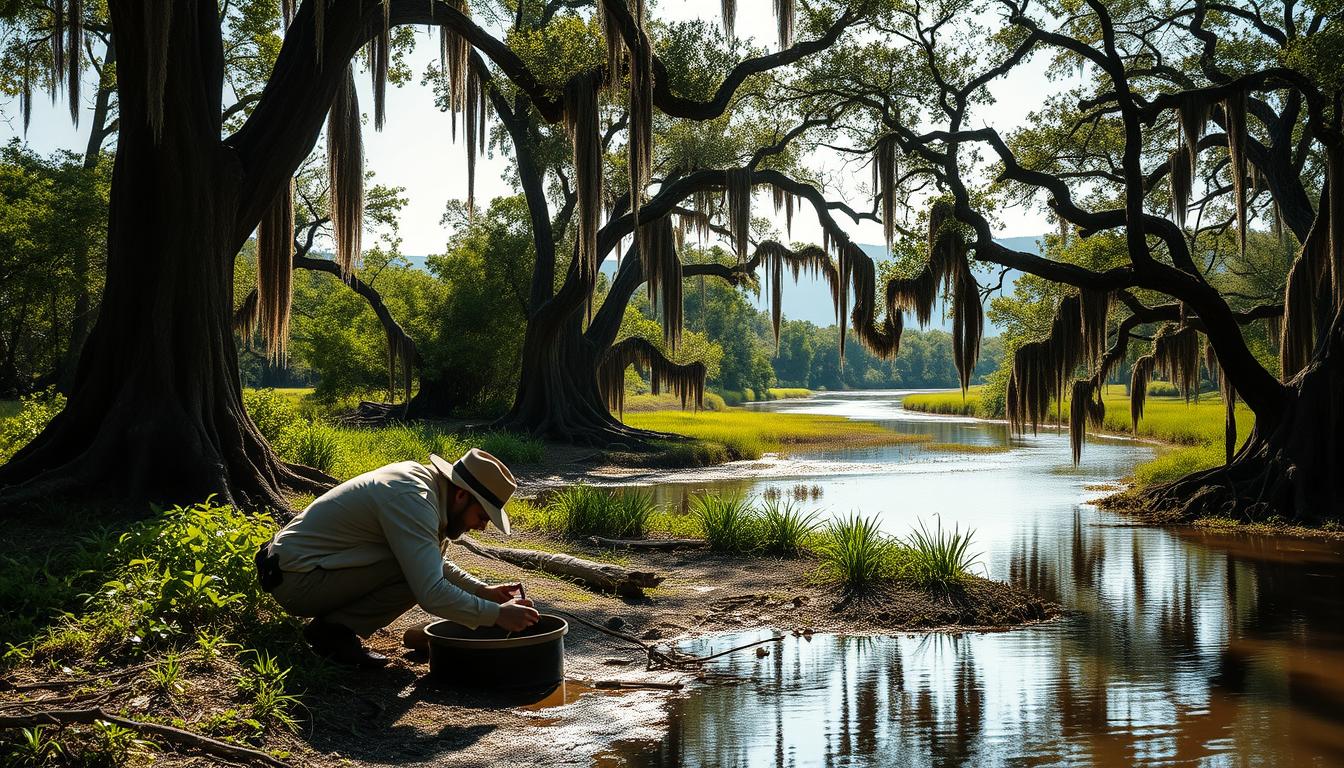
Find out why gold nuggets in Louisiana are unlikely, what geology and placer evidence suggest, and how to judge local prospecting claims realistically.
- Expect trace or flour gold reports, not realistic native nuggets.
- Use Louisiana geology to filter hype before planning field work.
- Test claims against documented nugget regions and mineral records.
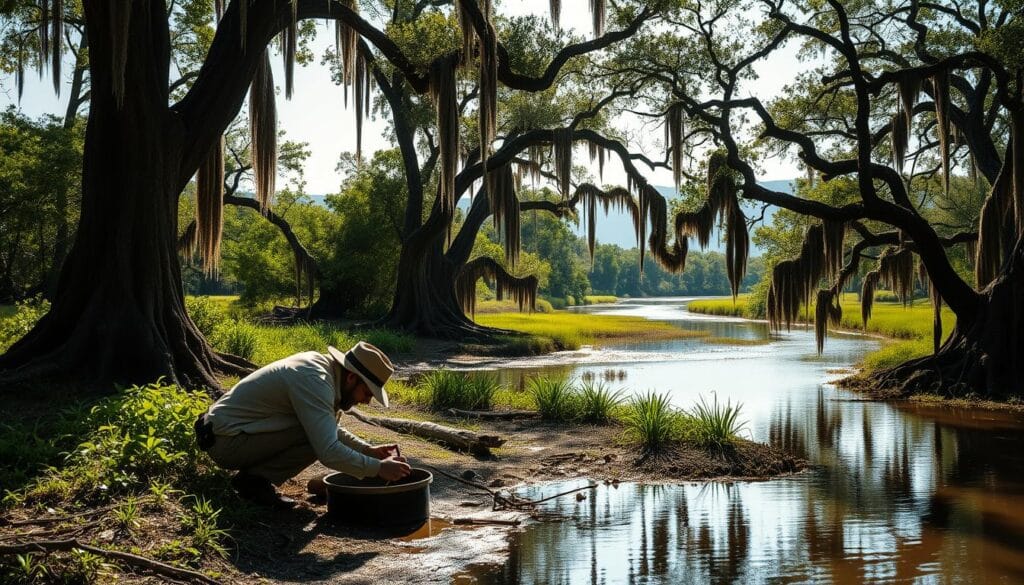
Gold nuggets in Louisiana are not a realistic expectation for most prospectors.
That does not mean every Louisiana gold story is automatically fake. It means the state does not have the hard-rock gold belts, major placer systems, or documented nugget-producing history that define real gold-nugget regions.
The useful answer is blunt: if you are in Louisiana, think trace gold, testing, and geology reality first. Do not plan around finding native nuggets.
TL;DR
- Louisiana is not a serious gold-nugget state.
- Small trace or flour-gold reports are different from native gold nuggets.
- The USGS mineral profile for Louisiana emphasizes industrial minerals, not gold as a meaningful state commodity.
- Many Louisiana “gold” finds are more likely to be mica, pyrite, brass fragments, iron staining, or relocated material.
- If you want real Southeast gold history, Georgia, Alabama, and North Carolina are stronger comparisons than Louisiana.
What Most Readers Miss
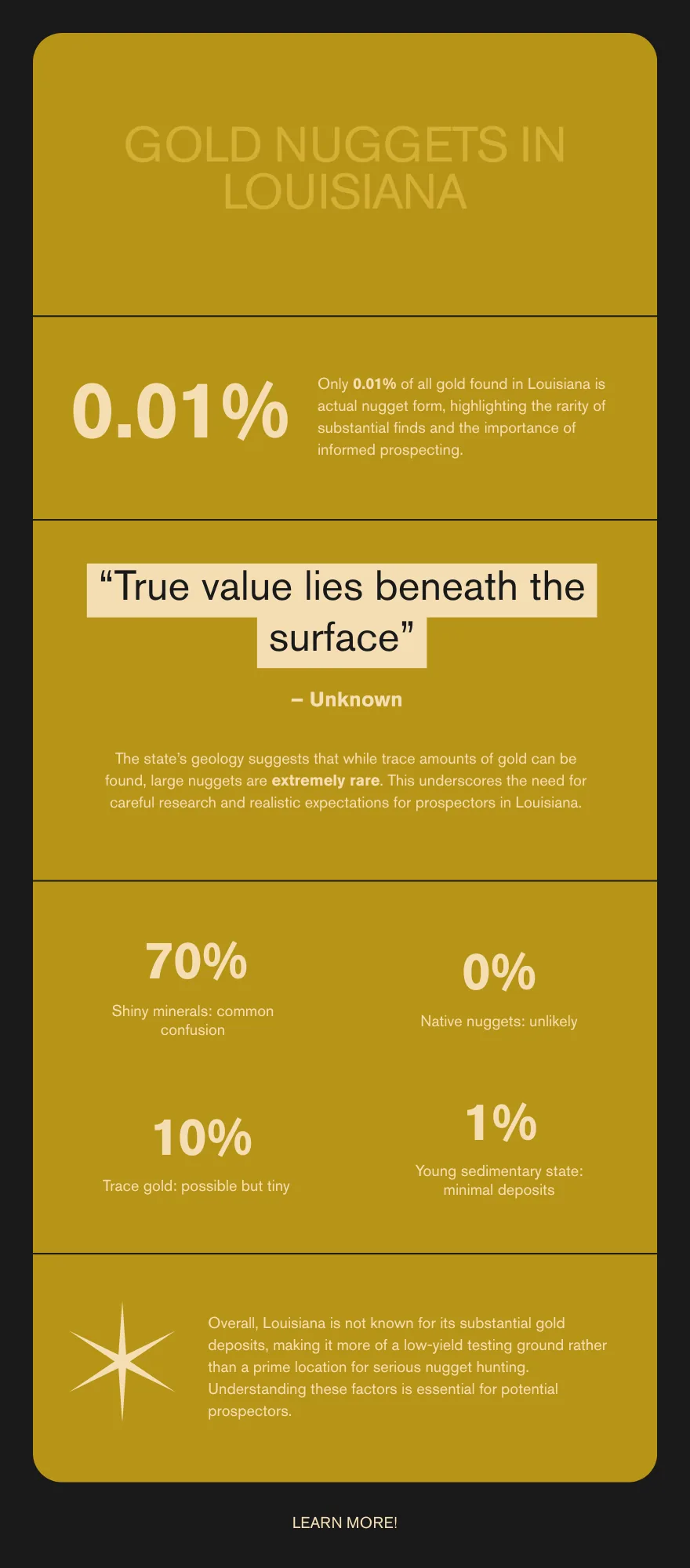
The mistake is treating every shiny flake, creek rumor, or prospecting-location list as evidence for natural Louisiana nuggets. The better distinction is simple: trace gold and gold-colored material are not the same thing as a nugget-producing gold province.
Fine gold:
Possible in tiny traces, but usually not enough to support serious recovery expectations.
Native nuggets:
Unlikely because Louisiana lacks the classic nugget-forming gold-district setting.
Better filter:
Ask whether a claim is geological, historical, or just prospecting copy.
Are Gold Nuggets In Louisiana Realistic?
For practical purposes, no.
Louisiana is not known as a natural gold-nugget state. Its mineral economy and geology point in a different direction, with industrial minerals and sedimentary resources carrying far more weight than gold.
The USGS Louisiana fact sheet frames the state around water, energy, coastal, and sedimentary resource issues rather than gold-mining districts. That context matters because nuggets usually come from regions with stronger primary gold sources or meaningful placer concentration.
Louisiana’s landscape is dominated by young sediments, river systems, floodplains, deltaic deposits, coastal environments, and transported material.
That can create confusing finds. It does not create a strong native nugget case.
Chart 1: Louisiana Gold Reality Map
Conceptual likelihood by claim type, not a production estimate
Interpretation: Louisiana may produce confusing shiny material and occasional trace-gold discussion, but that is not the same as a real nugget-hunting state.
Why Louisiana Geology Works Against Gold Nuggets
Gold nuggets usually need a source and a concentration mechanism.
The source is commonly a hard-rock gold district, mineralized belt, or older gold-bearing terrain. The concentration mechanism is often erosion, stream sorting, and long-term placer concentration.
Louisiana does not fit that pattern well.
Its surface story is overwhelmingly sedimentary and river-built. The Mississippi River system, coastal plains, flood deposits, sands, clays, silts, and gravels define much of the state’s near-surface geology.
That creates two important reader rules:
- A shiny particle in Louisiana is not automatically gold.
- A trace-gold rumor is not evidence of nugget-forming local geology.
- A creek with heavy minerals still needs testing before anyone should call it gold-bearing.
This is where many online prospecting pages become too loose. They jump from “possible trace gold” to “places to find gold nuggets” without proving the middle step.
Fine Gold, Flour Gold, And Nuggets Are Different Things
One of the main problems with Louisiana gold content is category confusion.
A reader searching for nuggets may see language about flakes, colors, traces, or placer material and assume those are all the same opportunity. They are not.
Chart 2: Nugget Likelihood Vs Fine-Gold Likelihood
Reader filter for interpreting Louisiana gold claims
| Material type | What it means | Louisiana expectation |
|---|---|---|
| Gold-colored flakes | Could be mica, pyrite, brass, or other material | Most common confusion |
| Flour gold | Very fine particles that require careful recovery and testing | Possible in trace discussions, but not a strong target |
| Picker-sized gold | Small pieces large enough to pick up with tweezers | Unlikely as a normal expectation |
| Gold nuggets | Natural, visible gold pieces formed and concentrated in stronger gold settings | Not a realistic Louisiana baseline |
Interpretation: Louisiana prospecting claims should be read at the fine-trace level first. Nugget language needs much stronger evidence.
What About Reports Of Gold In Louisiana?
Some prospecting pages and hobby discussions mention small amounts of gold or possible gold-bearing material in Louisiana.
Those reports should not be ignored, but they should be scaled correctly. The question is not whether someone can ever pan a few interesting colors. The question is whether Louisiana should be treated as a realistic gold-nugget state.
Competitor pages like Pan for Treasure’s Louisiana gold overview are useful because they push back on the idea that Louisiana is a strong gold state. GoldRushNuggets also frames expectations around very small finds rather than large nuggets.
That is the right direction.
The GoldConsul position is even clearer: readers should not plan a Louisiana trip around finding native nuggets. If they prospect at all, they should treat it as a low-yield hobby and a testing exercise.
Louisiana Vs Real Southeast Gold States
The easiest way to understand Louisiana is to compare it with states that do have stronger gold-mining records.
Georgia, Alabama, and North Carolina all sit closer to historically meaningful gold belts and gold-mining narratives. Louisiana does not occupy that same role.
Chart 3: Southeast Gold Comparison
Relative historical/geological gold strength, simplified for reader orientation
| State | Gold history strength | Nugget/prospecting expectation | Best reader frame |
|---|---|---|---|
| Louisiana | Weak | Very low | Trace/testing curiosity, not nugget hunting |
| Georgia | High | More credible | Historic gold-rush state |
| Alabama | Meaningful | Regional potential | Southeastern gold-belt context |
| North Carolina | High | More credible | Early U.S. gold history |
Interpretation: Louisiana is the wrong state to use as a main nugget-hunting target. It makes more sense as a geology reality-check topic.
The GoldConsul Editorial Perspective
Louisiana gold content should be honest enough to disappoint a little. That is the useful version. A reader saves time and money by learning that Louisiana is a weak nugget state before buying gear, chasing vague creek names, or misidentifying shiny minerals.
When A Louisiana “Gold” Find Is Worth Testing
Testing can still make sense if the find has enough signals to justify the effort.
The goal is not to prove every shiny particle is gold. The goal is to avoid fooling yourself before you spend more time on the site.
- The material is heavy for its size and stays in the pan with black sand.
- It does not float, flash, or break apart like mica.
- It appears rounded or water-worn rather than flaky and sheet-like.
- It survives gentle handling without crumbling like pyrite.
- The location has a plausible heavy-mineral concentration setting, not just random shiny sand.
Even then, keep the claim modest.
A tiny suspicious particle is not a nugget. For a practical field workflow, use the same discipline described in our guide to identifying gold-bearing material and the broader explainer on what gold ore actually means.
When It Is Probably Not Gold
Most false alarms come from materials that look exciting in sunlight.
That is especially true in a state where the geology does not give you a strong gold baseline.
- Mica: flashy, light, sheet-like, and often moves differently than gold in water.
- Pyrite: brassy and brittle, often breaks or powders rather than flattening.
- Iron staining: creates gold-brown color but not metallic gold behavior.
- Brass or man-made fragments: possible in populated or disturbed waterways.
- Relocated material: gravel, fill, landscaping, and transported sediment can confuse the local-source question.
If a find depends entirely on color, it is not enough.
Gold identification needs behavior, density, context, and sometimes professional testing.
Legal And Access Reality
Louisiana prospecting should be approached as a permission-first hobby.
Do not assume a creek, gravel bar, park, wildlife area, or state-managed land is open for digging, sluicing, or metal detecting. Rules can change by landowner, agency, parish, and activity type.
The safer default is simple:
- get written permission on private land
- check park and agency rules before disturbing sediment
- avoid banks, wetlands, protected habitats, and archaeological areas
- do not use motorized or high-disturbance equipment without clear legal authority
For a neighboring-state contrast, compare Louisiana’s weak gold case with the more grounded regional discussions on gold mining in Georgia, gold mining in Alabama, gold mining in Florida, and gold mining in Tennessee.
The Practical Bottom Line
If your goal is to find real gold nuggets, Louisiana is a poor target.
If your goal is to learn panning technique, study heavy minerals, or test suspicious material carefully, Louisiana can still be an educational field setting. Just keep the expectation honest: trace-level curiosity is not the same as nugget country.
Video Summary: Gold Nuggets in Louisiana
This short visual summary explains the core distinction in the article: Louisiana can create shiny-mineral confusion and trace-gold curiosity, but it should not be treated as realistic nugget country.
FAQ: Gold Nuggets in Louisiana
Can you find gold nuggets in Louisiana?
Natural gold nuggets are not a realistic expectation in Louisiana. Trace or fine-gold discussions may exist, but that is very different from a nugget-producing state.
Is there any gold in Louisiana at all?
There may be small trace-level reports or suspicious heavy-mineral finds, but Louisiana is not recognized as a meaningful gold-mining state. Its official mineral profile does not present gold as a major resource.
Why do some websites list places to find gold in Louisiana?
Many prospecting pages use broad location language because readers search for places to try. The problem is that possible trace finds, local rumors, and shiny minerals do not prove nugget-grade opportunity.
What is most often mistaken for gold in Louisiana?
Mica, pyrite, brass fragments, iron staining, and other shiny heavy minerals can all look convincing at first glance. Weight, behavior in a pan, malleability, and proper testing matter more than color.
Which nearby states are better for gold prospecting history?
Georgia, Alabama, and North Carolina have stronger gold histories than Louisiana. They are better comparison points for readers trying to understand real southeastern U.S. gold geology.
 When you purchase a service or a product through our links, we sometimes earn a commission, at no extra cost to you.