
Learn what changes gold ring resizing cost, from added metal to stones and plating. Use the quote checklist before approving work.
- A plain band is easier to quote than a stone-set design.
- Sizing up may require matching gold and refinishing.
- Have a jeweler check feasibility before paying.
Gold ring resizing prices depend on the metal, size change, design, stone work and finish. Published U.S. examples include $44 for a gold resize in one mail-in service’s detailed price table (shipping extra) and $40–$150 at one Santa Monica studio for a simple gold band changed one or two sizes. These are individual provider prices, not a national average; ask for an itemized quote after the ring is inspected.
A ring that is loose or tight needs more than a guessed size number. The best next step is a professional measurement and a feasibility check, especially if the band has stones, engraving, hollow areas or a special finish.
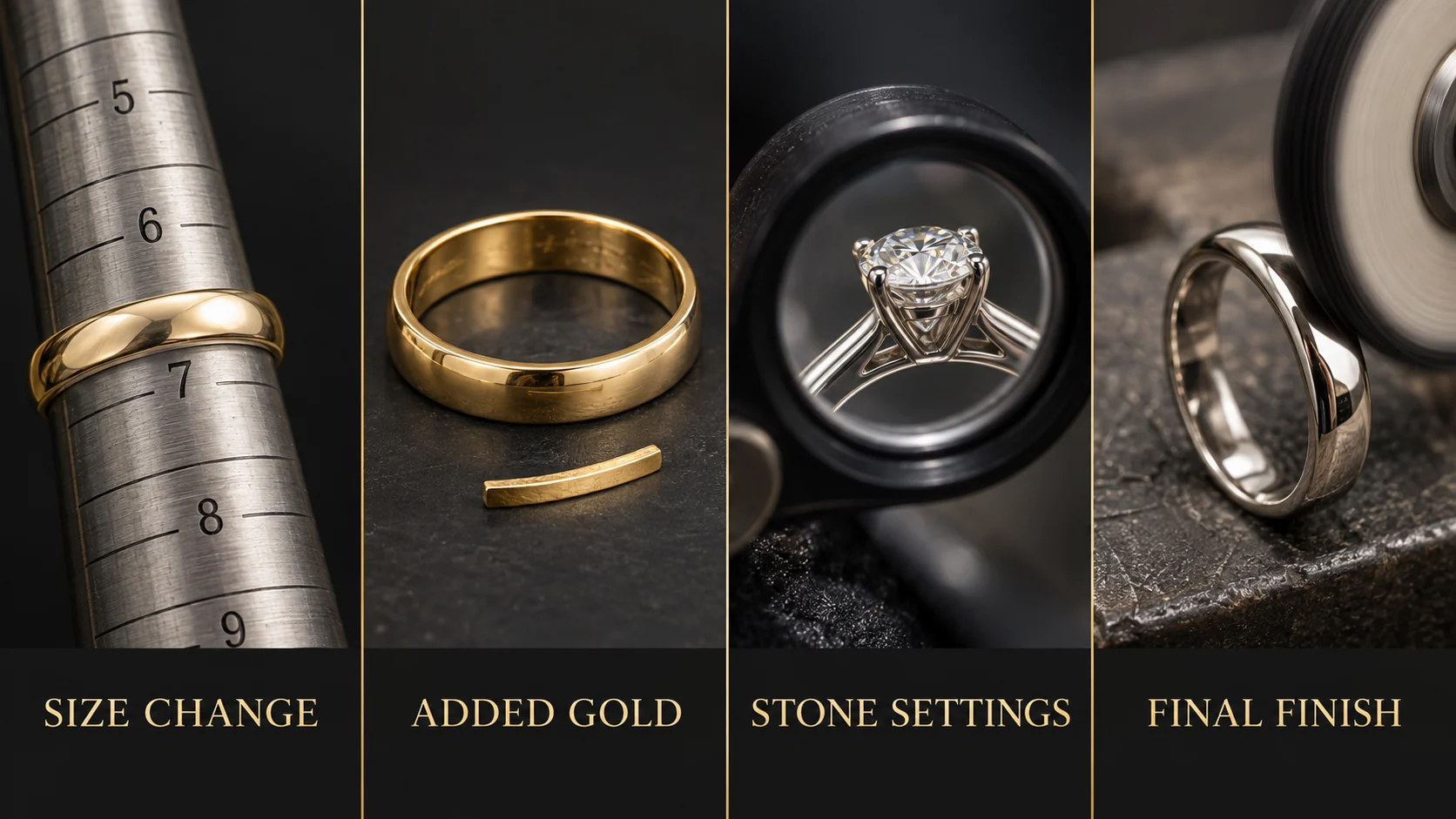
Why the quote changes
| Ring feature | Why it changes the job |
|---|---|
| Size down | May involve removing metal and joining the shank |
| Size up | May require added matching gold, not merely stretching |
| 10K, 14K or 18K alloy | Metal and color matching differ; karat alone does not set the labor price |
| Stones or prongs | Settings may need inspection and protection during work |
| Engraving, eternity design, plating | May need refinishing or make resizing impractical |
Ask the shop to list finish work separately. Polishing restores shine on a smooth surface; refinishing can restore a brushed, matte or patterned texture after the repair; rhodium plating adds a bright white surface layer to white gold. These are different jobs, and shops may use “finish” differently. Not every white-gold resize automatically includes replating, so agree on the planned finish and price in writing. See GIA’s guide to white-gold alloys and rhodium and our white-gold plating guide.
What published prices mean
The figures below are provider-published U.S. examples checked September 24, 2026. They show what an actual price list says; they are not a national average, and the providers do not publish a shared tariff by gold karat. A jeweler still needs to inspect the ring before quoting its exact work.
Mail-in resizing rates listed by Quick Jewelry Repairs
| Gold ring adjustment | Price in the provider FAQ |
|---|---|
| Up by 1 size | $44 |
| Up by 2 sizes | $64 |
| Up by 3 sizes | $84 |
| Up by 4 sizes | $104 |
| Down by 1 or more sizes | $44 |
Quick Jewelry Repairs lists round-trip shipping at $30 for FedEx 2-Day or $80 for overnight service. The same service page displays “from $45” on its resize cards while its detailed gold table lists $44, so confirm the price shown at checkout. Its FAQ also says channel-set rings may need separately priced stone tightening.
One Santa Monica studio’s published ranges
Kate Rose Fine Jewelry published the following studio ranges on August 7, 2026. This chart is a single studio’s menu, not a U.S.-wide estimate. The scale ends at $400; the pavé/channel-set example is published as $400 or more.
Kate Rose Fine Jewelry, Santa Monica · U.S. dollars
Neither provider publishes a complete 10K-versus-14K-versus-18K price schedule. Tell the jeweler the ring’s stamped karat and color, then ask whether matching alloy, added gold or finishing changes the estimate.
When resizing is a poor idea
Stones running all the way around the band, significant damage, unusual construction or a large requested change can make resizing risky or impossible. A jeweler should explain whether the work would disturb settings or design symmetry.
- For a temporary fit issue, compare a properly fitted ring guard or sizing aid using our ring-sizer guide.
- For a valuable or sentimental ring, document markings, stones and condition before work.
- If the ring will be shipped, confirm the workshop’s loss coverage and follow our shipping checklist.
Your written-estimate checklist
- Write down the current and target size and name the sizing scale. U.S./Canadian number sizes and U.K. letter sizes differ; if a quote is international, confirm the scale and cross-check the measurement with GIA’s international ring-size chart.
- Ask how the jeweler will change the size, whether matching metal is needed and where any seam will sit.
- Request separate prices for resizing, added metal, stone tightening or resetting, polishing/refinishing, rhodium plating and shipping.
- Photograph the ring before handoff. Note hallmarks, engraving, visible wear and any loose stones; ask the shop to contact you before doing unquoted work.
- Get the expected appearance, turnaround and the shop’s written warranty terms, including what the warranty covers and for how long. If the ring came with a seller warranty, check its paperwork before using another shop.
- Get a second opinion if the first jeweler warns of stone or design risk.
Do not force a tight ring or try cutting or heating it at home. If a ring is stuck and circulation is affected, seek prompt in-person help.
Worked example: include shipping in a mail-in quote
Quick Jewelry Repairs’ FAQ table lists $44 for a gold ring made one size smaller and $30 for its round-trip FedEx 2-Day shipping. If those listed amounts apply at checkout, the starting subtotal is $74 before any extra work.
The same page shows resizing cards from $45 and says channel-set stones may need separately priced tightening. Ask the provider to confirm the exact service price, shipping, stone work and final finish in writing before mailing the ring. This is one mail-in provider’s arithmetic, not a local-shop estimate.
For a ring with a center stone, a documented setting check may matter more than a small price difference. For a full eternity band, first confirm that the design can be resized safely at all.
Measure first and plan for normal fit changes
Finger size can vary with temperature, time of day and temporary swelling. Have the wearer measured when the finger is at a typical size, and check that the ring can pass over the knuckle without forcing it. A wide band often feels tighter than a narrow one of the same nominal size, so the design must be part of the fit check.
Ask the jeweler how many sizes can be changed without upsetting the ring’s shape, engraving or stone alignment. A small reversible insert or guard may suit a temporary problem, while a permanent size change may be appropriate when the fit remains wrong across ordinary conditions. Do not use a temporary aid to conceal a ring that is damaged or trapping the finger.
These dollar examples are from U.S. providers. If you compare a quote from another country, confirm its ring-size system and currency rather than converting a U.S. size number by assumption; GIA’s chart gives a useful cross-check.
What actually happens when a ring gets larger or smaller?
To size down a plain band, a jeweler commonly removes a measured section and rejoins the shank. Sizing up may require adding matching metal. Merely stretching the existing band can thin it, so the method needs to suit the ring. Jewelers Mutual’s cost guide explains how metal, width, design and stones change the job.
White gold may need rhodium refinishing after work; rose-gold alloys and patterned bands can present different finishing difficulties. Ask whether the quoted price includes the final surface treatment and whether the seam or pattern interruption will be visible.
Three fit paths before choosing permanent alteration
Best when the fit is consistently wrong and a jeweler confirms the ring can be altered safely.
Useful when the ring is loose at the base but must still pass over a wider knuckle.
Consider this when stones, engraving or construction make a size change unsafe or visually damaging.
Do not choose a permanent size from one cold-morning measurement. A wide band can feel tighter than a narrow band of the same size, so have the ring and finger measured together. Our ring-sizer comparison covers temporary aids without confusing them with professional repair.
Professional fit adjustments for a slightly loose ring
A jeweler adds two small beads inside the lower shank. They can steady a ring that is only slightly loose, though the ring may feel snugger over the knuckle.
A flexible horseshoe-shaped strip opens as the ring passes the knuckle, then springs back against the finger. It can suit a larger fit difference than beads.
A hinged bar opens for putting the ring on and closes around the finger. Ask a jeweler whether it suits your band and how it will feel in daily wear.
A purpose-made sleeve or coil can help with a short-term fit change. It is not a permanent repair and may need adjustment or replacement.
These options do different jobs; none is a universal substitute for resizing. Jewelers Mutual outlines these options and cautions against using tape, liquid guards or food-grade silicone on jewelry. For the small bead or spring-insert adjustment, Kate Rose’s single-studio example above is $40–$90; ask for a separate quote for other devices.
See why sizing down and sizing up are different jobs
The sequence below explains the labor behind two quotes. It is a process overview, not a do-it-yourself repair guide; stone settings and unusual designs can change either path.
- Measure the current and target sizes
- Remove an appropriate section of shank
- Join and reshape the band
- Check fit, stones and finish
- Measure the current and target sizes
- Add compatible metal when required
- Join, reshape and smooth the shank
- Check fit, stones and finish
The extra material step is one reason a larger size can cost more. Jewelers Mutual explains the cost factors; a jeweler must assess the specific ring.
Stone-set, eternity and engraved rings need a separate risk check
Changing a ring’s circumference changes the spacing and curvature around its shank. Stones along the sides may loosen or need resetting. A full eternity band can be impossible to resize without disturbing the continuous setting. Engraving or a repeating pattern can become asymmetric where metal is added or removed.
Ask the jeweler to inspect every setting before work and again afterward. The quote should distinguish resize labor from resetting, prong work and refinishing. If a stone is heat-sensitive or the mounting is complex, the shop may propose a different method or advise against alteration. Do not accept a generic “one-size-fits-all” promise for a valuable ring.
Compare quotes without hiding the extras
Request current size, target size, metal added or removed, whether the ring is hollow, stone work, finishing, tax, turnaround and warranty on one written estimate. Photograph the hallmark, stones and existing scratches when leaving the ring. If the shop sends work to another workshop, ask who holds responsibility during transport.
Compare the cost of the finished, wearable ring—not just the cut-and-join charge. A lower quote that excludes necessary stone tightening or white-gold replating may cost more once completed.
After pickup, check the fit at a normal finger temperature, verify that stones remain secure, and inspect the inside of the shank for a smooth join. Keep the receipt and return promptly if the fit or finish differs from the agreed result.
Watch a professional explanation of resizing costs
Jewelers Mutual explains how metal, size change and design affect a jeweler’s quote. The video is general education; your ring still requires an individual inspection. Watch directly on YouTube if the player is unavailable.
Related guides
measure and temporary fit options · white-gold replating · care after resizing · understand karat · value and documentation
FAQ: gold ring resizing cost
How much does it cost to resize a gold ring?
One mail-in service lists $44 for a gold size change in its detailed price table, with round-trip shipping extra; one Santa Monica studio publishes $40–$150 for a plain gold band moved one or two sizes. These are shop-specific prices, not an average. Ask for an all-in written estimate after inspection.
Is sizing up more expensive than sizing down?
It can be when matching gold must be added. The ring design and amount of change matter more than a universal rule.
Can an eternity ring be resized?
Full-circle stone settings are often difficult or unsuitable to resize. A jeweler must inspect the specific ring.
Does a white-gold resize include rhodium plating?
Not automatically. Rhodium is a bright surface coating; polishing and other refinishing are separate work. Ask which finish your ring needs and request each charge as a separate line in the quote.
How long should I wait before resizing a ring?
Check fit under normal conditions and have a jeweler measure it; temporary swelling can make a permanent change inappropriate.
Sources and scope
Provider prices checked September 24, 2026. They reflect individual U.S. shops and service terms, not a national price survey; the mail-in provider’s service cards and detailed FAQ show a one-dollar difference, so confirm the checkout quote. The second price chart reflects ranges published August 7, 2026 by a single Santa Monica studio. Neither source publishes a complete price schedule by gold karat.
- Quick Jewelry Repairs: ring-sizing prices, shipping and stone-setting notes.
- Kate Rose Fine Jewelry: resizing ranges published by its Santa Monica studio.
- Jewelers Mutual: resizing methods, limits and professional fit alternatives.
- GIA: international ring-size chart and white-gold and rhodium guidance.
Bottom line
Gold ring resizing cost depends on how far the size changes, whether metal must be added, the ring design and any stone or finish work. A plain band is usually simpler than a ring with stones around the shank. Get an itemized jeweler quote after measuring the actual ring and finger.
 When you purchase a service or a product through our links, we sometimes earn a commission, at no extra cost to you.