

Check whether a homeowners policy covers bars and coins, which limits or exclusions apply, and what to ask your insurer in writing.
- Bullion and jewelry may be classified differently.
- Check theft, fire and disappearance separately.
- Get limits and valuation in writing from your insurer.

A U.S. homeowners policy may cover some loss involving gold bullion, but exclusions, special limits and covered causes of loss vary by insurer and policy. Do not assume bars or investment coins have the same treatment as wearable jewelry. Ask your insurer for a written answer tied to your exact items and loss scenarios.
Keeping bullion at home creates a specific insurance question: what property is covered, for which events, at what limit, and on what valuation basis? A safe can reduce some physical risks, but owning one does not itself create insurance coverage.
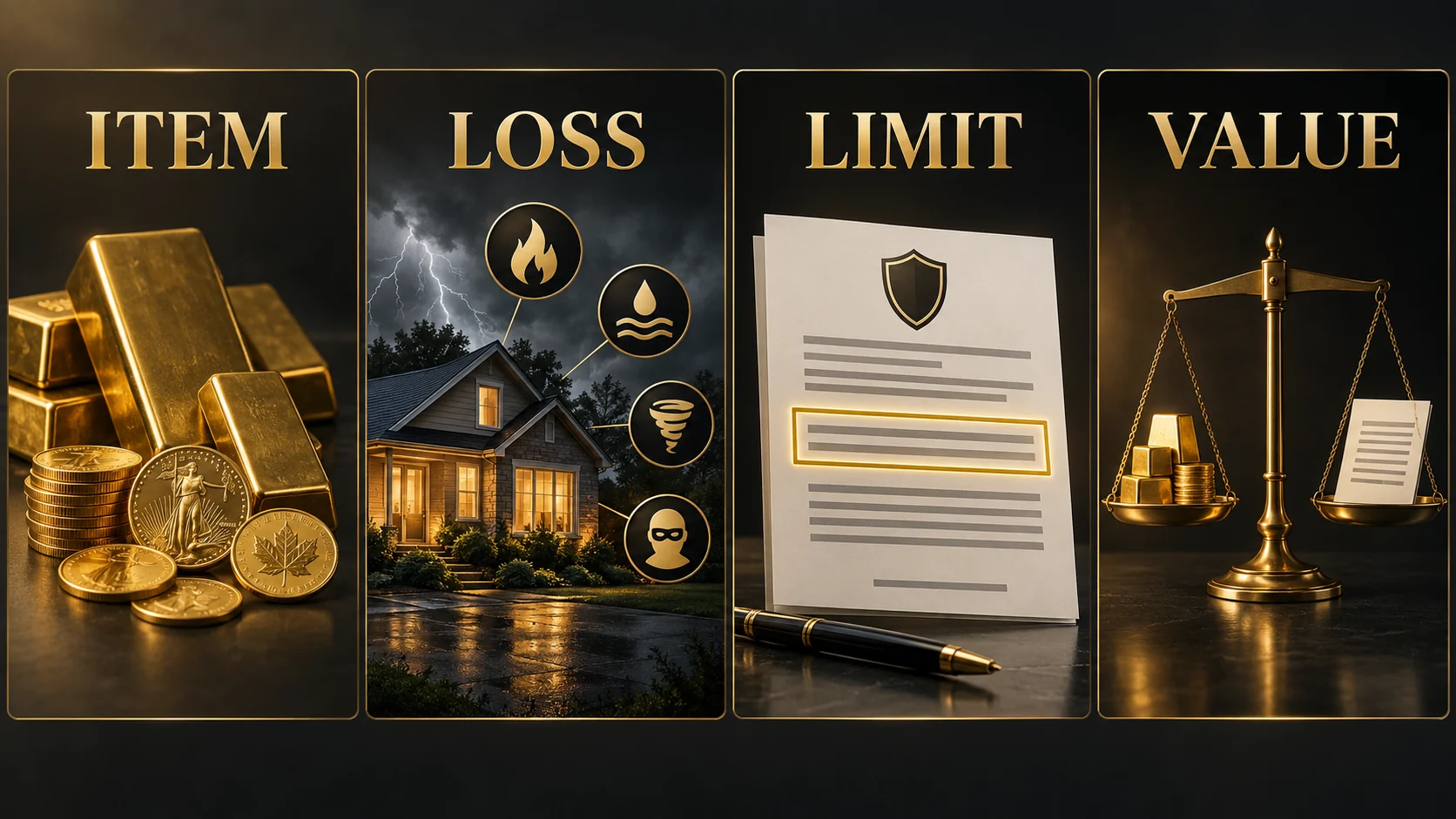
Four policy questions that decide the answer
- Classification: How does the policy define bullion, precious metals, coins, cash and jewelry?
- Cause of loss: Is theft, burglary, fire, accidental disappearance or flood covered? These can have different rules.
- Limit and deductible: Is there a special sublimit for this category, and does the deductible reduce the payment?
- Valuation: Is settlement based on cost, market value or a stated amount, and what proof is required?
The Insurance Information Institute explains that standard policies may include special limits and that endorsements or floaters can expand protection for certain valuables. It does not establish your bullion coverage or a universal limit.
Bars, coins and jewelry are not interchangeable
| Property | Question to ask the insurer |
|---|---|
| Investment bars | Are precious-metal bars covered as personal property, and under which special limit? |
| Bullion coins | Are coins treated as bullion, collectibles or money? |
| Worn jewelry | Would a jewelry endorsement apply, and does it exclude loose investment gold? |
| Items away from home | Does the same protection apply in transit or at a bank box? |
A jewelry floater should not be assumed to cover loose bars. Likewise, a bank safe-deposit box has different risks and insurance arrangements; see our bank-box insurance guide.
How to get a usable written coverage answer
Make a private inventory with descriptions, serial numbers if present, purchase records, photographs and current replacement information. Store a backup separately from the bullion. Give the insurer the total value and locations without relying on a generic web answer.
Ask: “For these specified gold bars and investment coins stored at home, what would this policy pay after theft, fire and unexplained loss? What are the exclusions, special limits, deductible, valuation basis and evidence requirements? Is an endorsement available?” Keep the response, declarations and endorsement together.
Compare home storage and alternatives
Compare the total cost of a suitable home safe, monitored security and documented insurance with a professional vault or bank box. Coverage varies, and a storage provider’s protection may have its own exclusions. Our gold storage comparison and insured shipping guide cover adjacent decisions.
Editorial perspective: The practical test is a written response for the exact form of gold and exact loss event. A broad claim that “homeowners insurance covers valuables” is too imprecise for a bullion decision.
Worked example: a limit is not the same as full protection
Imagine a household owns $20,000 of investment bars. If the relevant policy category has a $2,500 theft limit and a $1,000 deductible, assuming that the full $20,000 is protected would be a serious mistake. The figures are hypothetical and do not describe a typical policy; the actual payout can also depend on exclusions, proof and valuation terms.
Request a response that names the item class, each covered cause of loss and the applicable sublimit. If an endorsement is offered, check whether it increases only the limit or also changes the covered events. Compare the premium and deductible against the value at risk; retain the signed endorsement, not just a sales conversation.
What to document without creating a security problem
Keep invoices, certificates, serial numbers where applicable, photographs of both sides of coins and bars, and a dated inventory. Store the backup outside the safe, with access limited to people who need it. Documentation supports a possible claim but does not create coverage or establish a guaranteed valuation.
Ask how the insurer would treat a purchase that has appreciated, a coin with collectible premium, and a bar whose only proof is an old receipt. Ask whether a periodic inventory or appraisal is required. Revisit the written coverage after a significant purchase or storage change.
Read the policy in the right order
Start with the definitions of personal property, money, precious metals, coins and collectibles. Then locate special limits, exclusions, covered perils and valuation terms. A broad personal-property limit on the declarations page may not override a narrower category limit elsewhere in the contract.
The NAIC consumer guide to home insurance explains why scheduled personal-property endorsements can matter for valuable items, including coins. It does not establish that every bar or coin is eligible for a particular endorsement. Ask the insurer to identify the relevant policy language for your exact holdings.
Match the gold form to the loss event
Ask whether investment bullion is covered and under which special limit.
Ask whether ordinary bullion coins and collectible coins are classified differently.
Do not assume a jewelry floater extends to loose investment metal.
Then ask about theft, fire, flood, unexplained disappearance and loss while away from home as separate scenarios. A policy can respond differently to each. The NAIC’s policy guide recommends checking valuables limits and keeping an inventory.
Decode four terms before asking your insurer
Open each term and compare it with the wording in your own policy. These definitions help you ask a precise question; they do not establish that a particular bar or coin is covered.
Special limit
A lower maximum can apply to a property category even when your overall personal-property limit is higher. Ask which category covers bullion and whether theft has a different limit.
Scheduled property
An endorsement may list a specific valuable item and amount. Ask whether investment bars or coins are eligible and what documents the insurer requires.
Deductible
The portion of a covered claim you pay. Ask whether the general deductible or a special deductible applies to the bullion loss you are considering.
Valuation basis
Payment can depend on the contract’s valuation rule and proof of ownership. Ask how market value, purchase cost and collectible premiums would be treated.
Use this alongside the NAIC consumer guide and your insurer’s current policy wording.
How to compare an endorsement, specialty coverage and a different storage location
Ask whether a scheduled endorsement names each bar or coin, changes the per-item or aggregate limit, changes covered causes of loss, or imposes security conditions. Check whether market appreciation is reflected automatically or only after updating the insured amount. Record the deductible and claims valuation method.
Specialty coverage can have different custody, transit and documentation requirements. A vault’s advertised insurance is not the same as a policy issued to you; ask who is insured, what events are covered and how a claim would be valued. A bank safe-deposit box introduces another set of conditions; our safe-deposit-box insurance guide treats that separately.
Choose the storage-and-insurance combination only after comparing a written insurer response, total storage cost, access needs, deductible, claims process and any security requirements. A safe alone does not answer the coverage question.
Build a claim-ready private inventory
Record the issuer or refiner, denomination, weight, fineness, serial number where applicable, purchase date and source. Photograph both sides of coins and all bar markings, and retain invoices or dealer records. Keep an encrypted or otherwise secure duplicate away from the storage location. Do not publish an inventory or exact storage details.
Ask your insurer what evidence is needed for a claim and whether its requirements change above a value threshold. Update the schedule after a significant acquisition or sale. A current inventory is evidence of ownership and value, but only the policy determines whether a loss is payable.
How would a covered bullion claim be valued?
Coverage and payout are separate questions. Even if a loss is covered, the policy’s property classification, special limit, valuation rule, evidence requirements and deductible can affect what you receive. Ask the insurer which rule applies to your exact bars or coins.
Generally takes age, condition and depreciation into account. Ask how the insurer would apply this rule to bullion rather than assuming that your purchase price or today’s spot price controls.
Generally refers to the cost of replacing property with like kind and quality. Check the contract’s limits, claim conditions and whether a collectible premium is included; RCV does not by itself promise a particular gold-market payout.
If an insurer offers an item-specific amount, ask whether it is a fixed settlement amount or only a maximum limit, and how later price changes are handled. The endorsement wording decides.
The NAIC explains ACV and RCV for homeowners coverage. That general explanation does not establish that a particular bullion item is eligible for either method.
A scheduled personal property endorsement may be available for some valuables, including certain coins, as the NAIC home-insurance guide explains. It does not mean that an investment bar or every coin can be scheduled with your insurer. Ask for item-specific eligibility and written terms before relying on a quote.
If gold is lost or stolen: build a clear claim file
- Record the event. Note when and where the loss was discovered and preserve relevant photographs, packaging and other evidence. Report a suspected theft to the police when appropriate; ask the insurer whether it needs the report number.
- Notify your insurer promptly. Give your policy number and a factual account of what happened. Reporting deadlines vary by state and contract, so check your policy rather than waiting for a valuation.
- Identify each item. Supply your private inventory, invoices, photographs, refiner or mint details, serial numbers where present and any endorsement or appraisal requested by the adjuster. Retain copies.
- Request the coverage calculation. Ask which property category, covered event, special limit, valuation rule and deductible the insurer applied to each item.
- Keep the written record. Save claim correspondence, the adjuster’s requests and the written decision. If you disagree, ask the insurer to identify the policy language and its review process; your state insurance department can explain consumer assistance options.
These steps follow the NAIC homeowner claim guidance. They prepare a claim; they cannot establish coverage for bullion that the contract excludes or limits.
This guide is general U.S. education, not an interpretation of your contract or an insurance recommendation. Confirm the exact wording and written coverage decision with your licensed insurer or agent.
Related guides
where to store gold · bank-box coverage · coverage in transit · documenting jewelry value · market-price context
FAQ: does homeowners insurance cover gold bullion
Is gold bullion covered by standard homeowners insurance?
Possibly in limited circumstances, but the policy wording, special limits and loss type control. Obtain a written insurer confirmation for bars and coins.
Does a home safe make bullion insured?
No. A safe is a security measure; the insurance contract determines coverage.
Will jewelry insurance cover gold bars?
Do not assume so. Ask whether the endorsement explicitly includes investment bullion.
What proof should I keep?
Maintain purchase records, photographs, identifying marks and a separate secure copy of the inventory.
Are bullion coins treated like jewelry?
Not necessarily. Ask the insurer which property definition, special limit and endorsement applies to investment coins.
Sources and scope
Insurance Information Institute personal-property guide. Insurance Information Institute homeowners overview. Prices and policies can change; verify current written terms before paying or shipping.
Bottom line
A U.S. homeowners policy may cover some loss involving gold bullion, but exclusions, special limits and covered causes of loss vary by insurer and policy. Do not assume bars or investment coins have the same treatment as wearable jewelry. Ask your insurer for a written answer tied to your exact items and loss scenarios.
 When you purchase a service or a product through our links, we sometimes earn a commission, at no extra cost to you.