
Use this free gold guide to compare coins, bars, premiums, dealers, storage, testing, and resale before buying physical gold.
- Start with your purpose: physical gold solves different problems from an ETF, mining stock, or collectible coin.
- Compare the all-in round trip—premium, tax, storage, insurance, and dealer buyback—not just today’s spot price.
- Use a written dealer, product, storage, and resale checklist before paying; pressure and vague fees are stop signs.

- Choose the ownership form before choosing a coin or bar.
- Physical bullion is not the same as an ETF, mining share, pooled account, or collectible coin.
- Your break-even starts with premium, tax, shipping, storage, insurance, and the sell-back spread.
- Recognizable bullion and documented custody usually improve resale confidence.
- Make the first purchase small enough to test the dealer, delivery, records, storage, and exit process.
Start with the useful version first. The rest of this guide adds the evidence, edge cases, and stronger checks.
Bars often offer more gold for each dollar because their premiums can be lower. Coins can be easier to recognize, divide into smaller sales, and compare across established dealer markets.
One one-ounce bar concentrates the holding in one item. Four quarter-ounce coins hold the same nominal gold weight but allow smaller partial sales, usually at a higher total premium.
The better choice depends on local premiums, dealer buyback terms, authenticity checks, storage, insurance, and how you expect to sell later.
Start with Gold Made Simple to move from basic gold terms to buying, testing, investing, and storage without the jargon.
A first purchase should be a process test
Gold is easy to admire and surprisingly easy to buy badly. The metal may be genuine while the product, premium, financing, storage arrangement, or resale path is wrong for the buyer.
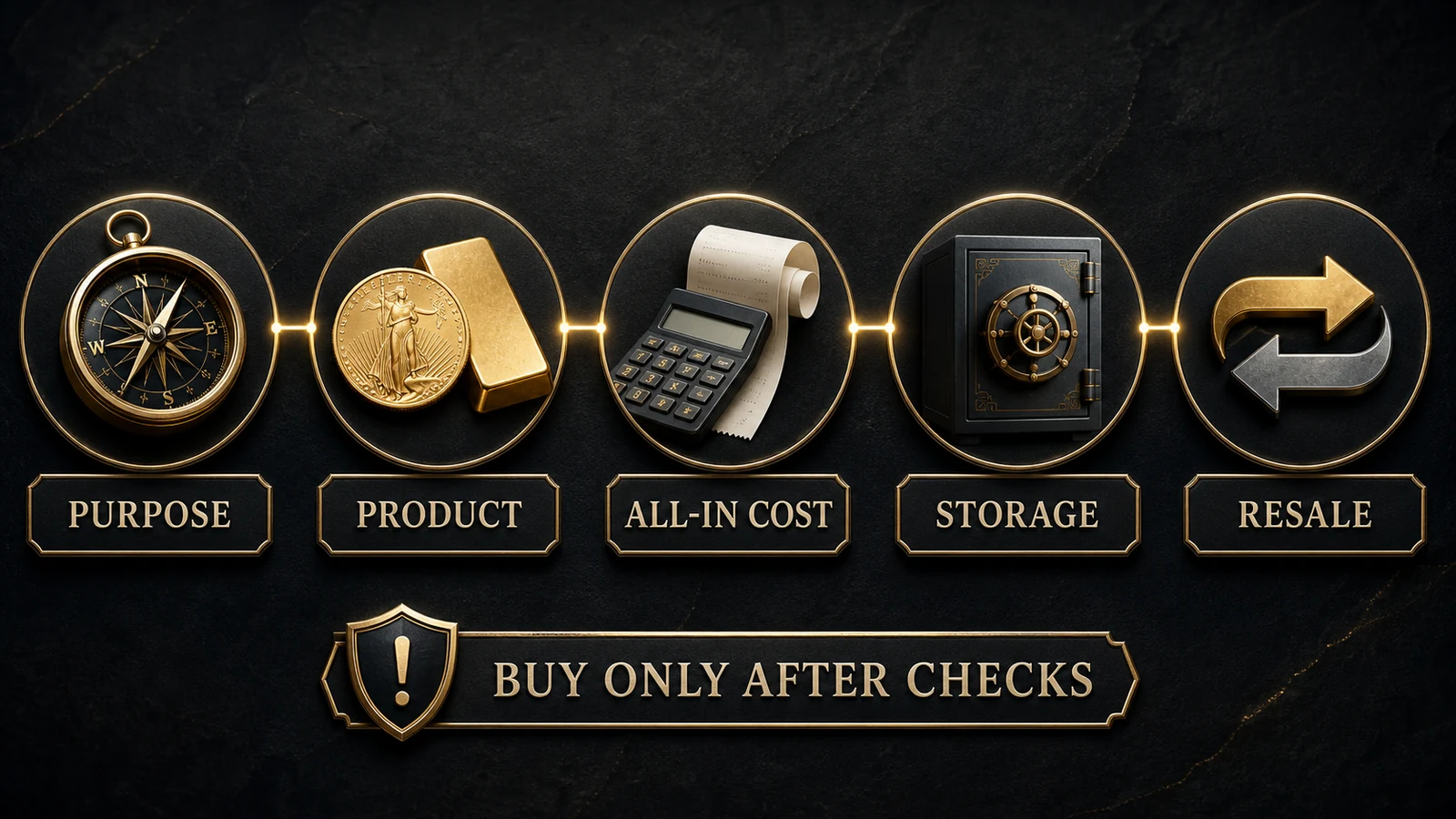
Step 1: define the job before the product
Physical gold can provide direct ownership outside a brokerage account, but it produces no interest or rent. It also creates storage, insurance, verification, and resale work.
If the goal is short-term price exposure and easy trading, a regulated exchange-traded product may be more practical. If the goal is ownership of specific metal, the custody chain matters more than a ticker.
For the mechanics of securities-based exposure, see how a gold ETF works. For tokenized claims, use the separate gold-backed cryptocurrency guide.
Step 2: choose bullion before choosing a design
Bullion products are purchased mainly for precious-metal content. A coin can carry government-mint recognition and legal-tender status, while a bar can offer more metal per dollar at larger sizes.
| Choice | Strength | Trade-off | Best beginner question |
|---|---|---|---|
| Widely traded 1 oz coin | Recognition and divisibility | Often a higher premium than a comparable bar | What is today’s written buy and buyback price? |
| Fractional coin | Lower cash outlay per piece | Premium per ounce can be much higher | What premium percentage am I paying? |
| Small assay-card bar | Compact and often lower premium | Packaging and refiner recognition affect resale | Will you buy this exact brand back unopened and opened? |
| Large bar | Lower premium per ounce is possible | Less divisible and more valuable per unit | Can I sell only part of this holding? |
| Numismatic coin | Potential collector value | Specialist grading and a wider spread | What portion of price is metal and what portion is collectible premium? |
The U.S. Mint describes its bullion programs and specifications, while LBMA Good Delivery rules govern a wholesale refinery and bar standard. Neither source proves that a particular retail offer is fairly priced.
Use how to buy gold coins, how to buy gold bars, and Gold Eagle weights for product-level checks.
Step 3: calculate metal value and the all-in purchase cost
Gold spot is normally quoted per troy ounce, not ordinary ounce. One troy ounce is about 31.1035 grams, and a product’s gross weight can differ from its pure-gold weight when the item is alloyed.
Fine gold weight = gross weight × fineness. Metal value = fine troy ounces × reference spot price. Premium % = (retail price − metal value) ÷ metal value × 100.
Then add tax where applicable, insured shipping, payment fees, storage, and insurance. These are illustrative calculations, not a live quote.
The CFTC and FINRA emphasize that dealers sell above spot and buy below it. That two-sided difference matters more than an advertised premium alone.
Worked example: the round trip, not the headline
Assume a bullion item contains exactly one fine troy ounce. Spot is hypothetically $4,000, the dealer sells it for $4,160, shipping is $25, and the written immediate buyback is $3,920.
| Line item | Illustrative amount | Meaning |
|---|---|---|
| Metal value | $4,000 | Reference value at the assumed spot price |
| Retail premium | $160 | 4% above metal value |
| Shipping | $25 | Raises acquisition cost |
| Cash paid | $4,185 | Before any tax or storage |
| Immediate buyback | $3,920 | 2% below the assumed spot price |
| Initial round-trip gap | $265 | Cash paid minus immediate resale proceeds |
Spot must rise enough to cover the gap plus future costs before the position shows a positive cash result. A small-looking premium can still produce a meaningful break-even hurdle.
Step 4: verify the dealer and exact listing
Retail metals dealers are not all supervised like securities brokers. The CFTC recommends checking physical address, operating history, owners, complaints, fees, product weight, and buyback terms.
- Record the legal business name, physical address, phone number, and responsible seller.
- Search state attorney-general, consumer-protection, court, and regulator records for the business and principals.
- Request the mint or refiner, exact product, gross weight, fine weight, fineness, condition, and packaging.
- Get retail price, premium, commissions, tax, shipping, storage, insurance, and payment fees in writing.
- Ask what the dealer would pay for the exact item today and whether packaging condition changes that quote.
- Confirm delivery time, tracking, signature, loss allocation, inspection period, returns, and dispute procedure.
- Walk away from cold calls, leverage, guaranteed returns, countdown pressure, or a refusal to document fees.
A professional-looking website is not a substitute for corporate identity and written terms. Card and bank-transfer protections also differ, so understand the payment channel before sending funds.
Step 5: authenticate without damaging the product
Start with documentation, dimensions, mass, packaging, maker, and known specifications. A scale, caliper, magnet, conductivity device, ultrasound, or XRF can answer different questions, but no single test proves every product.
Do not acid-test a sealed investment bar or scratch a collectible without understanding the loss of value. See how to tell if gold is real and testing gold coins for a layered approach.
Step 6: select storage by threat model
| Storage path | Control | Main risk | Document before buying |
|---|---|---|---|
| Home safe | Immediate personal access | Theft, coercion, fire, inadequate insurance, disclosure risk | Safe rating, anchoring, privacy, insurer limits, recovery plan |
| Bank safe-deposit box | Institutional premises | Access hours, contract exclusions, insurance gaps | Box agreement, access rules, insurance, estate access |
| Allocated professional vault | Identified metal under a custody contract | Counterparty, jurisdiction, fees, withdrawal conditions | Allocation, bar list, audit, insurance, subcustodian, delivery rights |
| Unallocated account | Claim against a provider | Metal is not necessarily set aside for you | Creditor status, redemption, fees, governing law |
Allocated and unallocated are legal and operational distinctions, not marketing adjectives. Read allocated versus unallocated storage before using a vault or pooled account.
Step 7: plan resale before purchase
Ask two or three dealers for live buyback methodology before buying. Record whether the quote is a fixed amount, a percentage of spot, or subject to inspection, packaging, minimum size, assay, shipping, and payment delay.
Keep invoices, serial numbers, photographs, assay packaging, and custody statements. Do not publish the location or value of privately stored metal.
Common beginner mistakes
- Buying from fear, urgency, or an unsolicited call.
- Comparing a fractional coin’s dollar premium with a one-ounce bar instead of percentage premium.
- Confusing gross weight with fine-gold content.
- Paying collector premiums without collector knowledge.
- Assuming “IRA approved,” “LBMA,” or “minted” means the retail price is fair.
- Using leverage for an asset that can be volatile and produces no cash flow.
- Buying a large indivisible bar before testing resale.
- Ignoring storage and inheritance access.
Retail pages often show only the buy price. The missing data are the dealer’s same-day buyback, all fees, product-specific resale conditions, and storage-to-liquidation process—the variables that determine realizable value.
A beginner does not need the “best” gold product on the internet. A better first move is a modest, recognizable product with transparent two-way pricing, documented delivery, secure storage, and a rehearsed exit path.
This guide is educational and not personalized investment, legal, or tax advice. Gold can fall, costs can be material, and tax and retirement-account rules depend on jurisdiction and circumstances.
Watch: How To Invest In Gold For Beginners In 2026
This beginner overview is useful for seeing the major ownership choices. Verify every product, cost, custody, and tax detail independently with the primary sources and written seller terms above.
Video: Ryan Scribner. YouTube oEmbed availability validated July 17, 2026.
Bottom Line
A good physical-gold purchase starts with purpose, not product. Compare ownership forms, calculate the full round trip, verify the seller and item, choose storage by threat model, and document the resale path before money moves.
FAQ: Free Gold Guide for Beginners
How much gold should a beginner buy first?
There is no universal amount. Keep the first transaction small enough to test the dealer, delivery, storage, records, and resale process without disrupting emergency savings.
Are gold coins better than bars?
Coins can offer recognition and divisibility; bars can offer lower premiums at some sizes. Compare exact two-way prices and your resale needs.
What is the biggest hidden cost of physical gold?
Often it is the full buy-sell spread plus storage, insurance, shipping, tax, and payment fees—not one line item alone.
Is an assay card proof that a gold bar is real?
It is evidence from the issuer, not independent proof of every item. Confirm the maker, seller, dimensions, mass, packaging, and appropriate tests.
Should a beginner use a gold IRA?
Only after understanding custody, fees, eligible assets, tax rules, conflicts, and alternatives. Never roll over retirement savings because of an unsolicited metals pitch.
Sources and verification
Use the primary documents below to verify rules, data, definitions, and evidence. Product terms, market conditions, and research conclusions can change.
- CFTC and FINRA — 10 things to ask before buying physical metals
- CFTC — Gold is no safe investment
- CFTC — Precious metals fraud
- American Numismatic Association — Bullion buying guide
- U.S. Mint — Bullion coins
- LBMA — Precious metal prices
- LBMA — Good Delivery rules
- World Gold Council — How to invest in gold
- SEC — Self-directed IRAs and the risk of fraud
- IRS — Retirement plan investments in collectibles
 When you purchase a service or a product through our links, we sometimes earn a commission, at no extra cost to you.