
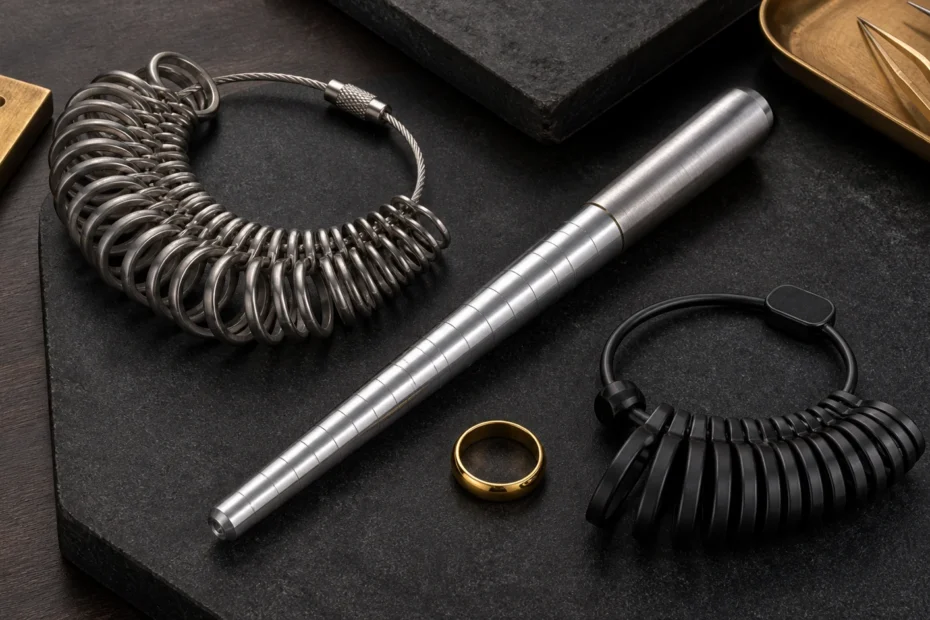
Compare finger gauges, mandrels, belt sizers, and temporary adjusters to measure gold rings accurately before buying or resizing.
- Measure the exact finger under normal conditions.
- Wide bands need a different fit than narrow rings.
- Use a mandrel for rings and gauges for fingers.
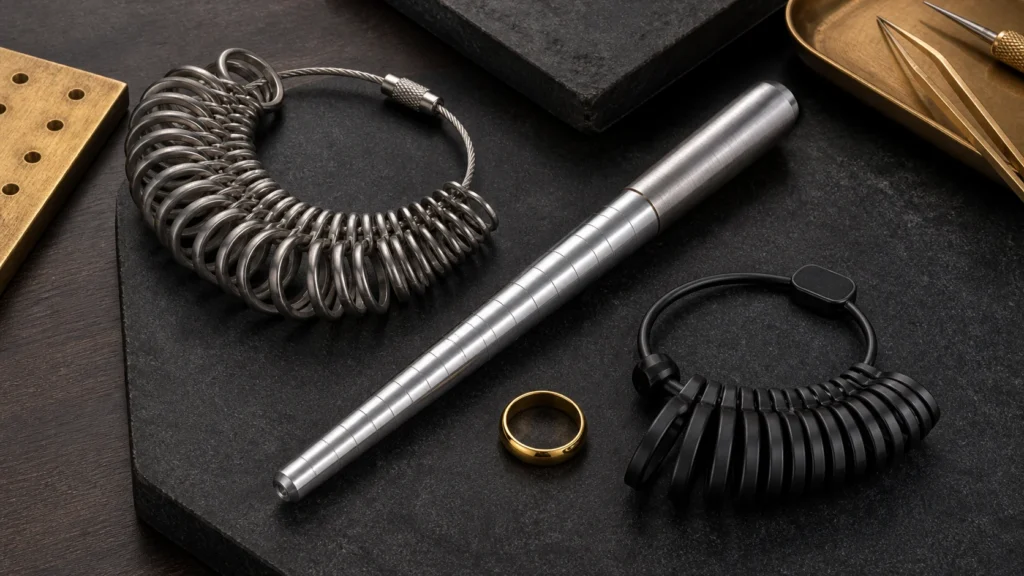
The best ring sizer for a gold ring depends on what you are measuring. Use metal finger gauges to measure a finger, a mandrel to measure an existing round ring, a reusable belt sizer for a convenient home estimate, and a temporary adjuster only to reduce looseness—not to determine the original size or replace professional resizing.
See the complete ring sizing kit on Amazon →NIUPIKA gauge and mandrel set
- Measure the exact finger and hand where the ring will be worn.
- Finger gauges measure fingers; mandrels measure existing rings.
- Wide bands usually fit more tightly than narrow bands at the same nominal size.
- Measure more than once under normal temperature and swelling conditions.
- A silicone or clip-on adjuster is temporary fit support, not permanent resizing.
Recommended options

NIUPIKA 27-Piece Ring Sizer and Mandrel Set
Best for: Measuring both fingers and existing rings in common US sizes with a metal gauge set and mandrel.
Avoid if: You need certified calibration, quarter sizes, wide-band gauges, international standards, or professional bench accuracy.
Verify before buying: Confirm the current size range, increments, mandrel material, marking system, gauge width, and whether the kit uses US sizing throughout.

UUBAAR Mandrel, Metal Gauges, and Belt Sizers
Best for: Comparing an existing ring, metal finger gauges, and reusable belt measurements within one kit.
Avoid if: Extra tools may create false confidence or you need a jeweler to account for wide bands, large knuckles, arthritis, or a valuable stone setting.
Verify before buying: Confirm size systems and ranges for every component; two tools can disagree if their scales, widths, or manufacturing tolerances differ.

Clip-On Invisible Ring Size Adjusters
Best for: Temporarily reducing spin or looseness on compatible flat bands while you evaluate fit or wait for professional advice.
Avoid if: The ring is too tight, the band profile is incompatible, skin reacts, stones are at risk, or the piece needs structural resizing.
Verify before buying: Confirm band width and profile, adjuster sizes, material, comfort, cleaning needs, and return terms. Inspect the ring regularly for trapped moisture or abrasion.
Ring-size errors are small in millimeters and large in consequences. A ring that will not pass the knuckle cannot be worn; a loose ring can spin, snag, or disappear. Gold also adds a material decision because resizing may affect solder, plating, engraving, hallmarks, symmetry, and stone settings.
The Gemological Institute of America’s ring-size benchmark distinguishes narrow and wide finger gauges, explains how to read rings of different profiles on a mandrel, and treats a correct fit as one that passes the joint and settles securely where worn.
Which ring-sizing tool do you need?
Knowledge Gap: the same size number can fit differently
Band width, interior profile, knuckle size, finger shape, swelling, dominant hand, stacked rings, and sizing-system conversion all affect fit. A narrow sample gauge and a wide gold band can carry the same printed size while feeling different on the finger.
Ring sizers, mandrels, charts, and adjusters compared
| Tool | Measures | Best use | Main error source |
|---|---|---|---|
| Metal finger gauge set | Finger fit | Repeated home measurement with ring-like samples | Gauge width or profile differs from intended ring |
| Wide-band finger gauges | Finger fit for broad rings | Bands wider than about 4 mm or stacked sets | Not included in many inexpensive kits |
| Tapered mandrel | Existing ring interior | Round, undamaged rings with known reading method | Oval rings, protruding stones, convex interiors, or unclear scale |
| Reusable belt sizer | Finger circumference estimate | Convenient first pass or travel | Pull tension and flexible material change fit |
| Printable chart | Ring diameter or finger estimate | Rough check when correctly printed at 100% | Printer scaling, paper distortion, screen scaling, and reading error |
| Clip-on or spiral adjuster | Temporary looseness reduction | Short-term fit support on compatible bands | Trapped moisture, discomfort, visibility, abrasion, and incompatible profile |
GIA’s consumer guide says a professional jeweler using finger gauges is the most accurate route and warns that string or paper can stretch, deform, and ignore the knuckle. The GIA ring-size guide also recommends bringing an existing ring from the correct finger to a jeweler when a surprise is necessary.
The Jewellery Council of South Africa emphasizes measuring when hands are not cold, checking how the ring passes the knuckle, using the right national size system, and allowing for wider bands.
A reliable home measurement routine
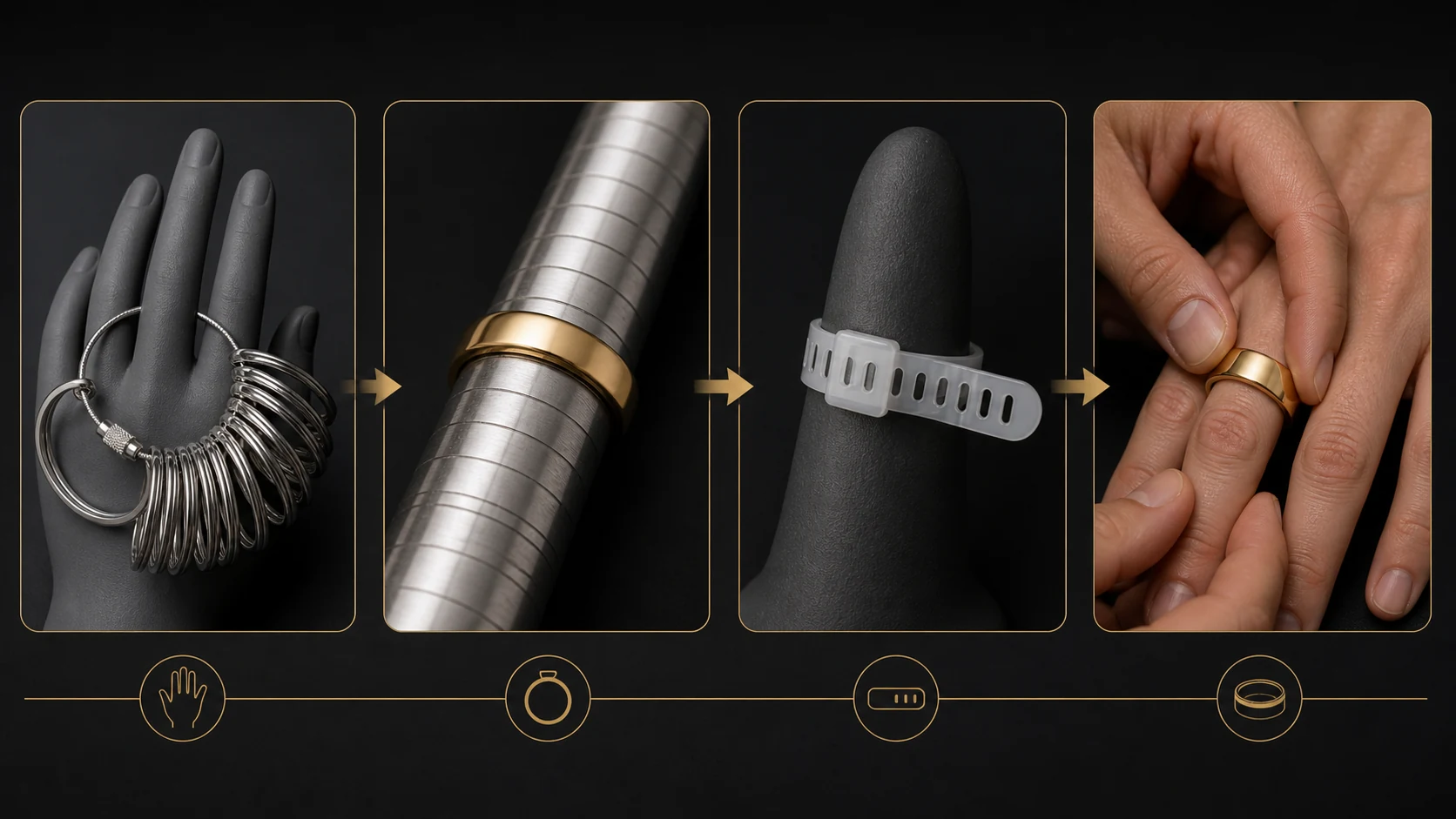
- Name the exact finger and hand. Do not transfer a result from the opposite hand or a different finger.
- Measure under normal conditions. Avoid immediately after cold exposure, heavy exercise, very salty food, injury, or unusual swelling.
- Use the right-width gauge. Narrow and wide bands do not feel the same. Test stacked rings together when they will be worn together.
- Check the knuckle and resting position. The ring must pass the widest point with resistance but remain secure at the base.
- Repeat at different times. Record several comfortable results rather than forcing one tight measurement.
- Confirm the sizing system. US numbers, UK letters, and EU circumference are not interchangeable labels.
- Verify before a costly order. Take the gauge result or existing ring to the jeweler supplying the new piece.
How to read a ring on a mandrel
Use a round ring without a stone or setting protruding into the finger opening. Lower it gently without forcing or hammering. Read the maker’s instructions for whether the lower edge, center of the inner band, or another reference line is the correct point.
Wide, tapered, convex-interior, irregular, or out-of-round rings require different interpretation. A mandrel made for measuring is not permission to stretch or reshape the ring. Professional resizing can alter a gold ring’s finish and construction, especially for white gold, patterned bands, tension settings, and stones around the full circumference.
When a temporary ring adjuster makes sense
- Seasonal finger-size change creates slight, temporary looseness.
- A surprise ring needs short-term fit support before professional sizing.
- A top-heavy ring spins and the jeweler wants to observe fit before adding sizing beads.
- Pregnancy, medication, or health changes make immediate permanent resizing unwise—after appropriate medical and jewelry advice.
Remove the adjuster regularly to clean and dry both ring and insert. Stop if it causes pressure, skin irritation, trapped moisture, abrasion, or stress near a setting. Never use an adjuster to make a tight ring wearable.
Before buying a ring online, combine size with construction checks from Gold Jewelry Markings and the Amazon Gold Jewelry buying guide. For white-gold color and finish changes after sizing, read Why Is My White Gold Ring Turning Yellow?.
After the fit is confirmed, use the material-specific steps in How to Clean White Gold before adding any temporary insert. A ring and adjuster should both be clean and completely dry so grit and trapped moisture do not sit against the band.
Editorial Perspective
Use a home ring sizer to narrow uncertainty, not to transfer all fitting responsibility away from the seller or jeweler. When the ring is expensive, wide, stone-set, engraved, antique, or hard to resize, professional confirmation is part of the purchase—not an optional extra.
Video: six ways to work out ring size
This comparison shows why tools that measure a finger, an existing ring, or a printed chart can produce different confidence levels. Match the method to the intended band.
Bottom line
The best ring sizer for gold rings is the tool matched to the measurement: rigid gauges for a finger, a mandrel for an existing ring, and a temporary adjuster only for slight looseness. Recheck the exact finger, band width, knuckle, and sizing system before ordering.
Continue with the Gold Jewelry Guide for buying, verification, wear, care, and resale decisions.
FAQ: best ring sizer for gold rings
Are metal ring sizers more accurate than plastic belt sizers?
Rigid gauges usually reproduce ring-like fit more consistently, especially when the gauge width matches the intended band. A belt sizer is useful for an estimate.
Should a wide gold band be ordered larger?
Wide bands often feel tighter, but the correct adjustment depends on width, profile, finger shape, and the maker. Confirm with wide-band gauges or the jeweler.
Can I measure an existing ring with a mandrel?
Yes, if the ring is round and the interior has no protruding stone or feature. Follow the mandrel maker’s reading method and do not force the ring.
Do ring size adjusters damage gold rings?
A compatible soft adjuster can be temporary, but trapped moisture, grit, pressure, and poor fit may mark the ring or irritate skin. Remove, clean, dry, and inspect it regularly.
When should I have a jeweler measure my ring size?
Use a jeweler for expensive, wide, stone-set, antique, engraved, stacked, unusual-profile, or difficult-to-resize rings, and whenever home methods disagree.
 When you purchase a service or a product through our links, we sometimes earn a commission, at no extra cost to you.