
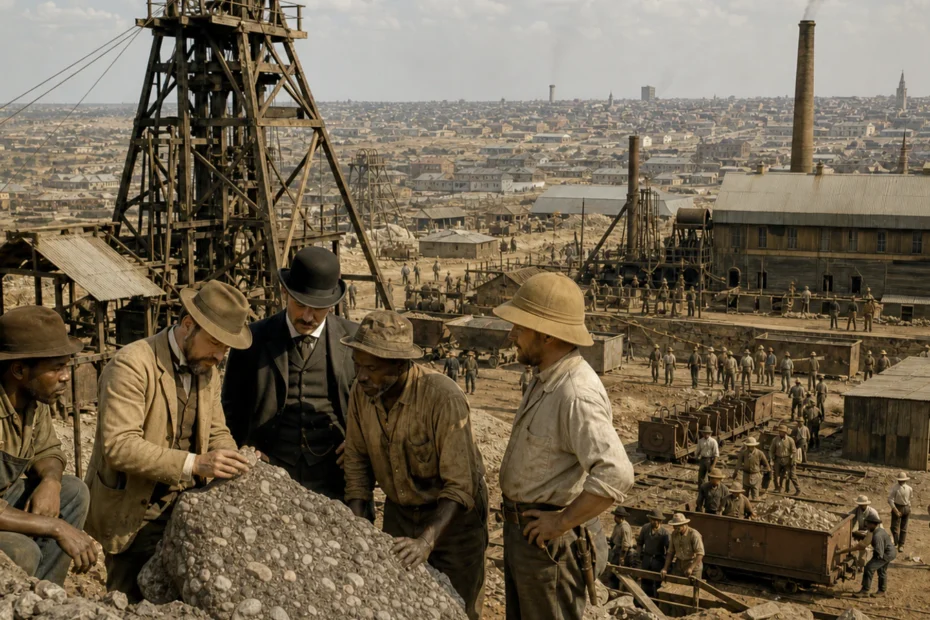
Understand the Witwatersrand Gold Rush through Johannesburg, deep mining, capital, labor, geology, political power, and South Africa's gold legacy.
- The rush built Johannesburg through deep reefs, capital, and industrial mining.
- Labor systems and politics are central to the story, not background details.
- Consider the environmental legacy alongside production and city growth.
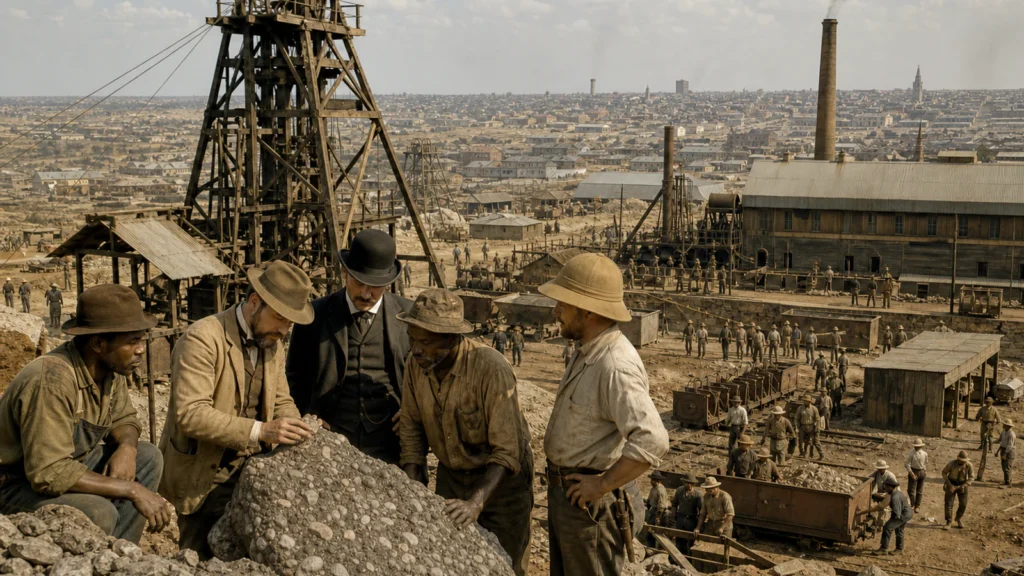
The Witwatersrand Gold Rush was not just another rush of prospectors chasing surface gold. It was the event that turned a rocky Highveld ridge into Johannesburg and pushed South Africa toward deep-level industrial mining, migrant labor systems, imperial conflict, and long-lasting environmental damage. That is why the Witwatersrand story needs more than a discovery date.
The Witwatersrand Gold Rush was not just another rush of prospectors chasing surface gold. It was the event that turned a rocky Highveld ridge into Johannesburg and pushed South Africa toward deep-level industrial mining, migrant labor systems, imperial conflict, and long-lasting environmental damage.
That is why the Witwatersrand story needs more than a discovery date. The real question is how a gold-bearing reef discovered in the 1880s became an economic machine powerful enough to reshape a country.
TL;DR
- The Witwatersrand Gold Rush began around the 1886 Main Reef discoveries near present-day Johannesburg.
- Unlike many gold rushes, the Rand quickly became a capital-intensive deep-mining industry, not just a digger camp.
- Johannesburg grew from a mining camp into South Africa’s dominant economic city within a remarkably short period.
- The rush accelerated mining houses, migrant labor systems, racialized labor control, and British-Boer political tension.
- The modern legacy includes wealth, infrastructure, mine dumps, pollution, acid mine drainage, and a city still shaped by mining land.
Animated Summary: Why the Witwatersrand Rush Was Different
This short animation shows the core chain behind the article: reef discovery, deep mining, Johannesburg’s rise, migrant labor systems, and political conflict.
What Most Readers Miss
The Witwatersrand Gold Rush is usually told as a discovery story. That is too small. Its importance comes from the way geology forced the rush to become an industrial, financial, political, and labor system.
Why the Witwatersrand Was Not a Normal Gold Rush
Many gold rushes begin with surface finds, placer deposits, and individual miners hoping to make a quick fortune. Witwatersrand was different because the key gold was locked inside extensive conglomerate reefs.
That made the Rand less like a romantic panning rush and more like the beginning of a modern mining complex. The ore had to be mined, crushed, treated, financed, and worked at increasing depth.
Britannica’s history of Johannesburg describes the Main Reef as low-grade but remarkably persistent. That combination created a profitability problem that favored scale, machinery, engineering, and large mining houses rather than small independent diggers.
This is the first major knowledge gap. The Witwatersrand Gold Rush was a rush into an industrial system.
Discovery Timeline: From Early Finds to Public Diggings
The discovery story is more complicated than a single lucky moment. South African History Online notes that Jan Gerrit Bantjes recorded gold on Vogelstruisfontein in 1884 and that the Struben brothers found the Confidence Reef near Roodepoort later that year.
The Main Reef discovery is usually associated with George Harrison on the farm Langlaagte in 1886. SA History Online also records that public diggings were proclaimed on 8 September 1886, and Johannesburg was named in early October 1886.
The speed matters. Within months, farms and mining camps were being reorganized into an urban-mining landscape.
Chart 1: Witwatersrand Rush Timeline
Bantjes and the Struben brothers identify gold-bearing ground before the Main Reef rush.
George Harrison’s Langlaagte discovery becomes the catalytic goldfield story.
Authorities proclaim farms on the Rand as public gold diggings.
The settlement is formally named and begins explosive growth.
Capital, technology, and consolidation dominate the field.
Interpretation: The rush moved from discovery to urban-industrial transformation in months, not generations.
The Geology: Why the Rand Needed Big Mining Capital
The Witwatersrand Basin was extraordinary because of the scale and continuity of its gold-bearing reefs. But extraordinary does not mean easy.
The gold was hosted in conglomerate beds, and the ore was not a simple pile of nuggets waiting in a stream. Large volumes of rock had to be extracted and processed to recover gold.
That geology explains why the industry consolidated so quickly. As mines went deeper, capital costs rose, technical requirements increased, and smaller operators found it harder to compete.
For a broader geology primer, GoldConsul’s guide to gold ore helps explain why visible gold and profitable ore are not the same thing. Witwatersrand was the perfect example: scale mattered as much as spectacle.
Chart 2: Placer Rush vs Witwatersrand Industrial Rush
Typical Placer Rush
- Often starts with visible surface or river gold.
- Individual miners can enter with simple tools.
- Early fortunes may be made quickly.
- Settlements can move as deposits are exhausted.
Witwatersrand Rush
- Gold was held in extensive reef systems.
- Ore required crushing, treatment, and engineering.
- Deep mining favored capital and large companies.
- Johannesburg grew into a permanent industrial city.
Interpretation: Witwatersrand was less a lone-miner rush and more the birth of a gold-mining industrial complex.
Johannesburg’s Explosive Rise
Johannesburg did not grow because it was a natural port, old capital, or river city. It grew because the goldfield demanded labor, supplies, capital, rail links, water, housing, administration, and markets.
SA History Online states that by August 1886 the unnamed mining camp already had about 3,000 inhabitants. By 1895, Johannesburg was known to hold around 102,000 people, divided roughly between White and Black residents.
That speed is the urban heart of the Witwatersrand story. A mining camp became a major city because the reef required a permanent economic system around it.
For comparison with other rush-driven settlements, see GoldConsul’s article on gold rush towns. Johannesburg was different because it did not remain a temporary frontier camp.
Mining Houses, Capital, and Consolidation
As the easy surface phase ended, mining became more technical and expensive. Deepening shafts, pumping water, processing ore, and managing labor required a scale that individual diggers could not sustain.
The Minerals Council South Africa traces the Chamber of Mines’ predecessor to 1887 in Johannesburg, just one year after Harrison’s Langlaagte discovery. By 1889, the Chamber was formalized to represent mining interests and validate information about the goldfields.
This matters because institutions followed geology. The reef encouraged large mining houses, centralized capital, and organized industry lobbying.
The Witwatersrand therefore helped create not only mines, but a mining-capital system. That is why it belongs beside broader South African gold history, including GoldConsul’s South African Gold Rush overview.
Labor Systems and Racialized Control
The goldfields needed a huge workforce. That workforce was not created in a neutral labor market.
Black migrant labor became central to the mines, while housing, wages, movement, and workplace control were shaped by racial hierarchy. The mines did not simply reflect South Africa’s social order; they helped harden it.
Wits research on the power of mining argues that mining around Johannesburg helped create an integrated labor market across southern Africa and played a key role in shaping the racial oligarchy that dominated South Africa until the end of apartheid.
This is one of the most important points missing from light gold-rush summaries. The wealth of the Rand was built through systems of labor control as much as through geology and capital.
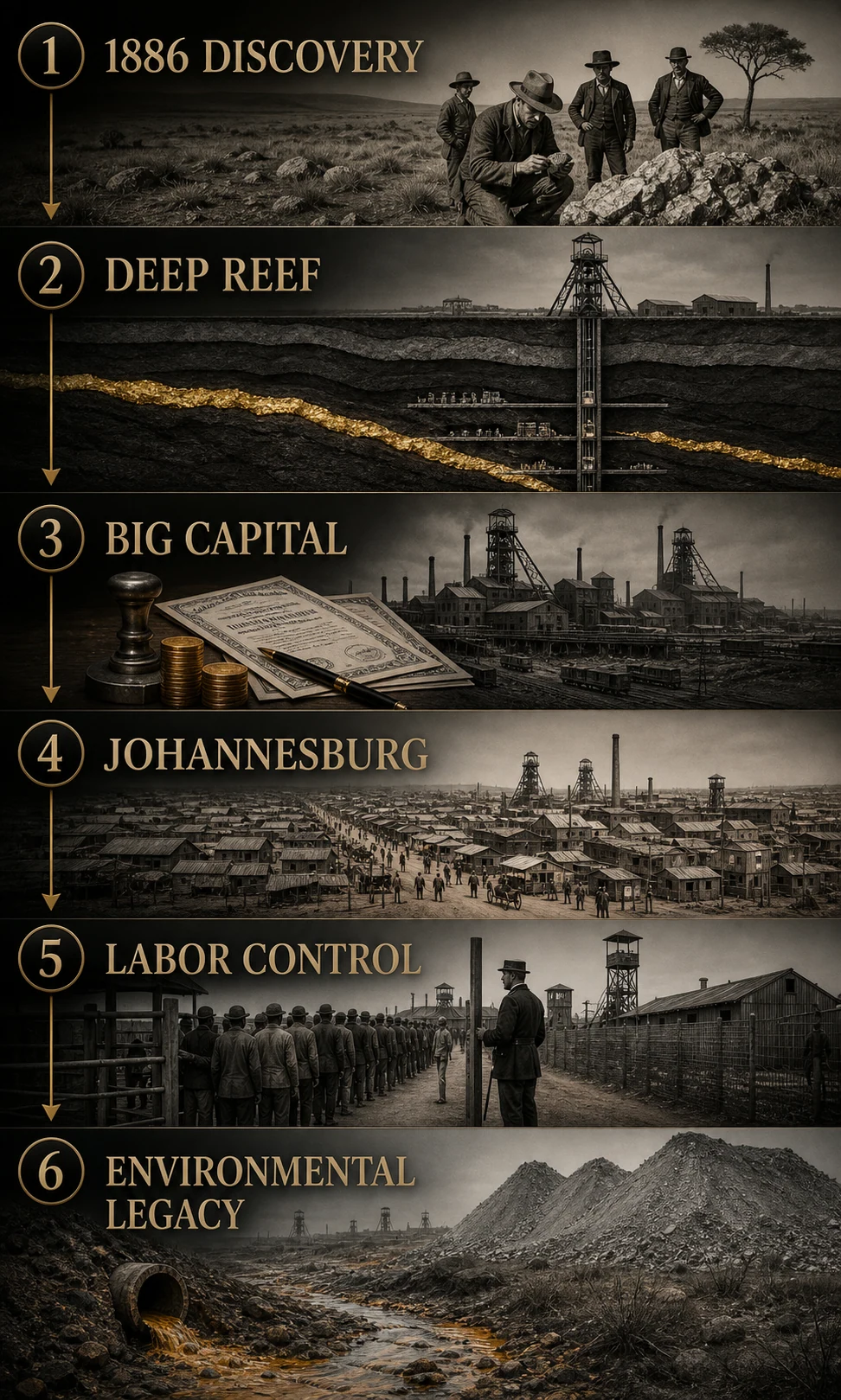
Chart 3: The Witwatersrand Impact Chain
Gold-bearing conglomerate changes the value of Highveld land.
Deep mining requires machinery, finance, and consolidation.
Migrant work and racialized control become central to mine operations.
Johannesburg becomes a mining city and economic hub.
Uitlander pressure, imperial interests, and Boer resistance intensify.
Interpretation: The rush mattered because each stage created the next: geology drove capital, capital drove labor systems, and mining wealth drove political conflict.
Political Consequences: Uitlanders, Kruger, and War
The Witwatersrand goldfields sat inside the South African Republic, but the rush drew foreign miners, investors, and entrepreneurs into the Transvaal. These newcomers were often called Uitlanders.
President Paul Kruger’s government faced a difficult problem. Mining capital and foreign residents wanted political influence, while the Boer republic wanted to preserve autonomy.
The result was not just tension in a mining town. The goldfields became a major factor in British imperial interest, the Jameson Raid context, and the road to the South African War.
That is why Witwatersrand cannot be understood as an isolated mining event. It was a gold rush with state-level consequences.
Video Context: Rhodes, Mining Capital, and Imperial Pressure
This documentary is broader than the Witwatersrand alone, but the relevant section helps explain why mining capital and British imperial ambition became so closely connected in southern Africa.
Environmental Legacy: Dumps, Drainage, and Polluted Water
The Rand’s gold wealth came with a long environmental bill. Mine dumps still mark the landscape, and abandoned or aging mining systems continue to affect water and land.
A ScienceDirect study on the impact of gold mining on Witwatersrand rivers and karst systems describes development and wealth alongside war, social uprooting, pollution, negative health impacts, and ecological destruction.
Modern readers should not treat this as a footnote. Environmental legacy is part of the economic history because the costs did not vanish when mines closed or moved.
GoldConsul’s article on ethical gold connects this kind of legacy to modern questions about mining responsibility, environmental risk, and supply-chain standards.
Comparison: Witwatersrand vs California vs Australia
| Gold rush | Main character | Economic result | What makes it different |
|---|---|---|---|
| Witwatersrand | Deep-level industrial reef mining around Johannesburg. | Built South Africa’s mining-finance core and reshaped national politics. | Huge low-grade reef system favored capital, labor control, and mining houses. |
| California | Placer rush followed by hydraulic and hard-rock mining. | Accelerated settlement, statehood, infrastructure, and capital flows. | Early phase allowed more individual miner participation. |
| Australia | Major alluvial and hard-rock goldfields across colonies. | Transformed colonial economies, migration, and political reform pressure. | Multiple fields spread across regions rather than one dominant inland mining city. |
If you want the broader multi-rush comparison, see GoldConsul’s guide to the Gold Rush Era. Witwatersrand stands out because its legacy became a national industrial structure.
The GoldConsul Editorial Perspective
The Witwatersrand Gold Rush matters because it shows what happens when a mineral discovery is too large for a simple rush economy. The reef did not just attract miners; it built institutions, labor systems, cities, and political conflict.
Knowledge Gap: The Better Way to Read Witwatersrand History
The strongest version of this article should not stop at “gold was found and Johannesburg grew.” It should explain why the structure of the deposit changed the structure of society.
- Discovery was only the trigger: The deeper story is industrialization.
- Geology shaped ownership: Low-grade reef mining favored companies over individual diggers.
- Labor was central: Migrant labor and racialized control were not side issues.
- Politics followed money: The goldfields changed the balance between Boer autonomy and British imperial interests.
- Legacy remains visible: Mine dumps, polluted water, and post-mining land use still shape Gauteng.
Bottom Line
The Witwatersrand Gold Rush was one of the most consequential gold rushes in history because it did more than create a boomtown. It created Johannesburg, reorganized South African mining capital, expanded migrant labor systems, and intensified conflicts that reshaped the region.
The key lesson is that not all gold rushes are alike. In Witwatersrand, the deposit itself pushed the rush toward deep mining, corporate control, and permanent urban-industrial transformation.
FAQ: The Witwatersrand Gold Rush
When did the Witwatersrand Gold Rush begin?
The rush is usually dated to 1886, when the Main Reef discoveries near Langlaagte triggered rapid migration, public diggings, and the founding of Johannesburg.
Who discovered gold on the Witwatersrand?
The discovery story involved several earlier finds, including Jan Gerrit Bantjes and the Struben brothers. George Harrison is most often associated with the 1886 Main Reef discovery at Langlaagte.
Why was the Witwatersrand Gold Rush different from other gold rushes?
It quickly became a deep-level industrial mining rush. The gold was held in reef systems that required capital, machinery, labor organization, and large mining companies.
How did the gold rush create Johannesburg?
The goldfields required workers, supplies, housing, transport, finance, and administration. That demand turned a mining camp into Johannesburg within a very short period.
What is the lasting legacy of the Witwatersrand Gold Rush?
Its legacy includes Johannesburg’s rise, South Africa’s mining economy, labor migration systems, racialized labor control, political conflict, mine dumps, and long-term environmental damage.
 When you purchase a service or a product through our links, we sometimes earn a commission, at no extra cost to you.