
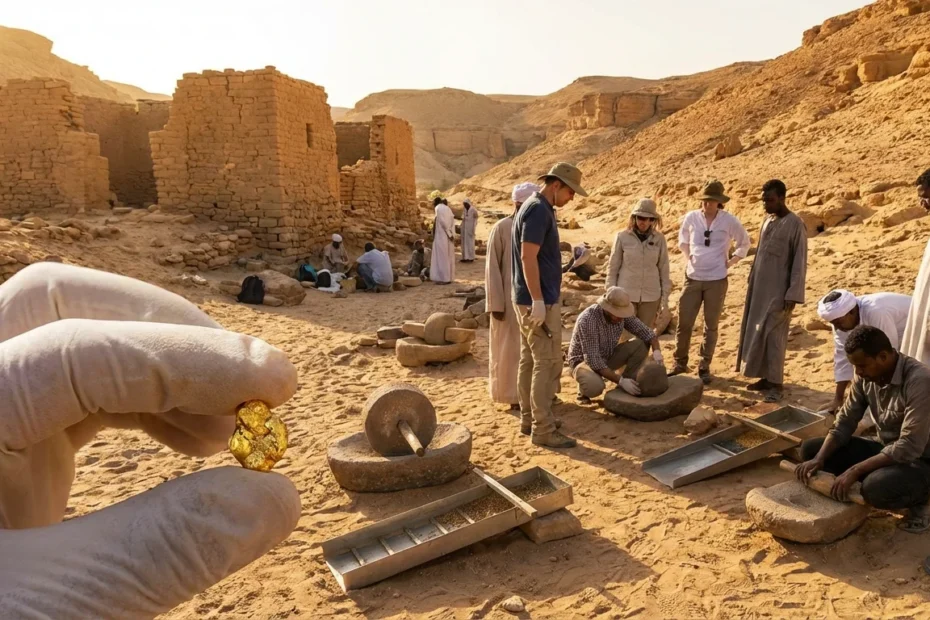
Gold mining in ancient Nubia was not just a story of rich ground and lucky prospectors.
It was a controlled production system built around desert routes, labor organization, ore processing, and political power. That is why Nubian gold mattered so much to both Kush and Egypt.
If you only picture isolated miners digging in sand, you miss the real mechanism. Ancient Nubian gold depended on mines, crushing areas, washing zones, transport corridors, and administrators who could move metal from remote landscapes into royal economies.
TL;DR
- Ancient Nubian gold mining was a full production chain, not just mine shafts.
- Gold came from ore zones in the Eastern Desert and Nubian terrain, then had to be crushed, washed, and transported through harsh dry landscapes.
- Officials connected to the Gold of Kush show that administration and state control mattered as much as geology.
- Modern archaeology suggests camps, processing areas, and route management are central to understanding why Nubian gold became politically powerful.
What Most Readers Miss
The main challenge was not finding gold alone. It was moving people, water, ore, and authority across desert environments where every step after extraction could decide whether a mine was economically meaningful.
Gold Mining in Ancient Nubia Worked as a System
Ancient Nubia mattered because it linked geology to political control.
The phrase Gold of Kush was not just poetic branding. Evidence highlighted by the Tombos archaeological project shows that officials could be tied directly to reckoning and managing gold associated with Kush, which implies a structured administrative world around production, accounting, and movement.
That matters because strong gold output in antiquity required more than ore. It required an organized chain that could connect remote extraction zones to courts, temples, tribute systems, and long-distance exchange.
Chart 1: The Nubian Gold Workflow
The production chain that most summary articles skip
Interpretation: In Nubia, the bottleneck was often logistics after extraction, not just the presence of gold-bearing rock.
Where the Gold Came From
Nubian gold was tied to desert and wadi landscapes rather than one single famous mine.
The AcrossBorders Gold of Kush project emphasizes how archaeological work in northern Sudan helps reconstruct gold-related activity across ancient Kushite landscapes. That wider framing is useful because it pushes the discussion beyond the simplistic image of one central mine.
Work on Egyptian and Nubian gold mining traditions, including the study Gold of the Pharaohs, also shows that Egypt and Nubia shared long mining histories across the Eastern Desert and adjacent zones. Nubia therefore sits inside a broader regional gold geography, but with its own political and labor significance.
Why Desert Water and Route Control Mattered So Much
Gold-bearing ore was only the starting point.
To make extraction worthwhile, miners and overseers needed camps, tools, food supply, transport animals or carriers, and crucially some way to process ore in water-constrained environments. That is why route control and access points mattered so much in desert mining regions.
If a site had ore but poor movement and processing conditions, it could be geologically interesting and still economically weak. That is one of the biggest knowledge gaps in simplified history summaries.
| Mining requirement | Why it mattered in Nubia | Reader takeaway |
|---|---|---|
| Ore access | No extraction happens without workable gold-bearing material | Geology starts the story, but does not finish it |
| Water or processing access | Washing and separation depend on practical processing conditions | Ore value depends on downstream handling |
| Labor organization | Remote mining needs teams, not isolated prospectors | Gold production was a labor system |
| Route and security control | Metal has to move from desert zones to centers of power | Logistics convert mine output into wealth |
Kush, Egypt, and the Politics of Gold
Nubian gold cannot be understood apart from political control.
The new ScienceDirect study on the economics of Late Bronze Age gold mining by the Egyptian New Kingdom in Nubia is especially useful here. It moves the topic away from romantic treasure language and toward a serious economic reading of mining in conquered or controlled territories.
That kind of work reinforces a key point: gold in ancient Nubia was entangled with imperial extraction, labor management, and the state’s ability to sustain costly operations far from the Nile heartland.
So when readers ask why Nubian gold was important, the answer is not only that it was precious. It is that gold could fund power, reward elites, support temple systems, and strengthen political legitimacy.
Chart 2: What Made a Nubian Mine Economically Important?
Conceptual importance score by system factor
Interpretation: The highest-value mine was not just the richest ore body. It was the site embedded in a functioning political and transport network.
How to read claims about ancient Nubian gold correctly
Good claim
Explains mines, camps, processing, labor, and movement together.
Weak claim
Says Nubia was full of gold without showing how output reached power centers.
Best question
Ask not only where gold was found, but who controlled it and how it was processed.
Video walkthrough: This clip gives visual context for how gold mining in ancient Nubia is usually framed before you compare it with the stronger archaeological workflow.
What Archaeology Now Shows at Camps and Processing Areas
One of the most useful modern shifts is that archaeology is no longer focused only on royal objects.
It increasingly studies the production landscapes themselves: camps, working floors, ore-processing zones, and inscriptions tied to administration. The recent ISAC Nubian Expedition report is useful because it references a large ancient gold-processing and panning camp near Hosh el-Geruf, which helps readers picture gold production as an operational landscape rather than a mythic backdrop.
That is the more serious picture of Nubian mining: not just treasure, but infrastructure.
Exact output totals for ancient Nubian gold are difficult to prove with precision. Archaeology is strongest when it reconstructs systems, camps, routes, and roles rather than pretending to know one perfectly exact production number.
The GoldConsul Editorial Perspective
The strongest way to understand ancient Nubian gold is to stop thinking like a treasure hunter and start thinking like a logistics officer. Mines mattered, but movement, water, labor, and administration decided whether gold became real power.
What the Top History Summaries Usually Miss
They usually over-focus on symbolism and under-explain production.
Gold absolutely had prestige and sacred significance. But if you stop there, you miss the harder and more useful answer: ancient Nubian gold was important because people built systems that could extract, process, move, count, and protect it.
That is also why Nubian gold belongs in the history of political economy, not only in the history of luxury objects.
Chart 3: The Knowledge Gap Map
What typical articles emphasize versus what readers actually need
Interpretation: The missing value is almost always system explanation, not another decorative summary of gold’s prestige.
The real missing question is operational
Many readers ask where the gold was. Fewer ask how ancient states made desert gold operationally useful.
That second question is the better one. It forces the article to explain camps, processing, accounting, and political control rather than repeating broad claims about wealth.
Why Ancient Nubian Gold Still Matters Historically
Nubian gold sits at the meeting point of archaeology, state formation, and extraction economics.
It helps explain why frontier landscapes mattered to ancient powers, how desert industries could be organized, and why control over resources was never just about ownership on paper. It was about the ability to sustain systems in harsh places.
That is why ancient Nubian gold should be understood as a production network with political consequences, not only as an exotic chapter in luxury history.
FAQ: How Was Gold Mined in Ancient Nubia?
Where did ancient Nubian gold mining take place?
It took place across Nubian and adjacent desert landscapes tied to gold-bearing ore zones, wadis, and route systems rather than one single iconic mine. The wider gold geography linked mines, camps, and transport corridors.
Was ancient Nubian gold mining only about digging ore?
No. Extraction was only one stage. Ore had to be crushed, processed, and moved, which is why water access, camps, and route control mattered so much.
Why is the phrase Gold of Kush important?
Because it points to administration and political control, not just raw geology. It suggests that gold was counted, managed, and tied to formal authority.
Did Egypt control Nubian gold mining?
At different times Egyptian power was deeply involved in Nubian gold extraction and its economics, especially during periods of strong New Kingdom control. But Nubia and Kush also need to be understood as political actors with their own landscapes, systems, and histories.
What do archaeologists now focus on most?
Increasingly they focus on camps, processing areas, inscriptions, route systems, and administrative evidence. That gives a more realistic picture than focusing on royal treasure alone.
 When you purchase a service or a product through our links, we sometimes earn a commission, at no extra cost to you.