
See whether gold is insured in a safe deposit box, what FDIC coverage excludes, and what private insurance or vault documentation may cover. in context.
- FDIC coverage protects deposits, not gold stored inside a bank box.
- Read the box lease because bank liability is often limited or excluded.
- Keep photos, receipts, and appraisals before buying separate valuables coverage.
Gold in a safe deposit box is usually not automatically insured. The box may sit inside a bank vault, but that does not make the gold a bank deposit, and it does not make the contents FDIC-insured.
The practical question is not only whether the box is secure. It is whether you can prove what was inside, whether your policy covers it, and whether the bank lease limits the bank’s responsibility.
TL;DR
- FDIC insurance covers eligible bank deposits, not gold, coins, cash, jewelry, or documents stored inside a safe deposit box.
- Banks often limit or exclude liability for box contents in the rental agreement.
- Homeowners or renters insurance may have low limits for off-premises valuables, jewelry, bullion, or collectibles.
- High-value gold needs a proof file: photos, receipts, appraisals, inventory, and policy wording.
- Large bullion holdings may fit better in professional private vault storage with clearer insurance and custody terms.
Animated Summary: The Safe Deposit Box Insurance Gap
This short animation shows the core problem: a bank box can reduce home-theft risk, but it does not automatically solve insurance, proof, or access risk.
What Most Buyers Miss
The mistake is assuming that a bank vault turns your gold into an insured bank product. It does not.
Is Gold Insured in a Safe Deposit Box?
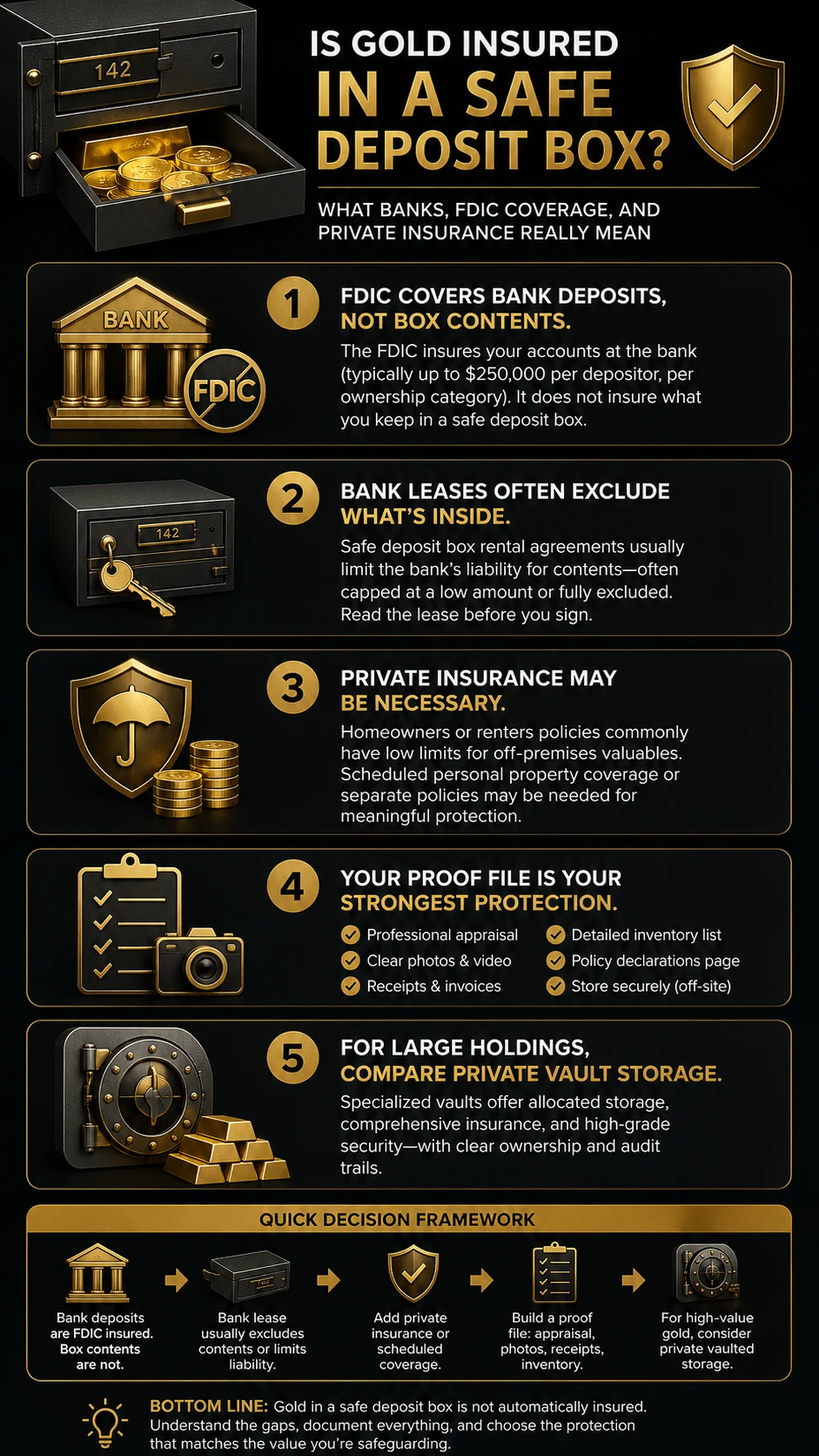
Usually, no. Gold in a safe deposit box is not insured by FDIC deposit insurance, because the gold is not a deposit account.
The FDIC explains that safe deposit box contents are not covered by FDIC deposit insurance if damaged or stolen. The FDIC’s separate page on financial products that are not insured also lists safe deposit box contents as outside FDIC protection.
If your box is at a credit union, the same basic issue applies. The NCUA says its share insurance does not cover safe deposit boxes or their contents.
Chart 1: Coverage Reality Map
Interpretation: A safe deposit box can be physically safer than a drawer at home, but insurance coverage must be arranged and documented separately.
Why FDIC Insurance Does Not Protect Gold in the Box
FDIC insurance is designed for eligible bank deposits. That means checking accounts, savings accounts, money market deposit accounts, and certificates of deposit at insured banks, subject to limits and ownership categories.
A gold coin or bar inside a box is personal property. It is not money deposited with the bank, and it does not become federally insured because it sits inside a bank building.
This distinction is important for readers who also follow the live gold price today. Price value and insurance protection are separate questions.
Bank Liability: Read the Safe Deposit Box Lease
The next issue is the box rental agreement. Many bank leases say the bank does not know what is inside the box and is not insuring the contents.
Some agreements may cap liability at a low amount unless negligence can be proven. Others may require separate insurance if you want meaningful protection.
Ask the Bank These Questions
- Does the bank insure box contents at all?
- Does the lease exclude gold, bullion, coins, jewelry, cash, or collectibles?
- Is there a liability cap if the box is damaged, drilled, flooded, robbed, or mishandled?
- What proof would the bank require if contents were missing?
- What happens if fees go unpaid, the branch closes, or the bank changes ownership?
Homeowners Insurance May Not Be Enough
Some homeowners or renters policies may cover personal property away from home, but the limits can be low. Precious metals, jewelry, collectibles, and cash often have special sublimits or exclusions.
That means a $20,000 coin or bullion holding may not be protected just because you have a homeowners policy. You need written confirmation from the insurer, not a verbal assumption.
For higher-value items, the answer may be scheduled personal property coverage, a valuables policy, or specialty safe deposit box coverage. The correct route depends on item type, value, location, and policy wording.
Chart 2: Insurance Strength Ladder
Interpretation: The jump from assumption to written policy language is the most important step. Without it, the safe deposit box may only be storage, not protection.
The Proof File: Your Strongest Protection
Insurance disputes often fail on proof. If you cannot prove what was in the box, what it was worth, and that your policy covered it, the physical vault did not solve the financial problem.
Create a proof file before storing valuable gold:
- Clear photos and video of each coin, bar, or item.
- Receipts, invoices, dealer records, and serial numbers where available.
- Professional appraisal for numismatic coins, jewelry, or high-value collections.
- Inventory list with date, quantity, weight, purity, and estimated value.
- Insurance declarations page and written coverage confirmation.
- Secure off-site backup of the proof file, separate from the box.
If you need help identifying what you own before documenting it, see GoldConsul’s guides to testing gold coins and how to buy gold coins.
Safe Deposit Box vs Home Safe vs Private Vault
A safe deposit box is useful for some gold owners, but it is not always the strongest solution. The right choice depends on value, access needs, insurance, and custody quality.
| Option | Best for | Main insurance issue | Main weakness |
|---|---|---|---|
| Home safe | Small access reserve | Home policy limits, disclosure, theft, fire | All risk sits at one address |
| Safe deposit box | Documents, small valuables, lower home-risk exposure | Not FDIC/NCUA insured; lease and policy dependent | Access hours, estate issues, unclear liability |
| Private vault | Larger bullion holdings | Contract, audit, custody, and insurance terms | Fees and provider due diligence |
For a deeper comparison, read GoldConsul’s guide to home safe vs private vault for gold and the article on allocated vs unallocated gold storage.
Chart 3: Access vs Insurance Control
Interpretation: The best plan often separates small access gold, documented valuables, and core bullion instead of relying on one storage location.
When Private Vaulting Deserves Comparison
If the gold value is large enough that a loss would materially hurt you, a standard bank box may be too vague. Professional private vaulting can offer clearer custody, audit, insurance, and withdrawal terms, but only if the contract is strong.
The LBMA vaulting standards are useful context because they frame vaulting as an operational discipline, not just a secure room.
GoldBroker Storage Context
If your goal is physical bullion ownership with professional storage options, GoldBroker is one provider to include in your comparison process. Compare custody structure, insurance, fees, withdrawal rules, and jurisdiction before choosing any provider.
Affiliate disclosure: GoldConsul may earn a commission if you use some external partner links, at no extra cost to you.The GoldConsul Editorial Perspective
A safe deposit box can reduce home-storage risk, but it can also create false confidence. If the gold is valuable enough to protect in a bank vault, it is valuable enough to insure and document properly.
Knowledge Gap: Storage Security Is Not the Same as Claim Quality
Most articles stop after saying safe deposit box contents are not FDIC-insured. That is correct, but incomplete.
- Security: the box may reduce casual theft risk.
- Coverage: your policy must actually cover the contents and location.
- Proof: you need evidence of what was inside before the loss.
- Access: bank hours, estate procedures, unpaid fees, and branch closures matter.
- Scale: large bullion holdings may need professional custody instead of a small rented box.
Bottom Line
Gold in a safe deposit box is not automatically insured. FDIC and NCUA insurance protect eligible deposit accounts, not gold stored inside a box.
If you use a safe deposit box for gold, read the bank lease, get written insurance confirmation, build a proof file, and keep duplicate records outside the box. For larger bullion holdings, compare professional vault storage rather than assuming a bank box solves every risk.
For next steps, see GoldConsul’s guides to where to store gold, private gold vaults in Europe, and what gold and silver bullion means.
FAQ: Is Gold Insured in a Safe Deposit Box?
Is gold in a safe deposit box FDIC insured?
No. FDIC insurance covers eligible bank deposits, not gold, coins, jewelry, cash, or documents stored inside a safe deposit box.
Does the bank insure safe deposit box contents?
Usually not automatically. The rental agreement often limits or excludes bank responsibility for the contents, so you need to read the lease carefully.
Will homeowners insurance cover gold in a safe deposit box?
It depends on the policy. Many policies have low limits or exclusions for valuables, precious metals, jewelry, collectibles, or property stored away from home.
What proof do I need to insure gold in a safe deposit box?
Keep photos, video, receipts, appraisals, serial numbers, inventory lists, and written coverage confirmation. Store backup copies outside the box.
Is a private vault better than a safe deposit box for gold?
For larger bullion holdings, a private vault may offer clearer custody, audit, insurance, and withdrawal terms. It still requires due diligence and contract review.
 When you purchase a service or a product through our links, we sometimes earn a commission, at no extra cost to you.