Learn why gold prices rise through real yields, the dollar, risk, investment flows, central-bank demand, and constrained supply.
- Gold rises when marginal demand outpaces available supply—not because one headline automatically controls the market.
- Real yields, the dollar, risk, investment flows, and central-bank buying often matter more than mine output short term.
- Use a multi-signal dashboard; inflation, war, or rate cuts can help gold, but none guarantees a rise.
- Gold is priced at the margin: a shift in investment demand can move price faster than annual mine output.
- Falling real yields often help because gold pays no income; rising real yields often hurt.
- A weaker dollar can support dollar gold, while local-currency results also depend on exchange rates.
- Risk, ETF flows, futures positioning, central-bank purchases, and momentum can reinforce or offset one another.
- Use a dashboard of confirming signals rather than a one-factor story.
Start with the useful version first. The rest of this guide adds the evidence, edge cases, and stronger checks.
Gold rises when buyers become more willing to own it than current holders are willing to sell it at the old price. Interest rates, currencies, risk, investment flows, and central-bank demand can all change that balance.
Falling real yields can make gold more attractive because investors give up less bond income by holding an asset that pays no coupon.
Inflation, war, rate cuts, or central-bank buying can support gold, but none of them guarantees that the price will rise on a particular day.
Start with Gold Made Simple to move from basic gold terms to buying, testing, investing, and storage without the jargon.
A mechanism guide—not a price prediction
The market-clearing price of gold is where buying and selling meet across London over-the-counter trading, futures exchanges, ETFs, bars, coins, jewellery, technology demand, recycling, and official-sector activity. A headline can matter, but only through the orders and expectations it creates.
Gold rises when marginal demand changes
Most gold ever mined still exists in some form. That large above-ground stock means the price is not set only by this year’s mine production; it is also set by whether current holders are willing to sell and whether new buyers want exposure now.
The World Gold Council’s market primer describes gold as both a consumer good and an investment asset. Jewellery and technology demand respond to income, culture, substitution, and price, while investment demand can react quickly to rates, currencies, risk, and momentum.
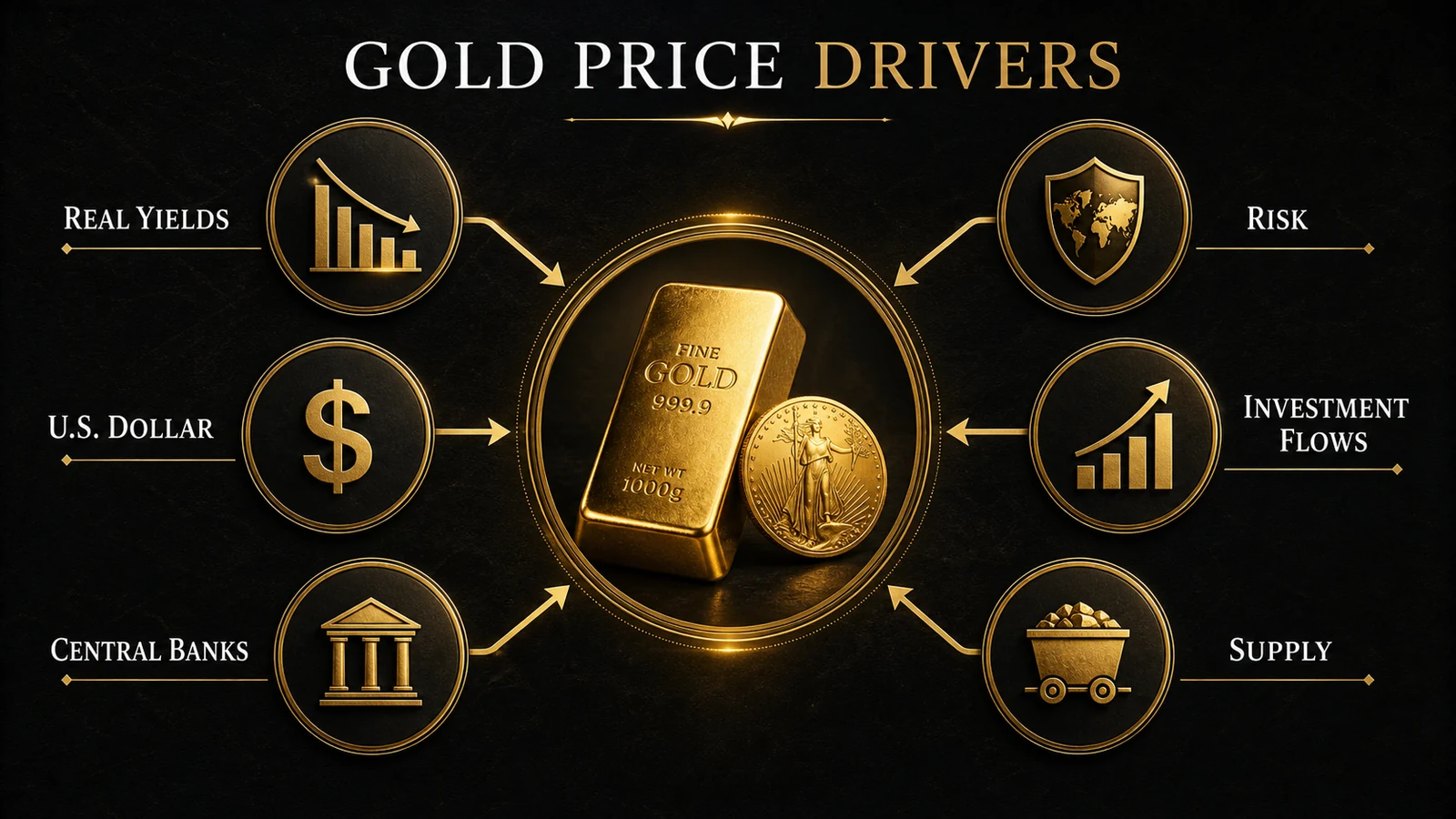
| Driver | Typical supportive change | Why it can lift gold | Why the signal can fail |
|---|---|---|---|
| Real yields | Inflation-adjusted bond yields fall | Gold’s opportunity cost declines | Risk or dollar moves can dominate |
| U.S. dollar | Broad dollar weakens | Gold becomes cheaper in other currencies | Local demand and hedging can offset it |
| Risk and uncertainty | Financial or geopolitical stress rises | Demand for liquid defensive assets can increase | Investors may sell gold to raise cash |
| Investment flows | ETF holdings or futures exposure rise | New financial demand meets finite liquidity | Short covering can look like durable buying |
| Central banks | Official purchases stay strong | Long-horizon demand absorbs supply | Reporting is delayed and incomplete |
| Supply | Mine or recycling response disappoints | Less metal reaches the market | Above-ground stocks dwarf one year of output |
1. Real interest rates change the opportunity cost
Gold does not pay a coupon. When a high-quality inflation-protected bond offers a higher real yield, an investor gives up more income by holding gold; when real yields fall, that opportunity cost shrinks.
Use the direction of real yields rather than the policy rate alone. A central bank can cut nominal rates while inflation expectations fall even faster, leaving real yields higher. Conversely, nominal rates can rise while inflation expectations rise more, leaving real yields lower.
The relationship is useful, not mechanical. From late 2022 into 2024, strong official-sector and risk-related demand sometimes outweighed rate pressure. A driver model should allow several forces to act at once.
2. The U.S. dollar changes the global price
Gold is commonly quoted in U.S. dollars. A broad dollar decline can make the same ounce cheaper for buyers using euros, yen, or rupees, while a stronger dollar can restrain demand or pressure the dollar quote.
A non-U.S. buyer experiences two prices: the international gold price and the exchange rate into the local currency. Dollar gold can be flat while local gold rises because the local currency weakens.
For a current quote, use a dated benchmark or the GoldConsul gold price calculator. Never label a manually entered number “live” without a timestamp and source.
3. Risk can create demand—and forced selling
Recession fears, banking stress, geopolitical conflict, and doubts about fiscal or monetary credibility can increase demand for gold. The logic is diversification and liquidity, not a promise that gold will rise in every crisis.
During the first phase of a market shock, leveraged investors may sell liquid assets to meet margin calls. Gold can fall alongside stocks before defensive demand appears. This is why “war equals gold up” is too simple.
Our guide to gold as a safe haven during recession separates strategic diversification from event trading.
4. Investment flows can move price quickly
Physically backed ETF holdings, futures positioning, options hedging, and bar-and-coin demand can change faster than mine supply. WGC calls investment demand an important marginal driver of short-run gold returns.
ETF inflows are clearest when they persist across several reporting periods and appear with broader participation. One week can reflect tactical hedging or short covering rather than a durable allocation shift.
Futures positioning also needs context. A rise in price with growing open interest may differ from a rally driven mainly by traders closing shorts. Flow data explain participation; they do not guarantee the next move.
5. Central-bank buying is structural, not a timing clock
Central banks hold gold as a reserve asset without another institution’s credit liability. Diversification, liquidity, sanctions risk, and confidence in reserve currencies can all influence official purchases.
Monthly and quarterly data arrive with lags, estimates, and revisions. Strong buying can support the market over time, but it does not create a precise price floor or tell a retail investor which day to buy.
See how much gold the United States reports for the difference between official reserves and market transactions.
6. Mine supply and recycling respond slowly
New mines require discovery, permitting, finance, construction, and operating capacity. A higher gold price can improve economics, but meaningful supply response may take years.
Recycling reacts faster because holders can sell jewellery or bullion when prices rise or cash is needed. That flow can cushion shortages, while high prices may also reduce jewellery volumes.
To understand production constraints, compare the gold extraction process and gold mining methods.
Why inflation does not always raise gold
Gold can preserve purchasing power across long periods, but the short-run path depends on the policy response. Inflation that causes real yields and the dollar to rise may pressure gold even while consumer prices remain high.
Expected inflation can matter before reported inflation. If a data release is high but below market expectations, gold may fall because the surprise was disinflationary relative to positioning.
A practical weekly dashboard
- Record the weekly change in the 10-year real yield and the broad U.S. dollar index.
- Compare gold’s return in U.S. dollars with the return in your local currency.
- Check ETF holdings and futures positioning over several weeks, not one session.
- Review official-sector and bar-and-coin data at their actual reporting frequency.
- Note whether the move began before or after the news being used to explain it.
- Separate a tactical price view from a long-term allocation decision.
- Record transaction cost and vehicle risk before acting on a bullish narrative.
Most explanations are written after the price moved, so they can confuse a plausible story with the actual marginal order flow. The honest answer is often a weighted combination of drivers with uncertain timing.
Do not ask whether one headline is “good for gold.” Ask which channel it changes, whether other signals confirm it, and what would falsify the explanation. That framework is slower than a slogan and much more useful.
This article is educational, not personalized financial advice or a price forecast. Gold can be volatile and can decline even when a familiar bullish driver is present.
Watch: Gold in 2026: what could keep the rally going?
This World Gold Council discussion illustrates how a current outlook combines macro conditions and demand rather than relying on one permanent gold-price rule.
Video: World Gold Council. YouTube oEmbed availability validated July 17, 2026.
Bottom Line
Gold prices rise when marginal demand strengthens relative to willing supply. Real yields, the dollar, risk, investment flows, central banks, and slower supply response provide the most useful map—but the map works only when several signals and their timing are checked together.
FAQ: Why Gold Prices Rise
Does inflation always make gold prices rise?
No. Inflation can help, but real yields, the dollar, expectations, and investment flows can offset it.
Why do lower interest rates often help gold?
Lower real yields reduce the income investors give up by holding an asset that pays no coupon.
Can gold fall during a crisis?
Yes. Investors may raise cash, unwind leverage, or decide the event is already priced in.
Do central-bank purchases guarantee a floor?
No. They can support structural demand, but data are delayed and other sellers and financial flows still affect price.
Is mine production the main short-term price driver?
Usually not. Mine supply changes slowly, while financial and official demand can change quickly against a large above-ground stock.
Sources and verification
Use these primary and specialist sources to verify the claims, rules, specifications, and market definitions. Access rules, prices, and product terms can change.
- World Gold Council — Gold market primer
- World Gold Council — Gold demand trends
- World Gold Council — Q1 2026 demand trends
- World Gold Council — Gold data
- World Gold Council — Mid-year outlook 2026
- FRED — 10-year real interest rate
- FRED — Broad U.S. dollar index
- LBMA — Precious metal prices
- IMF — International Financial Statistics
- U.S. Geological Survey — Gold statistics
 When you purchase a service or a product through our links, we sometimes earn a commission, at no extra cost to you.