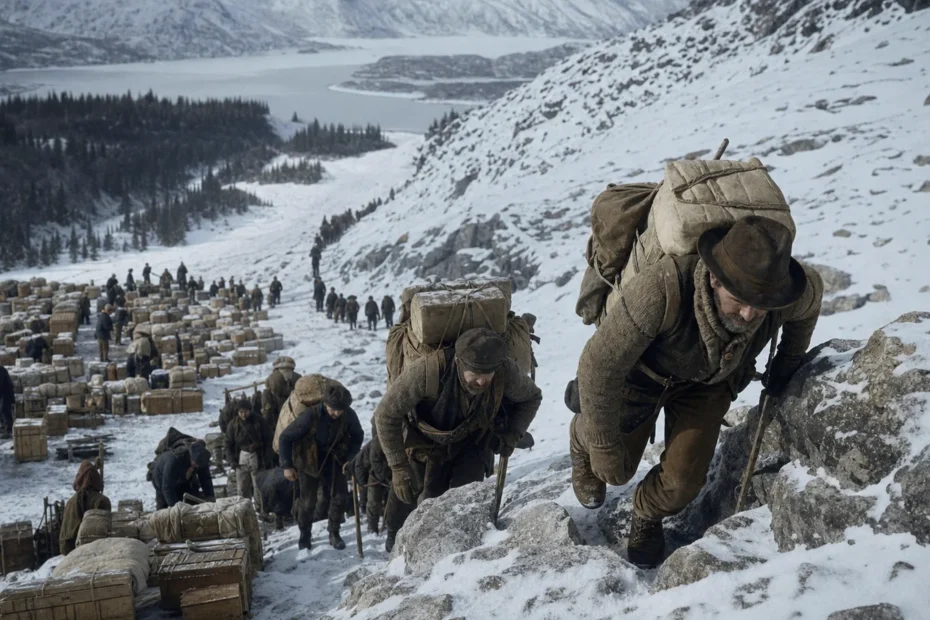
Follow the Klondike Gold Rush from the 1896 discovery through Chilkoot and White Pass to Dawson, claims, hardships, and lasting consequences.
- The 1896 discovery triggered the outside stampede only after gold ships reached U.S. ports in July 1897.
- Most stampeders crossed Chilkoot or White Pass with a year of supplies, then traveled more than 500 river miles toward Dawson.
- By the time many newcomers arrived, the richest accessible claims were already staked; transport, trade and services often paid more reliably than mining.
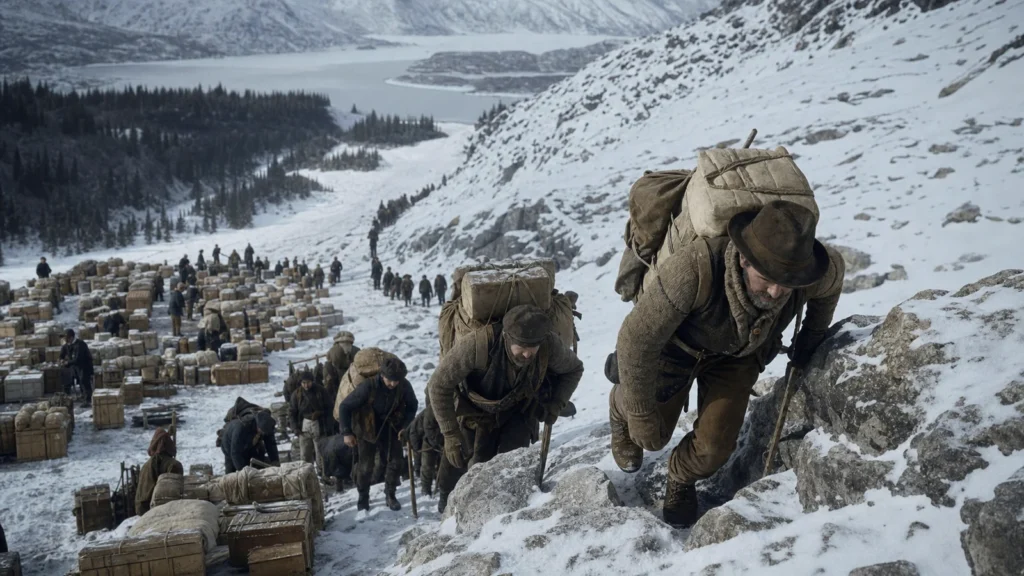
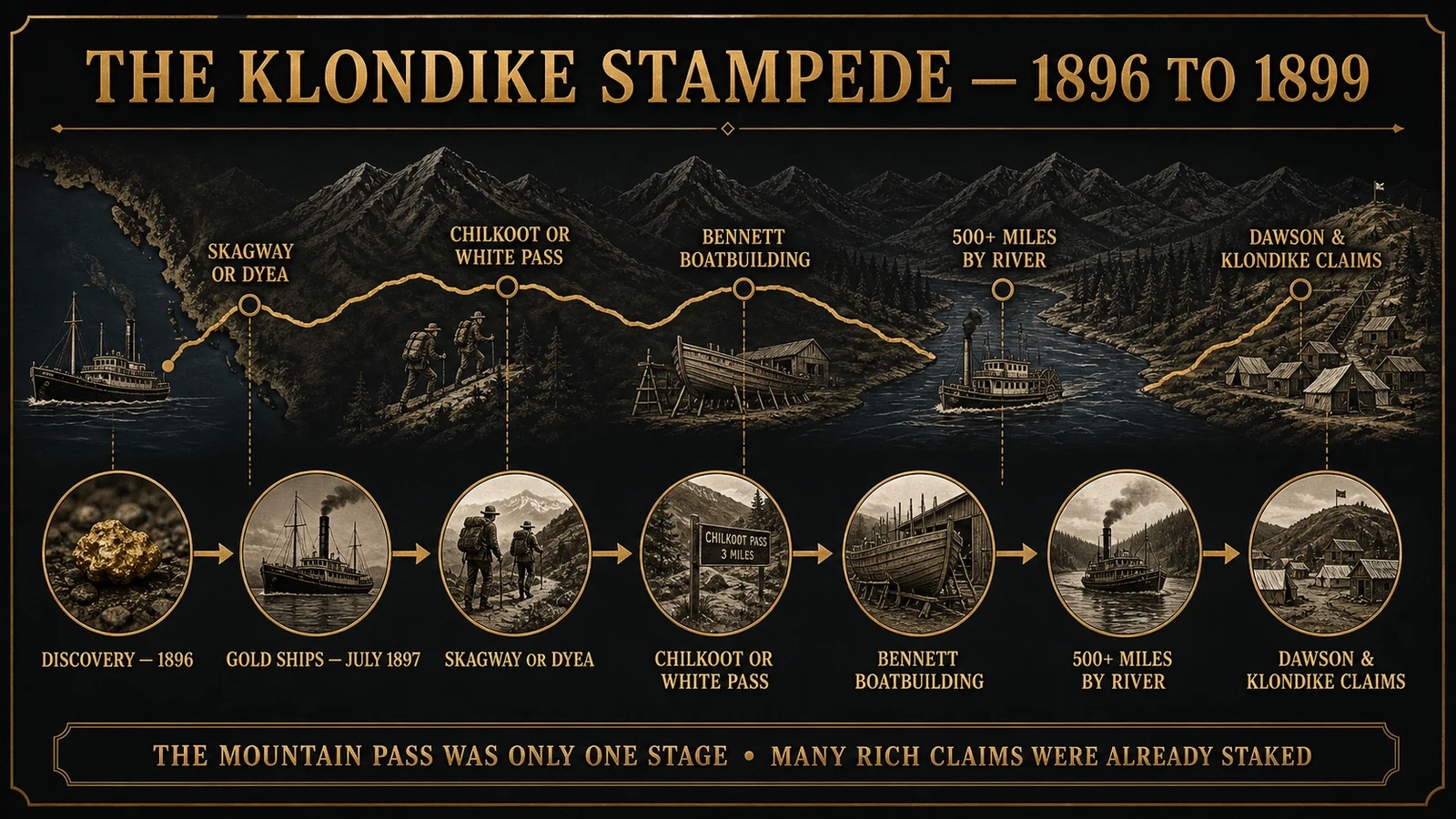
- The discovery was in 1896; the mass stampede followed news in July 1897.
- Skagway and Dyea were gateways, not the destination.
- Canadian authorities required enough supplies for roughly a year, creating the famous “ton of goods” ordeal.
- Crossing Chilkoot or White Pass was followed by boatbuilding and a long Yukon River journey.
- Mining success was exceptional; transport, supplies, lodging and services often offered steadier opportunities.
The real Klondike journey was a logistics chain
The popular image compresses the rush into stampeders climbing a snowy staircase. That scene is real, but incomplete. The National Park Service dates the discovery to August 1896 and the worldwide rush to the arrival of the Excelsior and Portland in July 1897. Between a newspaper headline and a claim in the Klondike stood money, freight, border rules, weather, skill and timing.
Klondike Gold Rush timeline: discovery, stampede and decline
| Date | What happened | Why it matters |
|---|---|---|
| August 1896 | Skookum Jim, Dawson Charlie, Kate Carmack and George Carmack were part of the discovery party on Bonanza Creek. | The find began local staking before outsiders heard the news. |
| Winter 1896–97 | Miners worked and traded in the Klondike while river travel was closed. | The time lag gave people already in the district a decisive advantage. |
| July 1897 | Ships arrived in San Francisco and Seattle carrying miners and gold. | Press coverage triggered the mass stampede. |
| 1897–98 | Travelers crowded Skagway and Dyea, crossed the passes and assembled boats at Bennett. | The most recognizable images belong to this supply-and-travel phase. |
| Summer 1898 | Large numbers reached Dawson after river breakup. | Many found that established claims controlled the best-known ground. |
| 1899 | News of Nome drew people away from Dawson. | The stampede shifted, although Klondike mining continued. |
The event belongs within a wider sequence of North American rushes. Compare the earlier California Gold Rush, the Pikes Peak rush, and the later Nome rush. Each combined mineral discovery with migration, speculation, supply markets and severe consequences for existing communities.
Who discovered Klondike gold?
Attribution is more complicated than the familiar name “George Carmack.” The discovery party included Tagish men Skookum Jim and Dawson Charlie, Jim’s sister Kate Carmack, and her husband George. The National Park Service identifies the family group and explains that later accounts disagreed about who first saw the gold. A responsible history names the party and does not erase Indigenous expertise.
The routes through the region were not empty wilderness corridors waiting for newcomers. Tlingit and Tagish people knew, used and traded through these landscapes. Indigenous packers became indispensable to many stampeders, yet the rush also brought disease, displacement, environmental disruption and outside control. The Parks Canada account of Chilkoot Trail culture is essential context.
Skagway or Dyea: choosing a coastal gateway
| Gateway | Main route | Appeal | Major problem |
|---|---|---|---|
| Dyea | Chilkoot Trail | Shorter pass route and long-established Indigenous trail. | Steep climb, repeated portage and avalanche exposure. |
| Skagway | White Pass | Advertised as easier for pack animals and wagons. | Mud, congestion, poor early trail conditions and extensive animal deaths. |
| All-water alternatives | Yukon River approaches | Avoided the coastal passes. | Long, expensive, seasonal and still logistically difficult. |
Neither coastal town was Dawson City. Travelers still had to move supplies across the Coast Mountains and into the Yukon watershed. On the Chilkoot, goods were divided into loads and cached again and again. On White Pass, commercial optimism collided with a route not ready for the volume of people and animals. Route choice changed the type of hardship; it did not remove it.
Why a “ton of goods” mattered
Canadian authorities sought to prevent destitute newcomers from becoming a public emergency. The famous requirement is often summarized as one ton of supplies, though the exact outfit varied by person and official list. The NPS ton-of-goods exhibit shows an illustrative year’s outfit: food, clothing, tools, shelter and equipment.
Suppose a traveler has 2,000 pounds of outfit and can carry 50 pounds per trip over a difficult section. That is 40 loaded trips before returning mileage is counted. If the cache is one mile away, the person walks roughly 79 miles to advance the outfit one mile: 40 loaded miles and 39 return miles.
This simplified calculation explains why the route could consume weeks and why paid packers, tramways and freight services mattered. It is not a claim that every stampeders’ load or distance was identical.
Lake Bennett was a construction site, not the finish
After reaching the lakes, stampeders waited for thaw and built boats from local timber or prepared prefabricated craft. Parks Canada documents a sudden boatbuilding economy at Bennett. Poor carpentry could become a lethal problem once travelers entered rapids and broad river systems. Boats also needed to carry people and a year’s supplies without becoming unmanageable.
From Bennett, the journey continued through lakes and down the Yukon system for more than 500 miles toward Dawson. Navigation, ice, rapids, current, cargo balance and congestion introduced new risks. The pass was an entry exam; it was not the complete route.
Dawson City, claims and the real odds of success
Dawson grew rapidly into an administrative, commercial and entertainment center near the goldfields. A newcomer still needed a valid claim, a partnership, wage work or a business. Staking did not guarantee payable ground, and a claim could require proof, records, labor and supplies. For the broader process, see how miners staked a Gold Rush claim.
By the mass arrival of 1898, many celebrated creeks were already divided. Some latecomers bought interests, worked for claim owners, prospected farther away or moved into services. The common lesson is not “nobody made money.” It is that widely reported discoveries and typical newcomer returns are different datasets.
| Opportunity | What created value | Main risk |
|---|---|---|
| Owning a productive claim | Gold-bearing ground plus labor and water access | Most prospects were not bonanzas; title and geology could disappoint. |
| Wage mining | Labor for an established operator | Hard, seasonal work and employer risk. |
| Freight and packing | Moving urgent supplies through bottlenecks | Weather, animals, injury and changing routes. |
| Food, lodging and retail | Serving a concentrated, cash-carrying population | High input costs, fire, competition and boomtown decline. |
| Speculation | Claims, lots or businesses resold on expectations | Rumor, fraud and rapid repricing. |
That pattern also shaped Gold Rush towns: infrastructure and merchants could outlast the first diggings, while some settlements disappeared when traffic shifted.
Mining methods and environmental change
Early work targeted placer gold concentrated by streams. Panning helped test material, while rockers, sluices and larger systems processed more gravel. Frozen ground demanded thawing and removal before pay gravels could be reached. Over time, capital and mechanization expanded. Read the method sequence in Gold Rush mining techniques.
Mining altered creek channels, vegetation and sediment. Town growth demanded timber, fuel and food. The rush also embedded a colonial economy in Indigenous lands. A full accounting therefore includes more than production totals or colorful saloons.
Four Klondike myths worth correcting
- “The rush started in 1898.” Large crowds reached Dawson in 1898, but discovery occurred in 1896 and international news broke in July 1897.
- “Everyone climbed the Golden Stairs once.” Many people used the Chilkoot route, but repeated freight trips—and alternative routes—matter more than one dramatic ascent.
- “Reaching Canada meant reaching the goldfields.” The summit led to lakes, boat construction and more than 500 river miles before Dawson.
- “Gold was waiting for the first fit traveler.” Local staking began long before outside headlines; arrival time and claim status mattered more than physical endurance alone.
These corrections make museum photographs easier to interpret. A line of stampeders may document a supply bottleneck, not a representative mining day. A crowded Dawson street may document commerce, not the number of productive claim owners. Evidence becomes clearer when the image is tied to its precise stage.
History credibility checklist
- Does the source distinguish the 1896 discovery from the 1897 public stampede?
- Does it name Indigenous participants and the existing use of the trails?
- Is the route described from coast to Dawson, not just to the summit?
- Are supply figures presented as an official or illustrative outfit rather than every person’s exact load?
- Does a success story identify whether wealth came from mining, wages, transport, land or retail?
- Are photographs dated and located rather than used as generic Gold Rush scenery?
- Are later memoirs checked against contemporary records and institutional collections?
Most summaries jump from the Chilkoot summit to Dawson and then from Dawson to “fortune.” The missing middle—freight repetition, Bennett boatbuilding, river travel, claim status and seasonal timing—explains why a person could complete the iconic climb and still have poor mining prospects.
The Klondike is best understood as a race against information delay. People already near the discovery converted local knowledge and timing into claims; outsiders reacted to spectacular but stale news and paid heavily to cross a chain of bottlenecks.
Watch: This short documentary provides visual context for the route, stampeders and Dawson.
Bottom Line
The Klondike Gold Rush was a 1896 discovery followed by a 1897–99 mass migration through coastal ports, mountain passes, Lake Bennett and the Yukon River to Dawson. The most durable lesson is logistical and economic: the headline described gold already found, not an equal opportunity waiting for every arrival.
FAQ: The Klondike Gold Rush
When did the Klondike Gold Rush start?
Gold was discovered on Bonanza Creek in August 1896. The mass international stampede began after ships carrying gold reached San Francisco and Seattle in July 1897.
Who discovered gold in the Klondike?
The discovery party included Skookum Jim, Dawson Charlie, Kate Carmack and George Carmack. Accounts differ on who first saw the gold, so responsible histories name the group.
How far was the journey from the coast to Dawson?
After a mountain pass and the lakes, stampeders still faced more than 500 miles of water travel through the Yukon system. Exact distance varied by route.
Why did stampeders carry a ton of supplies?
Canadian authorities wanted travelers to have roughly a year of provisions so they would not arrive destitute. The phrase describes an outfit of food, clothing, shelter and equipment.
Did most Klondike stampeders get rich?
No. Some claim owners made fortunes, but many arrivals found the best-known ground already staked and turned to wage work, services, prospecting elsewhere or returned home.
Sources and verification
This article separates documented evidence from inference and links the primary or specialist sources used. Dates, access rules, care advice and industrial controls should be rechecked when a decision depends on them.
- NPS — What Was the Klondike Gold Rush? — Official overview of discovery, routes, scale, hardships and Dawson journey.
- NPS — Ton of Goods — Supply requirement, weight, cost and portage evidence.
- NPS — Geology, Glaciers, and Gold — Gold geology and route context.
- NPS — History of the White Pass Trail — White Pass distance, pack-animal use and deadly trail conditions.
- Parks Canada — Chilkoot Culture and History — First Nations trade route and gold-rush cultural landscape.
- Parks Canada — History of the Chilkoot Trail — Trail economy, tramways, labor and railroad displacement.
- Parks Canada — Boat Building — Bennett and Lindeman boatbuilding before the Yukon River journey.
- Parks Canada — International Historical Park — 1897 gold-ship news and international historical significance.
- NPS — Klondike-Alaska Gold Rush — Canadian jurisdiction, claims and gold tax context.
- Buffalo Toronto Public Media — The Klondike Gold Rush — Public-media documentary overview selected for the article video.
 When you purchase a service or a product through our links, we sometimes earn a commission, at no extra cost to you.