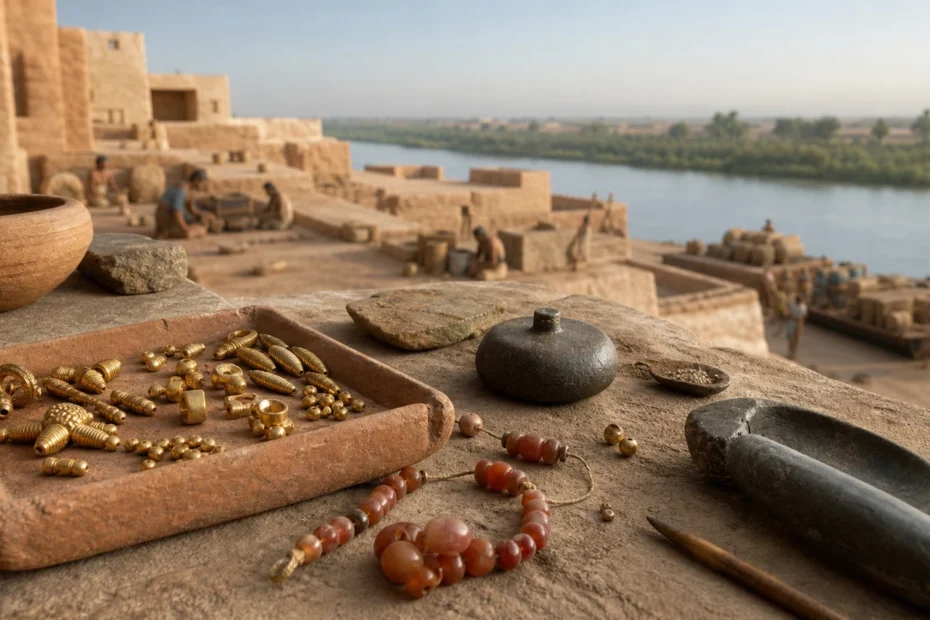
Examine Indus Valley gold artifacts, working evidence, source regions, and trade routes—and why direct mining claims remain uncertain.
- Gold objects and gold-working skill are well established in Indus archaeology; a large local gold-mining industry is not.
- Alluvial gold from wider South Asia and exchange through regional trade networks are plausible supply paths.
- Separate artifact evidence, workshop evidence, geological possibility, textual inference, and direct mine evidence.
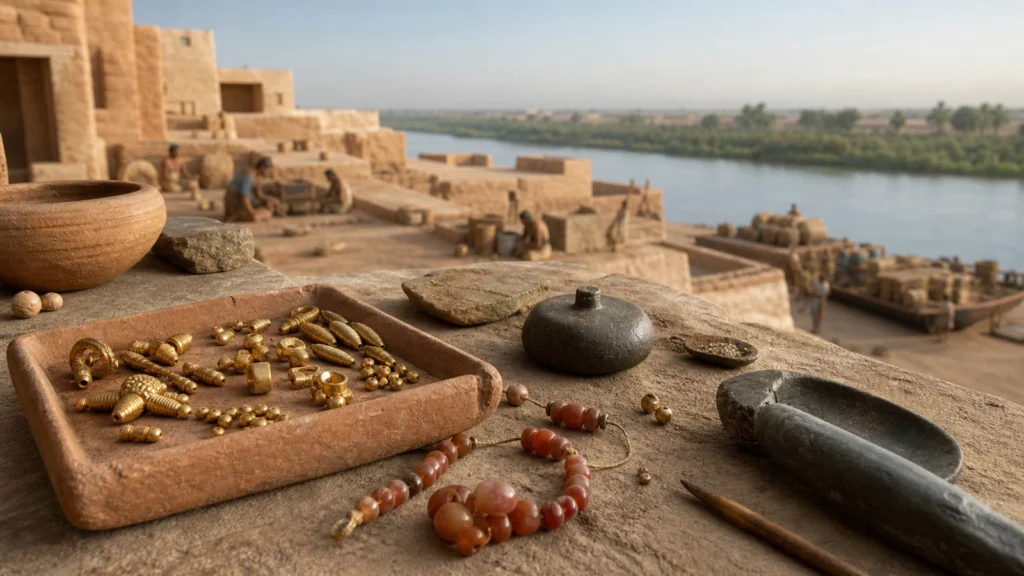
- Gold ornaments and beads establish skilled use and working.
- Workshop context can show production without identifying ore source.
- Trade with wider South Asia, the Iranian plateau, Oman, and Mesopotamia is well supported.
- Potential river and geological sources remain hypotheses until matched by provenance or excavated extraction evidence.
- The responsible conclusion is proven gold use, plausible mixed sourcing, and uncertain mining location and scale.
The key distinction is use versus extraction
The civilization commonly called Indus or Harappan flourished across parts of present-day Pakistan and northwestern India, with urban centers including Harappa, Mohenjo-daro, and Dholavira. Its exchange networks crossed modern borders that did not exist in the Bronze Age.
What archaeology establishes firmly
Excavated gold beads, ornaments, and composite jewelry show that Indus craftspeople could shape, join, perforate, and combine gold with stones and other materials. Standardized weights and specialized production further support sophisticated craft and exchange systems.
UNESCO’s records for Mohenjo-daro and Dholavira establish the urban and trading context. They do not, by themselves, document a gold mine.
| Evidence type | What it can support | What it cannot prove alone |
|---|---|---|
| Gold artifact | Gold was present, valued, and worked | Where the gold originated |
| Tool, crucible, workshop residue | Local working or refining activity | Local ore extraction |
| Standardized weight or seal | Organized exchange and administration | Commodity identity in every transaction |
| River or geological deposit | Gold could exist in a source region | Bronze Age exploitation |
| Ancient text about Meluhha trade | Long-distance exchange with the Indus sphere | A named Indus mine or production volume |
| Excavated workings with dating | Direct extraction at a location and time | Civilization-wide scale without broader evidence |
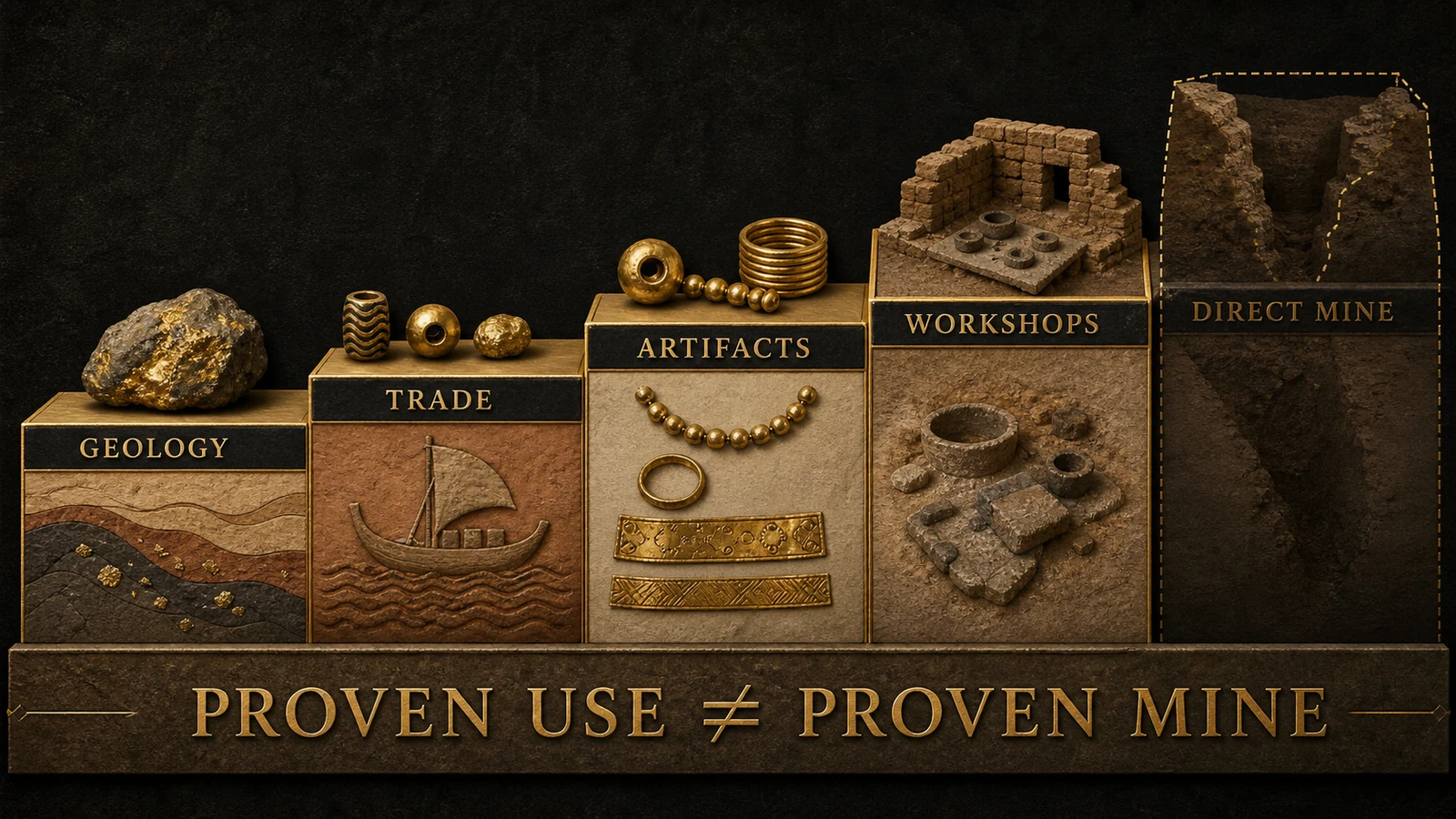
The evidence ladder for an ancient mining claim
Geological possibility is the lowest rung: a deposit exists and was technically accessible. The next rungs are period tools, ore, slag, washing features, workshop residues, and secure dates.
The strongest case connects extraction features to settlement, transport, processing, finished objects, and provenance. Indus gold research is much stronger at the artifact and exchange levels than at the excavated-mine level.
- Is the object or feature from a documented excavation context?
- Is its date secure, or inferred from nearby material?
- Does the evidence show extraction, processing, working, ownership, or trade?
- Has a metal-source claim been tested, or only suggested by geography?
- Is a modern mining practice being projected backward without archaeological continuity?
- Does the wording preserve uncertainty and alternative explanations?
Where could Indus gold have come from?
Researchers discuss alluvial gold from river systems and supplies from wider South Asia, Afghanistan, the Iranian plateau, and other connected regions. The Ancient Indus literature describes extensive exchange in stone, shell, timber, metals, and finished goods.
A source region is not necessarily a political territory controlled by an Indus city. Materials could move through several communities, ports, and intermediaries before reaching a workshop.
Dating and scale require separate evidence
A trench, pit, washing area, or hammerstone near a gold occurrence is not enough until its use and date are established. Archaeologists look for stratigraphic relationships, associated ceramics or tools, radiocarbon samples where appropriate, and evidence that the feature was created for extraction rather than another activity.
Scale is a second question. A securely dated small placer-working site could prove some recovery without proving state control, specialist labor, export production, or a civilization-wide supply system.
Quantities of finished jewelry also do not translate directly into annual mine output. Gold is durable, highly recyclable, and capable of circulating across generations; even a rich burial or workshop deposit can combine metal from different periods and sources.
Why alluvial gold is plausible but hard to prove
Placer gold can be recovered with relatively simple washing and concentration. Those activities may leave fewer monumental traces than hard-rock mining, especially along mobile river channels.
That preservation problem raises uncertainty; it does not convert absence of evidence into evidence of a large industry. Direct proof would require dated tools, processing features, sediments, or residues tied to Bronze Age activity.
Gold working is not the same as gold mining
A craftsperson can hammer, draw, join, polish, or remelt imported gold. A workshop therefore answers “where was the object made?” more readily than “where was the metal mined?”
Touchstones, balances, and production debris can reveal testing and fabrication. They still need contextual publication and material analysis before supporting a supply-chain conclusion.
What Meluhha trade can and cannot tell us
Mesopotamian texts and excavated Indus-style goods support contact with a region often identified as Meluhha. Harappan seals and beads found west of the Indus world reinforce the trade picture.
Trade evidence shows movement of people or goods, but commodity lists do not provide a mine map. Gold may have passed in either direction, through intermediaries, or as finished objects rather than raw metal.
Can science identify the source?
Elemental and isotopic methods can sometimes compare objects with geological sources. Gold is difficult because refining, alloying, remelting, contamination, and heterogeneous deposits can blur signatures.
A defensible provenance study needs representative source samples, transparent analytical methods, secure object context, and cautious statistics. One chemical similarity rarely establishes an exclusive origin.
- Locate the original excavation or analytical report, not only a news summary.
- Identify the site, layer, dating method, and chain of custody.
- Separate geological gold, extraction features, processing debris, and finished artifacts.
- Check whether provenance was tested against multiple possible sources.
- Look for peer review and acknowledgement of trade and recycling alternatives.
- Reject nationalistic or sensational conclusions that outrun the published evidence.
What the evidence means for the civilization
Gold use fits a broader pattern of specialized craft, standardized measurement, social display, and long-distance exchange. It also shows that high-value materials could move through networks without a surviving royal mine archive.
The undeciphered Indus script limits historical reconstruction. Archaeologists therefore rely heavily on stratigraphy, materials, production debris, settlement patterns, and comparison with neighboring records.
For context, compare ancient gold mining, gold in ancient Mesopotamia, ancient Chinese gold mining, gold mining in ancient Africa, and ancient gold trade.
Gold objects are easier to preserve and display than placer-washing sites or recycled supply chains. The surviving record is therefore biased toward possession and craft, while extraction location and production volume remain harder to reconstruct.
The strongest historical answer is not a confident yes or no. Say exactly which rung the evidence reaches: Indus gold use is certain, gold working is strong, regional supply and trade are plausible, and specific mining sites and scale remain unproven.
Watch: Indus Valley Civilization: Crash Course World History #2
This Crash Course overview supplies the urban, chronological, and trade context needed before interpreting a narrow claim about Indus gold extraction.
Video: CrashCourse. YouTube oEmbed availability validated July 17, 2026.
Bottom Line
The Indus Valley Civilization possessed gold and had skilled goldworkers, but those facts do not identify a mine. Current evidence supports mixed regional sourcing and exchange more strongly than a documented large-scale Indus mining system.
FAQ: Gold Mining in the Indus Valley
Did the Indus Valley Civilization mine gold?
It may have recovered some gold, including from alluvial sources, but current archaeology does not prove a large organized mining industry in the urban core.
What is the strongest evidence for Indus gold?
Excavated ornaments, beads, working skill, measurement systems, and trade networks are stronger evidence than direct mine remains.
Could all Indus gold have been imported?
It is possible that substantial supplies arrived through exchange, but a mixed model of regional recovery, trade, and recycling is also plausible.
Why can’t scientists simply match an artifact to a mine?
Refining, alloying, remelting, limited source samples, and overlapping geological signatures can make gold provenance difficult.
Does Meluhha prove an Indus gold trade?
Meluhha references support long-distance contact, but they do not by themselves identify gold’s direction, source mine, or production scale.
Sources and verification
Use the primary documents below to verify rules, data, definitions, and evidence. Product terms, market conditions, and research conclusions can change.
- UNESCO — Archaeological Ruins at Moenjodaro
- OpenStax — The Indus Valley Civilization
- Kenoyer — The Ancient Indus Valley: New Perspectives
- Harappa Archaeological Research Project — Harappa
- British Museum — Indus civilization collection search
- The Metropolitan Museum of Art — Indus civilization
- Encyclopaedia Britannica — Indus civilization
- ScienceDirect Topics — Indus Valley Civilization
- UNESCO — Dholavira: a Harappan City
- Archaeological Survey of India — Excavated sites
 When you purchase a service or a product through our links, we sometimes earn a commission, at no extra cost to you.