
Roosevelt ended domestic gold convertibility; Nixon closed the gold window in 1971. See the complete U.S. gold-standard timeline.
- Roosevelt ended domestic convertibility; Nixon closed the foreign gold window.
- The United States left gold in stages—not on one single date.
- Separate ownership, redemption, and international settlement when reading the timeline.

Richard Nixon is the short answer: on August 15, 1971, he suspended the dollar’s convertibility into gold for foreign governments and central banks. The complete answer also includes Franklin D. Roosevelt, whose 1933–1934 measures ended ordinary domestic dollar-to-gold convertibility. Roosevelt broke the domestic link; Nixon closed the international gold window.
- The United States did not leave gold in one step or on one date.
- Roosevelt ended the classical domestic gold standard during the 1933 banking crisis.
- The Gold Reserve Act of 1934 left a narrower official gold link in place.
- Bretton Woods made the dollar the center of an international gold-exchange system after World War II.
- Nixon suspended foreign official convertibility in 1971; floating exchange rates followed later.
The phrase “who took us off the gold standard?” hides two different questions. Could an American redeem dollars for gold, and could a foreign central bank exchange its dollars for U.S. gold?
Those rights ended decades apart. Once that distinction is clear, the Roosevelt-versus-Nixon argument largely disappears.
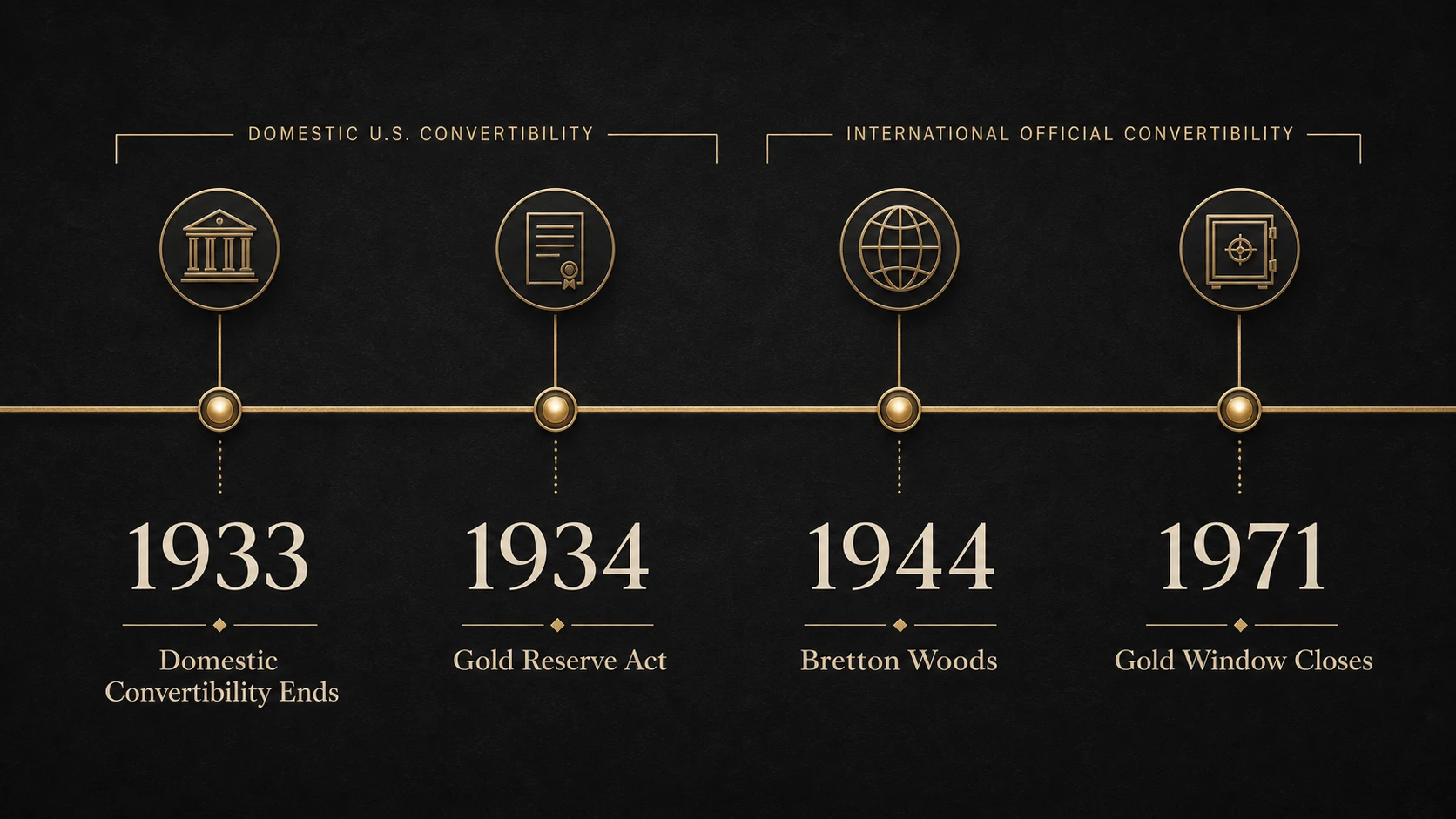
Reusable GoldConsul visual
Reuse this visual
You may reuse U.S. Gold Standard Timeline: 1933 to 1971 in an editorial or educational article under GoldConsul’s visual reuse terms. Credit the visual, link to this source page, and keep its facts and labels unchanged.
Copy the suggested embed code
<figure>
  <a href="https://goldconsul.com/who-took-us-off-gold-standard/"><img src="https://goldconsul.com/wp-content/uploads/2026/08/us-gold-standard-timeline.webp" alt="Timeline showing domestic gold convertibility ending in 1933, the Gold Reserve Act in 1934, Bretton Woods in 1944, and the gold window closing in 1971" width="1672" height="941" loading="lazy"></a>
  <figcaption>Source: <a href="https://goldconsul.com/who-took-us-off-gold-standard/">GoldConsul — U.S. Gold Standard Timeline: 1933 to 1971</a></figcaption>
</figure>
What did “the gold standard” mean?
A gold standard is a monetary arrangement in which a currency is defined by a fixed quantity of gold and can be converted under stated rules. The crucial questions are who may convert, at what rate, and under which legal conditions.
Before 1933, convertibility affected domestic money holders much more directly. After 1934, the dollar still had an official gold value, but ordinary Americans no longer had the same redemption right. Under Bretton Woods, convertibility primarily served foreign monetary authorities.
The Congressional Research Service describes 1879–1933 as the period that can most strictly be called the U.S. gold standard. Congress formally reaffirmed gold as the monetary standard in 1900, after earlier periods of bimetallism and wartime suspension.
The accurate timeline
| Date | What changed | Why it matters |
|---|---|---|
| 1879 | The United States resumed specie payments after the Civil War era. | This begins the strict gold-standard period identified in the CRS history. |
| 1900 | The Gold Standard Act formally defined the dollar in relation to gold. | Gold became the explicit legal monetary standard. |
| 1933 | Roosevelt suspended gold payments and restricted domestic monetary-gold ownership and movement. | Ordinary domestic convertibility effectively ended. |
| 1934 | The Gold Reserve Act transferred monetary gold to the Treasury and reset the official price to $35 per ounce. | A narrower official or quasi-gold system replaced the classical domestic standard. |
| 1944 | Bretton Woods tied other currencies to the dollar, while the dollar retained an official gold link. | Foreign monetary authorities—not ordinary U.S. citizens—stood at the center of convertibility. |
| 1971 | Nixon suspended conversion of official foreign dollar holdings into gold. | The gold window closed and the Bretton Woods structure began its final breakdown. |
| 1973–1976 | Major currencies moved to floating rates and remaining legal ties were removed. | The modern fiat and floating-exchange-rate system emerged through a transition, not one television speech. |
Why Roosevelt belongs in the answer
Roosevelt entered office during a banking panic, severe deflation and heavy gold withdrawals. The federal bank holiday and emergency legislation in March 1933 gave the administration broad authority over gold transactions.
The Federal Reserve History account of Roosevelt’s gold program describes the spring of 1933 as the phase in which the administration suspended the gold standard. Dollar holders could no longer assume they could demand a fixed quantity of monetary gold.
This was not merely an executive personality story. Congress passed the Emergency Banking Act, invalidated many gold-payment clauses and later enacted the Gold Reserve Act. The legal framework involved the president, Congress, the Treasury, the Federal Reserve and ultimately the Supreme Court.
What the Gold Reserve Act changed in 1934
The Gold Reserve Act consolidated federal monetary gold under the Treasury and allowed the official gold price to rise from $20.67 to $35 per ounce. Raising the dollar price of gold reduced the gold content represented by each dollar.
That did not restore normal domestic redemption. As the Federal Reserve’s Gold Reserve Act history explains, the government had changed both the ownership structure and the monetary rules.
Readers often mix this history with the separate question of whether private gold was “banned.” Our evidence-based guide to the 1933 U.S. gold restrictions explains the exemptions, legal steps and later restoration of private ownership.
How Bretton Woods preserved an international gold link
Delegates at Bretton Woods designed a post-war monetary system in which participating currencies were tied to the U.S. dollar. The United States maintained an official commitment to convert eligible foreign dollar holdings into gold at $35 per ounce.
This was a gold-exchange standard, not a return to pre-1933 domestic convertibility. A household could not walk into the Treasury and redeem dollar notes for bars, while a foreign central bank occupied a different position.
The system made the dollar both a national currency and the world’s principal reserve and settlement asset. That arrangement worked only while foreign governments trusted the United States to honor the gold commitment.
Why Nixon closed the gold window in 1971
By the late 1960s, foreign-held dollar claims had expanded while the U.S. gold stock was finite. Persistent balance-of-payments pressure and doubts about the $35 conversion rate made the commitment increasingly difficult to defend.
On August 15, 1971, Nixon announced a broader New Economic Policy. It included a wage-and-price freeze, an import surcharge and a direction to suspend the dollar’s convertibility into gold or other reserve assets.
The U.S. State Department history of the Nixon Shock identifies the move as the beginning of the end of Bretton Woods. Nixon’s own August 15 address confirms that suspension was one component of a much larger policy package.
History Claim Credibility Check
Claim: “Nixon alone took every American off the gold standard in 1971.”
Nixon closed foreign official convertibility in 1971.
Domestic convertibility had already ended under Roosevelt.
Roosevelt ended the domestic standard; Nixon ended the surviving international gold window.
What happened after Nixon’s announcement?
The word “suspend” suggested a temporary measure, but the gold window did not reopen. The Smithsonian Agreement attempted to reset exchange rates later in 1971, yet pressure continued.
By 1973, major currencies were floating against one another rather than operating within the old fixed-rate structure. The CRS history of the U.S. gold standard treats the 1934–1973 arrangement as a quasi-gold standard and explains the narrower official role of gold.
The United States still owns a large gold stock. That reserve does not make today’s dollar redeemable for a fixed weight of gold. See our guides to U.S. gold reserves and why central banks hold gold for the modern distinction between reserve ownership and currency backing.
Four claims the 1971 date cannot prove
- “Every later price increase was caused by Nixon.” Monetary regimes matter, but inflation also reflects fiscal policy, energy shocks, labor markets, productivity, credit and supply conditions.
- “The dollar immediately became a floating currency on August 15.” The move broke convertibility, but exchange-rate arrangements continued changing through 1973 and beyond.
- “The dollar is backed by nothing.” It is not redeemable for a commodity; its use rests on U.S. law, taxation, settlement systems and the government’s credit.
- “Gold stopped mattering after 1971.” Gold lost its fixed convertibility role but remained a reserve asset, market commodity and private store-of-value choice.
Gold’s market price after the fixed official era belongs to a different question. Use our gold price history and gold price factors guides rather than treating one monetary date as a complete price model.
Knowledge Gap: “off gold” can describe three different things
A source may mean domestic redemption, foreign official conversion or a legally defined gold value for accounting purposes. Those are not interchangeable. Before accepting a date, ask which right ended, who previously held it and whether the change was practical, statutory or international.
How to verify a gold-standard claim
- Identify the holder. Was the claim about households, banks, governments or central banks?
- Name the right. Did it concern owning gold, redeeming currency, settling international balances or valuing Treasury gold?
- Check the legal step. Distinguish an executive action, an act of Congress, a court decision and an international agreement.
- Check the date range. The transition spans 1933, 1934, 1944, 1971 and the later move to floating rates.
- Use primary history. Prefer legislation, presidential records, CRS and central-bank histories over political memes or investment promotions.
The GoldConsul Editorial Perspective
The practical takeaway is not that one president single-handedly created modern money. It is that monetary systems are layered legal promises. Whenever someone uses 1933 or 1971 to prove a sweeping economic claim, first determine which promise actually changed and what other forces the claim leaves out.
Video context: Bloomberg Television’s retrospective provides concise visual context for the 1971 decision. Keep the domestic 1933 break in mind while watching, because the surviving international gold window was the part Nixon closed.
Bottom line
If you need one name for the final international break, it is Richard Nixon. If you need the historically accurate answer, Franklin D. Roosevelt ended domestic convertibility in 1933–1934 and Nixon closed the foreign official gold window in 1971.
The United States left gold through a sequence of laws, emergency measures and international changes. That sequence—not a single slogan—is the useful answer.
This article is educational and does not constitute financial, investment, legal or tax advice. Historical monetary systems do not establish whether gold is suitable for an individual portfolio.
FAQ: Who took the U.S. off the gold standard?
Did Nixon take the United States off the gold standard?
Yes, in the commonly intended international sense. Nixon suspended the conversion of foreign official dollar holdings into gold on August 15, 1971, closing the gold window.
Did Roosevelt take the United States off gold first?
Yes. Roosevelt’s 1933–1934 program ended ordinary domestic gold convertibility and restructured monetary-gold ownership. That is why a complete answer includes both presidents.
What was the difference between 1933 and 1971?
The 1933 break concerned the domestic gold standard and American redemption rights. The 1971 break concerned the surviving official international promise to convert eligible foreign dollar holdings into gold.
Was Bretton Woods a true gold standard?
It was more accurately a gold-exchange or quasi-gold system. Other currencies were tied to the dollar, and the dollar retained an official gold link for foreign monetary authorities rather than the general public.
Could the United States return to a gold standard?
Congress could debate a new legal framework, but restoring convertibility would require decisions about the gold price, eligible holders, reserve adequacy and monetary policy. Holding gold reserves alone does not create a gold standard.
 When you purchase a service or a product through our links, we sometimes earn a commission, at no extra cost to you.