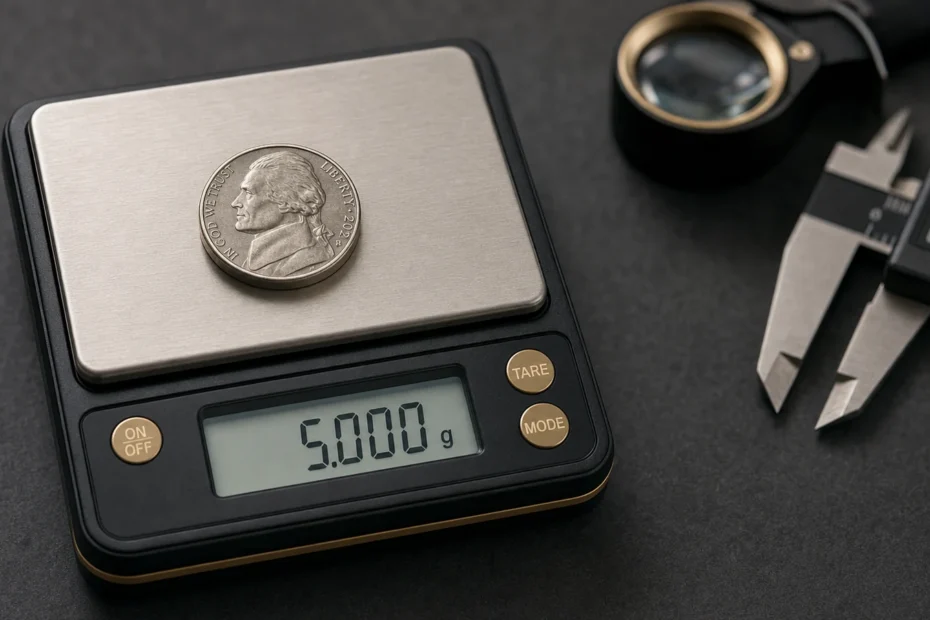
A U.S. nickel weighs 5.00 grams. See its official dimensions, 75/25 composition, legal tolerance, wartime alloy, and how to interpret a scale reading.
- A current U.S. nickel has a nominal weight of exactly 5.00 grams, or about 0.1764 avoirdupois ounce.
- The coin is 75% copper and 25% nickel; wartime 1942–1945 silver-alloy nickels kept the same nominal weight.
- Federal law allows a 0.194-gram weight variation, so weight is a screening clue—not proof of authenticity or an error.
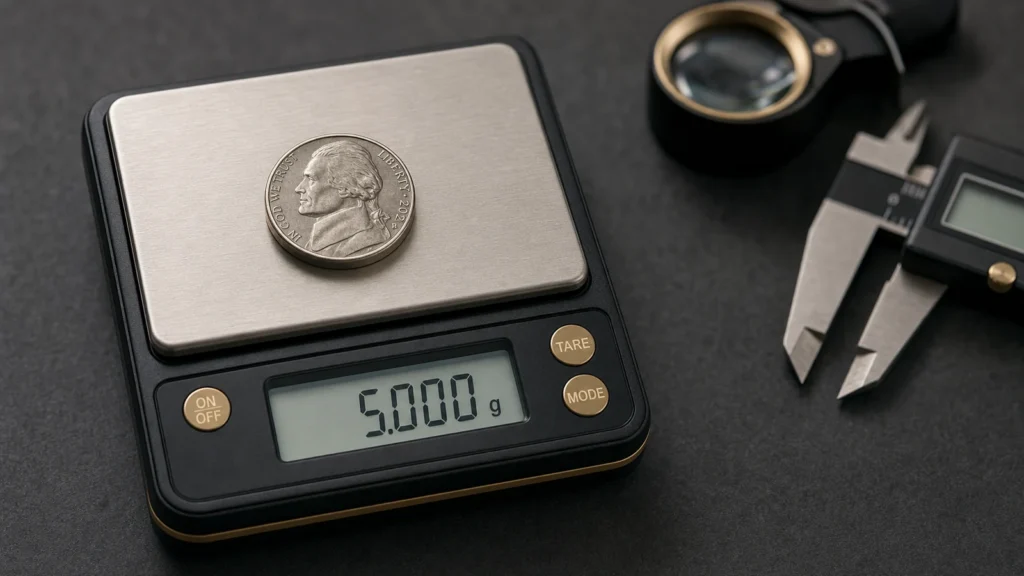
- Official mass: 5.00 g.
- Diameter: 21.21 mm; thickness: 1.95 mm; plain edge.
- Composition: 75% copper and 25% nickel by weight.
- Legal weight range: approximately 4.806–5.194 g before considering wear or debris.
- Weight is a screening measurement, not proof of authenticity or a mint error.
The five-cent answer is exactly five grams—nominally
The U.S. Mint specification gives the nickel a 5.00 g mass. “Nominal” matters: coins are produced at industrial scale, measurement devices have uncertainty, and circulated pieces acquire wear, dirt or corrosion.
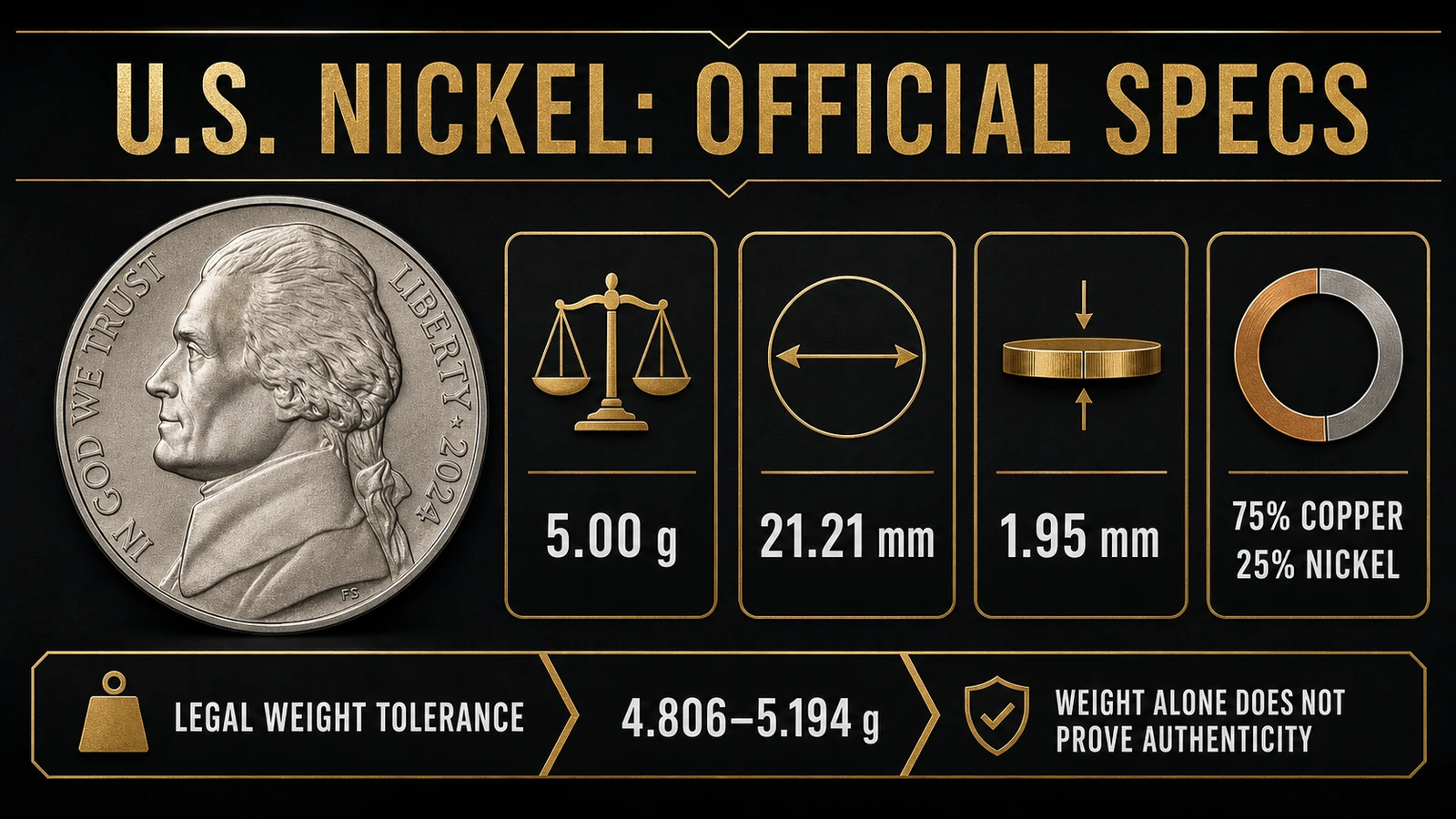
Nickel weight and dimensions
| Specification | Official value | Practical meaning |
|---|---|---|
| Weight | 5.00 g | The design target, not a promise that every scale displays 5.000. |
| Diameter | 21.21 mm / 0.835 in | Measure across the widest point with a suitable caliper. |
| Thickness | 1.95 mm | Wear and measurement position can affect a small reading. |
| Edge | Plain | A normal U.S. nickel has no reeds. |
| Composition | 75% copper, 25% nickel | “Nickel” is the coin name; most of its mass is copper. |
Conversions: grams, ounces and grains
Use the correct ounce. Everyday U.S. weight normally uses the 28.3495 g avoirdupois ounce. Precious metals commonly use the 31.1035 g troy ounce. The nickel does not contain a troy ounce fraction of precious metal; the conversion simply expresses the same total mass in another unit.
- 20 nickels have a nominal mass of 100 g.
- 100 nickels have a nominal mass of 500 g.
- A $2 roll contains 40 nickels and nominally weighs 200 g before the wrapper.
Do not use these estimates for shipping or legal metrology without accounting for wrappers, circulation wear and scale uncertainty.
What is the legal weight tolerance?
31 U.S.C. § 5113 states that the five-cent coin’s weight may vary by no more than 0.194 gram. Applied symmetrically to the 5.00 g target, that gives a manufacturing window of approximately 4.806–5.194 g.
This is not a collector guarantee for every circulated coin. Normal wear can remove metal, debris can add mass, and corrosion can alter the surface. It is also not permission to declare every out-of-range reading a rare mint error.
Did wartime silver nickels weigh differently?
Selected Jefferson nickels dated 1942–1945 used a wartime alloy of 56% copper, 35% silver and 9% manganese to conserve nickel for military needs. Their nominal weight remained 5.00 g. A large mint mark above Monticello helps identify the wartime issues; a date alone should be checked against the exact design and mint mark.
Do not file, cut, acid-test or aggressively polish a suspected wartime nickel. Destructive testing can reduce collector value. Composition and authenticity require more than a kitchen-scale result.
Has the U.S. five-cent coin always weighed 5 grams?
No. The earlier silver half dime was a different, smaller five-cent denomination. The copper-nickel five-cent coin introduced in 1866 established the familiar 5 g standard. Shield, Liberty Head, Buffalo and Jefferson designs changed the artwork while retaining that nominal mass.
This is why denomination and era must be identified before a weight table is applied. A foreign “nickel,” a U.S. half dime, a modern token and a damaged five-cent piece can all be coin-sized without sharing the Jefferson nickel specification.
| Reading pattern | Plausible causes | Best next check |
|---|---|---|
| Unstable last digits | Air movement, vibration, low battery or insufficient scale resolution | Move to a stable surface, calibrate and repeat. |
| Consistently a little low | Wear, surface loss or scale bias | Measure dimensions and compare a certified reference mass. |
| Consistently high | Dirt, adhesive, alteration or scale bias | Inspect without harsh cleaning; verify diameter and design. |
| Far from 5 g | Wrong denomination, novelty copy, severe damage or wrong planchet | Preserve the coin and seek attribution if other diagnostics support it. |
How to weigh a nickel correctly
- Use a scale that resolves at least 0.01 g and place it on a stable, level surface.
- Warm up and calibrate the scale with its specified calibration mass.
- Set the display to grams and confirm the pan reads zero.
- Weigh the dry coin three times, lifting it between readings.
- Check a known reference mass; do not use another worn coin as a perfect standard.
- Record weight, diameter, thickness, date, mint mark and visible wear together.
Resolution, accuracy and calibration are different
A display that shows 0.001 g is not automatically accurate to 0.001 g. Resolution is the smallest displayed step; accuracy describes closeness to the true value; repeatability describes how consistently the scale returns the same result. Cheap pocket scales can show many digits while drifting under temperature, battery or placement changes.
Calibration also needs the correct mass. A random coin is not a certified 5 g standard because the legal tolerance is large relative to a fine scale’s display. Use the calibration weight specified by the manufacturer, avoid touching it with oily fingers and do not calibrate on a soft or vibrating surface.
If a coin may be collectible, do not scrape away residue to “fix” its weight. Photograph it, handle it by the edge and use a non-destructive professional examination.
Why weight cannot authenticate a coin
A counterfeit can be engineered to the correct mass, and a genuine coin can deviate through wear or damage. Authentication combines design diagnostics, dimensions, edge, alloy evidence, surface examination and provenance. Magnetic response is also limited because the 75% copper/25% nickel coin is not strongly attracted like steel.
For related measurement context, see the weight of Gold Eagle coins, gold-bar weights, gold weight estimator, gold purity testing and gold authenticity guide.
How much copper and nickel are in one coin?
Applying the official alloy percentages to a nominal 5.00 g coin gives about 3.75 g of copper and 1.25 g of nickel. Those are design-composition figures, not a home assay. Manufacturing tolerance and circulation condition mean multiplying one scale reading by 75% or 25% does not prove its precise elemental mass.
The metal’s commodity value is also not the coin’s legal or collector value. Melting U.S. five-cent coins for their metal is restricted under U.S. Mint regulations, and a collectible date, mint mark or error can be valued for numismatic reasons unrelated to raw alloy value. Do not treat a spot-metal calculation as permission to destroy coinage.
Knowledge Gap and Editorial Perspective
Public guidance gives an official target and legal tolerance, but it does not provide a simple universal weight-loss table for every amount of circulation wear. A conclusion about a specific coin needs the complete physical context.
Use 5.00 g as a reference, not a verdict. A repeatable reading outside the expected range is a reason to investigate dimensions, alloy and design—not a reason to announce a valuable error.
Video walkthrough: This visual history shows how the U.S. five-cent coin evolved while the modern 5 gram specification remained the key measurement reference.
Bottom Line
A U.S. nickel nominally weighs 5.00 grams. The legal tolerance, scale uncertainty and circulation history explain why a real reading may differ; weigh carefully and evaluate the whole coin.
FAQ: U.S. Nickel Weight
How much does a nickel weigh in ounces?
About 0.1764 avoirdupois ounce, or 0.1608 troy ounce.
How many nickels make 100 grams?
Twenty nickels have a nominal combined mass of 100 grams.
How much can a nickel legally vary in weight?
Federal law allows up to 0.194 gram of variation from the standard.
Does a silver wartime nickel still weigh 5 grams?
Yes. The 1942–1945 wartime alloy changed, but the nominal mass remained 5.00 grams.
Is a light nickel automatically a mint error?
No. Recheck the scale, wear, dirt, damage, dimensions and composition before requesting professional authentication.
Sources and verification
- U.S. Mint — Nickel — Official 5.00 g weight, 21.21 mm diameter, 1.95 mm thickness and 75% copper/25% nickel composition.
- U.S. Mint — Coin Specifications — Official side-by-side circulating coin specifications and historical composition context.
- 31 U.S.C. § 5113 — Tolerances and Testing of Coins — Statutory maximum weight variation of 0.194 gram for the five-cent coin.
- U.S. Mint — Wartime Nickels — Official historical context for Jefferson and wartime nickel issues.
- Treasure Town — History of the U.S. Nickel — Visual history context; specifications remain sourced to the U.S. Mint and federal law.
 When you purchase a service or a product through our links, we sometimes earn a commission, at no extra cost to you.