Bulk gold is not flammable, but it can melt near 1,064°C. See what fire does to bullion, alloys, solder, stones, coatings, and recovery.
- Solid bulk gold does not ignite and sustain ordinary combustion like wood, fuel or many polymers.
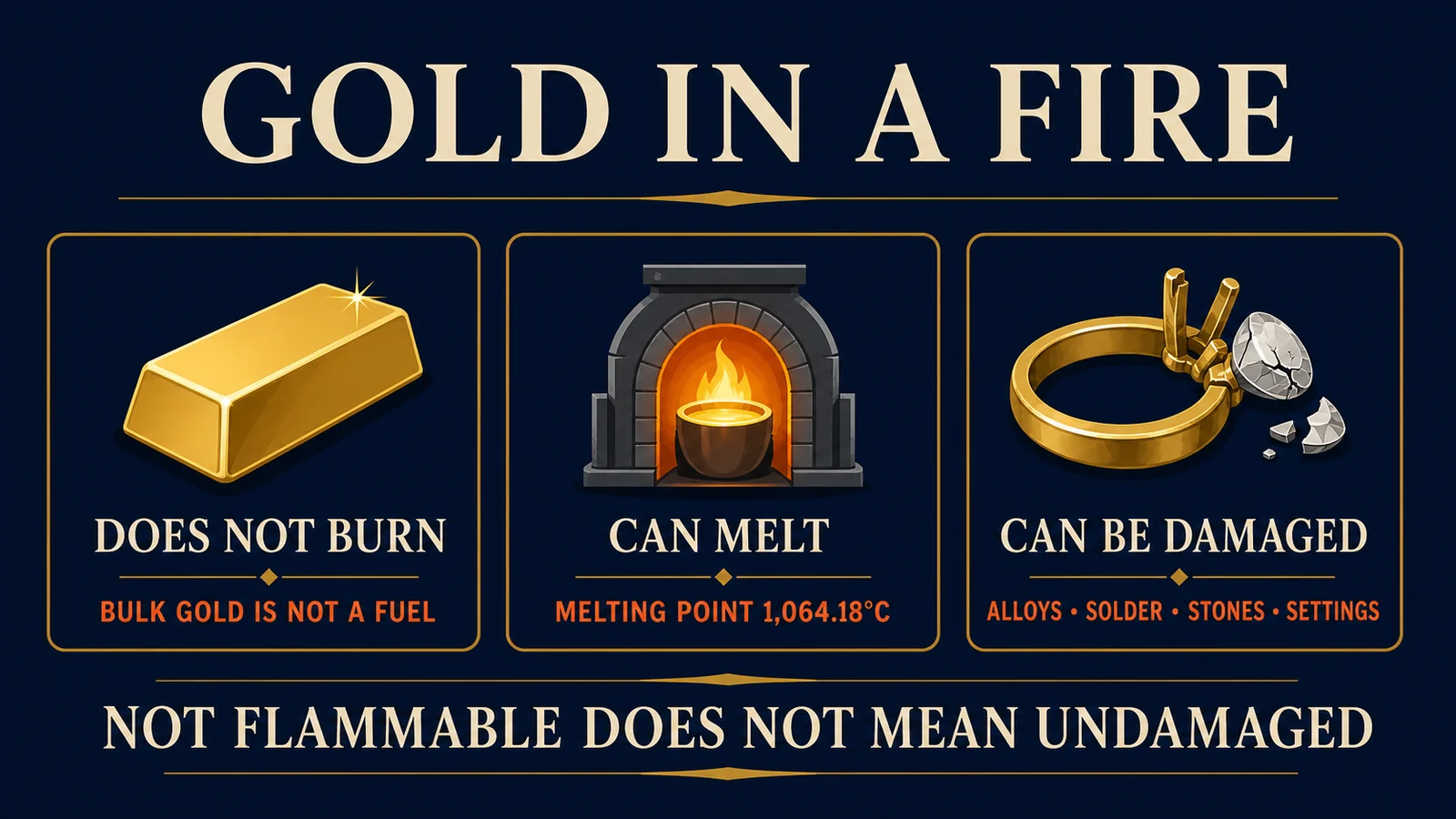
- Gold melts at about 1,064.18°C, while solder, alloy metals, plating, gemstones and settings may fail earlier.
- After a fire, do not clean or reshape the item; document it and use qualified fire, insurance and precious-metal professionals.
- Solid gold does not burn like wood, fabric or fuel.
- “Not flammable” does not mean fireproof or undamaged.
- Pure gold melts at 1,064.18°C; some solders and alloys fail sooner.
- Fire-damaged valuables should be documented, not cleaned or remelted.
- Fine powders and chemical compounds are different hazards from a bulk bar or ring.
Separate burning, oxidation, melting and damage
Flammability describes whether a material ignites and sustains combustion. Melting is a phase change. Oxidation is a chemical reaction, and vaporization requires still more energy. These processes are often collapsed into “burn,” which creates the false choice between perfectly intact gold and vanished gold.
What happens when gold is heated?
| Process | What it means | Gold response |
|---|---|---|
| Combustion | A self-sustaining reaction with an oxidizer that releases heat. | Bulk solid gold is not a normal fuel. |
| Oxidation/tarnish | Surface chemical change. | Pure gold is highly resistant; alloy metals may discolor. |
| Annealing/softening | Heat changes the metal’s structure and mechanical behavior. | Jewelry can distort before it becomes liquid. |
| Melting | Solid becomes liquid. | Pure gold melts at 1,064.18°C. |
| Vaporization | Liquid becomes gas. | Requires temperatures far above ordinary fires. |
The melting point is reported by the Royal Society of Chemistry. A house or vehicle fire is not thermally uniform, so survival cannot be predicted from a single “typical fire temperature.” Duration, oxygen, enclosure, neighboring materials and the object’s location matter.
Why jewelry can fail before pure gold melts
Most jewelry is not pure gold. Copper, silver, nickel, palladium and other additions determine color and strength. Solder joints can have lower melting ranges than the surrounding piece. Thin prongs can deform; a stone can crack from thermal shock; enamel, glue, plating or a watch movement can be destroyed.
This is why the broader question can gold survive a fire? must be answered in terms of recoverable metal, not pristine appearance.
Can gold disappear in a house fire?
A gold item can be lost, mechanically dispersed or fused into debris even when its gold does not combust. A chain can melt into tiny beads; a bar can deform; molten metal can flow into cracks; debris removal can carry it away. Severe heating can also erase serial markings and invalidate packaging or third-party certification.
Do not assume a recognizable object is the only recoverable form. Equally, do not enter a damaged structure to search. Fire scenes may contain unstable structures, live utilities, toxic residues and sharp debris. Follow fire-authority and insurer instructions.
What to do after a fire
- Wait for official clearance; personal safety comes first.
- Notify the insurer and ask how salvage should be documented.
- Photograph items and location before moving or cleaning anything.
- Preserve receipts, certificates, serial numbers and pre-loss photographs.
- Bag loose fragments separately without scraping or polishing them.
- Use an insurer-approved jeweler, refiner or appraiser for identification.
- Do not remelt a potentially collectible coin, hallmarked piece or insured object before valuation.
FEMA’s post-fire guidance emphasizes safety, insurance contact and careful records. Soot and firefighting residues may be hazardous; a casual kitchen cleaning routine is not an appropriate default.
Does a torch test prove an item is gold?
No. Heating an unknown item is destructive, unsafe and diagnostically weak. Plated base metal, solder and stones can release fumes, crack or ignite attached materials. A piece that does not visibly burn has not been authenticated. Use non-destructive methods described in how to test gold at home, then escalate valuable items to a professional.
If a heat source is advertised at 1,100°C, that does not mean the entire gold object instantly reaches 1,100°C. Heat transfer depends on distance, flame chemistry, contact, mass and time. Conversely, a small solder joint can fail even when the bulk piece has not reached pure gold’s melting point.
Pure gold versus alloy behavior
Pure gold is a noble element and highly resistant to ordinary corrosion; see why gold is an element and whether gold can rust. Alloy metals can form oxides and produce red, gray or black surface changes. Smoke deposits can also make intact metal look burned.
Melting ranges for alloys and solders depend on composition. Karat alone is not enough to calculate an exact failure temperature. A jeweler needs the actual construction, joint and gemstone information.
What about gold powder, leaf and compounds?
A bulk bar has low surface area relative to its mass. Fine powder, nanoparticles, organometallic compounds and gold-containing coatings behave differently because particle size, carrier material and chemistry change the hazard. Safety data for the exact product controls. Do not transfer a statement about bulk gold to an industrial powder or laboratory reagent.
Gold leaf on wood or paper may appear to “burn” because the substrate burns and the microscopic leaf disperses. Gold-colored paint may contain little or no elemental gold. Always identify the material before applying a metals reference.
Does a safe make gold fireproof?
A fire-rated safe is tested to a stated time and internal-temperature standard; it is not a universal guarantee for every fire. Ratings intended to protect paper or digital media address different temperature limits. The safe’s location, anchoring, water exposure and fire duration also matter.
Keep a separate inventory with photographs, weights, serial numbers, receipts and insurer requirements. Do not store the only copy inside the same safe. For bullion, packaging can be destroyed at temperatures far below gold’s melting point, so an insurer or dealer may later require fresh authentication even when the metal is intact.
Storage design should address theft and access as well as heat. A professionally installed, correctly rated safe and adequate insurance solve different parts of the risk; neither turns a finished object into an indestructible asset.
Ask the insurer whether bullion, jewelry and collectibles have separate limits or appraisal requirements. Fire resistance preserves material; correct documentation is what helps preserve a financial claim.
Update that inventory after every purchase or sale and store a copy away from the protected property.
Bullion recovery is not the same as value recovery
A damaged gold bar may retain most of its metal value while losing retail premium, verifiable weight, packaging and easy resale. A rare coin can lose numismatic value through heat or cleaning even if its gold content remains. Jewelry value includes craftsmanship and stones that melt value does not capture.
Short answers often stop at “gold does not burn.” That is chemically reassuring but practically incomplete. Readers need to know that solder, alloys, stones, documentation and scene safety determine what can actually be recovered and sold.
The useful answer is not that gold is indestructible. It is that elemental gold is unusually fire-resistant as a material, while finished objects are systems with weaker components. Treat the object, evidence and recovery process separately.
Never enter a fire-damaged area without clearance or heat unknown material as a test. Follow emergency-service, insurer and hazardous-material guidance. This article is general education, not scene-safety or insurance advice.
Selected explainer This video adds a concise visual explanation to the evidence and decision framework above.
Bottom Line
Bulk solid gold is not flammable, but it can soften, deform, melt and become mixed with debris. Finished jewelry and bullion packaging can fail well before the gold disappears. After a fire, prioritize safety, documentation and professional recovery over cleaning or remelting.
FAQ: Gold and Fire
Can gold catch fire?
Bulk solid gold is not a normal combustible fuel and does not sustain burning under ordinary fire conditions.
At what temperature does gold melt?
Pure gold melts at about 1,064.18°C, or 1,947.5°F. Alloy and solder behavior can differ.
Will a house fire destroy a gold ring?
It may warp, melt, discolor or lose stones and solder joints. The gold metal can remain recoverable even when the ring no longer is.
Can I clean fire-damaged gold myself?
Do not start before insurer documentation and professional advice. Residues may be hazardous, and cleaning can damage evidence or collector value.
Is heating an item a good gold test?
No. It is destructive, unsafe and cannot reliably authenticate an unknown alloy or plated object.
Sources and verification
Values, rules and historical interpretations were checked against the linked primary or specialist sources. Recheck any current rule or market data before acting.
- Royal Society of Chemistry — Gold — Authoritative melting point of 1,064.18°C and elemental properties.
- NIST — Composition of Gold — Elemental composition and density reference.
- PubChem — Gold — NIH chemistry database for elemental gold properties and identifiers.
- NIST — Density Definition — Fire-investigation terminology context for physical properties.
- OSHA — Welding, Cutting, and Brazing — Hot-work fire prevention and ventilation boundaries.
- GIA — Choosing the Right Jewelry Metal — Gemological context for gold alloys, jewelry construction and metal choice.
- U.S. Mint — Bullion Coin Programs — Official bullion coin compositions showing pure and alloyed products.
- U.S. Fire Administration — After a Fire — Current safety, documentation, insurance and recovery guidance after a home fire.
- GoldConsul — Can Gold Survive a Fire? — Related object-recovery and survival context.
- Periodic Videos — Gold — University of Nottingham chemistry video on elemental gold.
 When you purchase a service or a product through our links, we sometimes earn a commission, at no extra cost to you.