
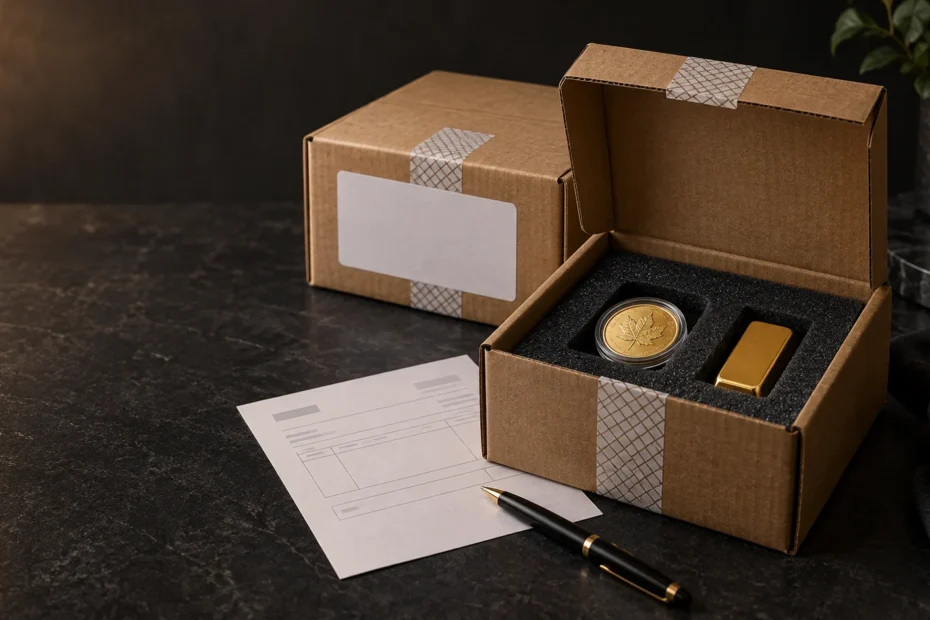
A U.S. checklist for shipping jewelry and bullion: verify eligibility, real indemnity, packaging, carrier terms and proof of acceptance.
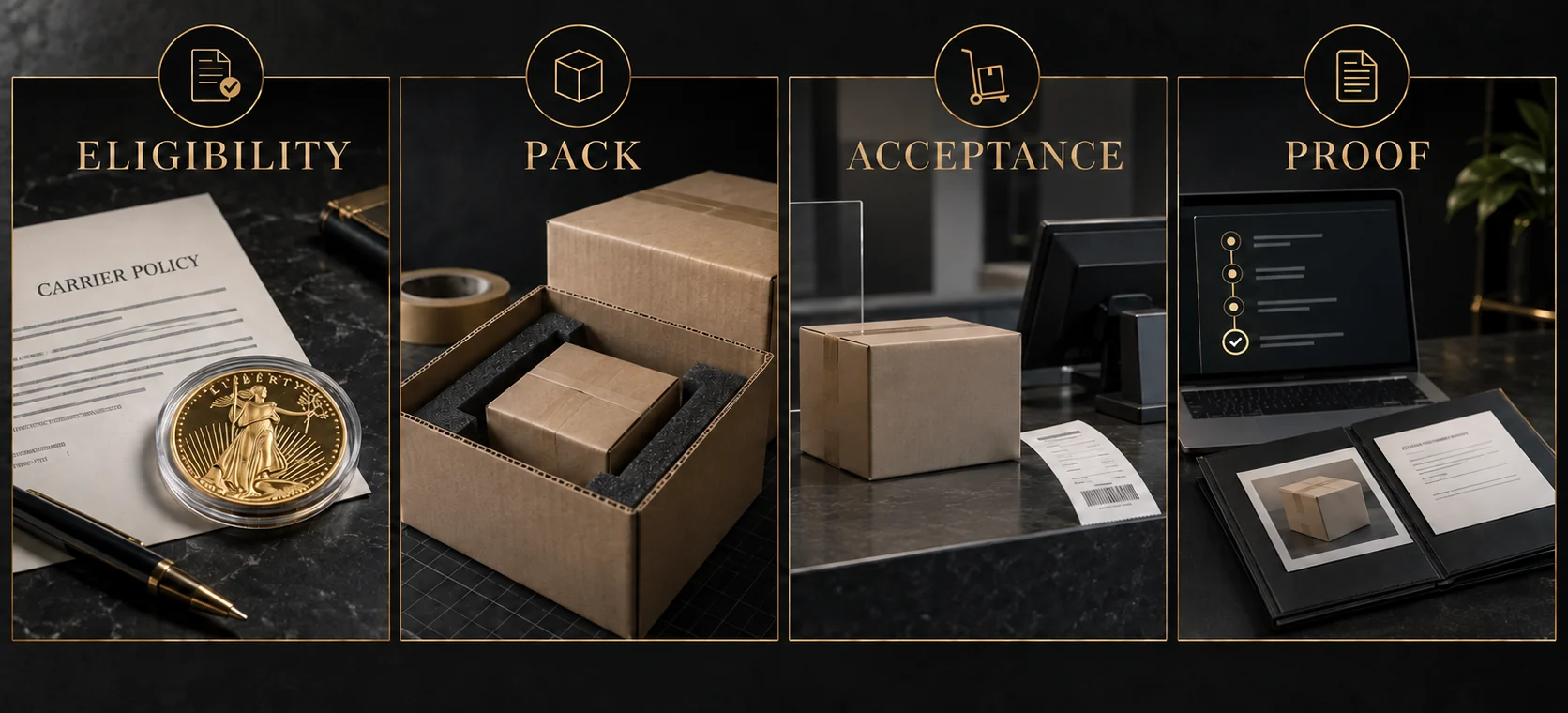
- Confirm item eligibility and indemnity before postage.
- For bullion, ordinary added insurance may be inadequate.
- Keep item, packing and acceptance evidence.
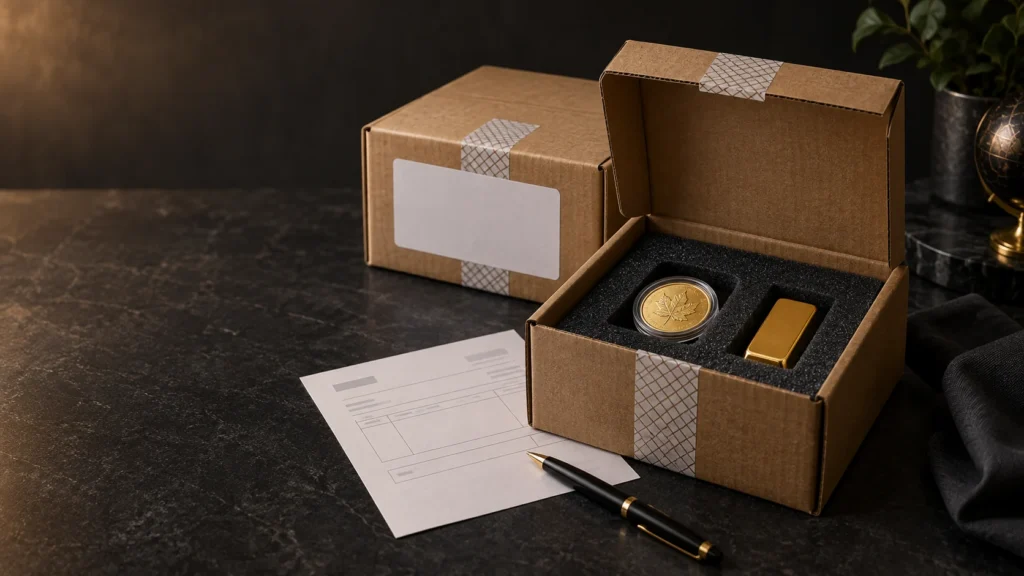
To ship gold safely in the U.S., verify that the carrier and the specific service accept your exact item and provide the indemnity you need before sealing the box. A declared value or generic added-insurance receipt alone does not prove bullion coverage. Document the contents, use secure packaging, retain acceptance proof and follow the buyer’s written label instructions.
The first decision is whether you are shipping ordinary jewelry, investment bullion or coins. Carrier rules and retailer-provided labels can treat these differently. For high-value gold, check the live terms for the exact service, route and contents before purchasing postage.
Choose the shipping route before packing
| Route | What to verify |
|---|---|
| Seller/dealer-provided label | Who buys coverage, when responsibility transfers, and required packing/scan steps |
| Your own carrier label | Whether the exact service accepts the item and what loss indemnity applies |
| Specialist valuable-goods service | Item eligibility, declared value, custody chain, exceptions and claim documents |
Do not substitute your own label for a buyer’s approved insured label without written confirmation. Dealer terms may place loss risk on a sender using an unapproved method.
Compare the carrier rules for a U.S. shipment
These published rules show why a service’s headline value limit is not enough. They were checked on September 24, 2026; confirm the current terms for the exact item and label before shipping.
| Carrier | What its current U.S. guidance says |
|---|---|
| USPS | Domestic Registered Mail has a maximum insured value of $50,000 under its rules. For bullion sent outside Registered Mail, USPS says maximum indemnity is $15. Both figures are ceilings subject to eligibility, preparation and proof requirements. USPS domestic claim limits. |
| UPS | UPS lists gold and other precious metals as restricted. It says some restricted items are accepted only under contract for eligible shippers with regular volume. A standard retail label is not confirmation that UPS has accepted your gold. UPS prohibited and restricted items. |
| FedEx | Declared value is not shipping insurance. Its Declared Value Advantage program is limited to eligible jewelry shipments and excludes coins and gold bars. Do not infer that a jewelry program covers bullion. FedEx declared value rules. |
| DHL Express | DHL Express U.S. lists bullion of any precious metal among prohibited commodities. Check the specific DHL product and current terms; DHL eCommerce and DHL Express are different services. DHL Express U.S. item rules. |
For a separate cargo policy or specialist valuables service, request the actual policy or certificate. Check that it names the correct insured party, gold form, route, carrier, value limit, packaging conditions, exclusions and claim deadline. If the buyer supplies the label, agree in writing who files the claim and when risk transfers.
International gold shipments need a separate check
Do not apply the domestic USPS $50,000 Registered Mail maximum to an international parcel. The current USPS International Mail Manual limits international Registered Mail indemnity to $40.20 regardless of declared value. Its valuable-article rules allow only specified services; First-Class Mail International with Registered Mail is limited to cases where destination customs treats the item as a document, or Priority Mail International. Country rules can further restrict or prohibit gold, and Priority Mail Express International cannot be used for these listed valuable articles.
- Check the USPS country listing or the destination customs authority to confirm the exact item can enter and what permits, duties or taxes may apply.
- Use the U.S. Census Bureau’s Schedule B search tool to confirm the export commodity code for the actual form of gold. Ask the carrier or customs broker whether export filings or additional documents apply.
- Describe the contents and value accurately on customs paperwork. Get written carrier acceptance and insurance terms for the exact origin, destination, service and item before tendering the parcel.
These are route checks, not a universal international shipping recommendation. USPS notes that destination prohibitions and customs decisions can lead to return or seizure; the sender remains responsible for checking the current country rules.
Pack and document without advertising the contents
- Photograph the items and identifying features privately; keep invoices or other proof of value.
- Protect individual items from rubbing and movement. Use a sturdy inner container and an opaque outer box.
- Follow the selected service’s sealing and packaging rules exactly; Registered Mail has specific preparation requirements.
- Use a neutral sender description on the exterior where allowed. Never misdeclare contents to obtain service or coverage.
- Hand over the package at the approved acceptance point and obtain a dated receipt showing the scan and declared service.
- Send tracking information to the recipient through a secure channel and retain all records until delivery and inspection are confirmed.
Keep each coin in a capsule or tube so pieces cannot rub against one another. Cushion the container inside a rigid inner box.
Protect any assay card or sealed packaging, then immobilize the bar inside a fitted or cushioned inner container so it cannot shift.
Close clasps and place pieces in separate soft pouches to limit tangling and surface contact. Keep item photos and identifying marks in your private records.
Place the inner container in an opaque, sturdy outer box and fill empty space so the contents do not move. Follow the chosen carrier’s exact packaging and sealing requirements; these examples do not replace its rules.
Before shipping to a gold buyer
Read the buyer’s instructions for testing, short-weight disputes, rejected offers, return shipping and when the buyer assumes loss risk. Our gold-selling guide helps compare the resulting cash offer with melt value; the scrap calculator provides a metal-only baseline.
Worked example: why declared value is not enough
Imagine mailing a $12,000 bullion bar using an ordinary parcel service and entering $12,000 as the declared value. If the service excludes or sharply limits bullion indemnity, that declaration may not produce a $12,000 claim payment. This is an illustrative scenario, not a statement about a particular shipment. Read the actual carrier terms before choosing the label.
For a dealer-issued label, ask the dealer to confirm the covered amount, the first scan that starts its responsibility and whether drop boxes are prohibited. For a self-bought label, obtain the carrier’s content eligibility and indemnity terms for bullion or jewelry in writing. Do not rely on a support agent’s generic statement that “insurance is available.”
USPS Registered Mail: know what the service does and does not say
USPS describes Registered Mail as its most secure mail service and states a domestic maximum insured value of $50,000. Packages above that value must still be declared at full value, but that declaration does not raise the maximum indemnity. Use the current USPS packaging and sealing instructions; the acceptance clerk cannot prepare or seal the parcel for you.
The USPS domestic claims guidance says that, except for Registered Mail, maximum indemnity for bullion, currency and negotiable items is $15. This is why a generic added-insurance checkbox can be misleading for bullion. Confirm the current service rules at the time of mailing, especially if the route or contents are unusual. Do not apply a domestic rule to an international shipment.
USPS bullion indemnity: the two ceilings to distinguish
These are maximums under USPS rules, not guaranteed claim payments. Eligibility, declared value, preparation and evidence requirements still apply. The figures refer to domestic shipments and should be verified against current USPS terms before mailing.
Maximum indemnity stated by USPS for bullion, currency and negotiable items outside Registered Mail.
Maximum domestic insured value. Items worth more still require full-value declaration; that does not raise this ceiling.
Source: USPS Domestic Claims and USPS Registered Mail Basics. The difference is a service-specific rule, not a visual price comparison.
Build a clean chain of custody
Use an inventory photograph before packing, but do not expose valuables or identifiers on the outside of the parcel. Protect individual pieces from contact, keep the inner container from moving, and follow the carrier’s sealing method precisely. For a dealer-provided label, follow the dealer’s specific drop-off and scan instructions; a drop box may not establish the required acceptance evidence.
At handoff, obtain a physical or digital receipt identifying the tracking number, date and service. Keep the label, receipt, purchase evidence, packing photos and the recipient’s written instructions in one private folder. A delivery scan proves a carrier event; it does not settle a later disagreement about weight or condition. Agree with the recipient on inspection and dispute procedures before mailing.
What happens if the package is delayed or damaged?
Deadlines and claimants depend on the service and who bought the label. Start promptly, then follow the exact carrier or buyer-label process:
- Record the last scan and contact the recipient. Ask the carrier to open a trace if tracking stalls; tell the buyer or recipient if the package is due for inspection.
- Preserve the package. If it arrives damaged or short, photograph the outer box, label, seals and packing before changing or discarding anything.
- Gather proof. Keep the acceptance receipt, tracking number, label, proof of value, item photographs, packing records and the buyer’s written instructions.
- Ask who must file. For a buyer-provided label, confirm whether the buyer or account holder controls the carrier claim. For USPS, its current domestic claims page lists service-specific filing windows and required proof; do not use another carrier’s deadline.
- Keep the decision in writing. If a claim is reduced or denied, ask for the applicable service term and review or appeal route.
See USPS domestic claim steps, proof requirements and deadlines. Carrier procedures change, so use the current claim page for the label you actually shipped.
Three common shipping mistakes
- Using a headline limit: a general service maximum may be overridden by a special bullion restriction.
- Changing the buyer’s label: a self-purchased label may shift loss risk back to the sender under buyer terms.
- Losing acceptance proof: tracking alone may not establish the service or declared value paid for at mailing.
For a sale, compare the buyer’s cash terms alongside its shipping terms. Our gold-selling guide covers itemized offers, while the scrap calculator provides a metal-value reference.
Carrier rules, eligibility, compensation limits and buyer contracts can change. Recheck original current terms for your item, route and declared value before each shipment.
Related guides
sell gold jewelry safely · estimate melt value · at-home insurance · storage choices · bank-box risks
FAQ: how to ship gold safely with insurance
Can I insure gold with ordinary USPS insurance?
Do not assume ordinary added insurance covers bullion at its declared value. USPS has special bullion indemnity rules; verify the exact service and use Registered Mail when appropriate.
Is declared value the same as insurance?
No. It may set a maximum or be subject to exclusions and proof requirements. Read the carrier’s actual indemnity terms.
Should I use a buyer-provided label?
Use it only after reading the buyer’s written packing and coverage terms. Ask when responsibility transfers and what happens if the package is lost.
What records should I keep?
Keep item photos, value proof, packing evidence, label, receipt, tracking and the buyer’s written instructions.
Does USPS Registered Mail cover any amount of gold?
No. USPS states a domestic insured-value maximum of $50,000; eligibility, declaration and claim rules still apply.
Sources and scope
USPS Registered Mail basics. USPS insurance limits. USPS extra services. Prices and policies can change; verify current written terms before paying or shipping. UPS restricted items. FedEx declared value and exclusions. DHL Express U.S. prohibited commodities. USPS International Mail Manual. U.S. Census Schedule B.
Bottom line
To ship gold safely in the U.S., verify that the carrier and the specific service accept your exact item and provide the indemnity you need before sealing the box. A declared value or generic added-insurance receipt alone does not prove bullion coverage. Document the contents, use secure packaging, retain acceptance proof and follow the buyer’s written label instructions.
 When you purchase a service or a product through our links, we sometimes earn a commission, at no extra cost to you.