
Calculate melt value, compare gold buyers, protect collectible pieces, and recognize weak offers before selling gold jewelry.
- Calculate melt value before requesting offers.
- Separate collectible pieces from ordinary scrap.
- Compare written terms, not headline percentages.
To sell gold jewelry without guessing, first separate pieces that may be worth more intact, then calculate each scrap piece’s approximate melt value. Request itemized offers from more than one buyer and compare the cash offer with the same-day melt value—not with the original retail price. Never let a buyer melt, cut, or keep a potentially signed, antique, or stone-set piece before you understand what it is.
Selling gold jewelry is not one valuation problem. A broken 14K chain, a signed designer bracelet, and an inherited ring with stones can contain gold while requiring three different selling routes.
The practical goal is to learn which value applies, create a defensible baseline, and give buyers the same information so their offers are comparable.
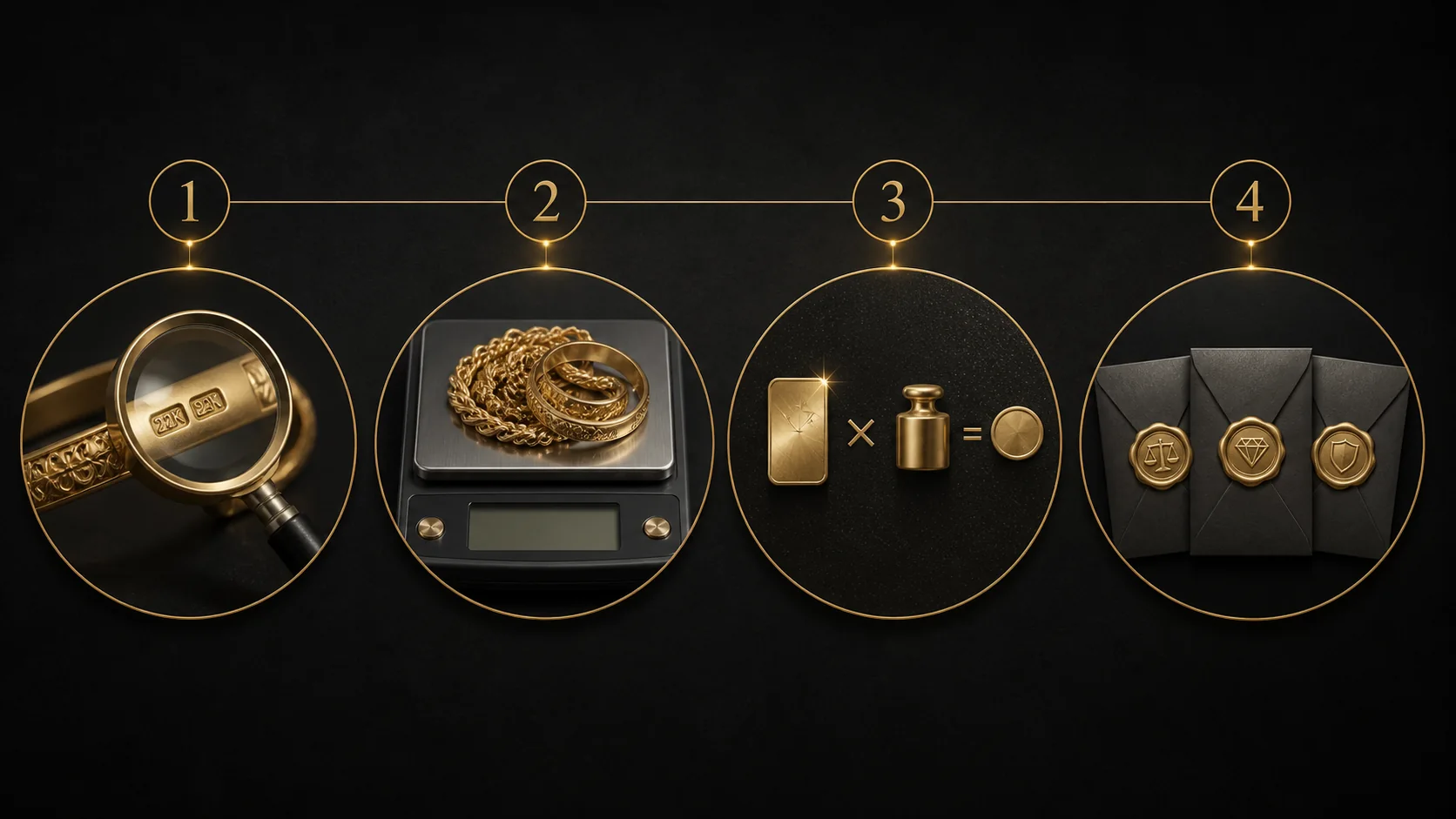
- Sort first: separate karats, plated pieces, signed jewelry, stones, and intact wearable items.
- Calculate: weight × purity × current gold price per gram gives an approximate melt value.
- Compare: ask for the tested karat, payable weight, deductions, fees, and final cash amount in writing.
- Protect upside: get an appraisal before selling rare, antique, branded, or unusually well-made pieces as scrap.
- Document: photograph every item and keep receipts, shipping records, and offer sheets.
Decide whether you are selling jewelry or scrap gold
Scrap buyers mainly value recoverable metal. An as-is buyer may also value the maker, design, condition, provenance, gemstones, or demand for that exact piece.
Knowledge Gap: melt value can be the wrong ceiling
A scrap quote deliberately ignores design and collector demand. That is appropriate for ordinary damaged jewelry, but it can destroy value when an intact piece has a market above its metal content. If the object looks distinctive, compare an as-is appraisal with the scrap baseline before authorizing irreversible work.
Calculate the melt-value baseline
Use the live spot price per gram, the item’s gross weight in grams, and its purity fraction. The Gold Purity Calculator converts karat or fineness marks, while the Scrap Gold Calculator can run the estimate with current inputs.
Payable gold weight × purity fraction × spot price per gramCommon purity fractions include 10K = 10/24, 14K = 14/24, 18K = 18/24, and 22K = 22/24. A stamp is only a starting claim; a buyer may test the item.
A worked example
Assume a plain 14K chain weighs 12 grams and the example spot price is $100 per gram of pure gold. The numbers are deliberately hypothetical so the method does not become stale.
| Step | Calculation | Example result |
|---|---|---|
| Convert purity | 14 ÷ 24 | 0.5833 |
| Estimate pure gold | 12 g × 0.5833 | About 7.0 g |
| Estimate melt value | 7.0 g × $100/g | $700 |
| Compare a $560 offer | $560 ÷ $700 | 80% of the example melt value |
The example does not say that 80% is universally fair. A buyer’s payable weight, refining relationship, test result, lot size, overhead, settlement time, and local competition all affect the offer.
Check the same-day context on Live Gold Price Today. If the piece contains stones, springs, steel pins, solder, or non-gold components, gross weight may overstate the payable gold weight.
How much does a pawn shop pay for 14K gold per gram?
There is no fixed nationwide 14K pawn-shop price per gram. A shop’s cash offer depends on the day’s gold price, verified purity and weight, resale potential, its costs and margin. A pawn loan is different from a sale: the loan amount, fees and deadline must be evaluated separately from a final cash purchase.
Use this hypothetical comparison, not a live quote: if fine gold were $100 per gram, 14K metal’s fine-gold content would be 14/24, giving a $58.33-per-gram theoretical melt baseline before deductions. A 10 g piece would have a $583.33 theoretical baseline. If a buyer offered $400 cash, the implied offer would be $40 per gram and about 69% of that hypothetical baseline. Replace $100 with the current spot price and have the shop verify the actual metal-only weight.
| Quote field | Ask the buyer to write down |
|---|---|
| Material | Tested karat, metal weight excluding stones, and test method |
| Cash sale | Total payable today, fees and payment method |
| Pawn loan | Loan principal, total repayment, due date and consequences of nonpayment |
| Other value | Whether design, brand or stones were considered separately |
Calculate a reference with our scrap gold calculator, then compare at least two itemized offers. Do not infer a fair payout from a headline “percent of spot” unless the shop states which weight, purity and price it used.
Jewelry appraisal vs resale value: which number matters?
An insurance replacement appraisal, an expected resale price and scrap melt value answer different questions. An appraisal is not a promise that a buyer will pay that amount. Jewelers Mutual explains that replacement and resale valuations can diverge substantially.
| Value type | Useful for | What it does not prove |
|---|---|---|
| Insurance replacement | Documenting a comparable replacement for coverage | A same-day cash offer |
| Resale / fair market | Estimating what a buyer may pay for the piece intact | Guaranteed proceeds or a universal market price |
| Scrap melt baseline | Checking the metal content of an ordinary piece | Designer, antique, gemstone or craftsmanship value |
For example, a documented designer ring might have a $2,000 replacement appraisal, a $900 prospective resale offer and a $350 metal baseline. These are hypothetical figures illustrating different purposes. Before selling, gather hallmarks, receipts, grading reports and any appraisal, then request quotes for the intact ring as well as its scrap metal. If the item may be collectible, seek a qualified independent appraisal before authorizing destructive testing.
For shipping a piece to an online buyer, follow our insured-shipping checklist and confirm the buyer’s return and loss terms in writing.
Compare gold buyers on the terms that matter
| Buyer route | Potential strength | Main trade-off | Best fit |
|---|---|---|---|
| Local precious-metal buyer or refiner-facing jeweler | Fast testing and payment; easy to obtain a second local quote | Offer quality varies; ask how weight and purity were determined | Ordinary scrap gold |
| Pawn shop | Convenient and immediate | Convenience, resale risk, and overhead may reduce the offer | Speed matters more than maximizing proceeds |
| Mail-in gold buyer | May provide access to a specialist or larger-volume operation | Shipping, insurance, return policy, settlement timing, and dispute terms matter | Seller has documented items and checked terms |
| Estate jeweler, auction, consignment, or specialist marketplace | Can recognize design, brand, age, and collectible demand | Slower; commissions, photography, authentication, and unsold-item terms apply | Signed, antique, rare, or desirable intact jewelry |
| Private sale | Possible as-is premium | Fraud, payment, returns, safety, and authenticity disputes shift to the seller | Experienced seller with a verifiable item |
Natural nuggets follow another market because shape and collector appeal can matter; see where to sell natural gold nuggets. Gold coins also need a numismatic check before being treated as metal.
Use an offer sheet, not a sales pitch
Ask every buyer to state the same facts. A large advertised percentage is not useful if it applies to a different price reference, excludes part of the weight, or is reduced by later fees.
- Item description and photographed hallmark
- Gross weight and the unit used
- Buyer’s tested karat or fineness
- Payable weight after stones or non-gold parts
- Gold price reference and time of quote
- Fees, refining deductions, commissions, or shipping charges
- Final cash amount and how long the offer remains valid
If a mark is unclear, start with the gold-purity testing guide. Acid, electronic, XRF, and fire-assay methods do not offer the same precision or risk profile.
Protect stones, documents, and sentimental decisions
Diamonds and colored stones are not part of the gold melt calculation. Ask whether stones will be returned, valued, or treated as zero-value inclusions before you surrender the piece.
Keep maker certificates, appraisals, receipts, boxes, and repair records with the jewelry until a specialist says they add no value. Photograph the front, back, clasp, marks, stones, damage, and total group before shipping or leaving items for testing.
The GoldConsul Editorial Perspective
Treat the melt calculation as a negotiating baseline, not a promise of proceeds. Raise the evidence standard when an item is signed, historically interesting, stone-set, or emotionally important: request identification, a written appraisal, or a specialist route before an irreversible scrap sale.
Red flags when selling gold jewelry
- The buyer will not let you see or record the weight and unit.
- Several karats are combined without an itemized calculation.
- The quoted “market price” cannot be tied to a recognizable spot reference.
- Pressure tactics imply the offer expires in minutes without a market reason.
- A mail-in program hides return shipping, insurance limits, acceptance rules, or dispute timing.
- The buyer wants to cut, melt, or remove stones before you approve a written offer.
The US Federal Trade Commission’s precious-metal guidance explains why karat, plating, and trademark descriptions matter. Use those descriptions to organize pieces before obtaining offers.
US tax boundary: a sale can be reportable
For US federal tax purposes, jewelry is generally a capital asset when held for personal use. The IRS explains in Publication 525 that a gain on personal-use property may be taxable, while a loss on personal-use property is generally not deductible.
IRS Publication 544 also discusses gains and losses from sales of gold, gems, and jewelry. Basis, inherited-property rules, business inventory, and collectibles treatment can change the result, so keep acquisition and sale records and ask a qualified tax professional about your facts.
This guide is educational only. It is not financial, legal, appraisal, or tax advice, and it cannot determine the authenticity, value, or tax treatment of a specific item.
Video: see the melt-value calculation
This short walkthrough shows the basic weight-and-purity logic. Use current spot data and verify stones or non-gold components separately.
Bottom line
The safest way to sell gold jewelry is to identify what should remain intact, calculate an approximate melt baseline for ordinary scrap, and compare itemized offers from suitable buyer types. The highest-sounding percentage is less important than transparent weight, purity, deductions, and final cash.
If you are still deciding what the jewelry contains, return to the Gold Jewelry Guide before requesting quotes.
FAQ: How to sell gold jewelry
What is a fair price for selling gold jewelry?
There is no universal percentage. Calculate the same-day melt value, confirm payable weight and tested purity, then compare final written cash offers after every fee and deduction.
Who usually pays the most for gold jewelry?
The best route depends on the piece. Competitive precious-metal buyers may suit ordinary scrap, while estate jewelers, auction specialists, or collectors may pay more for intact signed or antique jewelry.
Should I remove stones before selling gold jewelry?
Do not remove them blindly. First ask whether the buyer values, returns, or ignores stones, and use a qualified jeweler when removal could damage either the setting or the stone.
Do I have to pay tax when selling gold jewelry?
In the United States, a gain may be taxable, while a personal-use loss is generally not deductible. Basis, inheritance, business use, and holding period matter, so keep records and obtain tax advice for your situation.
Is it better to sell gold jewelry online or locally?
Local selling makes testing and multiple same-day quotes easier. Online selling may reach a specialist, but only if shipping insurance, return terms, settlement timing, and dispute procedures are acceptable.
 When you purchase a service or a product through our links, we sometimes earn a commission, at no extra cost to you.