
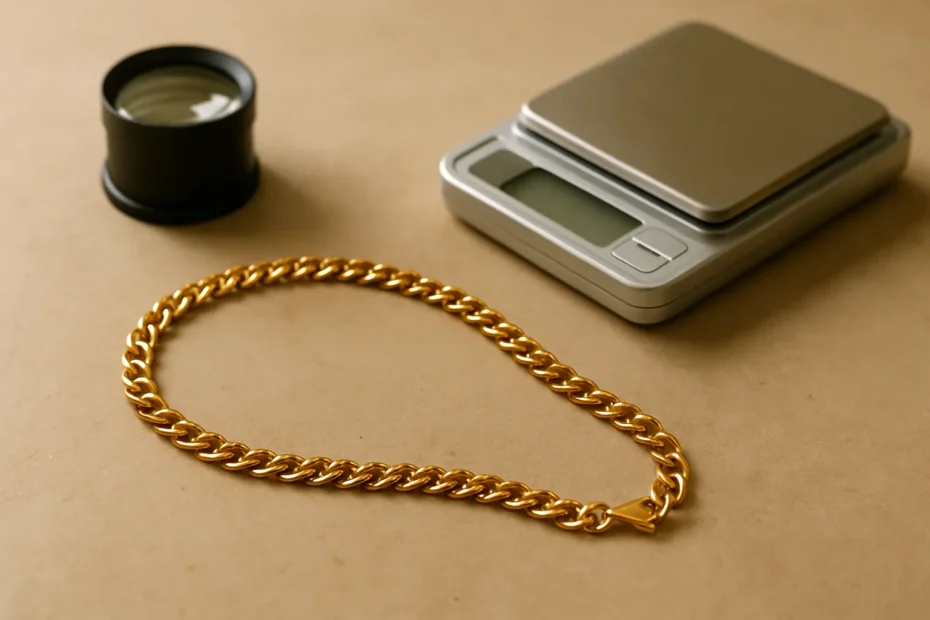
Check whether a NuraGold item matches its claim by verifying the exact listing, seller, karat, gram weight, construction, hallmark and return terms.
- Judge the exact NuraGold listing and seller—not only the brand name
- Real karat gold can still use hollow rather than solid construction
- Save the weight, hallmark, return terms, and delivered-item evidence
- Judge the exact listing and seller, not only the NuraGold name.
- “Real 14K gold” can still describe a hollow chain.
- Save the advertised gram weight, construction, seller, and return window.
- A hallmark supports a claim but does not independently prove purity.
- Handle a mismatch through documentation, timely testing, and the seller/platform process.
Queries such as “Is NuraGold legit?” and “NuraGold reviews complaints” usually combine several different concerns. A buyer may worry about gold purity, a chain that feels too light, a third-party seller, shipping damage, a return dispute, or a listing that used “solid gold” without making construction clear.
Those problems require different evidence. A useful review separates five layers instead of issuing one permanent verdict about every product carrying the name.
The five-layer NuraGold verification model
1. Brand claim
The NuraGold website says its jewelry uses genuine 10K, 14K, or 18K gold and offers both hollow and solid options. That is a first-party claim.
2. Exact listing
The title, specifications, images, variation, weight, width, length, clasp, construction, and included documentation define what you are ordering.
3. Seller
A marketplace storefront, authorized seller, reseller, or lookalike account can have different inventory, fulfillment, policies, and accountability.
4. Delivered item
The actual chain must match the ordered variation, stated weight range, karat mark, dimensions, and construction.
5. Independent evidence
A qualified jeweler or precious-metal professional can inspect the piece and choose an appropriate test when the documentation is insufficient.
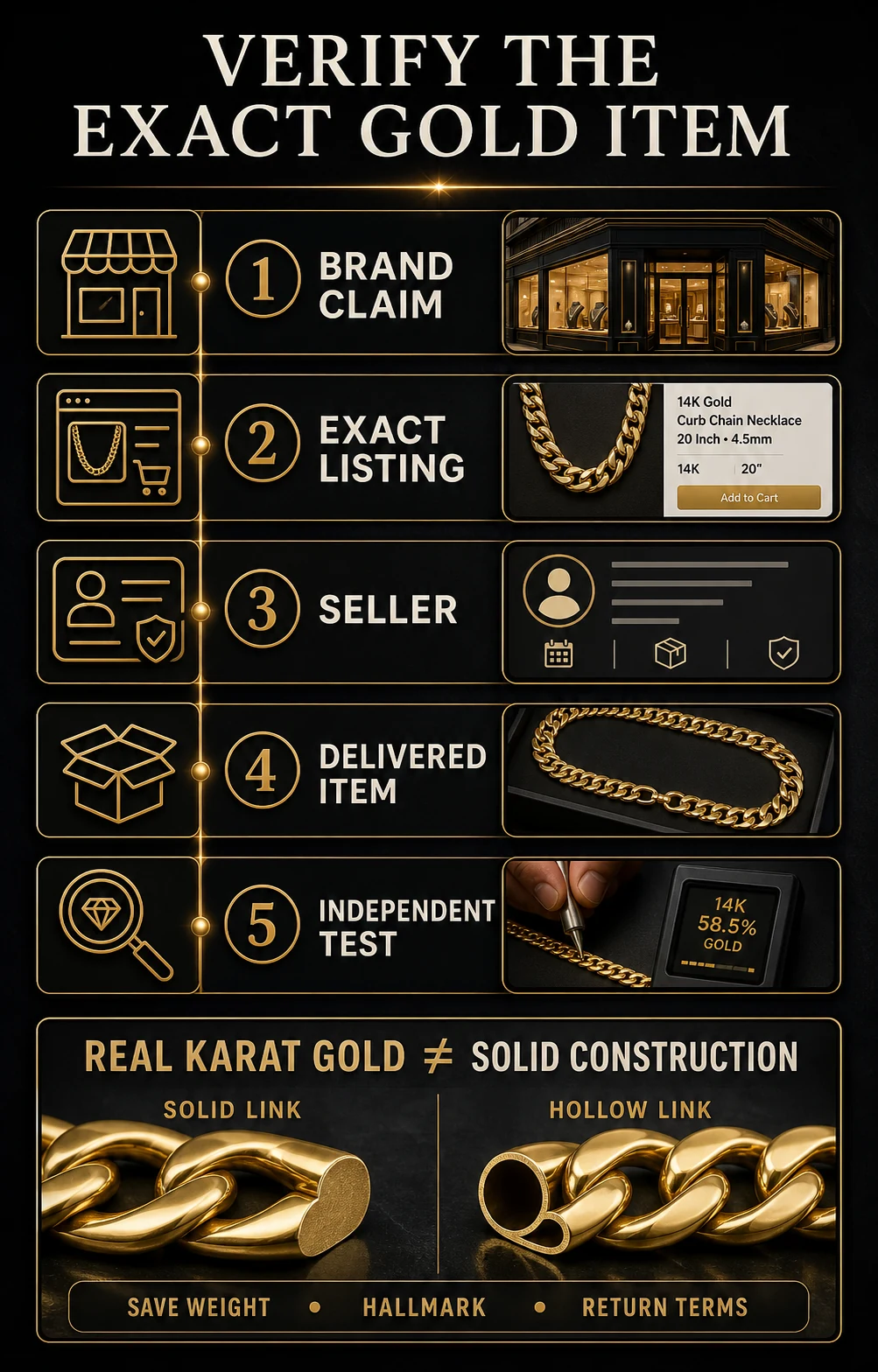
Real gold and solid construction are not the same claim
| Listing term | What it can mean | Buyer question |
|---|---|---|
| 14K gold | A gold alloy nominally containing about 58.5% gold by mass | Is the full chain 14K, including clasp and soldered parts? |
| Solid gold | Normally distinguishes bulk gold alloy from plated or filled metal | Does “solid” describe material only, or also non-hollow construction? |
| Hollow gold | A real gold-alloy shell with internal space | What is the gram weight and repair limitation? |
| Semi-solid | A non-standard construction term that can vary by seller | What exact weight and link construction are promised? |
| Gold plated or gold filled | A gold layer over a different core material | What base metal, layer method, and required disclosure apply? |
The U.S. FTC Jewelry Guides in 16 CFR Part 23 address claims about precious-metal content and product description. They do not replace testing, but they show why qualifiers should be read as part of the claim rather than ignored in the fine print.
Read what hollow gold means before treating low weight as automatic proof of fake gold. Hollow jewelry can be genuine, yet it usually offers less gold mass and can be more difficult to repair than a comparable solid-link chain.
Before buying: capture evidence from the listing
- Seller identity: Save the exact storefront name, seller profile, and marketplace order page.
- Variation: Record karat, color, length, width, clasp, and the selected solid/hollow option.
- Gram weight: Look for a stated or approximate weight for that exact length and width.
- Material wording: Search the entire page for plated, filled, hollow, semi-solid, vermeil, or base-metal qualifiers.
- Returns: Save the return deadline, restocking rules, shipping responsibility, and exclusions for worn or altered jewelry.
- Warranty: Separate a purity guarantee from coverage for wear, breakage, clasps, and hollow-link repair.
Take screenshots before purchase because marketplace titles, variations, and seller details can change. Keep the invoice, packaging, certificate, and shipping label until the inspection window has passed.
How to read reviews and complaints responsibly
The BBB complaint page for NuraGold is a record of submitted disputes and company responses, not a laboratory purity study. Its own notice says displayed complaint text may not represent every complaint filed.
| Review or complaint theme | Evidence that would clarify it | What not to assume |
|---|---|---|
| “It feels too light” | Exact listed gram weight, delivered weight, and hollow/solid description | Low weight alone proves fake gold |
| “The color looks wrong” | Neutral-light photos, karat/alloy, surface treatment, and professional inspection | Color alone determines purity |
| “The chain broke” | Construction, wear history, impact point, repair assessment, and warranty scope | Breakage automatically proves false karat |
| “The test failed” | Test method, calibration, surface preparation, sampling location, and written result | Every home test has equal reliability |
| “Return was refused” | Order date, return policy, condition, communications, and tracking | The dispute proves or disproves gold content |
Reader reports, including discussions on forums, are useful for finding recurring questions. They remain anecdotal and should not be converted into a universal purity conclusion without item-level evidence.
Use price per fine gram as a reasonableness screen
Suppose a 14K chain weighs 10 grams and costs $800. Its nominal fine-gold content is about 5.833 grams, so the price is approximately $137 per fine-gold gram before accounting for labor, design, distribution, warranty, and retailer margin.
This calculation does not prove authenticity or value. It helps compare two listings that use different karats or weights and highlights implausible omissions. Use the gold purity calculator for the conversion.
For the metal-value reference, follow the timestamp and spread checks in Gold Today. A retail chain can reasonably cost far more than its contained gold because the price also includes manufacturing, distribution, seller margin, and service.
Inspect the delivered item before the return window closes
- Film or photograph the sealed package and unboxing if the order value is significant.
- Match the chain to the invoice: length, width, color, clasp, karat, and construction.
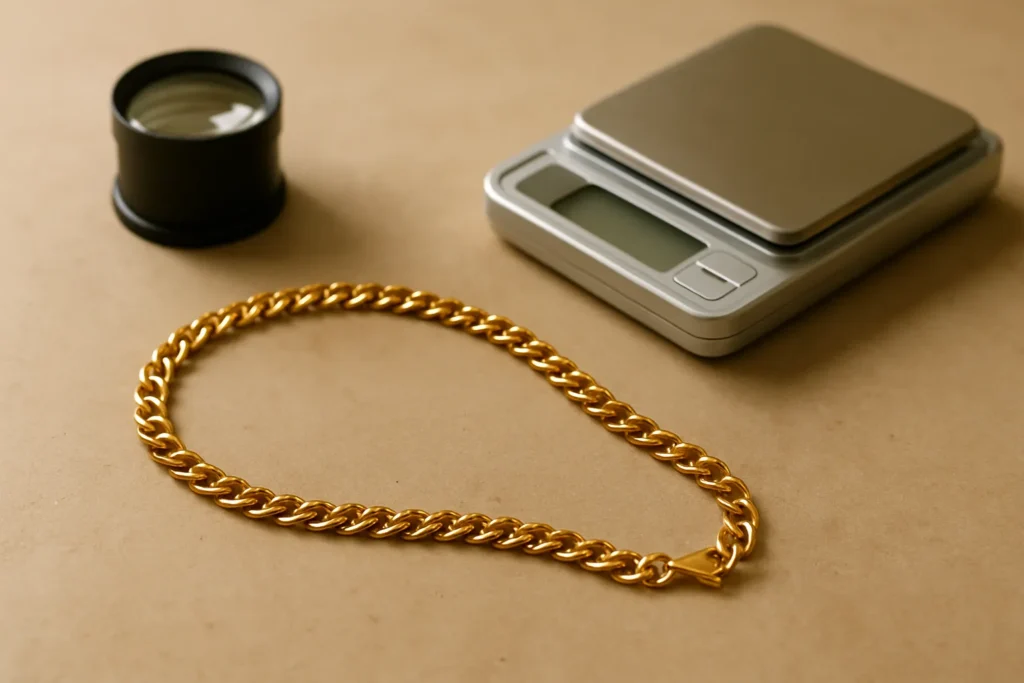
- Weigh it on an appropriate scale and compare with the stated tolerance.
- Photograph hallmarks and maker marks with a loupe or macro camera.
- Check links, clasp, solder joints, sharp edges, dents, and shipping damage.
- If material is in doubt, request a written independent assessment before altering the item.
The guide to testing gold purity explains professional and screening methods. A magnet test can flag some base metals, but a nonmagnetic result does not prove gold.
What to do if the item does not match
- Stop wearing, polishing, cutting, or chemically testing the piece.
- Save the listing, order confirmation, seller messages, packaging, and test report.
- Contact the seller in writing with the specific mismatch and requested remedy.
- Open the marketplace dispute within its deadline if the seller does not resolve it.
- Use the payment provider’s process only with accurate documentation and within its rules.
The safest conclusion is item-specific: a credible brand claim improves context, but only the listing, seller, delivered piece, and evidence can establish what you bought. Save proof before purchase and inspect before the return clock expires.
Public reviews cannot establish the purity of your chain, and a surface test may miss plating, solder, mixed components, or a hollow structure. Valuable disputes deserve a documented test from a qualified professional.
Video: solid vs hollow gold chains
This jeweler’s comparison shows why two real-gold chains can differ sharply in weight, durability, and price.
Bottom line
NuraGold states that it sells genuine karat-gold jewelry, but no brand-level statement can authenticate every third-party offer. Verify the exact seller and variation, distinguish gold material from hollow construction, compare weight, preserve the return path, and test independently when the value warrants it.
FAQ: Is NuraGold real gold and legit?
Does NuraGold sell real gold?
NuraGold states that its products use genuine 10K, 14K, or 18K gold. Confirm the exact listing, seller, hallmark, weight, and delivered item rather than relying on the name alone.
Can a hollow NuraGold chain still be real gold?
Yes. Hollow describes construction, while 10K or 14K describes alloy purity. A hollow chain can be real karat gold and still weigh less than a solid-link version.
Are NuraGold complaints proof that its jewelry is fake?
No. Complaints can concern shipping, damage, construction, weight, service, returns, or purity. Evaluate the underlying evidence and exact item.
How can I test a NuraGold chain?
Start with documentation, weight, dimensions, and hallmarks, then use a qualified jeweler or precious-metal professional for an appropriate test if needed.
What should I do if my NuraGold order does not match the listing?
Preserve the item and all evidence, contact the seller in writing, and use the marketplace or payment dispute process before deadlines expire.
 When you purchase a service or a product through our links, we sometimes earn a commission, at no extra cost to you.