
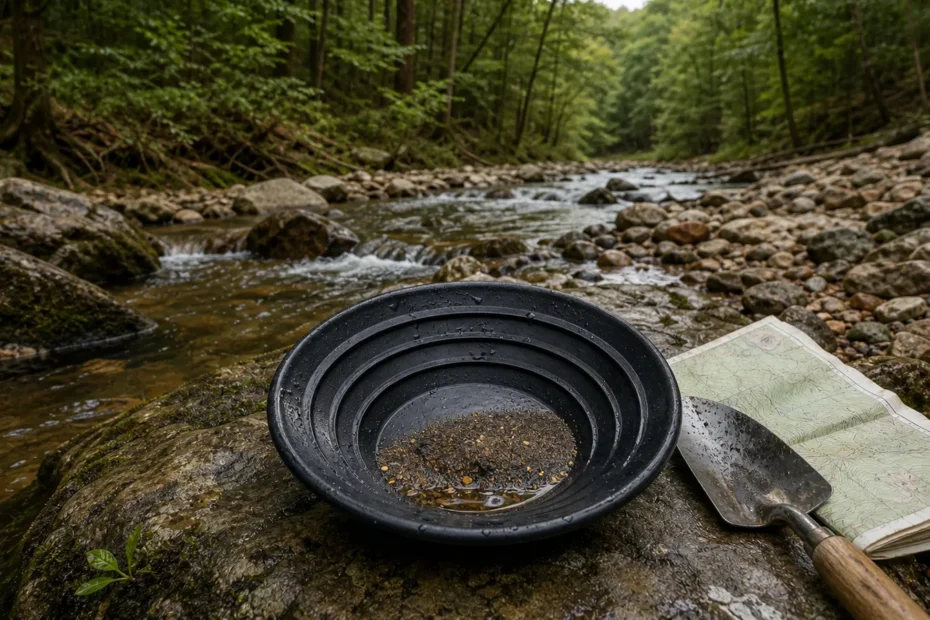
Check what is realistic about gold mining in Arkansas, including local history, placer expectations, public land rules, and why hype often misleads.
- Arkansas is a low-expectation prospecting state, not a hidden rush.
- No documented commercial gold deposit means small testing is the realistic frame.
- Check land access, water rules, and safety before panning creek gravels.
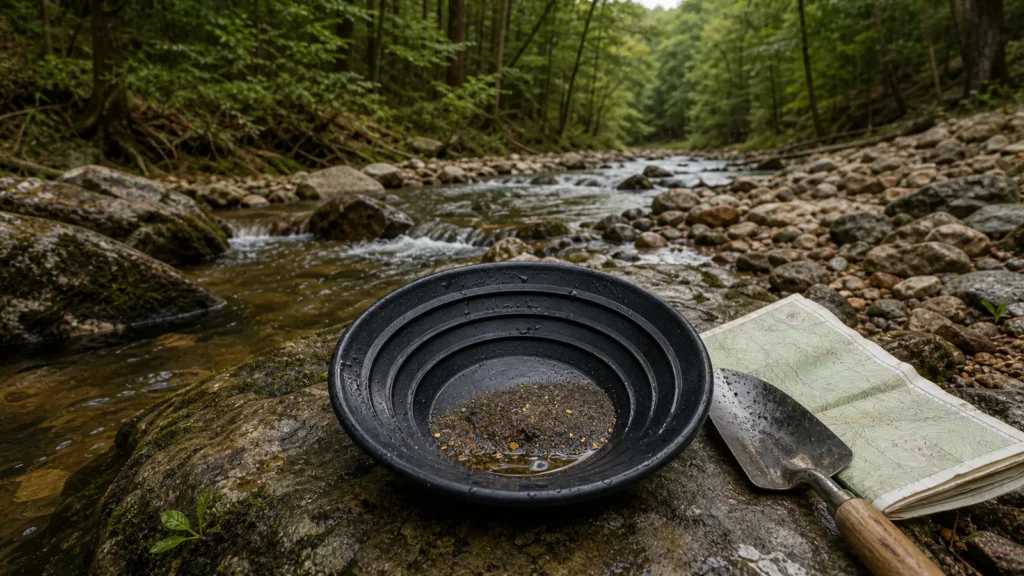
Gold mining in Arkansas is best understood as a low-expectation field hobby, not a hidden gold rush. The state has a real history of gold and silver rumors, assays, and prospecting interest, but the most important fact is blunt: Arkansas has not produced a documented, commercially payable gold deposit.
That does not make the topic useless. It makes it more practical. If you want to pan a creek, study old reports, or understand why the Ouachita Mountains attracted attention, the right question is not “where is the big strike?” It is “where can I legally and safely test small gravels while keeping expectations realistic?”
TL;DR: Gold Mining in Arkansas
- Arkansas has gold reports and trace occurrences, but no confirmed payable gold deposits.
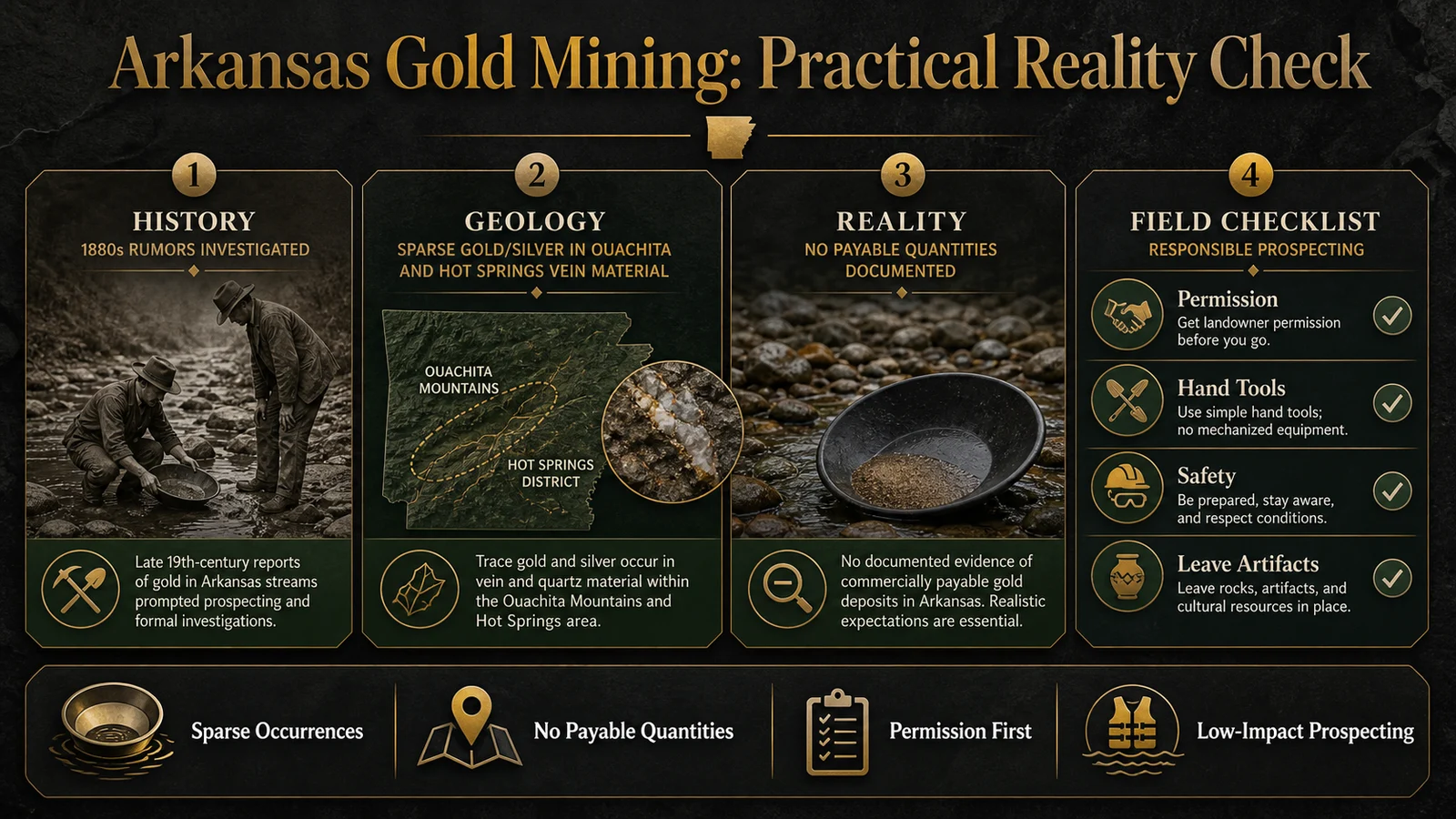
- The most discussed areas are in and around the Ouachita Mountains and Hot Springs region, where quartz and vein material drew historic attention.
- Recreational prospecting should be treated as field learning, not income generation.
- Permission matters: state parks, museums, protected lands, private land, and artifact sites can be legally sensitive.
- The safest approach is low-impact panning with hand tools only, after checking land status and local rules.
Is There Gold in Arkansas?
Yes, but that answer needs context. Gold has been reported in Arkansas, and some samples have shown traces of gold and silver. The Arkansas Geological Survey summarizes the practical reality clearly: no payable quantities of gold have been discovered in the state.
That single distinction prevents most bad advice. A creek can contain a few colors in a pan without being a mine. A quartz vein can carry trace metal without being ore. A nineteenth-century report can be historically interesting without proving a modern economic deposit.
For comparison, states such as Georgia and South Carolina sit in more productive gold belts. GoldConsul’s guides to gold mines in Georgia and gold mining in South Carolina show what a stronger historical mining record looks like.
Arkansas Gold History: Rumor, Assay, and Reality
Arkansas gold interest grew in the late nineteenth century, especially after reports from west-central Arkansas prompted formal geological attention. Prospectors investigated quartz veins, stream gravels, and mineralized zones, hoping the state might join the broader American gold story.
The results were disappointing from a mining standpoint. Assays and field checks found traces in some places, but not the grade, continuity, or volume needed for sustained commercial mining. That is why Arkansas never developed a gold district comparable to the Dahlonega area of Georgia, the Carolina Slate Belt, or the major western camps.
This matters because old “gold found” language often survives online without the follow-up. The follow-up is the point: small occurrences do not equal a workable deposit. Readers interested in the wider development of extraction methods can compare Arkansas with GoldConsul’s overview of gold rush mining techniques.
Practical Arkansas Gold Locations, History, and Geology
The table below is a practical orientation tool, not a claim map. Always verify land ownership and rules before visiting any site, and do not assume that a historic mention creates a right to dig, pan, or collect.
| Area or Setting | Why It Comes Up | Geology Signal | Practical Takeaway |
|---|---|---|---|
| Ouachita Mountains | Historic gold and silver interest focused on west-central Arkansas. | Quartz veins, altered rock, and complex folded mountain geology. | Best treated as a geology-learning region, not a proven pay-streak destination. |
| Hot Springs Area | Often mentioned in older discussions of mineralized veins and assays. | Vein material and mineral occurrences, with trace gold/silver references. | Many places are protected, private, or urbanized; check rules before collecting anything. |
| Small Creek Gravels | Recreational panners look for heavy-mineral traps behind rocks and inside bends. | Black sand, dense minerals, quartz fragments, and reworked stream sediment. | Possible educational panning target, but expect tiny specks at most. |
| Old Prospect Mentions | Old reports can point to where earlier prospectors tested material. | Assay results may show trace values without commercial continuity. | Use historic reports as context, not as permission or proof of mineable gold. |
| Protected Parks and Cultural Sites | Arkansas has many natural, historic, and archeological sites. | The geology may be interesting, but legal protection is the controlling factor. | Look, photograph, and learn unless written permission clearly allows collection. |
Why Arkansas Did Not Become a Gold State
Gold deposits need more than gold atoms. A mineable deposit requires enough grade, tonnage, continuity, access, metallurgy, capital, and legal permission to justify extraction. Arkansas has not met that test for gold.
The state’s better-known mineral identity sits elsewhere, including diamonds at Crater of Diamonds, quartz, bauxite, bromine, and other industrial or collectible resources. The Arkansas Geological Survey’s broader metallic minerals overview notes that several metals have been reported without being found in ore-forming quantities.
Gold can still appear as a trace mineral in complex systems. The practical problem is concentration. A recreational pan can reveal a few colors, but commercial mining needs repeatable material at scale.
Where a Beginner Should Start
Start with maps, not a shovel. Identify land ownership, check current rules, and read state geological material before planning a field day. If you cannot clearly answer who manages the land, do not prospect there.
For legal panning practice, private land with written permission is usually the cleanest path. Ask the landowner exactly what is allowed: hand panning only, no digging into banks, no motorized equipment, no artifact collection, and no disturbance of fences, roads, livestock, or water structures.
If you are new to panning technique, GoldConsul’s guide to how to pan for gold is more useful than chasing unverified location lists. Skill matters because tiny flakes are easy to wash out of the pan.
Prospecting Legality and Safety Checklist
Before You Pan in Arkansas
- Confirm land status. Private, state, federal, municipal, park, and wildlife lands can have different rules.
- Get written permission. Verbal permission is easy to misunderstand; written permission protects both sides.
- Check park rules. Arkansas park rules restrict unauthorized searching, excavation, and removal on state park or museum properties without written permission from the State Parks Division Director.
- Leave artifacts alone. Do not collect arrowheads, pottery, historic metal, human remains, or site material. The Arkansas Archeological Survey is the better starting point for cultural-resource law.
- Use hand tools only unless explicitly allowed. Motorized dredges, pumps, and bank disturbance can trigger different environmental and land-management rules.
- Do not undercut streambanks. Bank collapse, erosion, and habitat damage are not worth a few specks.
- Watch water conditions. Flashy creeks, slippery bedrock, snakes, ticks, heat, and remote roads are more realistic risks than “claim jumping.”
- Fill small test holes. Leave the area looking like you were never there.
- Keep records. Note date, GPS approximation, land permission, material type, and what you actually recovered.
The legal side is not a formality. The Code of Arkansas Rules section on state park properties says people may not excavate, search for, or remove minerals, artifacts, lost articles, or similar materials from state park or museum property without written permission. Treat protected land as closed unless you have a clear, current authorization.
Field Method: A Low-Impact Arkansas Test Pan
A sensible Arkansas test pan is small and disciplined. Sample a few tablespoons to a partial pan from natural heavy-mineral traps: behind larger rocks, inside bends, at the base of small drops, or in cracks where dense material settles.
Classify the material if you have a screen. Pan slowly, keep the black sand until the final stage, and use a snuffer bottle only if you see actual metallic yellow that stays bright when shaded and does not crumble. If the “gold” floats, smears, or breaks, it may be mica or another mineral.
Do not dig deep holes into active banks. Do not move large rocks in a way that changes stream flow. Do not assume that finding black sand means gold is present; it only means dense minerals are concentrating there.
How to Judge a Gold Claim About Arkansas
Arkansas gold claims often fail because they skip scale. A statement such as “gold was found near Hot Springs” may be technically possible, but it does not tell you grade, sample method, location accuracy, permission status, or repeatability.
Reader Tool: Arkansas Gold Claim Filter
Before acting on a location tip, ask four questions. If two answers are missing, treat the claim as unproven.
The same discipline applies to gold identification. GoldConsul’s article on testing gold purity is focused on finished metal, but the larger lesson carries over: do not rely on color alone.
What Equipment Makes Sense?
Keep it simple. A pan, classifier, small hand trowel, snuffer bottle, magnet, field notebook, and sturdy footwear are enough for ethical recreational testing. A loupe helps distinguish real metal from glittery minerals.
Skip expensive sluices, pumps, and dredging gear unless you have verified that the method is legal for that exact site. Arkansas is not the place to justify heavy equipment based on expected gold recovery.
If your real interest is broader prospecting history, compare Arkansas with stronger gold narratives such as gold mining in Arizona or the placer-focused lessons in GoldConsul’s Louisiana gold nuggets guide. The contrast helps keep Arkansas expectations grounded.
Knowledge Gap: Trace Gold Is Not a Gold District
Most weak Arkansas gold content treats any mention of gold as a location recommendation. That is the wrong standard.
The useful gap is economic geology: separating trace occurrences, old rumors, field hobby potential, and legally accessible prospecting ground. Arkansas becomes clearer when those four ideas are kept separate.
Editorial Perspective
The GoldConsul Editorial Perspective
The honest Arkansas gold story is not that prospecting is pointless; it is that the reward is learning, field discipline, and maybe a few tiny colors, not a secret commercial deposit.
Bottom Line
Gold mining in Arkansas has history, but not the history of a major producing state. The strongest evidence points to trace occurrences, old investigations, and limited recreational interest rather than payable gold mining.
For a beginner, that means Arkansas can still be a useful classroom. Learn stream concentration, read geological reports, respect land rules, leave artifacts alone, and keep the pan small. If you find a few specks, treat them as a field note, not a financial plan.
FAQ: Gold Mining in Arkansas
Can you find gold in Arkansas?
Trace gold has been reported in Arkansas, but no payable quantities have been documented. Recreational panners should expect very small colors at most, not nuggets or reliable income.
Where is the best place to look for gold in Arkansas?
The Ouachita Mountains and Hot Springs region are the most commonly discussed historical areas, but land access and rules matter more than vague location names. Do not prospect without clear permission.
Is gold panning legal in Arkansas?
It depends on the exact land. Private land requires permission, and state parks or protected sites can prohibit searching, excavation, or removal without written authorization. Always check current rules first.
Are there active gold mines in Arkansas?
No major active gold mines are known in Arkansas. The state has mineral resources, but gold has not been discovered in commercially payable quantities.
What equipment should I use for Arkansas gold prospecting?
Use a basic gold pan, classifier, hand trowel, snuffer bottle, magnet, hand lens, and notebook. Avoid motorized or heavy equipment unless the managing land authority explicitly allows it.
 When you purchase a service or a product through our links, we sometimes earn a commission, at no extra cost to you.