
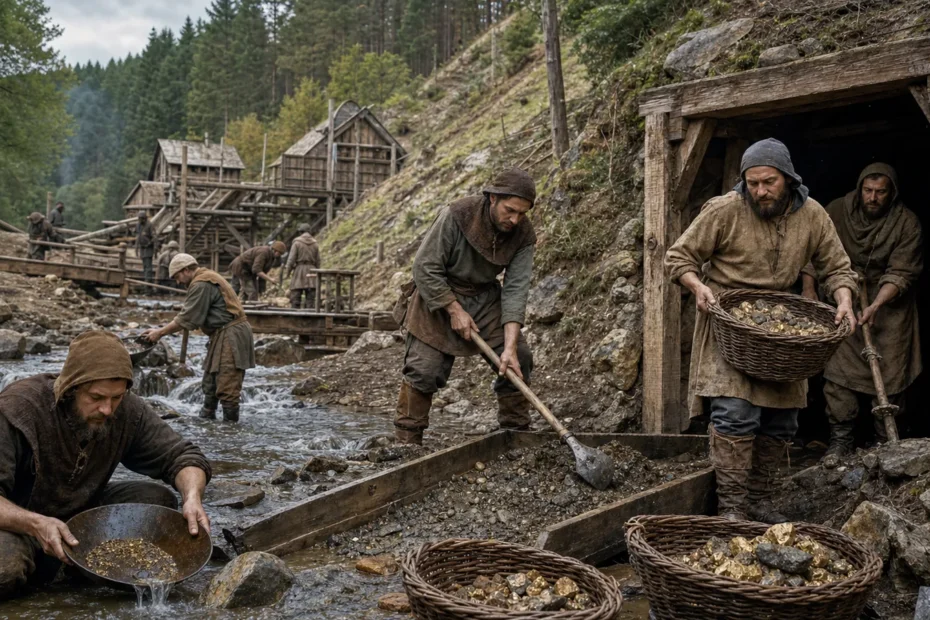
See how medieval European miners used panning, shafts, water power, fire-setting, and washing methods, and what evidence limits modern claims today.
- Separate simple stream washing from capital-heavy underground work.
- Check how water, wood, labor, and law shaped each mining district.
- Use evidence limits before turning medieval methods into one neat story.
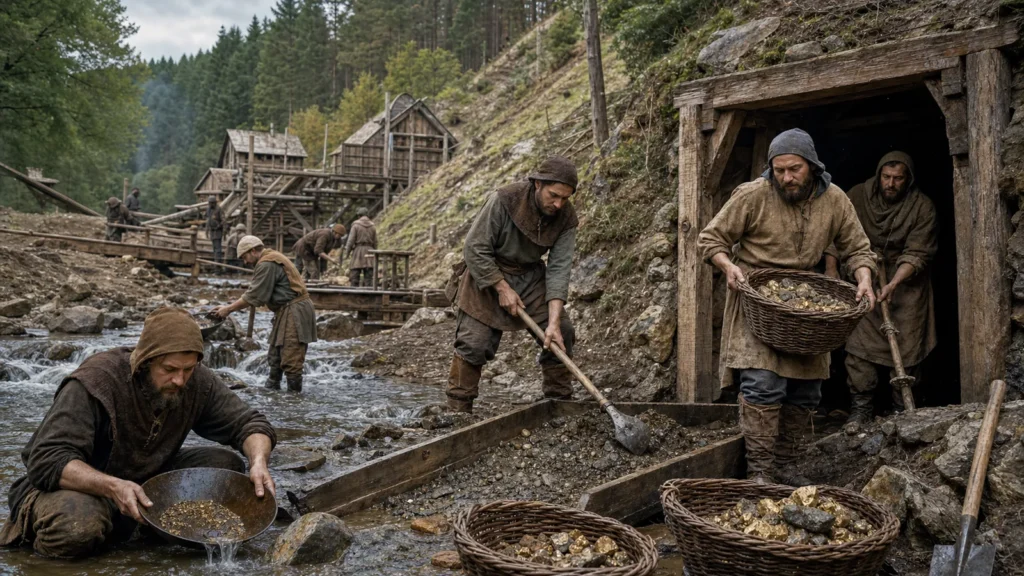
Medieval European gold mining was not one technique. It was a practical toolkit shaped by geology, labor, water, wood, law, and risk. Where gold sat in stream gravels, miners could work with pans, troughs, and washing floors.
Medieval European gold mining was not one technique. It was a practical toolkit shaped by geology, labor, water, wood, law, and risk.
Where gold sat in stream gravels, miners could work with pans, troughs, and washing floors. Where it was locked in quartz or sulfide-bearing rock, the work moved underground through shafts and adits, then into crushing, washing, and smelting chains that demanded far more capital and organization.
- Alluvial panning and washing were the simplest methods, but they worked only where streams had already concentrated gold.
- Hard-rock mining used shafts, adits, picks, wedges, timber supports, drainage, and sometimes fire-setting to break resistant rock.
- Water power mattered because it could drain mines, move ore, crush rock, and wash sediment, but only where terrain and investment allowed it.
- Medieval mining was regulated through rights, dues, leases, and local mining law; it was not a free-for-all.
- The main limits were ore grade, flooding, timber supply, smoke, labor discipline, and contamination from waste, washing, and smelting.
The Short Answer
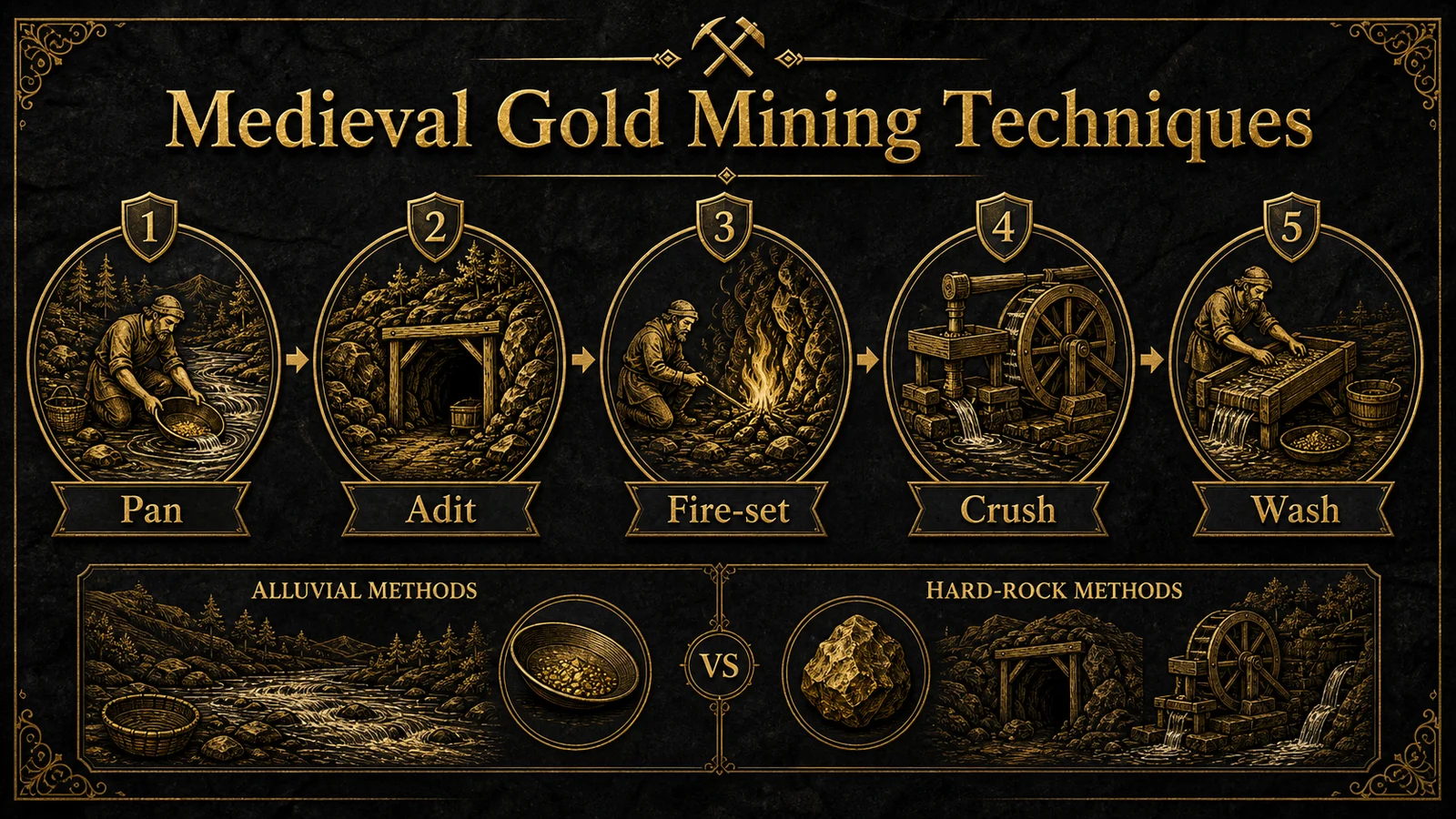
Gold mining techniques in medieval Europe ranged from low-tech alluvial recovery to organized underground mining. The method depended on whether miners were dealing with loose gold in river deposits or gold-bearing ore in veins.
That distinction matters. Stream gold could be separated because it was dense. Vein gold required excavation, ventilation, drainage, crushing, and washing before any refining or smelting could make sense.
For a wider context on pre-medieval practices, see GoldConsul’s guide to ancient gold mining techniques. Medieval mining inherited older habits, but the growing use of water power and formal mining law changed the scale of work in many districts.
Alluvial Gold: Panning, Troughs, and Washing
Alluvial mining targeted gold particles that streams had already freed from bedrock. Miners worked bars, bends, gravel layers, and older river deposits with pans, wooden bowls, sluices, rakes, and washing troughs.
The logic was simple: gold is much denser than common sand and gravel. Water carried lighter material away while heavier grains settled in the bottom of a pan, riffle, cloth, or wooden channel.
- Panning was flexible and cheap, but slow.
- Washing troughs processed more gravel if water supply was reliable.
- Ground sluicing used controlled water flow to expose or move sediment where terrain allowed.
- Sorting by hand remained important because tools were simple and losses were easy.
This was the least capital-intensive form of medieval gold recovery. It also had a hard ceiling: once rich gravels were exhausted, more workers did not automatically mean more gold.
Hard-Rock Mining: Shafts, Adits, and Timber
When gold was bound in ore, miners had to reach the vein. They did that through vertical shafts, inclined openings, and horizontal adits driven into hillsides.
An adit had several advantages. It could follow a vein, allow easier ore removal, and drain water by gravity if the tunnel was placed below the workings. Shafts, by contrast, demanded hoisting, ladders, platforms, and more attention to flooding.
Medieval miners used iron picks, hammers, chisels, wedges, baskets, leather bags, and windlasses. Timbering was essential in unstable ground, and timber supply could limit expansion as sharply as ore grade.
The same mining communities that supplied metal for coinage and luxury objects also fed the workshops discussed in goldsmithing in medieval Europe. Mine output, craft skill, and elite demand were connected, but not evenly across the continent.
Fire-Setting: Useful, Dangerous, and Often Misunderstood
Fire-setting was a pre-explosive method for breaking hard rock. Miners built fires against the working face, heated the rock, and then attacked the weakened surface with tools after cooling.
It was not magic and it was not universal. It consumed wood, filled underground spaces with smoke, and could be dangerous in poorly ventilated shafts or adits. The method made most sense where rock resisted hand tools and where fuel was available.
Georgius Agricola’s De Re Metallica, published in 1556 but grounded in late medieval and early modern central European mining practice, describes fire-setting alongside ventilation, drainage, ore dressing, and machinery. It is later than much of the Middle Ages, so it should be used carefully, but it remains one of the clearest technical windows into the mining world that developed from medieval practice.
Water Power: The Medieval Force Multiplier
Water power did not replace human labor, but it could change what was economically possible. Where streams, gradients, channels, and investment lined up, water wheels helped drive machinery for pumping, crushing, washing, and bellows.
Britannica’s overview of De Re Metallica summarizes the range of early mining machinery shown by Agricola, including shafting, pumping, conveying, and water-powered devices. The important point for medieval Europe is not that every mine had elaborate machinery. It is that larger districts increasingly depended on mechanical assistance for deeper and more continuous work.
Water also imposed constraints. Mines without dependable water supply could not easily wash large volumes of ore. Mines with too much groundwater needed drainage, pumping, or shallower exploitation.
Crushing, Washing, and Concentrating Ore
Hard-rock gold ore had to be reduced before gold-bearing particles could be separated. Miners broke ore by hand, crushed it with hammers or stamps, and washed the crushed material to concentrate heavy particles.
This stage is where many simplified histories lose the plot. Mining was not just digging. It was a chain of extraction, transport, breaking, sorting, washing, fuel management, and metallurgical work.
| Method | Best Use | Main Tools | Limits |
|---|---|---|---|
| Panning and washing | Loose gold in stream gravels | Pans, bowls, troughs, water channels | Low throughput; depends on rich gravels |
| Shaft and adit mining | Veins in hillsides or underground rock | Picks, wedges, timbering, windlasses | Flooding, collapse, ventilation, hoisting cost |
| Fire-setting | Hard rock before explosives | Wood fuel, fire, iron tools | Smoke, fuel demand, heat, safety risk |
| Water-powered crushing | Ore that needed volume processing | Wheels, stamps, mills, channels | Requires capital, water rights, maintenance |
For comparison with later mechanized methods, the Gold Rush article on gold mining techniques during the Gold Rush shows how pans, sluices, shafts, and ore processing persisted in changed forms centuries later.
Labor, Skill, and Mine Organization
Medieval mining required more than brute force. Prospectors, miners, timber workers, haulers, washers, charcoal burners, smiths, assayers, merchants, and local officials all mattered.
Some work was seasonal or small-scale. Larger mining districts needed capital, wage labor, shares, leases, and rules for drainage, boundaries, dues, and disputes.
Mining rights were often connected to rulers, towns, monasteries, or territorial lords. Local mining law could define who was allowed to open a claim, how claims were measured, what dues were owed, and how conflicts were settled.
This legal and fiscal side connects directly to the economic impact of gold in medieval Europe. Gold was not merely a shiny metal; it was a taxable resource, a monetary input, a diplomatic gift, and a source of local power.
Environmental Limits and Damage
Medieval mining changed landscapes. Washing disturbed streams, adits and shafts moved waste rock, fire-setting and smelting consumed wood, and ore dressing concentrated unwanted minerals in spoil heaps and waterways.
A recent Cambridge Archaeological Dialogues article on the ecology of medieval mining towns emphasizes that waste from sorting, crushing, washing, and smelting could leave persistent heavy-metal contamination. That does not mean every medieval gold site caused the same damage, but it does warn against treating premodern mining as environmentally gentle.
Fuel was another limit. Fire-setting, charcoal production, smelting, and construction all drew on nearby forests. Transport costs meant a mine could be constrained by wood and water long before the ore body was geologically exhausted.
The safest reading is evidence-based and regional. Medieval Europe had sophisticated mining districts, but techniques varied sharply by deposit, terrain, capital, and date. Avoid claims that all medieval gold was mined one way or that medieval miners were either primitive or industrial in the modern sense.
A Practical Process Map
- Prospect: inspect streams, exposed rock, old workings, and local reports.
- Test: pan gravels or sample vein material before committing labor.
- Open: dig shallow pits, drive an adit, or sink a shaft depending on terrain.
- Extract: use hand tools, wedges, timbering, hoisting, and sometimes fire-setting.
- Dress: break, sort, crush, and wash ore to concentrate gold-bearing material.
- Refine or sell: send concentrate or metal into smelting, minting, craft, or trade channels.
That chain helps explain why medieval gold entered different parts of society in uneven ways, from coinage and ecclesiastical treasure to objects covered in what gold was used for in medieval Europe.
Many medieval gold sites are poorly documented compared with silver, copper, lead, and later colonial gold fields. Archaeology, slag analysis, landscape survey, and mining-law records often provide better evidence than broad narrative histories.
Bottom Line
Gold mining techniques in medieval Europe were practical responses to specific deposits. Alluvial gold called for panning and washing. Vein gold required shafts, adits, drainage, timber, crushing, and concentration.
The most important takeaway is that medieval mining was a system. Tools, water power, fuel, skilled labor, regulation, and environmental limits all shaped what could be mined profitably.
FAQ: Gold Mining Techniques in Medieval Europe
Did medieval Europeans pan for gold?
Yes. Panning and washing were used where streams or older river deposits contained alluvial gold. These methods were simple, portable, and cheap, but limited by the richness of the gravel.
Did medieval miners dig underground for gold?
Yes, where gold occurred in veins or gold-bearing ore. Miners used shafts, adits, timber supports, hand tools, hoisting systems, and drainage methods to reach and remove ore.
What was fire-setting in medieval mining?
Fire-setting heated hard rock so it fractured or weakened before miners attacked it with tools. It was useful before explosives but dangerous because it consumed wood and filled workings with heat and smoke.
How did water power help medieval gold mining?
Water power could drive pumps, crushing equipment, washing systems, and bellows. It improved throughput where terrain and capital allowed, but it was not available at every mine.
Was medieval gold mining regulated?
Often, yes. Mining rights, claim boundaries, dues, leases, and dispute rules were important in organized districts. Local practice varied widely by region and political authority.
 When you purchase a service or a product through our links, we sometimes earn a commission, at no extra cost to you.