
Compare home safes vs private vaults for gold storage by access, insurance, privacy, allocated ownership, theft risk, cost, and documentation. in context.
- Compare access, theft risk, insurance terms, and privacy needs.
- Consider split storage if one location creates too much single-point risk.
- Check custody documents and exit rules before choosing a private vault.

Choosing between a home safe and a private vault for gold is not really a security question. It is a control question. A home safe gives immediate access and privacy, but it concentrates theft, fire, and disclosure risk at one address.
A private vault can reduce household risk and improve insurance discipline, but it adds fees, access friction, and custodian due-diligence work. The best answer is often not home safe or private vault; it is how much gold belongs in each place.
TL;DR
- A home safe is useful for a small emergency-access allocation, not usually for your entire gold stack.
- A private vault makes more sense when the holding is large enough that theft, insurance, and documentation risk matter more than instant access.
- Safe deposit boxes and home safes are not automatically insured; coverage must be verified separately.
- Allocated storage matters because it separates ownership of specific metal from a general claim against a provider.
- The strongest storage plan usually splits access gold, core bullion, and documentation into different risk buckets.
Animated Summary: Home Safe vs Private Vault Storage Decision
This short animation shows why the decision is not one location versus another. Strong storage separates access, custody, insurance proof, and resale readiness by purpose.
What Most Buyers Miss
The biggest mistake is comparing a $300 home safe to an annual vault fee as if both solve the same problem. They do not.
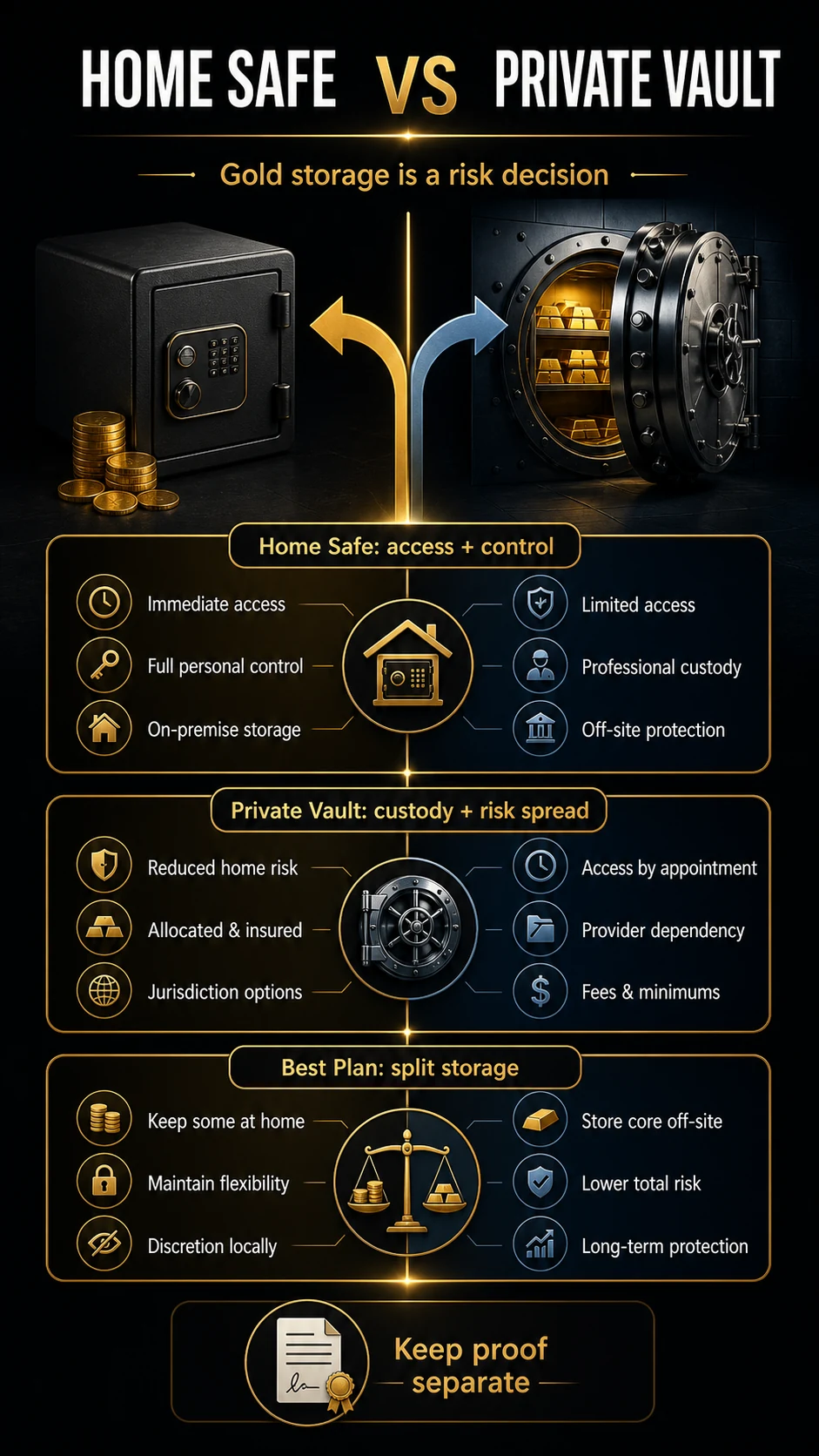
Home Safe vs Private Vault: The Real Decision
If you own a few coins, the problem is not the same as owning kilo bars, numismatic pieces, or a six-figure bullion position. The storage decision should follow value, access need, household risk, and insurance proof.
GoldConsul already covers broader bullion basics in what gold and silver bullion means and practical purchasing context in how to buy gold bars. Storage is the next layer: after you buy, where does the risk actually sit?
Chart 1: Storage Risk Heatmap
Interpretation: The safest structure is rarely the most convenient one. The stronger plan spreads risk without losing all access.
When a Home Safe Makes Sense
A home safe is rational when the amount is modest, you need quick access, and you can keep knowledge of the gold tightly controlled. It is also useful for documents, receipts, photos, and small emergency-access coins.
The problem is that many buyers treat the safe itself as the full plan. In reality, a safe is only one layer: placement, bolting, fire rating, moisture planning, alarm systems, secrecy, and insurance all matter.
Home Safe Checklist
- Use a heavy safe that is professionally anchored to the structure.
- Keep purchase invoices, photos, serial numbers, and appraisals separately backed up.
- Do not disclose holdings to casual friends, contractors, social media, or extended acquaintances.
- Ask your insurer whether bullion, coins, and jewelry are covered, capped, excluded, or require a rider.
- Do not store the entire bullion position in one obvious location, especially a small portable safe.
A home safe is strongest for the part of your gold you want to access without permission from a bank, vault, or counterparty. It is weakest when the whole holding becomes discoverable at one address.
When a Private Vault Makes Sense
A private vault becomes more attractive when your gold position is large enough that one household location is the wrong risk container. This is especially true for bars, larger coin holdings, or bullion intended as long-term wealth storage rather than emergency pocket money.
Professional vaulting also changes the documentation discipline. A serious vault relationship should make you think in terms of bar lists, audit trails, storage agreements, insurance terms, access rules, and exit procedures.
The LBMA vaulting guidance is useful because it frames vaulting as an operational discipline, not just a room with thick doors. For account structure, the LBMA also distinguishes precious-metal account types in its precious metal accounts guide.
Chart 2: Convenience vs Protection Tradeoff
Interpretation: This is a conceptual access score, not a universal rating. The point is that more custody protection often comes with less instant control.
Safe Deposit Box Is Not the Same as a Private Vault
A bank safe deposit box can be useful for some valuables, but it should not be confused with insured bullion custody. The FDIC explains that safe deposit box contents are not FDIC-insured if damaged or stolen.
That point matters because many readers hear “bank vault” and assume “insured.” A safe deposit box is rented storage space. Your agreement and separate insurance coverage decide the protection, not the FDIC label on the bank.
Bank boxes can also create access problems. If you need gold during bank closure hours, estate administration, a local emergency, or a documentation dispute, the box may be less liquid than you expected.
Allocated vs Unallocated Storage
If you use professional storage, the key word is not only “vault.” The stronger question is whether the metal is allocated.
Allocated gold should mean specific metal is held for you, rather than you holding only a general claim against a provider. BullionVault’s explanation of allocated gold captures the basic distinction: allocated metal is owned outright and held under a custody arrangement.
That does not mean every vault provider is equally strong. It means your due diligence should focus on ownership evidence, audits, insurance terms, bar lists, withdrawal rules, fees, and what happens if the provider fails.
Chart 3: Practical Split Storage Model
Small coins or bars for immediate access, not your whole stack.
Long-term bullion stored with stronger custody, insurance, and records.
Invoices, photos, serial numbers, appraisals, and policy documents backed up.
Interpretation: The percentages are not financial advice. They show the logic: keep access gold small and protect the core holding with better risk controls.
Worked Example: The $50,000 Gold Storage Decision
Suppose someone owns about $50,000 in coins and small bars. A single home safe may feel simple, but one burglary, disclosure mistake, fire, or insurance gap can put the entire position at risk.
A better framework is to separate the gold by job:
| Portion | Possible location | Purpose | Main risk to manage |
|---|---|---|---|
| $5,000-$10,000 | Anchored home safe | Emergency access and privacy | Disclosure, theft, fire, policy limits |
| $35,000-$42,000 | Allocated private vault | Long-term storage and risk spread | Provider diligence, fees, access rules |
| Documents | Separate physical and encrypted digital copies | Insurance, resale, estate proof | Missing records after a loss |
This approach is not perfect, but it avoids the worst single-point failure: all gold, all proof, and all access risk sitting in one place.
The GoldConsul Editorial Perspective
Owning metal directly is valuable because it can sit outside many financial promises. But storage turns that advantage into a practical risk-management problem. Control is useful only when it does not create an obvious target.
Knowledge Gap: Storage Is Part of the Investment, Not an Afterthought
Most storage articles ask where gold is safest. That is too vague. A better question is what failure you are trying to avoid.
- Burglary failure: too much value at one known address.
- Insurance failure: assuming coverage without written confirmation.
- Liquidity failure: storing all gold somewhere you cannot access when needed.
- Custody failure: using a vault without clear ownership, audit, insurance, and withdrawal terms.
- Documentation failure: losing invoices, photos, bar lists, or appraisals when they matter most.
GoldBroker and Private Storage Context
If you are comparing bullion purchase and custody options, one provider worth researching is GoldBroker, especially if your goal is physical bullion ownership with professional storage options rather than keeping everything at home.
Do not treat any provider name as an automatic recommendation. Compare fees, jurisdictions, insurance terms, allocated ownership, withdrawal rules, and whether the storage model matches your risk profile.
Storage Decision Rule
If the gold amount is small and access matters most, a discreet home setup may be enough. If the amount is large enough that one address would change your life if compromised, professional storage deserves serious comparison.
Affiliate disclosure: GoldConsul may earn a commission if you use some external partner links, at no extra cost to you.Decision Checklist Before You Choose
- How much gold would be financially painful to lose?
- Who knows where the gold is stored?
- Is the safe bolted, hidden, fire-aware, and supported by alarms or monitoring?
- Does your insurance policy explicitly cover bullion, coins, and jewelry at the stated value?
- If using a vault, is the gold allocated, insured, audited, and withdrawable under clear rules?
- Can your heirs or trusted executor find the documentation without exposing the gold to everyone?
Bottom Line
Home safe vs private vault for gold is not a universal winner question. A home safe wins on access and control, while a private vault can win on concentration risk, professional custody, and documentation discipline.
For many serious buyers, the practical answer is split storage: a small access position at home, the core position in stronger custody, and proof documents stored separately. For related next steps, see GoldConsul’s guides to where to store gold, private gold vaults in Europe, and the live gold price today.
FAQ: Home Safe vs Private Vault for Gold
Is a home safe better than a private vault for gold?
A home safe is better for immediate access and small holdings. A private vault is often better for larger holdings where theft concentration, insurance, and documentation risk matter more.
Are safe deposit box contents insured by the FDIC?
No. FDIC deposit insurance covers eligible bank deposits, not the contents of a rented safe deposit box.
How much gold should I keep at home?
There is no universal number. A practical rule is to keep only the amount you genuinely need for access, while storing larger long-term holdings with stronger risk controls.
What does allocated gold storage mean?
Allocated storage generally means specific metal is held for you, rather than you holding only a general claim against a provider. The exact protection depends on the contract and custody structure.
Should I split gold between home and vault storage?
For many owners, split storage is more resilient than choosing one location. It can preserve access while reducing the risk of losing the entire holding in one event.
 When you purchase a service or a product through our links, we sometimes earn a commission, at no extra cost to you.