
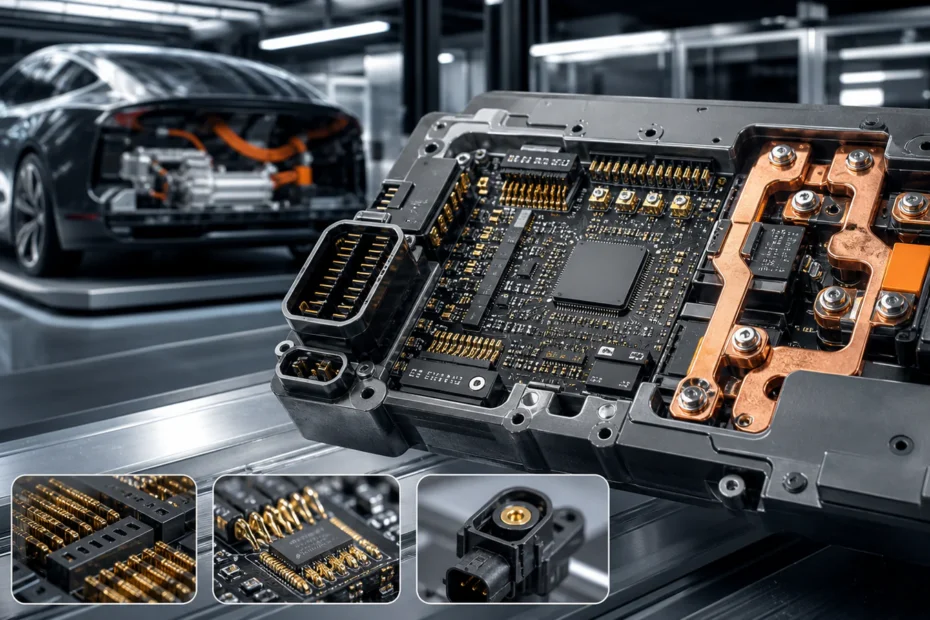
See where EVs use gold in contacts, sensors, chips, control electronics and charging systems—and why copper, aluminum, silver and tin dominate bulk functions.
- Gold is used selectively in high-reliability contacts, semiconductor packaging, sensors and control electronics.
- It is not a battery active material and does not carry the vehicle’s bulk traction current; copper and aluminum dominate those jobs.
- Electrification can support technology demand, but higher prices also drive thinner plating, selective deposition and substitution.
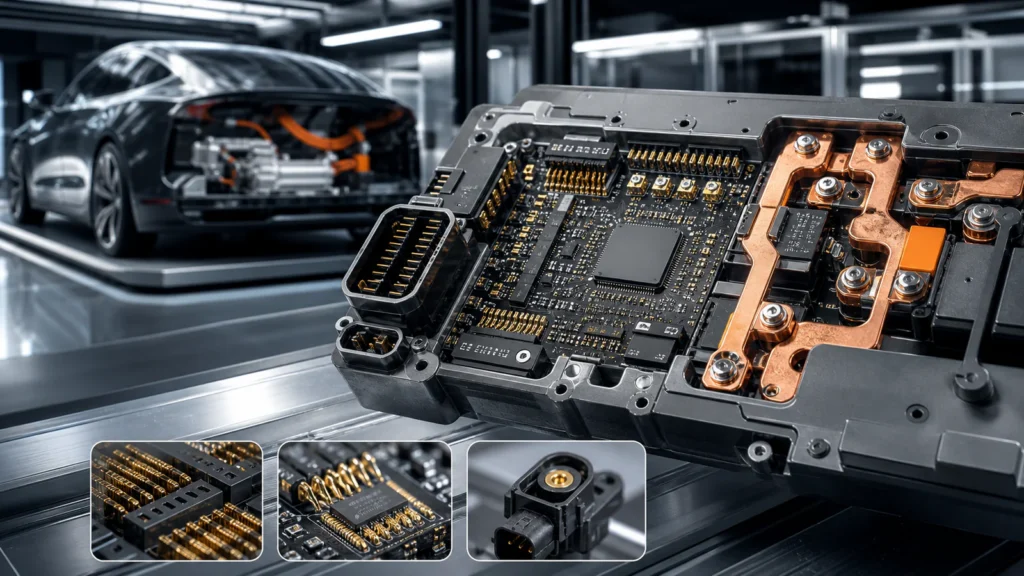
- Gold usually appears as micrometre-scale plating or fine electronic interconnects.
- Its value comes from corrosion resistance and dependable low-level contact performance.
- Copper, aluminum, silver and tin carry most bulk electrical and thermal loads.
- Vehicle electronics growth can support gold demand while manufacturers simultaneously thrift and substitute.
- Recycling recovers mixed precious-metal streams; it is not normally an “EV gold” process.
Small mass, high consequence
An EV does not need a gold battery. It needs thousands of connections and semiconductor functions to survive vibration, temperature cycling, humidity and years of operation. Engineers reserve gold for interfaces where a thin, stable surface can prevent a disproportionately expensive failure.
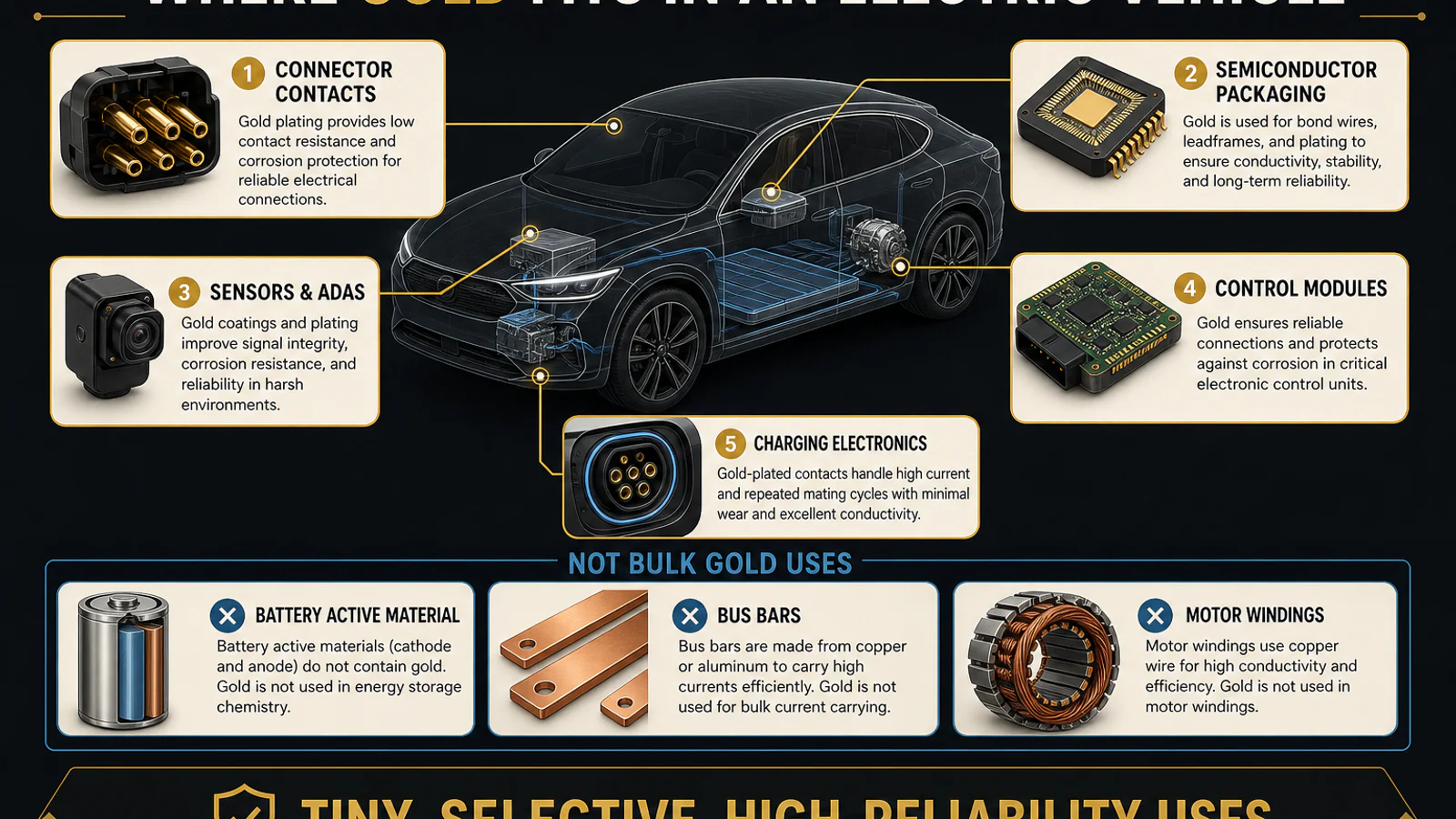
Where gold can appear in an EV
| Application | Typical form of gold | Why it may be chosen |
|---|---|---|
| Connector contacts | Selective thin plating over nickel and copper alloy | Low contact resistance, corrosion protection and mating reliability. |
| Semiconductor packages | Bond wire, bumps, die attach or plated surfaces depending on design | Stable interconnects and mature packaging processes. |
| Sensors and ADAS | Contact plating and package interconnects | Reliable low-level signals in harsh automotive environments. |
| Control modules | Board finishes, connectors and semiconductor content | Long service life across power, safety and body electronics. |
| Charging electronics | Selected signal and power-control contacts | Repeated mating, monitoring and communication reliability. |
Gold-plated contacts: the most visible role
Connector manufacturers use gold selectively on the contact interface rather than coating the entire terminal. A nickel underplate can act as a diffusion barrier over a copper alloy. The gold surface resists oxidation and supports repeatable low contact resistance, especially in low-voltage signal circuits where a small film can disrupt communication.
TE Connectivity’s automotive contact guidance shows that terminals are specified as systems: base material, plating, contact force, current, temperature and mating cycles all matter. “Gold-plated” does not state thickness, area or performance class.
Semiconductor packaging and bond wires
Power-control, battery-management, infotainment, sensor and driver-assistance systems use many semiconductor packages. Gold has a long history in bond wires and package surfaces because it is conductive, corrosion-resistant and compatible with established assembly processes. Copper and aluminum wires, flip-chip connections and other metallization systems also compete strongly on cost and performance.
Do not assume every chip contains a visible gold wire. Package type, fab process, reliability qualification and supplier determine the interconnect. The correct statement is that semiconductor content creates potential high-reliability gold applications, not a fixed gold mass per chip.
Sensors, ADAS and control modules
EVs add battery monitoring, thermal management, inverters, charging control and high-voltage safety functions. ADAS and connected features add cameras, radar, communication and processing. Gold can appear at selected connector and package interfaces across these systems. The same applications also exist in modern combustion and hybrid vehicles, so electrification is not the only demand driver.
Where gold is not the bulk material
| EV subsystem | Dominant material logic | Gold reality |
|---|---|---|
| Battery active material | Lithium, nickel, manganese, cobalt, iron-phosphate, graphite and other chemistries | Gold is not a standard bulk cathode or anode ingredient. |
| Busbars and cables | Copper or aluminum carry high current economically | Gold may protect a small interface, not replace the conductor mass. |
| Motor windings | Copper, with some aluminum development | Gold is far too costly for bulk winding use. |
| Thermal structure | Aluminum, copper, steels and engineered interfaces | Gold is not a bulk heat-spreader choice. |
This distinction matters for both SEO and investment claims. A photo of gold-colored contacts does not mean the traction battery “contains gold” in the commodity sense.
Why there is no universal grams-per-EV number
A mass estimate requires the bill of materials, number and type of connectors, plated surface area, plating thickness, density, package designs and manufacturing scrap. Vehicles differ by platform, trim, battery architecture, ADAS level and supplier. A fleet-average estimate also changes when a manufacturer thrifts plating or shifts from gold to tin, silver, palladium-nickel, copper wire or another system.
If a hypothetical contact has 20 mm² of selectively plated area and 0.5 µm coating thickness, the gold volume is 0.01 mm³. Using gold density near 19.3 mg/mm³, the coating contains about 0.193 mg of gold before process losses. Real contacts vary widely, and hundreds of interfaces do not all use the same finish.
Thrifting and substitution are part of the story
Manufacturers reduce precious-metal use by plating only the mating zone, lowering thickness where qualification permits, improving underplates and redesigning contact geometry. Tin is economical for many power and non-critical connections; silver can handle high current but tarnishes; palladium-nickel with a gold flash is another option; copper wire has replaced gold in many semiconductor packages.
Substitution is not merely “cheaper metal wins.” Engineers evaluate fretting corrosion, galvanic compatibility, temperature, vibration, current, insertion cycles and failure cost. Safety-critical or low-signal interfaces can retain gold even while average use per function declines.
What WGC technology data can tell us
The World Gold Council reported 2025 technology demand of about 322.8 tonnes, including roughly 270.4 tonnes in electronics. In Q1 2026, technology demand was about 81.6 tonnes, with electronics near 69.3 tonnes. Its reports cite growth in AI-related electronics and automotive/EV compound-semiconductor applications alongside continued thrifting.
Those totals cover global technology, not EVs alone. They cannot be converted into a per-vehicle mass without proprietary component-level data. Read them as directional market context with an industry-source caveat.
Recycling: valuable, but mixed and complex
End-of-life vehicle electronics are dismantled, shredded and separated with broader automotive and electronic waste. Precious metals may be concentrated in circuit-board and connector fractions, then recovered through specialized smelting and refining. Economic recovery depends on collection, grade, scale, hazardous-material controls and the combined value of gold, silver, palladium, copper and other metals.
Individual owners should not burn boards or use acids. Use regulated e-waste and vehicle recycling channels. See how gold is extracted from e-waste, gold in electronics and electric conductivity of gold.
A due-diligence checklist for EV-gold claims
- Does the source mean gold plating, bond wire, a bulk metal or a market value?
- Is the claim for one model, an average fleet or all EVs?
- What vehicle year, trim, architecture and component suppliers were measured?
- Was the gold mass measured, modeled from plating specifications or copied from another article?
- Does the number include manufacturing scrap or only metal shipped in the vehicle?
- Are hybrid and combustion electronics being confused with EV-specific content?
- Does the source account for thrifting and substitution?
For physical-property context, compare gold density and whether gold is flammable. These properties explain why gold survives harsh environments but do not by themselves justify a component choice.
Reliability is a system property
A gold finish can still fail if the base metal, underplate, contact force, sealing, cleanliness or mating geometry is wrong. Too-thin coating may wear through; porous plating can expose the substrate; incompatible finishes can accelerate fretting or galvanic problems. Automotive qualification therefore tests the connector system across temperature, vibration, humidity, salt, current and mating cycles.
This also explains why a catalog description cannot be converted directly into fleet demand. One terminal family may offer tin, silver and several gold thicknesses for different cavities and duty cycles.
EV growth does not translate one-for-one into gold growth
Three forces act simultaneously: more vehicles and electronic functions increase the number of potential interfaces; manufacturers thrift precious metal per interface; and alternative materials capture applications when qualification allows. Total demand rises only when volume and complexity outweigh thrifting and substitution.
A useful forecast therefore separates vehicle production, electronic content per vehicle and gold intensity per function. Multiplying EV sales by an unsupported fixed grams figure hides the variable that engineers change most actively.
Public automotive sources describe components and coatings better than total gold mass. Most exact per-EV figures lack model-specific bills of materials, coating area and thickness. A range without architecture and method creates false precision.
Gold’s EV story is not about tonnage hidden in batteries. It is about spending milligrams where the cost of corrosion or signal failure can exceed the value of the entire coating many times over.
This article is educational and not a manufacturing specification, commodity forecast or recycling instruction. Automotive materials vary by supplier and design. Do not dismantle high-voltage systems or chemically process e-waste outside qualified facilities.
Video context This short chemistry explainer summarizes why gold remains useful in electronic contacts. EV engineering still depends on component-level qualification and selective use.
Bottom Line
Electric vehicles use gold selectively in contacts, semiconductor packaging, sensors, control modules and charging electronics. Copper and aluminum carry the bulk power. Demand can grow with electronic complexity even as gold per function falls, so trustworthy analysis focuses on component architecture—not a universal grams-per-car claim.
FAQ: Gold in Electric Vehicles
Do electric-car batteries contain gold?
Gold is not a standard bulk battery active material. It may appear in nearby electronics and connector interfaces, not as the energy-storage metal.
How much gold is in one electric vehicle?
There is no reliable universal figure. Model, electronics content, plating area and thickness, semiconductor packaging and supplier choices vary.
Why are EV connectors gold plated?
Selected contacts use gold for corrosion resistance and stable low-level electrical performance, often over a nickel underplate.
Is there more gold in an EV than a gasoline car?
An EV can have more power and battery-control electronics, but modern combustion and hybrid vehicles also contain extensive electronics. A defensible comparison needs matched models and bills of materials.
Can I recover gold from an old EV myself?
Do not dismantle high-voltage systems or use household chemical recovery. Regulated vehicle and e-waste recyclers aggregate mixed metal streams safely.
Sources and verification
Primary and specialist sources are linked below. Rules, market data and product specifications can change; verify the dated source before acting.
- WGC — Technology Demand FY 2025 — Electronics demand, automotive systems, thrifting and substitution.
- WGC — Technology Demand Q1 2026 — AI and EV semiconductor supply-chain demand.
- WGC — Gold Demand by Sector — Technology and automotive use overview.
- USGS — Mineral Commodity Profiles: Gold — Gold contact reliability and electronics properties.
- TE Connectivity — Connector Contacts FAQ — Gold, nickel and tin plating options for harsh transportation environments.
- TE Connectivity — Solid Contacts — Contact construction, plating and current ranges.
- SAE — Automotive Connector Corrosion Protection — Gold, silver and tin finishes over copper-alloy terminals.
- SAE — Gold-Plated Automotive Connector — Selective multilayer plating and reliability.
- SAE — Automotive Bond Wires — Gold, aluminum and copper bond-wire roles and thermal loads.
- TE Connectivity — EV Charging Guide — Gold- and tin-plated contact options in charging equipment.
 When you purchase a service or a product through our links, we sometimes earn a commission, at no extra cost to you.