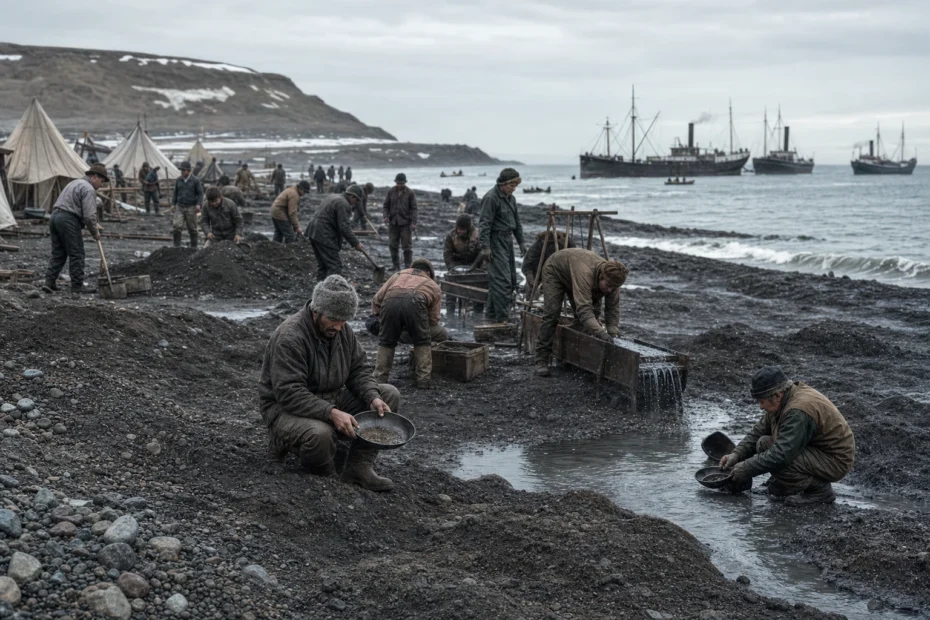
Learn how the Nome Gold Rush moved from Anvil Creek to open beach placers, why 20,000 people arrived in 1900, and how mining and Nome changed.
- The 1898 Anvil Creek strike started the district; beach gold found in 1899 made the 1900 stampede unusually accessible.
- Waves did not create the gold: weathering, streams and repeated shoreline sorting concentrated dense grains into placer layers.
- The rush built Nome but overwhelmed sanitation and services, displaced existing land use, and quickly shifted from hand tools toward capital-intensive mining.
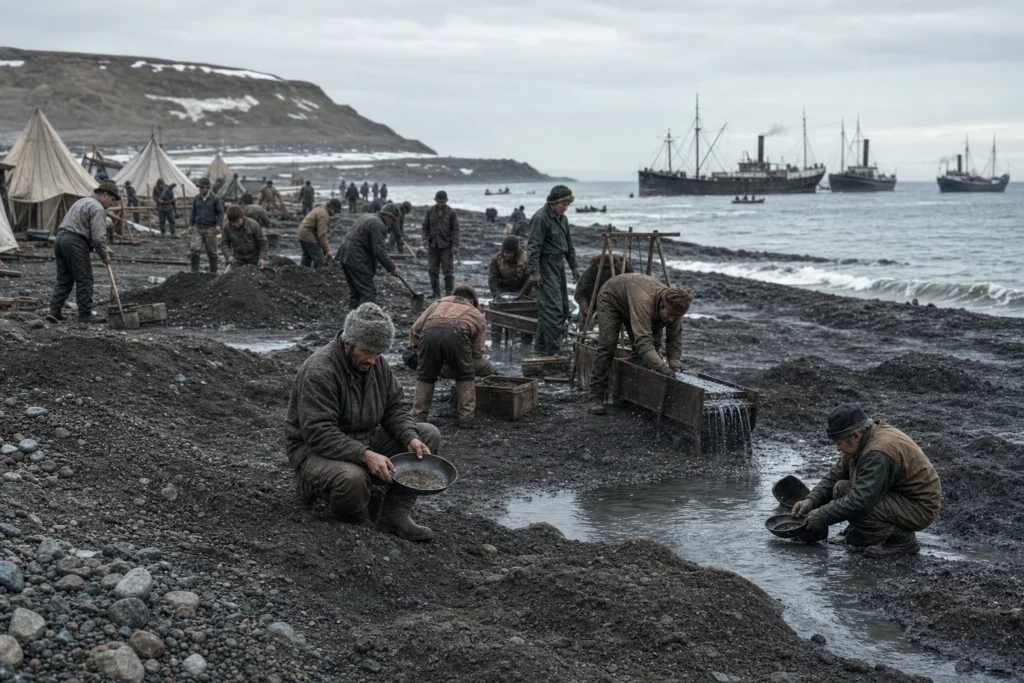
- Anvil Creek started the district; beach gold made Nome internationally famous.
- Gold did not originate in the sea: erosion, streams and shoreline sorting concentrated placer grains.
- Up to about 20,000 people arrived during 1900, overwhelming a town without a protected harbor or adequate services.
- Hand mining gave way to pumps, dredges and buried-beach operations as obvious surface ground declined.
- Iñupiat communities lived in the region long before the rush and experienced its land, labor and social consequences.
Nome turned a shoreline into a goldfield
Nome was unusual among North American gold rushes because newcomers landed directly beside workable placer ground. That proximity created the “poor man’s paradise” image: a shovel, pan or rocker seemed sufficient. The image was partly true for a short window—and dangerously incomplete as a plan.
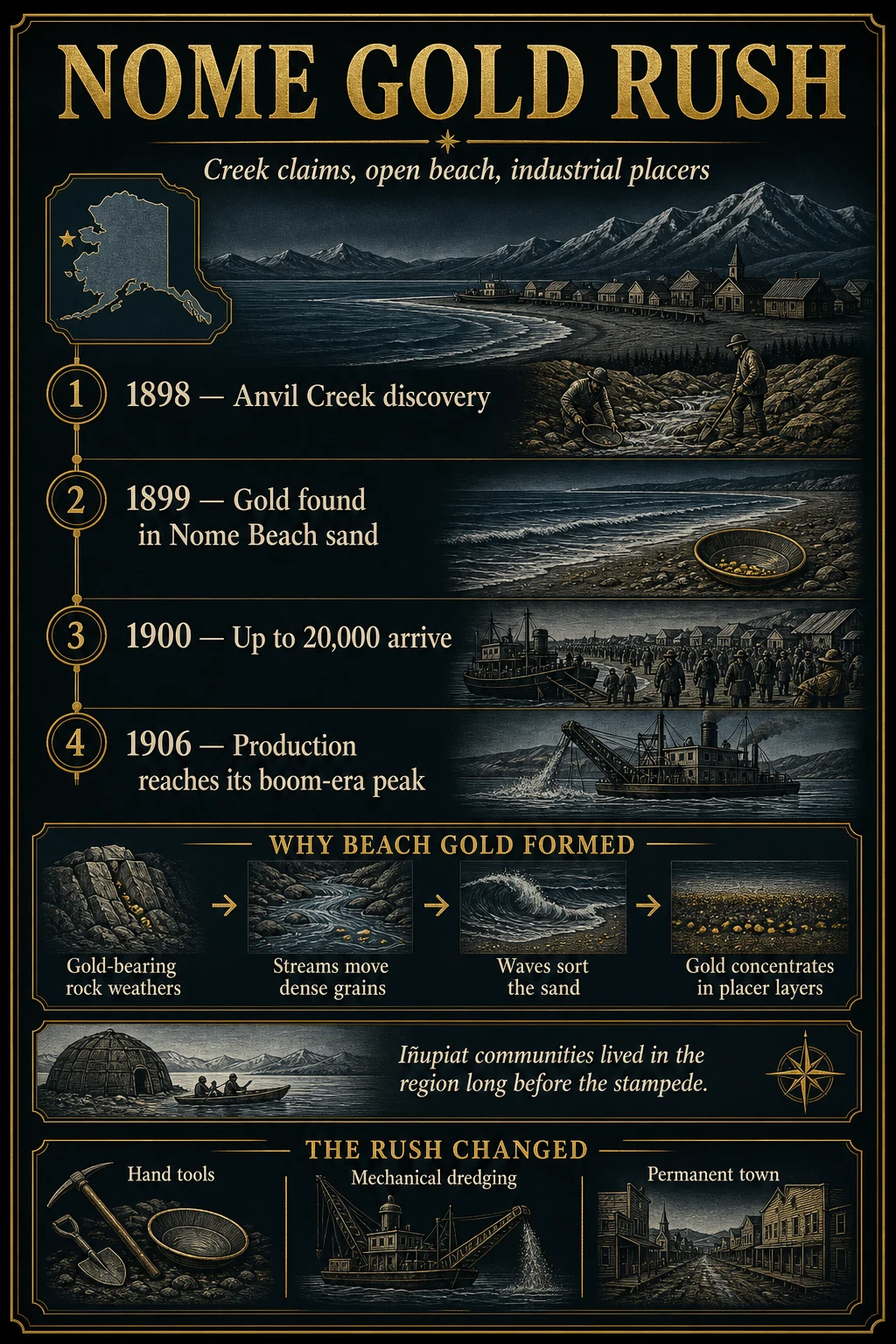
Nome Gold Rush timeline
| Date | Event | What changed |
|---|---|---|
| September 1898 | Jafet Lindeberg, Erik Lindblom and John Brynteson located rich placer ground at Anvil Creek and nearby tributaries. | Claim-based creek mining created the Cape Nome district. |
| 1899 | Gold was found in beach sand at Nome. | The beach’s open-access character reduced the immediate claim barrier and broadened participation. |
| Summer 1900 | Up to about 20,000 people arrived by ship. | Population, tents, freight and waste overwhelmed local capacity; many arrived underprepared. |
| 1900s | Miners pursued richer creek, ancient-beach and buried placer deposits with larger equipment. | Capital and mechanization increasingly replaced simple hand recovery. |
| 1906 | Boom-era production reached a peak according to the NPS landmark summary. | Nome persisted as a mining center even as the mass stampede faded. |
What was discovered at Anvil Creek?
The “Three Lucky Swedes” label refers to Lindeberg, Lindblom and Brynteson, although Lindeberg was Norwegian-born. Their 1898 Anvil Creek discovery was the first large placer strike in Alaska proper, according to the National Park Service. Creek claims could be located and controlled under mining law, which made ownership and claim jumping central issues.
The discovery story should not imply that the Seward Peninsula was unknown or unoccupied. Iñupiat communities had lived, traveled, hunted and traded across the region for generations. Outsider mining records recognize a legal “discovery” because it triggered a settler claim system; they do not mark the beginning of human knowledge of the landscape.
Why was there gold on Nome Beach?
Gold is dense and resistant to weathering. Mineralized rock in the surrounding region broke down, streams transported released grains, and repeated erosion and sediment movement concentrated the heavy particles. Shoreline waves and currents then sorted sand and gravel, creating placer layers. Some of the richest later ground lay in raised or buried ancient beaches inland.
An early USGS report on Cape Nome directly corrected the idea that waves continuously brought gold up from the deep ocean. The beach deposits were largely a reconcentration of gold-bearing land sediments. That distinction remains useful when modern marketing suggests the sea is generating or endlessly replenishing an easy resource.
Why the open beach changed the rush
A rich creek claim could be privately controlled. The tideland and active beach were harder to monopolize under ordinary claim practice, so thousands could work side by side. This access reduced one barrier but did not equalize outcomes. Productive streaks were narrow, waves shifted sand, tools differed, and miners still needed food, shelter, transport and time.
The beach also defused some pressure created by claim concentration and claim jumping. Yet Nome remained entangled in court corruption, disputed titles and political maneuvering. Alexander McKenzie became infamous for attempts to use federal receivership and a compromised judicial process to control valuable claims. The lesson is broader than one scandal: a rush creates legal rents wherever uncertain titles meet valuable ground.
The 1900 logistics crisis
Nome had no protected deepwater harbor. Ships anchored offshore, and passengers and freight crossed surf in small boats or makeshift systems. Thousands arrived in a brief ice-free season. Tents spread along the beach, drinking water and sanitation were inadequate, prices were high, and the return window was short.
The Alaska DGGS research summary notes that many poorly equipped arrivals became destitute and that the Army helped rescue people before winter. “Anyone could mine the beach” was not the same as “anyone could survive long enough to profit.”
From pans to dredges
Early beach workers used shovels, pans, rockers and small sluices. As surface concentrations declined and richer deposits were found below tundra or in ancient beach layers, mining required pumps, thawing, excavation and larger washing plants. Dredges and other mechanical systems increased throughput but demanded capital and technical management.
This is the classic placer sequence: easy-to-reach ground attracts individuals; depletion and geological learning direct attention to deeper or lower-grade material; machinery and finance consolidate production. GoldConsul’s guides to underwater gold mining, Alaska gold-mining history and gold mining methods explain the modern distinctions.
Nome was not simply a Klondike sequel
Klondike veterans and northern prospectors carried experience into Nome, but the geography differed. The Klondike required a difficult overland route and centered on inland creek claims. Nome could be reached by sea, and the beach lay at the landing point. That accessibility increased the speed and social range of the stampede.
For comparison, read the Klondike Gold Rush, the Black Hills Gold Rush, the Pikes Peak Gold Rush and GoldConsul’s guide to how miners staked claims.
How to evaluate a Nome gold claim today
- Identify active beach, raised beach, buried beach, creek placer or offshore sediment.
- Separate historical production from a modern recoverable-resource estimate.
- Ask whether the gold is coarse, fine or “flour” gold and how recovery efficiency was measured.
- Verify land status, permits, claim rights and equipment restrictions; historic access does not define current law.
- Include weather, mobilization, fuel, maintenance, reclamation and recovery losses in any economic claim.
This is historical education, not permission to mine. Modern Nome-area mining may involve state leases, claims, permits, environmental rules, equipment limits and private or Indigenous rights. Verify current agencies and title before disturbing sediment.
Video context: A concise visual history of Nome and the gold-rush identity that continued after 1900
Knowledge Gap and Editorial Perspective
Historical dollar-output totals often use contemporary gold prices and different geographic boundaries. They should not be converted to modern dollars without separating physical ounces, price level, production costs and district definitions. “Nome” may mean the town beach, the wider district or the Seward Peninsula.
Nome’s enduring lesson is not that beach gold was easy. It is that access and economics are different questions. The open beach widened participation for a moment; Arctic logistics and later mechanization quickly restored strong advantages to better-capitalized operators.
Bottom Line
The Nome Gold Rush moved from 1898 creek claims to 1899 open beach placers and a huge 1900 maritime influx. Its geology explains the gold; its logistics explain the hardship; and its rapid mechanization explains why the hand-mining window did not last.
FAQ: Nome Gold Rush
When was the Nome Gold Rush?
The district began with the 1898 Anvil Creek discovery. Beach gold was found in 1899, the largest stampede arrived in 1900, and boom-era mining continued through the following decade.
Why was gold found on Nome Beach?
Weathering released gold from mineralized rock, streams transported it, and waves repeatedly sorted dense gold grains into placer layers in active and ancient beaches.
Who discovered gold at Nome?
Jafet Lindeberg, Erik Lindblom and John Brynteson located the important 1898 Anvil Creek claims. The familiar “Three Lucky Swedes” nickname is imprecise because Lindeberg was Norwegian-born.
Could anyone mine the beach?
The active beach was unusually open compared with privately claimed creeks, which allowed broad participation. Access did not guarantee productive ground, legal rights outside the beach or economic success.
Is gold still mined at Nome?
Yes, placer mining has continued in the wider Nome district, including offshore activity. Modern operations are governed by current leases, claims, permits and equipment rules—not 1900 practices.
Sources and verification
The dates, physical values and evidence boundaries in this guide are based on the following primary or specialist sources.
- NPS — Cape Nome Mining District Discovery Sites — Official timeline for Anvil Creek, beach gold and the 1900 stampede.
- NPS — The Stampede North — Federal history of the Alaska gold rush landmarks and Nome discovery sites.
- USGS — Gold in Placer Deposits — Explains placer formation and Nome district production from raised beaches.
- USGS — Preliminary Report on Cape Nome Gold Region — Early scientific explanation that beach gold came from reconcentrated land-derived sediments.
- Alaska DGGS — A History of the Nome Gold Rush — Research summary on claim conflict, the open beach and the 1900 crisis.
- Alaska DNR — Nome history — State historical context for the city and discovery sites.
- Discovery — History of Nome — Visual overview of Nome and its continuing gold-mining identity.
 When you purchase a service or a product through our links, we sometimes earn a commission, at no extra cost to you.