
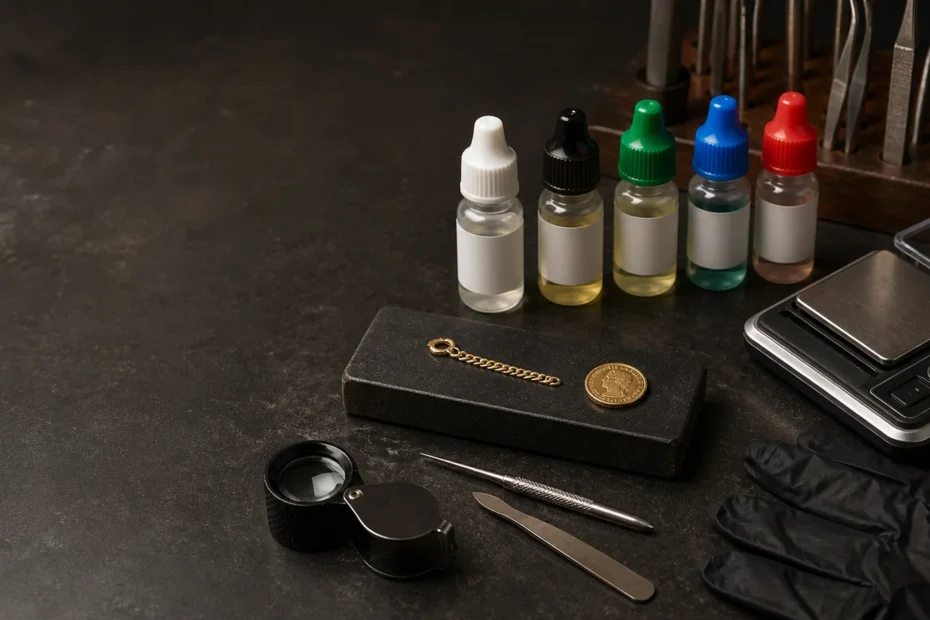
Compare gold testing kits by method, safety and limits. Choose the right setup for jewelry, coins or scrap without trusting one test alone.
- Match the kit to screening, karat checks, or mixed jewelry
- Acids require technique, ventilation, gloves, and safe storage
- No home kit replaces professional verification for high-value gold
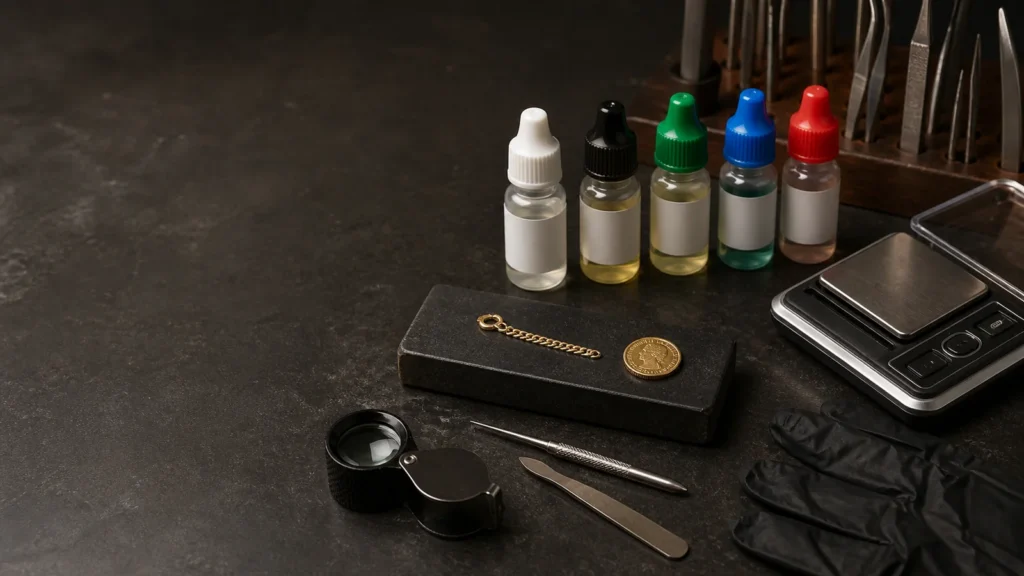
For most careful beginners, a complete touchstone-and-acid kit offers the clearest karat screening at modest cost. Choose a mixed electronic kit only when you also need stone screening, and treat every home result as one signal rather than final authentication.
See the top pick on Amazon →GTE Precious Metal Jewelry Testing Kit

GTE Precious Metal Jewelry Testing Kit
Best for: A first complete acid-testing setup with several karat solutions, touchstone, loupe and storage box.
Avoid if: You want a no-chemicals workflow or plan to test valuable finished jewelry without learning safe technique.
Verify before buying: Confirm the included solution range, bottle condition, safety instructions and current seller before ordering.

Gold, Silver and Platinum Appraisal Kit
Best for: Frequent hobby screening across several precious-metal claims and a broader karat range.
Avoid if: You only need an occasional visual or weight check and do not want consumable acids.
Verify before buying: Check the exact included acids, stone, storage and protective equipment; listing bundles can change.

GTE Mixed Jewelry Purity Testing Kit
Best for: A mixed jewelry workflow that also screens diamond, moissanite and gemstone claims.
Avoid if: Your only question is gold karat; the additional tester adds complexity without authenticating the metal.
Verify before buying: Treat stone and metal functions separately and confirm calibration, batteries and included acids.
What a Good Gold Testing Kit Must Include
A useful kit is a controlled testing system, not simply several small bottles. For a touchstone workflow, look for clearly identified solutions covering the karats you expect, a clean stone, a loupe, a file used only when appropriate, secure upright storage and instructions that explain control samples.
- Readable labels: never rely on cap color alone.
- Relevant karat range: 10K, 14K, 18K and 22K cover many jewelry questions.
- Suitable stone: enough surface for separate, traceable streaks.
- Safe storage: upright, closed and inaccessible to children or pets.
- Replaceable consumables: reagents age and contaminated droppers mislead.
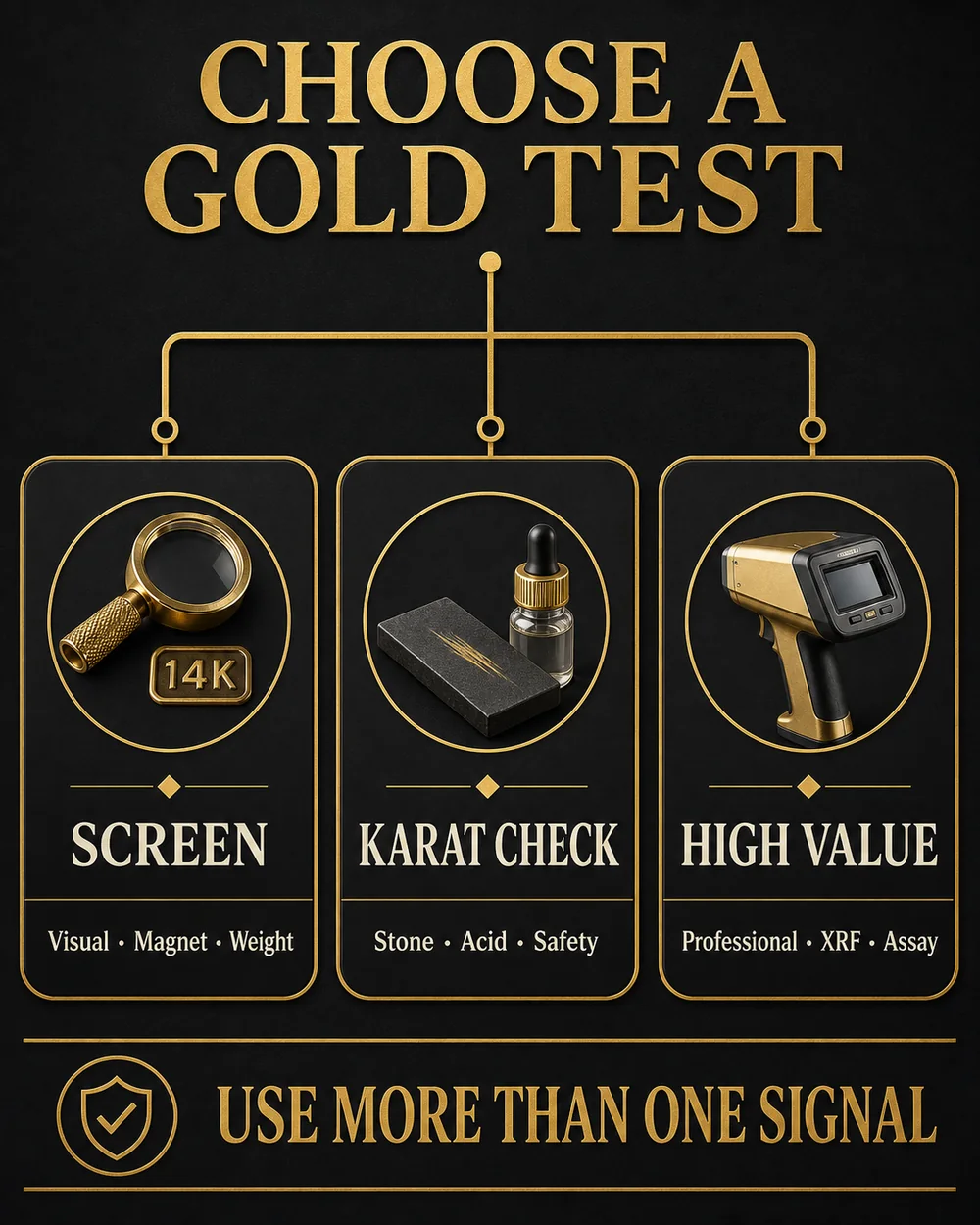
Acid, Electronic, or Professional Testing?
| Method | Useful for | Main limit | Best next step |
|---|---|---|---|
| Visual, mark, magnet, weight | Fast initial screening | Cannot prove karat or rule out plated construction | Compare listing and measurements |
| Touchstone and acid | Approximate karat resistance | Technique, reagent condition and surface construction matter | Use controls and more than one solution |
| Electronic tester | Fast repeated screening | Calibration and alloy/surface effects | Confirm questionable results independently |
| XRF or assay | Higher-value professional decisions | Cost and access; surface XRF still needs interpretation | Use a qualified independent provider |
Safety Comes Before Accuracy
Testing acids are corrosive chemicals. Read the specific safety data and manufacturer instructions before opening a bottle, work in an appropriate ventilated area, use compatible eye and hand protection and keep neutralization and spill procedures ready.
Never drip unknown acid directly onto a finished piece, and do not file through a surface unless you accept permanent damage. A jeweler or qualified tester is the better choice for sentimental, antique or high-value items.
How to Get More Reliable Results
- Photograph the marks and piece before testing.
- Check weight and dimensions against documented specifications.
- Clean the touchstone and prevent cross-contamination.
- Test known control samples before an unknown item.
- Use progressively appropriate solutions and record reactions.
- Escalate any mismatch instead of forcing a confident conclusion.
Our gold purity testing guide explains each method in depth. Use the gold purity calculator for the math, then compare the physical item with the documented claim.
Which Kit Fits the Item You Are Testing?
Inherited jewelry creates a different risk from scrap purchased for resale. A beginner examining one family ring may need only careful documentation, a scale and a jeweler visit. A hobby buyer sorting many low-value pieces can justify learning a repeatable touchstone workflow.
Coins and bars require another distinction. Acid can permanently damage a collectible surface and reduce resale trust. Use non-destructive dimensions, weight and known specifications first, then escalate to professional equipment rather than treating a general jewelry kit as universal.
Common Gold Testing Kit Mistakes
- Assuming a 14K stamp validates every component and solder joint.
- Testing only the surface of a plated or gold-filled object.
- Using expired or contaminated solution without a known control.
- Comparing streak colors under inconsistent lighting.
- Filing a finished or collectible piece before considering the damage.
- Calling a borderline reaction a precise karat result.
Delivery-Day Inspection
Open the package over a protected surface and check every bottle for leakage, unclear labeling or a damaged seal. Verify that the stone, dropper, loupe and any file match the saved listing. Photograph problems before handling the contents further.
Read the safety data before the first test. Keep bottles upright in the supplied storage, separate incompatible chemicals and do not transfer them into food or drink containers. If the listing lacks adequate hazard instructions, return the kit rather than inventing a procedure.
When the Kit Is Not Worth Buying
Skip a home kit when you have one valuable object, cannot provide safe chemical storage or need a result accepted by an insurer, buyer or estate. Paying an independent professional can be cheaper than purchasing consumables, learning the method and accepting the risk of damage.
A kit becomes more reasonable when you screen multiple lower-value items, can practice with known samples and understand that doubtful results still require escalation. The purchase should reduce uncertainty—not create false confidence.
Buy the simplest kit that answers your real question and that you can use safely. The strongest workflow combines documentation, measurements and an independent test rather than treating any bottle, stamp or device as proof.
FAQ: Best Gold Testing Kits
What is the best gold testing kit for beginners?
A complete, clearly labeled acid kit with a touchstone, several common karat solutions, safety instructions and secure storage is the most useful starting point for people prepared to handle acids safely.
Can a gold testing kit prove jewelry is real?
No single kit proves every part of a piece. Plating, solder, hollow construction and mixed components can mislead surface tests. Combine marks, weight, dimensions, seller evidence and professional testing when value is meaningful.
Does acid testing damage gold?
A touchstone method transfers a small streak to the stone, but poor technique, direct application or filing can mark a finished piece. Avoid destructive tests on sentimental or valuable jewelry.
Are electronic gold testers better than acid kits?
They are faster and avoid liquid acid at the test point, but they cost more, need calibration and can still be misled by surfaces and unusual alloys. Professionals often combine methods.
How long do gold testing acids last?
Age, heat, contamination and poor storage can weaken reagents. Follow the manufacturer date and storage guidance, and replace a solution when control samples no longer react consistently.
Sources
 When you purchase a service or a product through our links, we sometimes earn a commission, at no extra cost to you.