
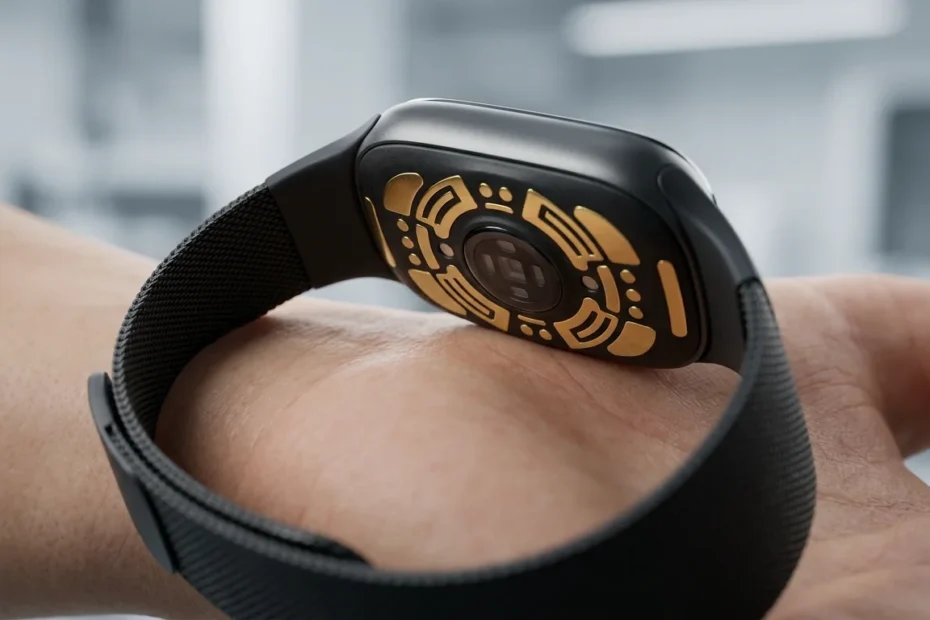
Gold in wearable health tech is not mainly about premium styling. Its real value is engineering value.
In advanced wearables, gold shows up because it conducts electricity well, resists corrosion, works reliably at the skin interface, and can be integrated into very small sensing structures. That makes it useful in biosensors, flexible electrodes, and signal-critical health-monitoring systems.
TL;DR
- Gold is used in wearable health tech less for luxury and more for conductivity, corrosion resistance, and stable sensing performance.
- It often appears in electrodes, nanowires, and sensor interfaces rather than as a visible outer-shell material.
- Gold helps with signal quality and skin-facing durability, but it does not solve the full cost, battery, or manufacturing challenge of wearables.
- The key distinction is between gold-colored consumer wearables and wearables that actually use gold as a functional health-tech material.
What Most Readers Miss
Most articles on this topic blend two very different stories: gold as a premium design finish, and gold as a functional material inside sensors. That creates confusion.
Gold-tone rings and watches are mostly about appearance, branding, and perceived luxury.
Gold electrodes and nanostructures are about signal stability, biocompatibility, and wearable sensing performance.
If you want to understand the technology, ask where gold sits in the sensing stack, not whether the device simply looks expensive.
How Gold Is Used in Wearable Health Tech
Gold is used in wearable health technology because it solves several materials problems at once. It offers high electrical conductivity, strong corrosion resistance, and stable behavior in small-scale interfaces that touch skin, fluids, or signal-processing layers.
That makes gold attractive in wearable systems that need reliable performance over repeated bending, sweating, washing, or long-term contact. Research on wearable patches and conductive systems published through sources like PubMed shows why gold nanowire and gold-enabled architectures keep appearing in health-monitoring prototypes and applied sensor work.
This does not mean the entire wearable is made of gold. In most cases, gold is concentrated in the parts where electrical stability matters most.
The GoldConsul Editorial Perspective
Gold matters in wearables when failure at the sensing interface is expensive. Engineers are not choosing it to make a device look elite. They are choosing it where weak conductivity, corrosion, or unstable skin contact would undermine the data itself.
Why Gold Works So Well at the Sensor Layer
Wearable health devices depend on clean signal capture. If the interface drifts, corrodes, or becomes noisy, the device may still look modern while the readings degrade.
Gold helps because it is chemically stable and electrically reliable. In soft or flexible devices, that stability matters as much as the raw conductivity number.
Recent materials research, including work summarized in ScienceDaily’s report on gold-nanowire wearable systems, highlights how gold-based structures can support continuous monitoring while tolerating movement and deformation more effectively than simpler rigid configurations.
Chart 1: Why Engineers Reach for Gold in Wearable Sensors
Conceptual advantage score for skin-facing and signal-critical wearable applications. Higher means stronger engineering fit in that category.
Chart 1 interpretation: Gold is rarely the cheapest answer. It stays in the conversation because the sensing and durability benefits can outweigh cost in the most critical layers.
What The Top Ranking Pages Still Miss (Knowledge Gap)
The common content gap is that articles talk about gold in wearables as if it is mainly a status signal. That misses the more useful technical story:
- gold electrodes help preserve signal quality at the interface
- gold nanowires can support flexible and stretch-aware sensing systems
- gold-coated components may improve durability in high-contact or high-moisture conditions
- gold does not replace full-system design; it only improves certain failure-sensitive layers
Where Gold Actually Shows Up in Wearable Health Systems
Gold may appear in several places inside a health-monitoring wearable. The most important use cases are usually electrical, not decorative.
| Wearable component | How gold is used | Why it matters |
|---|---|---|
| Electrodes | Gold can be used in skin-contact electrical interfaces | Supports stable readings and reduces corrosion-related drift |
| Nanowire sensor layers | Gold nanowires can be integrated into flexible sensing structures | Helps combine conductivity with movement tolerance |
| Biosensor surfaces | Gold can act as a functional surface for biochemical sensing interactions | Useful in high-sensitivity measurement environments |
| Interconnects / critical traces | Gold may be used where signal reliability matters most | Reduces degradation risk in compact architectures |
This is why the topic overlaps with a broader GoldConsul theme: gold often earns its place in advanced systems where failure costs are high. That logic shows up in other applied-tech areas too, not only consumer wearables.
Gold as Functional Material vs Gold as Luxury Finish
This distinction matters because many readers picture smart rings, watches, or health bands with gold-colored bodies. That is mostly an exterior design question.
The deeper technical story is different. Gold inside a wearable is often invisible to the user. It may be in the electrode path, the sensing film, or the nanostructured interface that captures data.
In other words, “gold in wearable health tech” can mean real engineering use even when the consumer never sees a gold surface. Research work discussed in sources like ScienceDirect’s cardiac-monitoring wearable study makes that distinction much clearer than generic trend pieces usually do.
| Question | Luxury finish answer | Functional gold answer | Reader takeaway |
|---|---|---|---|
| Why is gold present? | Brand / aesthetics | Signal + durability role | Do not confuse styling with engineering |
| Does it improve health data? | Usually no | Potentially yes | Function depends on placement in the sensing stack |
| Is the cost justified? | Subjective | Sometimes | Justification is technical, not cosmetic |
Chart 2 interpretation: The visible “gold wearable” narrative is often the least important one. The real value appears when gold improves the sensing path, not the marketing finish.
What Gold Does Not Solve in Wearable Health Tech
Gold improves some of the hardest interface problems in wearables. It does not solve everything.
It does not eliminate battery constraints, manufacturing cost pressure, data-interpretation limits, or regulatory hurdles. A gold-enabled sensor can still fail commercially if the full device is uncomfortable, too expensive, or hard to scale.
This is where many overhyped articles fall apart. They describe gold as if it turns a prototype into a finished product. In reality, it only strengthens the parts of the system where its material advantages are relevant.
Chart 3: Where Gold Helps vs Where It Does Not
Conceptual role map across the wearable stack.
Chart 3 interpretation: Gold is best understood as a high-value specialist material. It can improve performance-critical layers, but it is not a universal answer to wearable product design.
What This Means for Readers Evaluating the Trend
If you are reading about gold in wearable health tech, the first question should be: is the article talking about visible luxury styling or hidden functional materials?
If it is the second, then gold’s role can be technically meaningful. If it is only the first, the article is probably discussing product positioning more than health-tech performance.
That distinction is useful whether you are an investor, a technology reader, or someone watching how precious metals move into advanced applied systems. Gold in this setting is less about ornament and more about reliability where data quality matters.
Reader Decision Checklist
- Ask where the gold is: coating, casing, electrode, nanowire, or sensor interface are not the same thing.
- Ask what problem it solves: conductivity, corrosion resistance, skin contact stability, or merely product branding.
- Separate prototype from product: research success does not automatically mean consumer scalability.
- Watch for overstatement: gold can improve sensing performance, but it does not remove system-level engineering trade-offs.
This article is educational only and does not constitute medical, engineering, or investment advice. Research examples and prototype studies do not guarantee consumer-device outcomes or commercial viability.
Bottom Line
Gold in wearable health tech matters because it can improve the most failure-sensitive parts of a sensor system. Its value is mainly functional, not cosmetic.
When the article or product discussion is framed correctly, gold is less about “luxury meets wellness” and more about whether the device can maintain stable, repeatable contact and signal quality in the real world.
FAQ: Gold in Wearable Health Tech
Why is gold used in wearable health technology?
Gold is used because it combines conductivity, corrosion resistance, and reliable behavior in small, skin-facing sensing systems. Those traits help improve signal stability in certain wearable devices.
Is gold in wearables mainly for luxury branding?
Sometimes on the exterior, yes. But in serious health-tech applications, gold is often used inside electrodes, nanowires, or sensing interfaces for engineering reasons rather than visual appeal.
Does a gold-colored wearable mean it uses real gold functionally?
No. A gold-colored finish may be purely cosmetic. Functional gold use depends on whether the device includes gold in sensor-critical layers or electrical interfaces.
What health-tech components benefit most from gold?
Electrodes, conductive sensor layers, nanowire systems, and certain biosensor surfaces are the most common examples where gold can provide practical performance benefits.
Does gold solve all wearable-device problems?
No. It can improve sensing reliability and material stability in targeted areas, but it does not fix battery limits, cost pressure, comfort issues, or commercialization challenges on its own.
 When you purchase a service or a product through our links, we sometimes earn a commission, at no extra cost to you.