
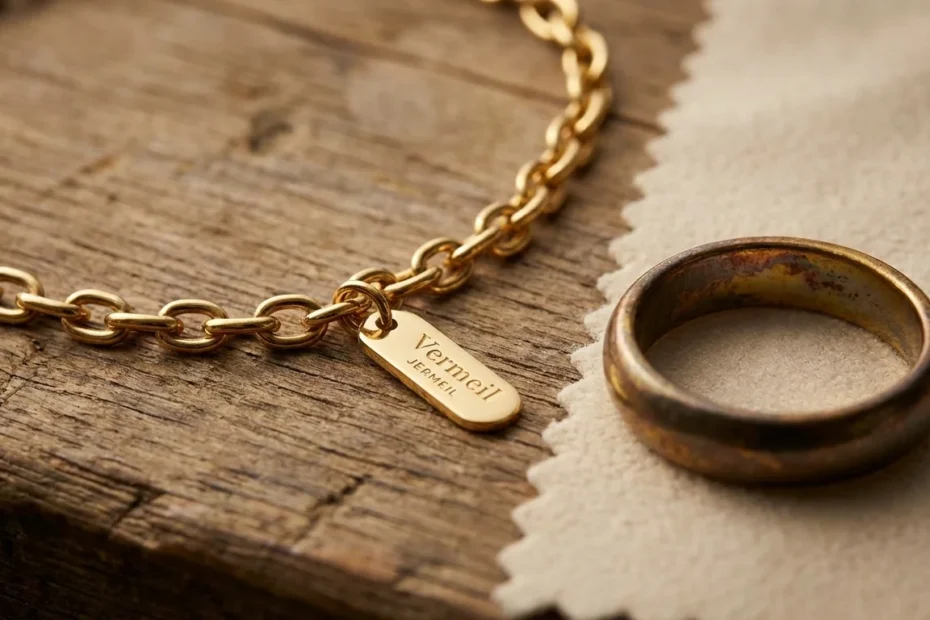
Gold vermeil can tarnish, but the more important buyer reality is that most disappointment comes from wear-through, fading, and base-metal exposure rather than the gold itself suddenly “going bad.”
If you understand how thick the plating is, where the piece will rub, and how often you plan to wear it, gold vermeil can be a smart buy. If you expect daily ring-level durability, it often becomes false economy.
TL;DR
- Gold vermeil can tarnish over time, but buyers often confuse tarnish with fading or plating wear.
- Vermeil uses sterling silver as the base, so once the gold layer thins, silver behavior starts to matter.
- Earrings and pendants usually last much better than rings, bracelets, and heavily rubbed pieces.
- If you want everyday durability, gold-filled or solid gold is often the better long-term buy.
Does Gold Vermeil Tarnish? The Direct Answer
Yes, gold vermeil can tarnish over time, but that answer needs context. Under U.S. jewelry guidance, vermeil generally means gold over sterling silver, with stricter quality expectations than basic flash plating.
The FTC jewelry guidance on vermeil matters because it helps separate actual vermeil from low-grade gold-tone jewelry that wears out much faster.
In practice, shoppers usually notice one of three things: surface dullness, color fading, or obvious wear-through at high-friction spots. Those are not the same problem, and treating them as one generic “tarnish” issue is where most buying advice goes wrong.
Chart 1: Tarnish vs Fading vs Wear-Through
These three outcomes get mixed together, even though they mean different things for repairability and resale:
Interpretation: buyers usually blame “tarnish” when the bigger issue is that the gold layer has worn thin in the wrong use case.
What Most Buyers Miss
Gold vermeil is not automatically a bad category. It becomes a bad buy when shoppers use it like solid gold, especially in rings, stackers, and everyday friction-heavy pieces.
Why Gold Vermeil Behaves This Way
Gold vermeil is built on sterling silver, not a cheap mystery base metal. That is a real quality advantage over standard gold-plated fashion jewelry. The downside is that vermeil is still surface-dependent.
Once enough abrasion, sweat, soap, lotion, or cleaning friction hits the piece, the outer gold layer weakens and the sterling base begins to influence appearance.
That is why buyer education matters more than marketing language. Retail explainers such as Mejuri’s care guide and category pages such as Helzberg’s vermeil comparison are more useful than generic listicles because they at least acknowledge wear patterns and care limits.
Chart 2: Which Jewelry Types Hold Up Best?
Illustrative durability profile by item type:
Interpretation: the same vermeil quality can feel durable in earrings and disappointing in rings because the friction profile is completely different.
The GoldConsul Editorial Perspective
Most buyers do not lose money on gold vermeil because the category is fake. They lose money because they choose vermeil for the wrong wear pattern and then expect solid-gold behavior from a plated surface.
Knowledge Gap: “Tarnish” Is Often a Consumer Vocabulary Problem
Many readers say “tarnish” when they actually mean one of three separate outcomes. That matters because the fix and the buying lesson are different.
- Tarnish: surface dullness or discoloration, often still somewhat recoverable.
- Fading: the yellow tone loses visual richness before the piece is structurally compromised.
- Wear-through: the gold layer is thin enough that the underlying silver starts showing at edges or high-contact points.
Practical Lifespan: How Long Does Gold Vermeil Last?
There is no honest universal number, because lifespan depends more on use case than brochure claims. A carefully worn pendant can still look good after years. A ring exposed to handwashing, lotion, sanitizer, desk contact, and stacking friction may look tired much sooner.
| Piece Type | Typical Outcome | Buyer Takeaway |
|---|---|---|
| Pendant | Usually ages well if kept dry and cleaned gently | Good use case for vermeil |
| Earrings | Often solid value because contact is limited | One of the safest categories |
| Bracelet | Moderate wear, especially at clasp and underside | Buy only if wear is occasional |
| Ring | Fastest disappointment risk under daily use | Often better to upgrade material |
What Speeds Up Tarnish and Wear?
The biggest killers are friction, moisture, skin oils, perfume, lotion, sunscreen, and repeated cleaning pressure. Daily contact points matter more than abstract purity discussions.
If you already care about long-term jewelry behavior, it also helps to compare with does 18k gold tarnish, does 14k gold tarnish, and how to clean gold chains.
- Handwashing and sanitizer: especially destructive for rings.
- Stacking and rubbing: edges and contact points wear first.
- Aggressive polishing: over-cleaning can remove surface life faster.
- Storage mistakes: humidity and friction in mixed jewelry piles accelerate decline.
Chart 3: Vermeil vs Gold-Filled vs Solid Gold
Decision framework for durability and long-term value:
Interpretation: vermeil wins on style-per-dollar, but it is not usually the best answer for high-friction everyday wear.
When Gold Vermeil Is a Smart Buy
- You want the look of gold in earrings, pendants, or occasion pieces.
- You understand that maintenance and gentle wear are part of the value equation.
- You care about design and appearance more than bullion-like longevity.
- You are buying from a brand that clearly discloses materials and replating options.
When It Becomes a Bad Buy
- You want one ring to wear daily with handwashing, gym use, and stacking.
- You are buying at a premium price close to entry-level solid gold pieces.
- You expect resale value beyond aesthetic enjoyment.
- You dislike maintenance or know you will wear the piece rough.
For adjacent buying decisions, compare with how to tell if rose gold is real and is white gold magnetic.
Video walkthrough: a quick visual explainer on what gold vermeil is and why expectations matter.
Bottom Line
Gold vermeil can tarnish, fade, and wear through, but the real question is whether it matches your use case. For lower-friction jewelry, it can be a practical and attractive middle ground. For heavy daily wear, especially rings, it is often smarter to buy up once than re-buy repeatedly.
FAQ: Does Gold Vermeil Tarnish?
Does gold vermeil tarnish faster than solid gold?
Can you shower with gold vermeil?
Is gold vermeil better than basic gold-plated jewelry?
Which gold vermeil pieces last the longest?
Can gold vermeil be restored?
 When you purchase a service or a product through our links, we sometimes earn a commission, at no extra cost to you.