
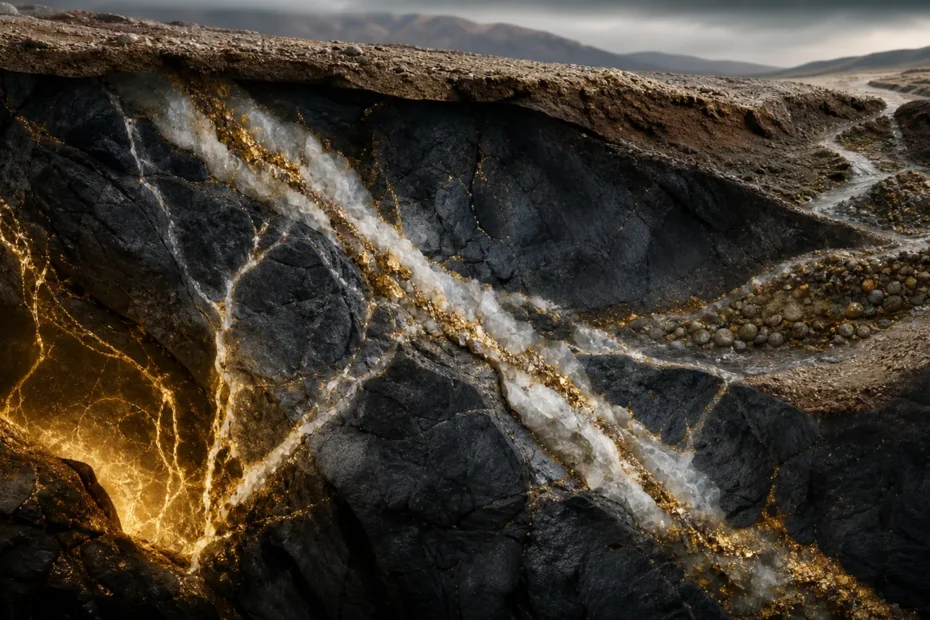
See how gold occurs in the earth, what deposit types matter, and why geology clues, host rocks, and assays are needed before assuming value. safely.
- Most gold is too dispersed to mine until geology concentrates it.
- Learn the difference between vein deposits, altered rock, and placers.
- Beginner clues need geology checks before becoming prospecting claims.
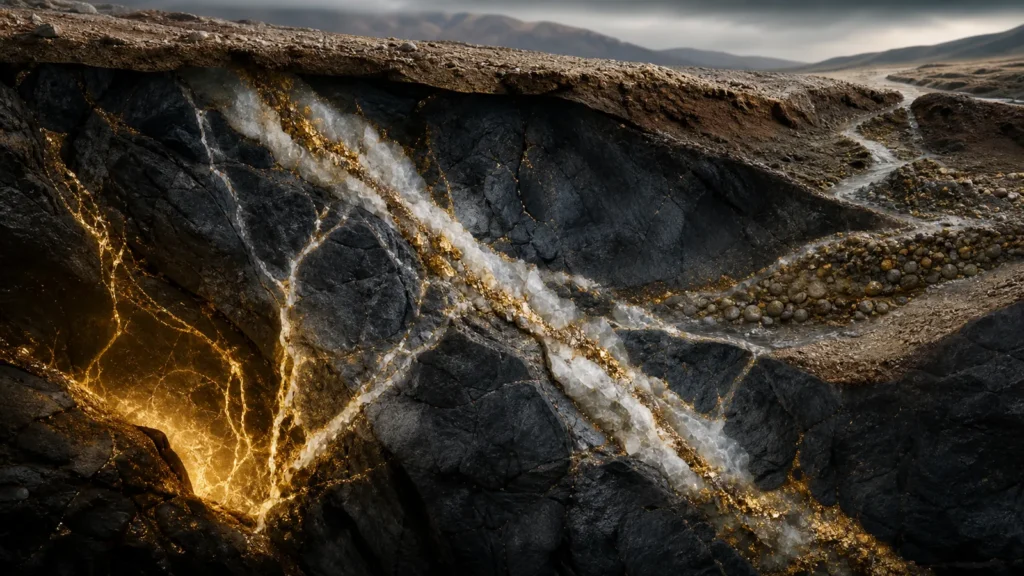
Gold in the earth is not spread evenly like flour in dough. It is scarce, usually microscopic, and only becomes mineable when geology concentrates it into veins, altered rock, river gravels, or ancient sedimentary layers.
This guide explains how gold gets into rock, why it collects in certain places, and what a beginner should look for when learning the difference between a real gold deposit and a hopeful story.
TL;DR: Gold in the Earth
- Most gold is too dispersed to mine; ore deposits form where heat, fluids, pressure, erosion, or sediment sorting concentrate it.
- The two simplest categories are lode gold in bedrock and placer gold moved by water into gravel, sand, and old river channels.
- Gold exploration depends on geology first, then sampling, mapping, geophysics, drilling, and economic testing.
- A visible flake or nugget is exciting, but grade, continuity, depth, metallurgy, permits, and recovery cost decide whether a deposit matters.
- Responsible sourcing matters because every ounce has a physical origin, not just a market price.
How Gold Gets Into the Earth
Gold is an element, so it is not made inside ordinary rocks by chemical reactions. The atoms were created before Earth formed, then became part of the planet as it assembled. For the chemistry boundary behind that statement, see how Au differs from a gold alloy, gold compound, and plated product.
The practical question is not whether gold exists in the crust. The useful question is whether natural processes have concentrated enough of it in one place to justify attention.
The U.S. Geological Survey explains that gold deposits are commonly discussed as lode deposits in bedrock and placer deposits formed by erosion and stream sorting. That distinction is still the cleanest starting point for understanding gold in the earth.
The Main Geological Paths That Concentrate Gold
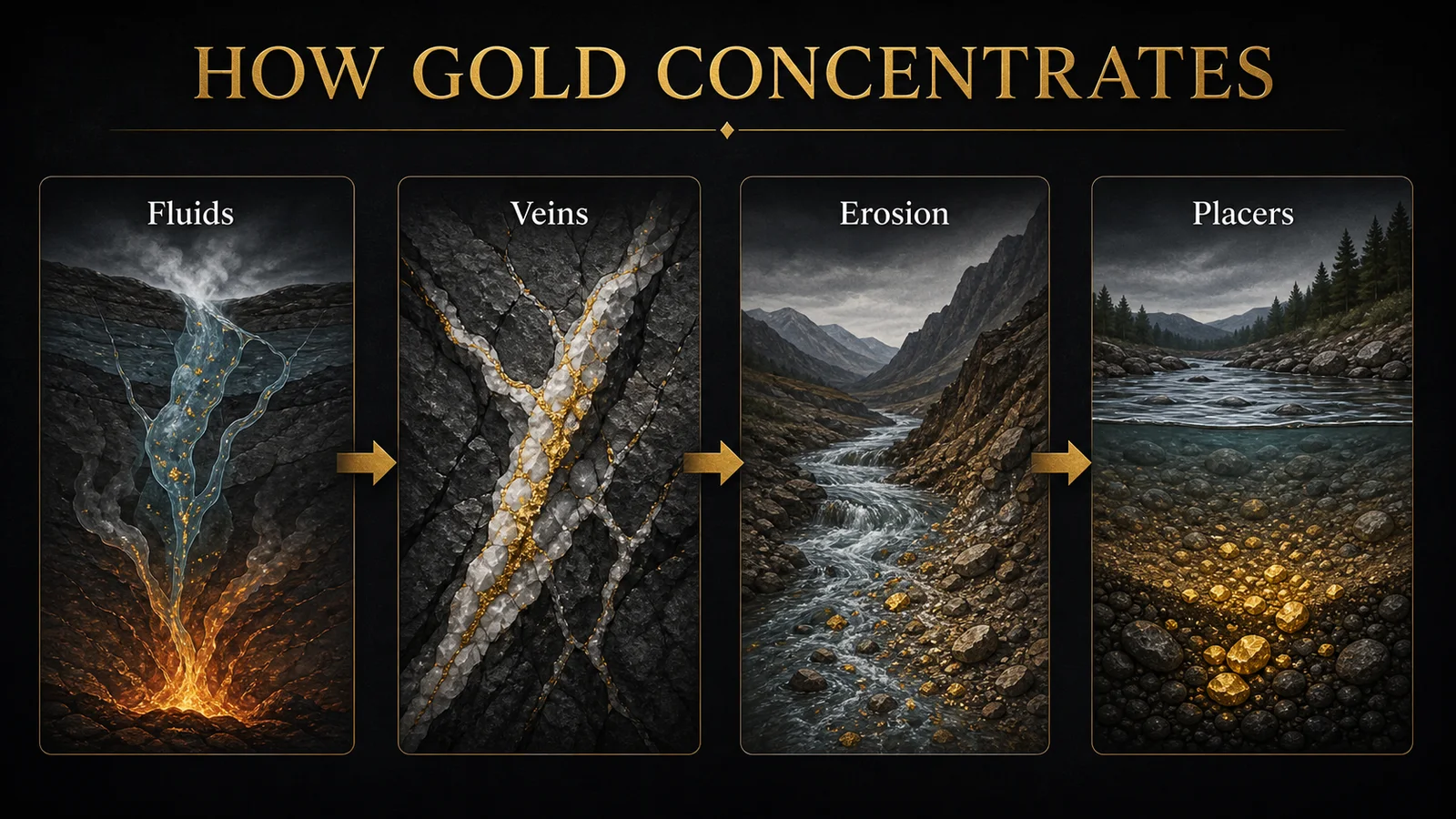
Gold can move through hot fluids, lodge in fractures, attach to sulfide minerals, or survive erosion because it is dense and chemically stubborn. Those traits explain why gold is found in quartz veins, altered volcanic belts, old river gravels, and some sediment-hosted systems.
| Geology or process | How gold concentrates | What learners should notice |
|---|---|---|
| Orogenic quartz veins | Hot fluids move through faults and fractures during mountain building, depositing gold with quartz and sulfides. | Vein orientation, shear zones, altered wall rock, and repeated mineralized structures. |
| Intrusion-related systems | Magmatic heat drives fluids through surrounding rock and may form vein networks or disseminated mineralization. | Granite or porphyry associations, alteration halos, arsenic or bismuth pathfinders, and broad low-grade zones. |
| Sediment-hosted deposits | Gold occurs as very fine particles in chemically reactive host rocks, often invisible without assays. | Carbonate or sedimentary host rocks, alteration, arsenic, antimony, mercury, and systematic sampling. |
| Placer deposits | Erosion releases gold from bedrock, then water sorts dense particles into riffles, cracks, bends, and old channels. | Black sand, bedrock traps, inside bends, flood benches, and upstream lode possibilities. |
| Paleoplacers | Ancient placer gravels become buried, compacted, and preserved as hard sedimentary rock. | Conglomerates, old channel geometry, regional continuity, and deep historical basins. |
Lode Gold vs. Placer Gold
Lode gold is still in its original bedrock setting. It may appear in quartz veins, shear zones, altered volcanic rocks, or sediment-hosted ore where the gold is too fine to see.
Placer gold has been freed from bedrock by weathering and moved by gravity, water, and time. That is why a beginner reading about gold panning sites is usually studying placer behavior, not underground ore geology.
The two categories are connected. A productive placer can point toward an upstream lode source, while a lode deposit may shed gold into creeks long after the original rock starts breaking down.
Why Most Gold Is Not Mineable
Gold feels rare because it is rare in economic concentrations. A rock can contain gold and still be worthless if the grade is too low, the deposit is too small, the ore is hard to process, or the permitting and environmental costs are too high.
Mineral-commodity statistics track supply, demand, reserves, and the flow of gold through the economy. Those statistics matter because geology only becomes mining when extraction is technically and economically realistic.
This is where many gold stories become misleading. A headline may say gold was discovered, but investors, prospectors, and serious readers should ask whether assays, tonnage, recovery, depth, land access, and environmental controls support the claim.
How Geologists Look for Gold
Gold exploration is a sequence, not a guess. Good work starts with regional geology, then narrows through field mapping, rock sampling, soil geochemistry, stream sediment analysis, geophysics, trenching, and drilling.
- Map the setting: faults, folds, contacts, intrusions, old mine workings, and favorable host rocks.
- Sample systematically: one shiny specimen means less than a grid of consistent assays.
- Check pathfinders: arsenic, antimony, mercury, copper, silver, tellurium, or bismuth can help trace certain gold systems.
- Test continuity: a deposit must persist across distance, depth, and repeated samples.
- Study recovery: gold locked in sulfides may need very different processing from coarse placer gold.
For a broader mining-methods view, compare this geology with gold mining methods and the gold extraction process. Finding gold and recovering gold are related, but they are not the same job.
Practical Learning Checklist
Use this checklist before trusting a claim about gold in the ground.
- Can you identify whether the claim is about lode gold, placer gold, paleoplacer gold, or broad exploration potential?
- Does the source provide assays, sample spacing, and basic geology, or only photos of attractive specimens?
- Is the gold visible, microscopic, refractory, free-milling, or associated with sulfide minerals?
- Are there nearby deposits, old workings, mapped structures, or known mineral belts?
- Does the claim discuss land rights, permits, water, reclamation, and community impact?
- Can the material be processed at a realistic cost, or is the gold technically present but practically unreachable?
Environmental and Supply Context
Gold in the earth is a geological fact, but mined gold is a human decision. Extraction can disturb land, water, energy systems, and communities, so responsible sourcing belongs in any modern discussion of gold deposits.
The World Gold Council describes mine production as the largest component of annual gold supply, with recycling responding more quickly to price and economic conditions. The LBMA Responsible Gold Guidance adds the supply-chain lens: where gold comes from matters after it leaves the ground.
That context is useful for readers who later study unexplored gold resources or modern underwater gold mining. The best question is not simply “is there gold?” It is “what would it take to recover it responsibly?”
Editorial Perspective
Gold geology rewards patience. The strongest claims usually sound less dramatic because they include uncertainty, sample limits, metallurgical questions, and permitting realities.
For learners, that is good news. Once you understand the difference between gold presence, gold grade, and gold recoverability, you can read prospecting stories, exploration updates, and mining claims with a much sharper filter.
Knowledge Gap
The biggest beginner mistake is treating a gold occurrence as a gold deposit. An occurrence means gold has been found; a deposit implies enough size, grade, continuity, and recovery potential to deserve serious economic study.
When those terms are blurred, readers can overvalue anecdotes and undervalue boring but essential evidence.
Bottom Line
Gold in the earth becomes meaningful only when nature has concentrated it and people can prove that concentration with evidence. The story starts with ancient atoms, but the useful analysis is local: rock type, structure, erosion, grade, continuity, recovery, and responsibility.
If you want to keep learning, pair geology with practical testing. Start with placer behavior, study deposit types, then learn how recovered metal is evaluated through gold purity testing.
FAQ: Gold in the Earth
Is gold naturally found in the earth?
Yes. Gold occurs naturally in the earth’s crust, but most of it is too dispersed to mine. Economic deposits form only where geological processes concentrate it.
What type of rock is gold usually found in?
Gold is often associated with quartz veins, altered volcanic or sedimentary rocks, sulfide minerals, and ancient conglomerates. The host rock depends on the deposit type.
Why is gold found in rivers?
Rivers carry gold released from weathered bedrock. Because gold is dense, it settles in cracks, bends, riffles, and gravel traps where lighter sediment keeps moving.
Can you tell if land has gold by looking at it?
Sometimes geology gives clues, such as quartz veins, iron staining, old workings, or favorable structures. But reliable evaluation requires sampling, assays, mapping, and often drilling.
Is visible gold better than microscopic gold?
Visible gold is easier to recognize, but it does not automatically mean a richer or better deposit. Some major deposits contain gold so fine that it is invisible without laboratory testing.
What is the difference between a gold occurrence and a gold deposit?
A gold occurrence means gold has been found. A gold deposit implies enough concentration, size, continuity, and recovery potential to justify more serious geological or economic evaluation.
 When you purchase a service or a product through our links, we sometimes earn a commission, at no extra cost to you.