
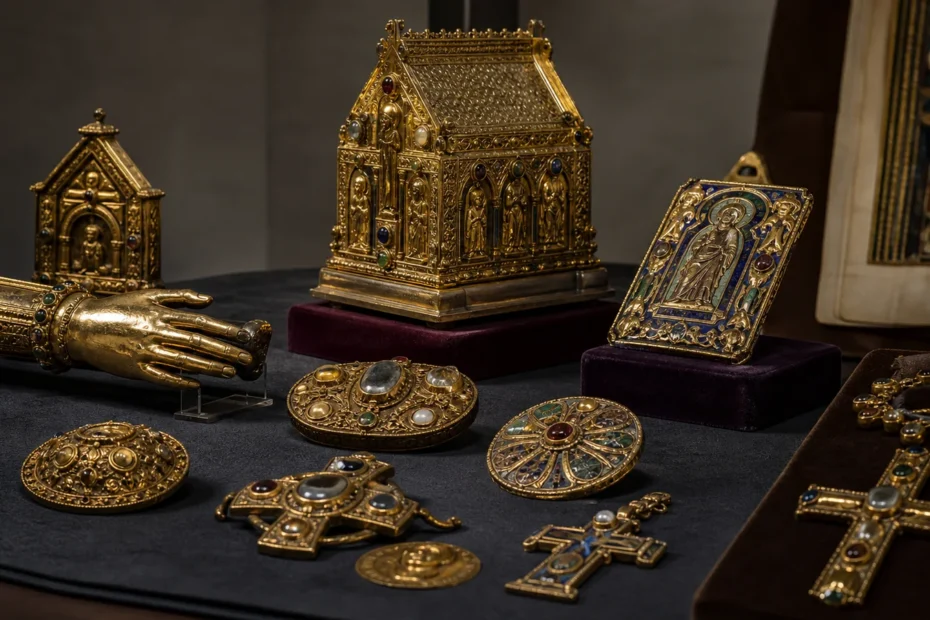
Compare famous medieval gold artifacts by craft, provenance, material, religious use, royal power and what museums can actually verify.
- Judge famous artifacts by context, craft, provenance, and function.
- A crown, brooch, or reliquary tells more when its movement is known.
- Spectacle alone can hide uncertain dating, ownership, or restoration.
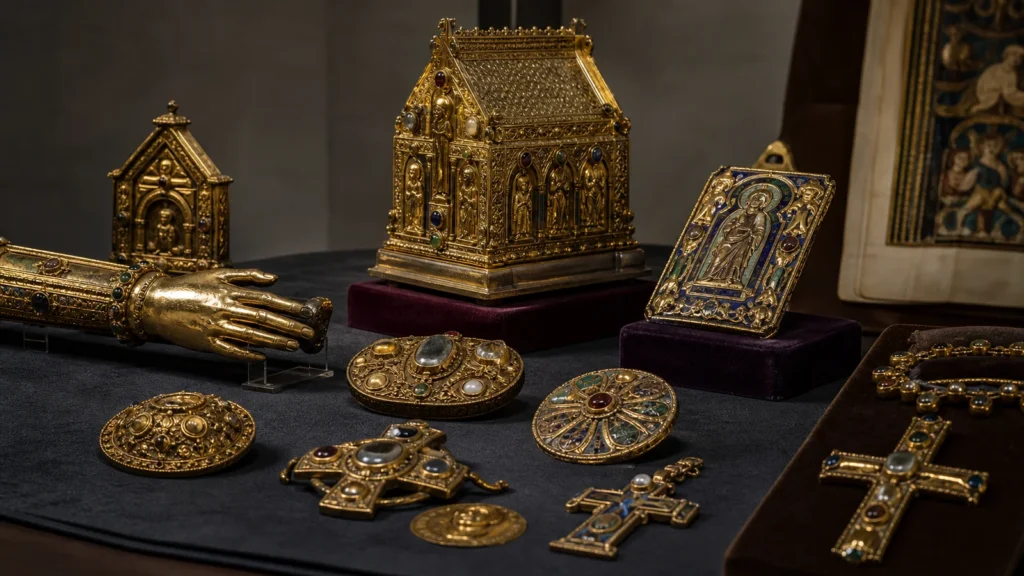
Famous medieval gold artifacts matter because context turns precious material into historical evidence. Sutton Hoo burial fittings, the Tara Brooch, reliquaries, enamel treasures and regalia reveal different things about rank, worship, craft and political legitimacy. Check provenance, material composition, restoration and original function before trusting a famous label.
Famous medieval gold artifacts are not important simply because they glitter. The best examples show how medieval societies used gold to make power, belief, rank, diplomacy, and memory visible.
That is the useful way to read them. A brooch, crown, reliquary, altar panel, or burial fitting can be beautiful, but its real historical value comes from context: who made it, where it was found, how it moved, and what claims were later attached to it.
TL;DR
- Medieval gold artifacts should be judged by context, craft, provenance, and function, not by spectacle alone.
- Burial gold such as Sutton Hoo signals elite status, long-distance materials, and political identity.
- Insular works such as the Tara Brooch show technical mastery through gold filigree, enamel, amber, and glass.
- Church treasures and reliquaries used gold to make sacred value visible, especially around relics and liturgy.
- Modern readers should be cautious with famous labels, old collecting stories, and objects whose provenances changed after excavation.
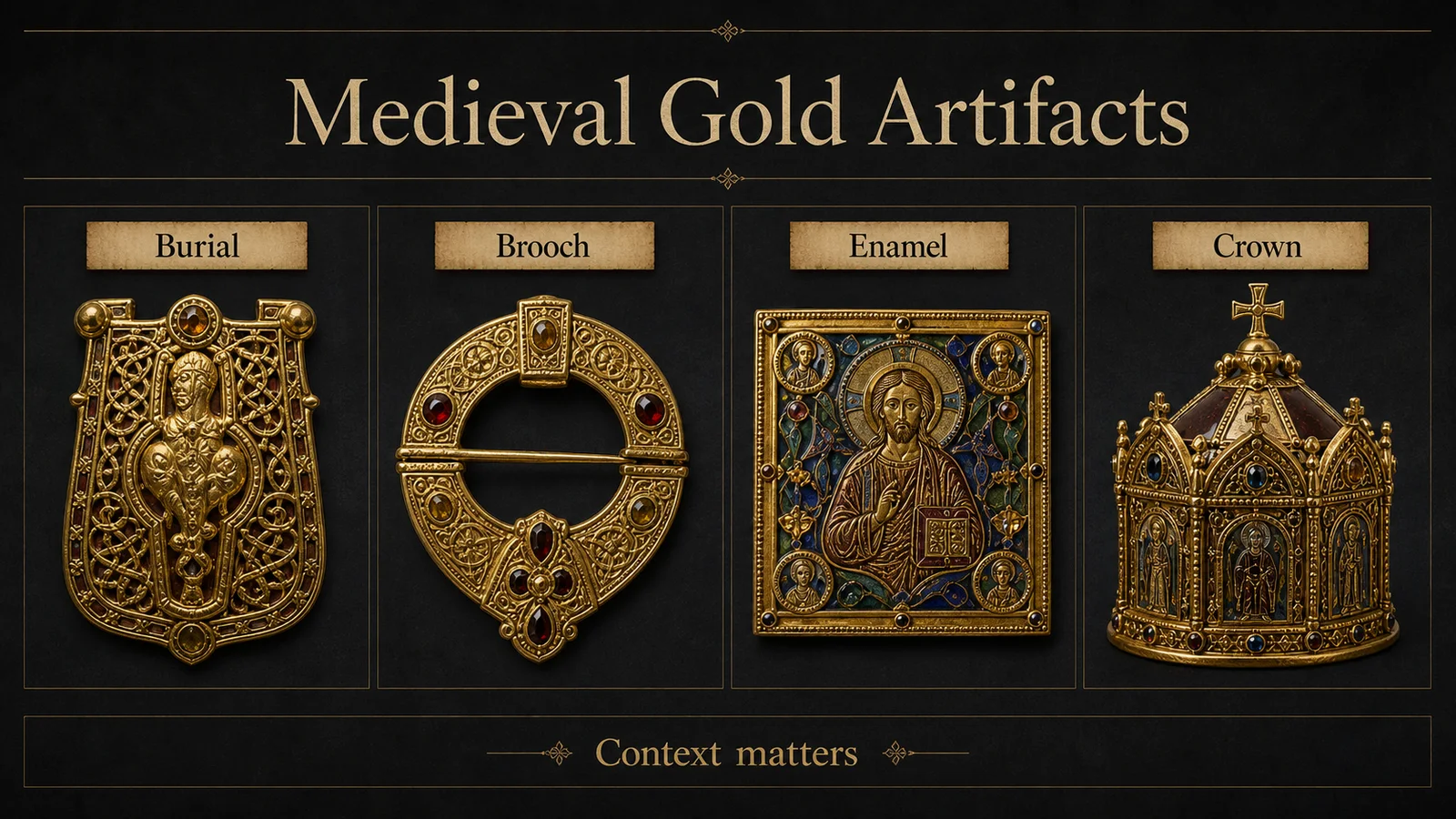
What Makes a Medieval Gold Artifact Famous?
Fame usually comes from a mix of rarity, survival, craft, and story. Some artifacts are famous because they were found in dramatic archaeological settings. Others matter because they represent the highest level of medieval goldsmithing or because they sat close to royal and religious power.
This is why a good artifact list should connect to broader medieval gold topics. For background, start with what gold was used for in medieval Europe, then compare that with gold in the Middle Ages and the technical craft covered in goldsmithing in medieval Europe.
Provenance and Context Caution
Medieval gold objects often changed hands many times. Some were excavated, some were looted, some were restored, and some were renamed by later collectors or dealers. Treat a famous name as a starting point, not as proof of origin.
For any major artifact, ask whether the findspot is documented, whether the object is complete, whether restoration is disclosed, and whether the museum record separates medieval material from later additions.
Artifact Comparison Table
The table below compares famous medieval gold artifacts by what they reveal historically. The point is not to rank beauty. It is to show what each object type can and cannot tell us.
| Artifact or group | Approximate context | Gold-related craft | What it reveals | Context caution |
|---|---|---|---|---|
| Sutton Hoo gold fittings and shoulder clasps | Early medieval ship burial in Anglo-Saxon England | Gold, garnet cloisonne, glass, precise animal and geometric work | Elite identity, burial display, long-distance material networks | The burial is archaeological, but identity and political interpretation remain debated. |
| The Tara Brooch | Early medieval Ireland; found in the nineteenth century | Gold filigree panels, silver-gilt structure, enamel, amber, glass | Insular metalworking skill and elite display beyond simple bullion value | The famous name is later; it was not found at Tara. |
| Medieval reliquaries | Church treasuries, pilgrimage, monastic and cathedral settings | Gold, gilded silver, enamel, gems, ivory, crystal, narrative panels | How precious materials made sacred authority visible | Many were altered, damaged, melted, or dispersed during religious and political upheaval. |
| Byzantine and Venetian enamel altar treasures | Imperial, liturgical, and diplomatic exchange around the Mediterranean | Gold settings, enamel plaques, gems, pearl-like visual effects | Cross-cultural prestige and the link between theology and court luxury | Later repairs and additions can blur the line between original medieval work and later presentation. |
| Royal crowns and regalia | Coronation, dynastic legitimacy, treasury display | Gold plates, gemstones, pearls, enamel, sacred imagery | Gold as political theology: kingship made visible | Regalia often carry later national stories that can simplify their medieval origins. |
Sutton Hoo: Burial Gold and Elite Identity
Sutton Hoo is one of the clearest reminders that medieval gold could speak politically. The British Museum describes gold shoulder clasps from the ship burial as spectacular objects decorated with glass and garnet inlays, geometric detail, and animal forms.
The official British Museum discussion of the Sutton Hoo shoulder clasps is useful because it keeps craft and burial context together. These objects were not loose treasure in a vacuum. They were part of a high-status funerary setting.
For GoldConsul readers, Sutton Hoo also connects naturally to gold in medieval society. The gold is impressive, but the deeper lesson is that elite display depended on skilled makers, imported materials, ceremonial clothing, and a social audience that understood the signals.
The Tara Brooch: Small Object, Huge Technical Signal
The Tara Brooch is famous because it compresses extraordinary metalwork into a wearable object. The National Museum of Ireland notes its gold filigree panels, animal and abstract motifs, and use of glass, enamel, and amber.
The museum’s own entry on the Tara Brooch also gives the necessary correction: the object’s modern fame is partly shaped by a later name and collecting history. Its historical importance is real, but the label should not be mistaken for a precise find context.
That distinction matters. Medieval gold artifacts can become national icons long after their original use, and modern identity can sometimes overshadow what the object itself can prove.
Editorial Perspective
The strongest medieval gold artifacts are not just expensive survivors. They are evidence systems. They preserve choices about material, workshop skill, faith, hierarchy, and memory, while also exposing the limits of what modern viewers can know.
Reliquaries: Gold as Sacred Visibility
In medieval Christianity, reliquaries turned relics into visible centers of devotion. The gold and gems were not just decoration; they framed sacred remains as objects worthy of reverence, procession, pilgrimage, and institutional prestige.
The Met’s overview of relics and reliquaries in medieval Christianity explains why precious containers mattered across Europe and Byzantium. Reliquaries could be covered with gold, silver, ivory, gems, and enamel because the container was meant to communicate spiritual value.
This is where artifact history overlaps with gold in medieval religion. The metal’s visual power made invisible claims easier to see: holiness, continuity, protection, and institutional authority.
Byzantine and Venetian Treasures: Gold Across Cultures
Medieval gold did not stay inside neat national borders. Objects, techniques, and visual languages moved through trade, diplomacy, conquest, pilgrimage, and gift exchange.
Byzantine-style enamel work and Venetian church treasure show how gold could carry both religious and imperial messages. They also remind us that medieval artifacts often have layered histories: a panel might be made in one context, reused in another, restored later, and interpreted through yet another political lens.
For a closer GoldConsul background on that world, see gold in the Byzantine Empire. For western European political continuity, compare it with gold in the Carolingian Empire.
Royal Regalia: Gold, Legitimacy, and Ceremony
Royal crowns and regalia are among the most recognizable medieval gold objects, but they are easy to misread. Their job was not merely to show wealth. Their job was to stage authority.
Gold surfaces, gemstones, sacred imagery, and inherited forms helped present rule as ancient, sanctioned, and publicly visible. The crown did not only sit on a head; it translated power into a material script that courts, clergy, rivals, and subjects could read.
This is why regalia can be historically valuable even when the exact manufacturing sequence is complicated. The object may preserve several moments at once: original production, later repair, ceremonial reuse, and modern treasury display.
Knowledge Gap
Many online summaries list famous medieval gold artifacts as if fame and authenticity are the same thing. The missing layer is provenance literacy: readers need to know which claims are documented, which are inferred, and which are later storytelling.
How to Evaluate a Famous Medieval Gold Artifact
Use a practical checklist before repeating claims about a medieval gold object. This keeps the discussion grounded and prevents a beautiful artifact from becoming a pile of unsupported assumptions.
1. Find Context
Was the object excavated in a controlled setting, discovered casually, purchased, inherited, or reconstructed from fragments?
2. Material Honesty
Is the artifact solid gold, gold sheet, gilded silver, copper-gilt, enamel over metal, or a mixed construction?
3. Function
Was it worn, buried, displayed, processed, used in liturgy, stored as regalia, or converted into later treasury material?
4. Restoration
Are repairs, missing sections, modern mounts, replacement stones, or nineteenth-century interventions disclosed?
5. Interpretation
Which claims are confirmed by the object, and which come from later national, religious, or collector narratives?
History Claim Credibility Check
Claim: A famous medieval “gold” artifact is solid gold and survives exactly as it was made.
What the evidence supports: Many celebrated objects contain genuine gold and exceptional medieval workmanship.
What must be checked: Gilding, silver cores, enamel, gemstones, later repairs, missing parts and uncertain find histories can all change what the label appears to promise.
Bottom Line
Famous medieval gold artifacts matter because they connect material beauty to social evidence. They show how gold functioned in burial, dress, worship, diplomacy, and rulership.
The best reading is cautious but not cynical. Gold can reveal real medieval priorities, but only when we keep the artifact’s context, provenance, function, and later history in view. For a darker side of the same topic, compare this with the dark side of medieval gold.
FAQ: Famous Medieval Gold Artifacts
What is the most famous medieval gold artifact?
There is no single uncontested answer. Sutton Hoo gold, the Tara Brooch, major reliquaries, Byzantine enamel treasures, and royal regalia are all famous for different reasons.
Were medieval gold artifacts usually solid gold?
No. Many famous objects combine gold with silver, gilded copper, enamel, glass, amber, gemstones, pearls, or rock crystal. Material descriptions matter.
Why did churches use so much gold in medieval artifacts?
Gold helped make sacred value visible. Reliquaries, altar fittings, and liturgical objects used precious materials to frame relics, rituals, and institutional authority.
Why is provenance important for medieval gold artifacts?
Provenance shows how much we really know. A documented excavation tells a different story than an object that passed through dealers, restorers, or older collections.
Can famous medieval gold artifacts be misleading?
Yes. Famous names, later repairs, national myths, and incomplete find histories can make an artifact seem more straightforward than it is.
 When you purchase a service or a product through our links, we sometimes earn a commission, at no extra cost to you.