
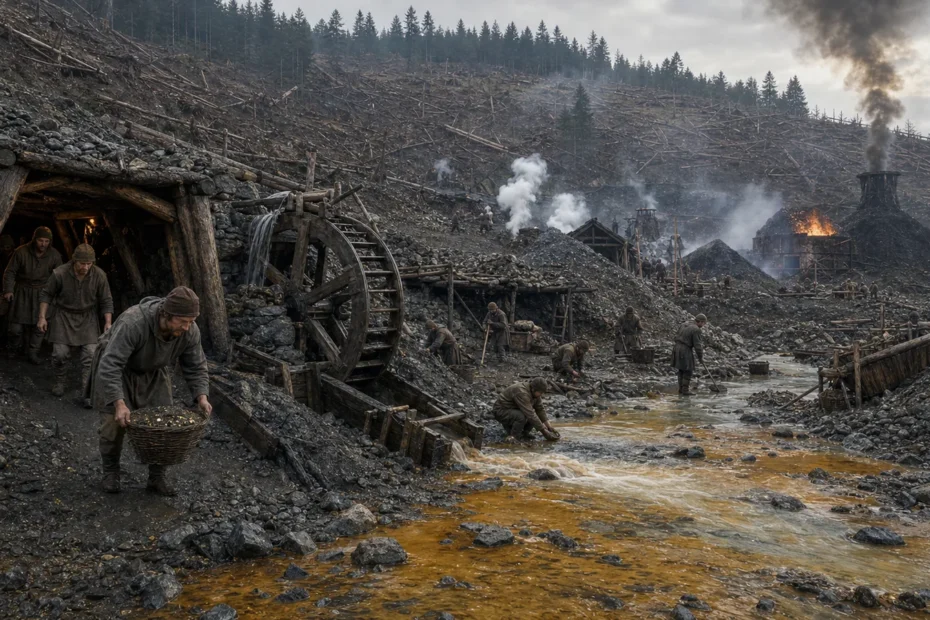
See how medieval gold mining affected forests, waterways, labor, warfare, and taxation, and why gold wealth often carried environmental and social costs.
- Medieval gold had environmental costs beyond the finished treasure.
- Look for mining, smelting, forest use, water diversion, and pollution evidence.
- Avoid simple blame stories when the surviving record is uneven.
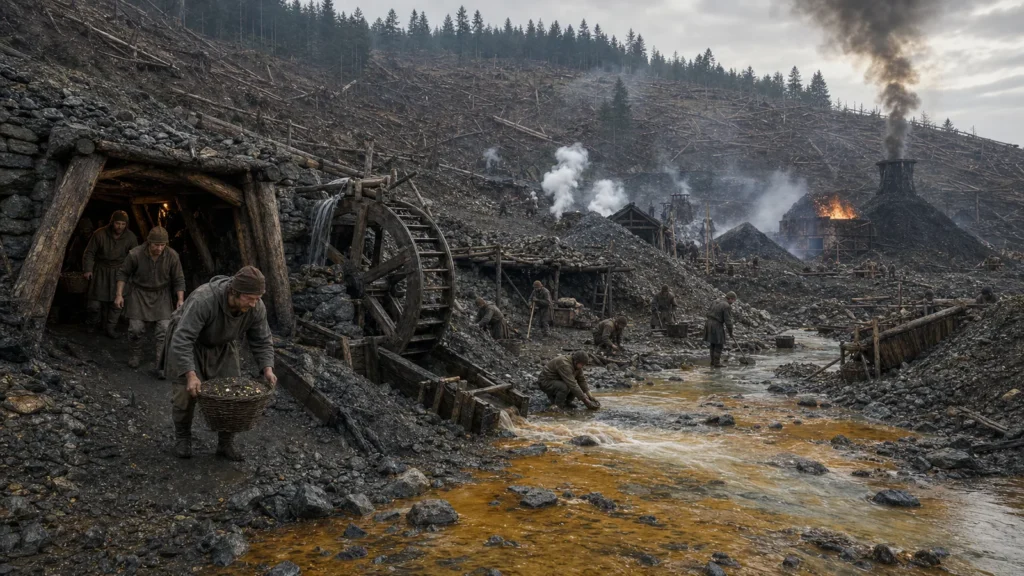
Medieval gold production came with environmental costs. Mining and metalworking consumed wood, redirected water, disturbed soil, and released metal-rich pollution, so its history includes ecological damage as well as precious objects and wealth.
Medieval Europe did not mine gold in a vacuum. The same appetite for precious metal that filled treasuries, reliquaries, coinage, and elite workshops also cut forests, moved streams, burned charcoal, and released metal-rich pollution into air, soil, and water.
The phrase dark side of medieval gold is useful only if we keep it evidence-based. The strongest record is not a single dramatic mine collapse or one poisoned river. It is the wider pattern left by precious-metal mining and smelting across Europe from roughly 950 to 1500 CE.
TL;DR: Dark Side of Medieval Gold
- Medieval gold was tied to silver, copper, lead, and mixed-ore mining; the ecological damage came from the whole precious-metal system, not gold alone.
- Ice cores, peat records, slag heaps, polluted soils, and mining-town archaeology show that medieval extraction left measurable environmental signals.
- Calling it Europe’s “first ecological crisis” is partly defensible, but only with a caveat: Roman mining created earlier continent-scale pollution, while medieval mining helped revive and localize that pressure.
- The biggest impacts were fuel demand, deforestation near mining districts, water disturbance, waste rock, and airborne lead from smelting lead-silver ores associated with precious-metal production.
- The lesson for modern gold is not that gold is uniquely immoral. It is that extraction costs are easiest to ignore when value is portable, beautiful, and politically useful.
Was Medieval Gold Really Europe’s First Ecological Crisis?
The cautious answer is: not exactly, but it was one of Europe’s first resource crises that left a broad environmental archive. Roman mining and smelting produced earlier lead pollution visible in Alpine and Arctic ice records, so medieval mining was not the first human-made metal pollution event in Europe.
What makes the medieval phase important is the renewed scale and persistence of extraction after the early medieval contraction. As towns, mints, monasteries, courts, and trading networks expanded, demand for precious metals rose with them.
Gold itself was often recovered with or alongside other metals. Medieval economies prized gold coin and ornament, but the environmental evidence is frequently tied to lead-silver smelting, copper mining, ore roasting, charcoal production, and the broader mining districts that supplied medieval wealth.
That distinction matters. If we blame only “gold,” we miss how medieval bullion systems worked. For more context on the wider period, see our guide to gold in the Middle Ages and the related overview of medieval gold culture.
Reader Tool: 30-Second Claim Credibility Check
Use this quick filter whenever a headline says medieval gold caused Europe’s first ecological crisis. If a claim fails two or more checks, treat it as a simplified story rather than a settled conclusion.
Why this helps: the best history is precise about metal, place, period, and evidence.
What the Environmental Evidence Shows
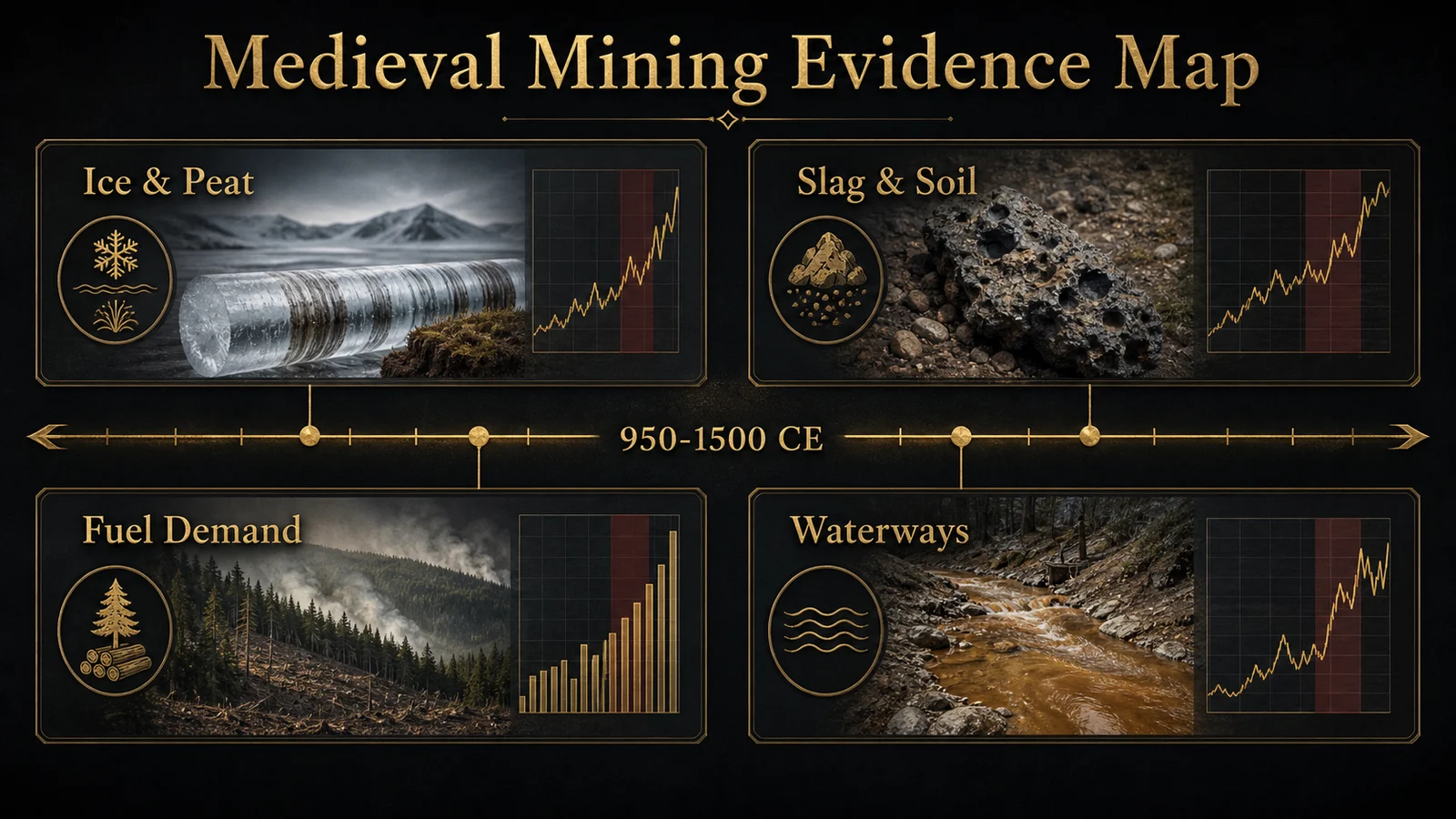
Modern researchers do not have to rely only on chronicles. Pollution from medieval mining can be read through environmental archives, especially when multiple records point in the same direction.
A PNAS study on Arctic lead pollution links medieval and early modern lead signals to European silver production, plague, climate, and conflict. Nature’s reporting on Alpine ice also notes that ancient mining and smelting left metal pollution in glacier records, a useful warning against treating medieval Europe as the absolute starting point.
| Evidence channel | What it can show | Why it matters | Main limitation |
|---|---|---|---|
| Ice cores | Atmospheric lead and other trace metals transported far from smelting districts. | Shows that mining pollution was not only local. | Often tracks lead-silver smelting more directly than gold. |
| Peat and lake sediments | Regional metal deposition over time. | Can connect pollution peaks to nearby mining districts. | Dating and source attribution can be complex. |
| Slag, tailings, and soils | Local waste volumes and heavy-metal contamination. | Makes the damage visible at mine and smelter sites. | Local evidence may not prove Europe-wide crisis by itself. |
| Charcoal and wood demand | Pressure on forests near smelting centers. | Smelting needed fuel, not just ore. | Forest change also came from farming, building, and heating. |
| Waterway disturbance | Sediment movement, stream diversion, and metal-rich runoff. | Mining altered the physical landscape, not only the atmosphere. | Survival of evidence varies by terrain and later land use. |
How Medieval Gold Demand Created Environmental Pressure
Gold concentrated value. A small object could represent labor, tribute, power, devotion, and political legitimacy. That portability made gold desirable, but it also made extraction costs easier to hide from the people who enjoyed the finished object.
The damage began before any coin, chalice, or ring existed. Ore had to be found, shafts opened, rock broken, water controlled, timber cut, charcoal burned, ore roasted, and metal refined. Each stage left a mark.
- Forests supplied fuel and supports. Mine timbers, charcoal, and construction material put pressure on nearby woodland.
- Streams became tools. Water powered wheels, washed ore, drained workings, and carried sediment away.
- Smelting spread pollution. Lead-rich ores and refining processes released metal particles beyond the mine mouth.
- Waste stayed behind. Slag, tailings, and disturbed soils could persist after a mining boom faded.
This is why medieval gold should be read alongside gold ore, smelting, silver mining, and wider mining technology. The clean shine of finished gold was the end of a dirty chain.
The Human Side of the Damage
Ecological damage was not separate from social pressure. Medieval mining districts attracted workers, specialists, merchants, creditors, and rulers who wanted revenue. Mining towns could become engines of technical skill and urban growth, but they also concentrated risk.
Recent Cambridge University Press work on medieval mining towns as socio-ecological systems uses Kutna Hora as a case study for how mining linked population growth, technology, deforestation, pollution, and social stratification. That is the better frame: mining was an economy, not just an industry.
The human costs varied by region and period. Some miners worked under town privileges and specialized legal systems. Others faced debt, dangerous shafts, toxic dust, heat, flooding, and coercive obligations. The archive is uneven, so broad claims about universal forced labor should be handled carefully.
The GoldConsul Editorial Perspective
The honest story is not “gold destroyed medieval Europe.” It is that precious-metal demand created concentrated extraction zones where rulers, merchants, and consumers benefited while nearby landscapes and workers absorbed much of the cost.
Why the “First Ecological Crisis” Label Needs Care
The label is powerful, but it can mislead. Europe had earlier human-driven environmental stress from agriculture, urbanization, warfare, deforestation, and Roman mining. A Nature summary of Alpine ice research highlights Roman-era lead pollution from mining and smelting before the medieval boom.
So the stronger claim is narrower: medieval precious-metal mining was one of Europe’s early documented resource systems in which economic expansion, state finance, urban growth, and environmental degradation became visibly linked. It was not the first human impact, and not every impact was caused by gold alone.
That nuance makes the history more useful. It lets us compare medieval extraction with later events such as the gold rush mining techniques of the nineteenth century and hydraulic mining’s reshaping of river systems.
Knowledge Gap: What We Still Cannot Prove Cleanly
The biggest gap is attribution. Environmental archives can show mining pollution, but separating gold-specific extraction from silver, lead, copper, and mixed-ore activity is often difficult.
Medieval precious-metal systems were interconnected.
A mining town is not the same as all Europe.
Later mining, farming, and construction can disturb medieval evidence.
How to Read Medieval Gold More Honestly
A practical way to read medieval gold is to separate the object from the system behind it. A reliquary, coin, or ring may be beautiful. The mining and refining network that supplied it may still have been environmentally destructive.
Use this simple interpretation checklist:
- Ask whether the source is discussing gold alone or the broader precious-metal economy.
- Look for evidence type: ice core, sediment, slag, soil, mining law, or archaeology.
- Separate local pollution from continent-wide atmospheric pollution.
- Check whether Roman, medieval, and early modern periods are clearly separated.
- Notice who benefited from gold and who lived near the extraction damage.
This lens also helps with other historical gold stories, including gold in medieval myths and legends, gold mining in ancient Greece, and gold mining in ancient Mesopotamia. Cultural meaning and material cost often sit side by side.
Bottom Line
The dark side of medieval gold is not that medieval people loved beauty, ritual, or wealth. It is that gold’s finished form made extraction look distant. By the time a coin reached a market or a gold object reached an altar, the cut forest, polluted stream, slag heap, and dangerous shaft were already somewhere else.
Medieval gold was not Europe’s first environmental wound, but it was part of an early, measurable resource crisis. The evidence is strongest when we treat gold as one visible face of a larger precious-metal system.
FAQ: Dark Side of Medieval Gold
Was medieval gold mining really Europe’s first ecological crisis?
It depends on how strictly the phrase is used. Medieval mining was an early documented resource crisis, but Roman mining created earlier large-scale metal pollution, so “first” should be treated as a qualified claim.
What was the biggest environmental impact of medieval gold?
The main impacts were deforestation for fuel and timber, stream disturbance, mine waste, soil contamination, and airborne metal pollution from smelting. Some evidence is tied more directly to lead-silver ores than to gold alone.
Why does lead pollution matter in a post about gold?
Medieval precious-metal systems were interconnected. Gold demand, silver coinage, lead-silver smelting, and mixed-ore mining often belonged to the same economic world, so lead can be an environmental tracer for precious-metal production.
Did medieval miners understand the environmental damage?
They could see local damage such as cleared forests, unstable ground, smoke, and dirty water. They did not have modern concepts of toxicology, atmospheric transport, or cumulative ecological risk.
What lesson does medieval gold offer modern gold buyers?
The lesson is to look beyond the finished object. Gold’s value and beauty can hide extraction costs, so modern buyers should pay attention to sourcing, recycling, refining standards, and the environmental footprint behind supply.
 When you purchase a service or a product through our links, we sometimes earn a commission, at no extra cost to you.